

DeepSeek's Price Bomb
A Chinese lab just matched 95% of frontier AI capability at one-sixth the price. The Western business model has no answer.

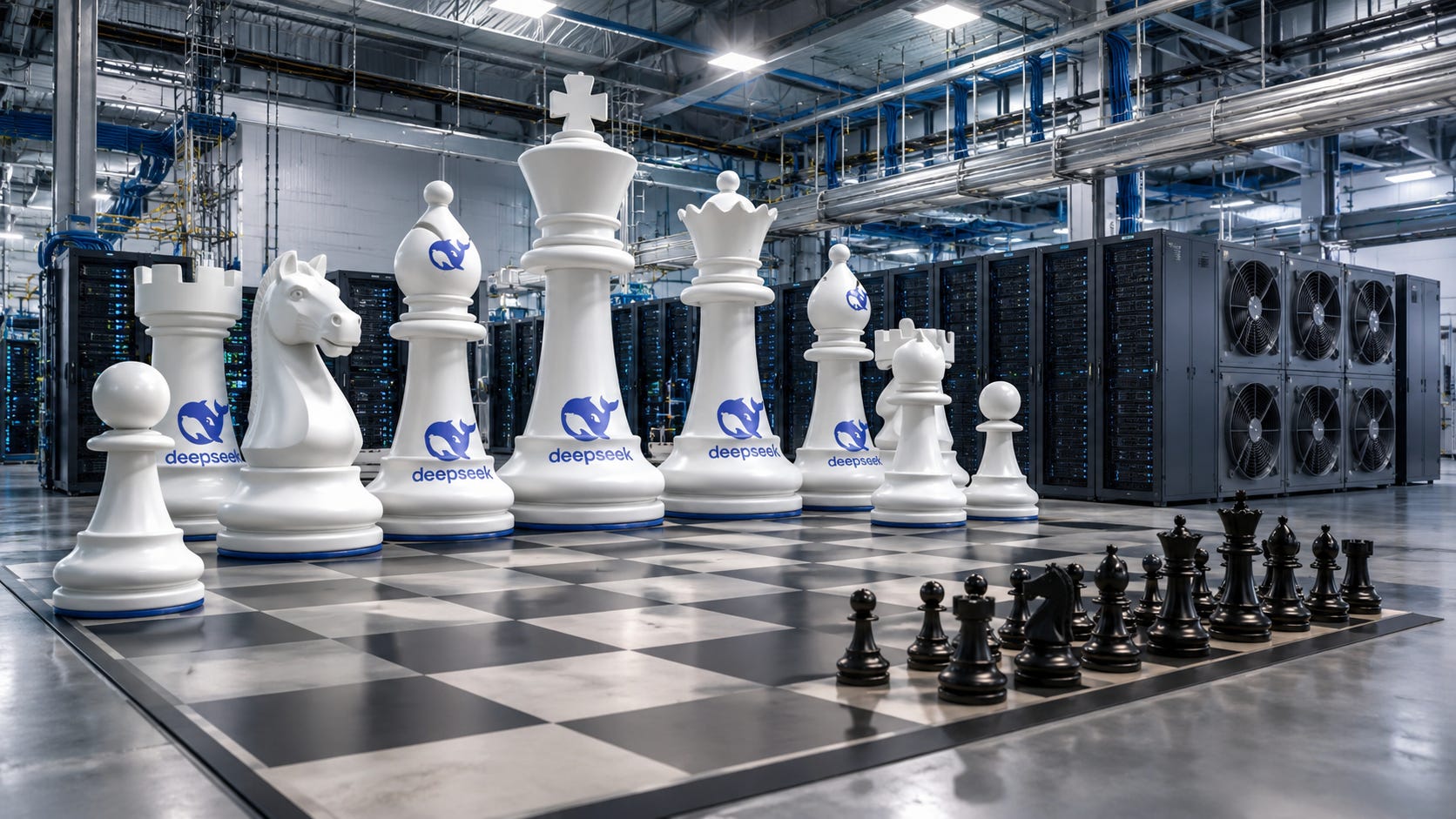
The API pricing page went live on April 24. Two lines of text, formatted in the flat sans-serif of DeepSeek’s developer documentation, contained the numbers that will define the next chapter of the AI industry’s economics. DeepSeek V4-Pro: $1.74 per million input tokens, $3.48 per million output tokens. For context, Anthropic’s Claude charges $25 per million output tokens for its comparable frontier model. OpenAI charges $30. Google’s Gemini sits in the same range. DeepSeek was offering a model that scored 80.6% on SWE-bench Verified, within two-tenths of a percentage point of the Western frontier, at roughly one-seventh of the price.
The V4-Flash variant was cheaper still. Twenty-eight cents per million output tokens. Not twenty-eight dollars. Twenty-eight cents.
The model ran on Huawei Ascend processors, manufactured domestically in China by SMIC, outside the reach of US export controls. Fortune reported that DeepSeek had worked closely with Huawei to optimise V4 for the Ascend architecture, and that Huawei had announced full support for DeepSeek’s models within 48 hours of the release. The training cost, unverified but directionally consistent with DeepSeek’s track record, was estimated at approximately $5 million, a fraction of the hundreds of millions that Western labs spend on comparable frontier training runs.
The benchmarks were strong but not unprecedented. Eighty percent on SWE-bench Verified. Seventy-three percent on AIME 2025 for mathematical reasoning. Seventy percent on LiveCodeBench. A one-million-token context window, the same depth offered by Western frontier models. Tool calling, structured output, JSON mode, and an API with OpenAI-compatible endpoints, meaning any developer currently building on GPT could migrate to DeepSeek by changing a single line of configuration code.
This is not a benchmarks story. For the reader tracking AI infrastructure economics, this is a pricing story, and pricing stories in technology end the same way every time a low-cost manufacturer enters a market where the incumbents have built their cost structures on the assumption that premium pricing is permanent.
Jensen Huang, the CEO of Nvidia, was reported to have described DeepSeek’s successful operation on Huawei chips as a “disaster” in a private meeting with investors, according to reporting from 36Kr. The word was not chosen for its diplomatic value. It was chosen because Nvidia’s $3.6 trillion market capitalisation depends in part on the assumption that the most capable AI models require the most expensive chips. DeepSeek V4 demonstrated that near-frontier capability can be achieved on domestically manufactured Chinese processors that cost a fraction of Nvidia’s H100 and B200 series. If the capability gap between Nvidia silicon and Huawei silicon continues to narrow, the pricing power that underpins Nvidia’s margins narrows with it.
The structural threat to Western AI labs is not that DeepSeek is better. It is not, on most benchmarks. The structural threat is that DeepSeek is nearly as good at a price point the Western labs cannot match without destroying their own economics. Anthropic’s annualized revenue crossed $30 billion in April 2026, surpassing OpenAI’s $24 billion, according to reporting from SaaStr and CNBC. Those revenue numbers are built on output token pricing in the range of $15 to $75 per million tokens across their model tiers. The cost structures beneath those revenues, thousands of researchers commanding $500,000 to $2 million in total compensation, massive GPU fleets purchased at $25,000 to $40,000 per chip, billions in annual training compute, require those price points to sustain operations and fund the next generation of frontier models.
DeepSeek’s cost structure is fundamentally different. Chinese AI researcher salaries run approximately 40% to 60% of US equivalents. The Huawei Ascend chips are domestically produced and not subject to the Nvidia premium. Training efficiency, a consistent DeepSeek advantage across three generations of models, reduces compute cost per parameter. Government support, in the form of subsidised compute, land, and energy, provides a further structural subsidy. The regulatory compliance burden is lighter: no EU AI Act, a different data privacy regime. The sum of these advantages is not a temporary discount. It is a permanent cost structure differential that Western labs cannot replicate without relocating their operations.
The enterprise customer sitting in the middle of this price war faces a calculation that grows more uncomfortable with each DeepSeek release. For the estimated 80% to 90% of commercial AI use cases that do not require absolute frontier capability, customer support automation, document summarisation, code review, data extraction, translation, and content generation, DeepSeek V4-Pro at $3.48 per million output tokens delivers sufficient quality at a fraction of the Western price. The 10% to 15% of use cases that require the absolute frontier, advanced multi-step reasoning, novel research, complex agentic workflows, remain with Western labs. But 10% to 15% of the market cannot sustain cost structures built to serve 100%.
The data sovereignty objection is the strongest argument against migration. DeepSeek routes API calls through Chinese-controlled servers. China’s 2017 National Intelligence Law requires Chinese companies to cooperate with state intelligence efforts upon request. For defence contractors, financial institutions handling sensitive data, healthcare companies managing patient records, and government agencies, the security concern is legitimate and likely permanent. But for the vast majority of commercial use cases, marketing copy, customer support, general coding assistance, document processing, the data sensitivity is low and the cost savings are compelling.
DeepSeek has a further weapon it has already demonstrated willingness to use. Previous models, including V3 and R1, were released as open source. If V4 follows the same pattern, enterprises can run the model on their own infrastructure, eliminating the data sovereignty concern entirely. Open-source DeepSeek at near-frontier capability would be the nuclear option: free, private, and good enough for 85% of commercial applications.
The historical parallel is the Chinese solar panel industry’s entry into global markets between 2008 and 2013. Western solar manufacturers, including Solyndra in the United States and a generation of European producers, charged premium prices that reflected their cost structures: Western labour, Western supply chains, Western regulatory compliance. Chinese manufacturers entered at 50% to 70% below those prices, backed by government subsidies, lower labour costs, and aggressive scale economics. Within five years, Chinese manufacturers held more than 70% of the global solar panel market. Western solar manufacturing was effectively destroyed. The survivors pivoted to installation, project development, and services, conceding the hardware to Chinese production.
The AI pricing dynamic is structurally analogous but moves faster. Solar panels are physical products with manufacturing constraints, shipping costs, and installation logistics. AI inference is a digital service delivered via API. There is no container ship between DeepSeek’s data centre and a developer’s application. The price signal propagates at the speed of a curl command. The migration barrier is a single line of code.
If you are pricing Western AI lab equities or evaluating your enterprise AI procurement strategy, the scenarios that follow are defined by which force prevails in the collision between Chinese cost advantage and Western capability premium.
Thirty-five percent of the probability weight belongs to price compression with market bifurcation. DeepSeek and the broader Chinese AI ecosystem, including Alibaba’s Qwen, Baidu’s ERNIE, and ByteDance’s Doubao, capture 20% to 30% of the global AI API market within eighteen months, concentrated in cost-sensitive and non-regulated use cases. Western labs retain frontier customers but are forced to reduce mid-tier pricing by 40% to 60% to stem migration. Margins compress. The revenue projections that justified $582 billion in 2025 capex are revised downward by 30% to 40%. No Western lab fails, but the growth assumptions that underpin current valuations are permanently reduced. The AI industry starts to look more like cloud computing, low margins and scale economics, than like enterprise software.
Twenty-five percent goes to the scenario Western lab investors need: the capability moat holds. Anthropic, OpenAI, and Google deliver next-generation models with such dramatic improvements that the gap with DeepSeek widens rather than narrows. Enterprise customers pay the premium for demonstrably superior performance on complex reasoning, agentic workflows, and multi-step tasks. DeepSeek remains a low-cost alternative for commodity use cases but does not threaten the frontier revenue pool. This scenario requires the next generation of Western models to be a step-change improvement, not an incremental one, and the trend line across the past three years suggests the opposite: the capability gap between Western and Chinese models is narrowing, not widening.
Another twenty-five percent sits with the solar panel outcome, the scenario where Chinese pricing becomes the global benchmark. DeepSeek and other Chinese AI labs collectively drive API pricing to commodity levels within three to five years. AI inference becomes a low-margin utility, comparable to cloud storage or bandwidth. Western labs cannot sustain current cost structures and undergo painful restructuring. Some survive by pivoting: Anthropic toward enterprise safety and compliance consulting, OpenAI toward consumer products and media, Google toward its integrated ecosystem where AI is a feature rather than a standalone revenue line. The $582 billion capex cycle produces infrastructure that generates utility-level returns, not software-level returns.
The remaining fifteen percent belongs to trade war escalation. The US government imposes restrictions on DeepSeek API access for American companies, citing national security under the same legal framework used for Huawei’s 5G equipment. China retaliates with restrictions on Western AI models in Chinese markets. The global AI market fragments into two blocs: a Western bloc with higher prices, higher capability, and heavy regulation, and a Chinese bloc with lower prices, near-frontier capability, and lighter regulation. Enterprise customers in non-aligned markets, India, Southeast Asia, the Middle East, Africa, and Latin America, overwhelmingly choose the cheaper Chinese option. Western AI dominance becomes a Western-market phenomenon rather than a global one.
The probability distribution above shifts on two variables. The first is the open-source decision for DeepSeek V4. If DeepSeek releases V4 weights as open source, the price compression and solar panel scenarios both gain 5 to 10 percentage points of probability, because the data sovereignty barrier, the strongest Western defence, disappears. Watch DeepSeek’s GitHub repository and Hugging Face page for the release announcement, which could come at any time.
The second variable is the next generation of Western frontier models. Anthropic’s Claude 5, OpenAI’s GPT-5, and Google’s Gemini 3 are all expected before the end of 2026. If any of these models delivers a genuine step-change in reasoning, agentic capability, or reliability that DeepSeek cannot match within six months, the capability moat scenario gains weight. If the next generation is incremental, the gap continues to close and the pricing pressure intensifies.
Nvidia’s next earnings guidance, expected in late May, will signal how the chipmaker reads the threat. If Nvidia revises its data centre revenue forecast downward, even modestly, the market will interpret it as a confirmation that Chinese inference on Huawei silicon is displacing Nvidia volume at the margin.
Western AI lab quarterly revenue growth rates, specifically Anthropic’s and OpenAI’s disclosures in the Q2 and Q3 reporting windows, will reveal whether enterprise customers are beginning to split their API budgets between Western and Chinese providers. Any deceleration in growth rates relative to the trajectory of the past four quarters is a price pressure signal.
The Chinese AI pricing wave is the indicator that separates an outlier from a trend. If Alibaba’s Qwen and ByteDance’s Doubao match or undercut DeepSeek’s pricing within the next two quarters, the solar panel scenario’s probability doubles.
Huang called it a disaster. He was not wrong about the stakes. The question is whether the disaster belongs to Nvidia, to the Western AI labs whose business models depend on premium pricing, or to the $582 billion infrastructure bet that assumed AI would be a high-margin business. The API pricing page that went live on April 24 contained two lines of text. The Western AI industry has not yet produced a convincing answer to either of them.
ANNEX: WHAT DEEPSEEK’S PRICING MEANS FOR YOUR AI POSITION
DeepSeek V4 has introduced a structural cost differential that forces a repricing of the Western AI business model. Four scenarios, mutually exclusive and collectively exhaustive, sum to 100%.
Price Compression, Market Bifurcation: 35%
If you are an enterprise buyer evaluating your AI procurement strategy for 2027, this is the world you are most likely heading into. DeepSeek and the broader Chinese AI ecosystem capture 20% to 30% of the global API market within eighteen months, concentrated in cost-sensitive and non-regulated applications. Western labs retain frontier customers but are forced to cut mid-tier pricing by 40% to 60%. Your procurement leverage improves, but your vendor landscape becomes more complex. If you are an investor in Western AI lab equities, this scenario reduces revenue growth assumptions by 30% to 40% without producing a crisis. The AI industry reprices from software multiples to cloud computing multiples. Margins compress permanently.
Tracking variable: Western AI lab pricing adjustments. Monitor Anthropic and OpenAI pricing pages monthly. The first Western lab to cut mid-tier output token pricing by more than 25% signals that this scenario is live. At one month, probability is 35%. At three months, if no Western lab has adjusted pricing, probability holds. If one or more labs cut prices, probability rises to 45%. At twelve months, enterprise API budget allocation data from Gartner or IDC will confirm whether bifurcation has occurred.
Western Capability Moat Holds: 25%
If you are long Western AI lab equities and your thesis depends on premium pricing power, this is the scenario you need. The next generation of Western models (Claude 5, GPT-5, Gemini 3) delivers a step-change improvement that widens the capability gap with DeepSeek. Enterprise customers pay the premium for demonstrably superior complex reasoning and agentic performance. DeepSeek remains a commodity alternative for simple use cases. Your position is safe, but only if the capability gap widens with each generation. The trend has been moving in the opposite direction.
Tracking variable: benchmark results for next-generation Western models. Claude 5 and GPT-5 are expected H2 2026. If the SWE-bench gap between the next Western frontier and DeepSeek widens from 0.2 percentage points to 5 or more, this scenario’s probability rises to 35%. If the gap remains within 2 points, probability drops to 15%. Watch the Chatbot Arena Elo rankings for real-time competitive positioning.
The Solar Panel Outcome: 25%
If you are modelling AI infrastructure returns on a five-year horizon, this is the scenario that breaks your terminal value assumptions. Chinese AI labs collectively drive global API pricing to commodity levels. AI inference becomes a low-margin utility. Western labs undergo painful restructuring. Some survive by pivoting to consulting, consumer products, or integrated ecosystems. The $582 billion capex cycle produces infrastructure that generates utility-level returns. If you are an allocator with AI infrastructure exposure, this scenario justifies reducing your position by 30% to 40% and reallocating to companies that benefit from cheap AI (enterprise buyers, application developers) rather than companies that sell it.
Tracking variable: pricing decisions from Alibaba Qwen, Baidu ERNIE, and ByteDance Doubao. If two or more of these Chinese labs match or undercut DeepSeek’s pricing within two quarters, the solar panel scenario’s probability doubles to 50%. At twelve months, DeepSeek’s open-source decision for V4 is the binary event. If V4 weights are released open-source, add 10 percentage points to this scenario immediately.
Trade War Escalation: 15%
If you are a non-US enterprise or an investor in emerging-market AI adoption, this is the scenario that reshapes your opportunity set. The US government restricts DeepSeek API access for American companies. China retaliates. The global AI market fragments into two pricing blocs. Non-aligned markets choose the cheaper Chinese option. Western AI dominance becomes a Western-market phenomenon. Your position depends on which bloc your customers and portfolio companies sit in.
Tracking variable: US government policy statements on Chinese AI model access. Any executive order, Commerce Department rulemaking, or Congressional hearing specifically addressing DeepSeek or Chinese AI API access to US enterprises is the trigger. At one month, probability is 15%. At three months, if no policy action has been signalled, probability drops to 10%. If policy action begins, probability rises to 25%. Watch the Senate Commerce Committee hearing schedule and BIS rulemaking docket through the summer.
Sources:
DeepSeek, V4 API pricing page and model documentation, April 24, 2026.
Fortune, “DeepSeek unveils V4 model, with rock-bottom prices and close integration with Huawei’s chips,” April 24, 2026.
Tom’s Hardware, “DeepSeek launches 1.6 trillion parameter V4 on Huawei chips as U.S. escalates AI theft accusations,” April 2026.
36Kr, “Jensen Huang Labels It a ‘Disaster’: DeepSeek Runs Successfully on Huawei Chips,” 2026.
MIT Technology Review, “Three reasons why DeepSeek’s new model matters,” April 24, 2026.
CNBC, “Anthropic CEO says 80-fold growth in first quarter explains ‘difficulties with compute,’” May 6, 2026.
SaaStr, “Anthropic Just Passed OpenAI in Revenue,” April 2026.
Stanford HAI, “The 2026 AI Index Report,” April 2026.
NBER Working Paper 34836, “Firm Data on AI,” February 2026.
ITIF, “The Impact of China’s Production Surge on Innovation in the Global Solar Photovoltaics Industry,” October 2020.
Scientific American, “Why China Is Dominating the Solar Industry,” 2024.
Disclaimer: This report is published by Scenarica Intelligence for informational purposes only. It does not constitute investment advice, a solicitation to buy or sell any financial instrument, or a recommendation regarding any particular investment strategy. Scenarica Intelligence is not a registered investment adviser or broker-dealer. All scenario probabilities and assessments represent the analytical judgment of Scenarica Intelligence and are subject to change without notice. Past performance of any asset or strategy discussed does not guarantee future results. Readers should conduct their own due diligence and consult with qualified financial advisers before making investment decisions.
Scenarica Premium: The full Scenarica suite includes Geopolitics, Economy, Bitcoin, AI, and Sunday Edition.
Scenarica Intelligence
We don’t predict the future. We price it.