


In a coat closet on the second floor of a terraced house in Kreuzberg, Berlin, a Raspberry Pi 4 the size of a credit card sits on top of a one-terabyte solid-state drive, connected to the home router by a single ethernet cable. The device draws roughly five watts of power. It costs its owner about seven euros a month in electricity and bandwidth. It earns nothing. No fees. No block rewards. No income of any kind. It has been running continuously for nineteen months. Its owner, a software engineer who works for a logistics company and has never mined a single satoshi, checks it once a week by glancing at a dashboard on his phone. The dashboard confirms that the device is doing the only thing it was built to do: independently verifying every Bitcoin transaction and every block against the protocol’s consensus rules. If a miner anywhere on earth produces a block that violates those rules, this five-watt computer in a coat closet in Berlin will reject it.
There are roughly 20,000 machines like it reachable on the public internet at any given moment, according to Bitnodes, the most widely cited node tracker. The true number, including nodes running behind firewalls, through Tor, or on private networks, is estimated at 50,000 to 70,000. Each one is a vote. Not a vote in the way that word is used in democratic politics, where ballots are counted and majorities govern. A vote in the way that word was used before elections existed: a declaration of allegiance, a refusal to be governed by rules you have not personally verified. In Bitcoin, that verification is not symbolic. It is operational. A miner who produces blocks that nodes reject is mining into the void.
This makes the Bitcoin node the most important and least understood governance mechanism in any financial system on earth.
In every other financial system, governance is visible. Central bank boards publish minutes. Congressional committees hold hearings. SEC commissioners vote in public. Shareholders file proxies. In Bitcoin, governance is invisible. It happens when a node operator in Sao Paulo decides whether to upgrade their software. It happens when a developer in Berlin publishes a patch and waits. It happens when thousands of individuals, most of them anonymous, most of them running hardware that costs less than a good pair of shoes, silently choose which version of the protocol to enforce.
And right now, that silent choice is producing the most consequential governance crisis Bitcoin has faced since the block size wars of 2017.
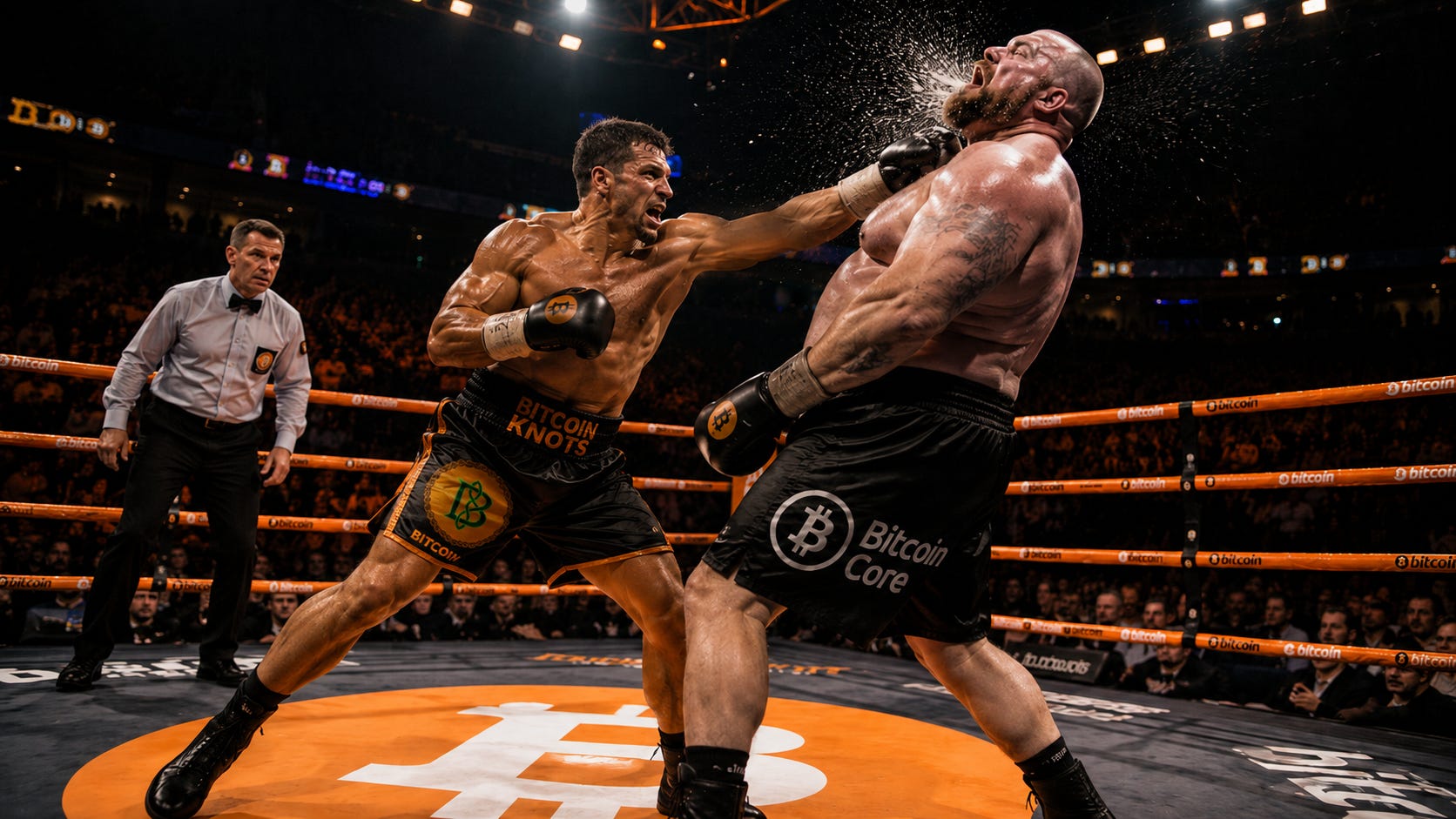
The crisis has a name, or rather two names: Bitcoin Core and Bitcoin Knots. Bitcoin Core is the reference implementation, the software that has maintained the network since 2009, built by more than six hundred contributors over fifteen years. It is the default. When someone says “run a Bitcoin node,” they almost always mean “run Bitcoin Core.” Until recently, Core commanded roughly ninety percent of all reachable nodes. It was not a monopoly in the legal sense, because anyone can fork the code and run an alternative. But it was a monopoly in the practical sense: Core defined what Bitcoin was.
Bitcoin Knots is the alternative that changed that. Maintained primarily by Luke Dashjr, a developer who has contributed to Bitcoin Core itself since 2011 and has over two hundred commits to his name, Knots is not a rival currency. It is not a fork in the way Bitcoin Cash was a fork. It runs on the same blockchain, validates the same transactions, connects to the same network. It differs in one respect that turns out to be the most politically charged decision in Bitcoin’s architecture: what the mempool should accept.
The mempool is the waiting room. When you send a Bitcoin transaction, it enters the mempool of every node on the network and waits there until a miner includes it in a block. Core’s philosophy is permissive: let the fee market decide which transactions get processed, and do not judge whether a transaction is “financial” or “non-financial.” Knots’ philosophy is restrictive: filter out transactions that use Bitcoin for non-financial purposes, including Ordinals, inscriptions, BRC-20 tokens, and large data payloads embedded through the OP_RETURN field.
The dispute crystallised in 2025 when Bitcoin Core version 29 removed the data size limit on OP_RETURN outputs, allowing effectively unlimited non-financial data to be embedded in Bitcoin transactions. Dashjr’s Knots rejected this change and enforced a strict 42-byte limit. The community responded. By mid-2025, Knots had grown from a negligible presence to roughly twelve percent of reachable nodes. By September 2025, it had reached nineteen percent. Some tracking services reported spikes as high as twenty-five percent, though Bitcoin Core developer SuperTestnet alleged that a portion of Knots nodes were double-counted through a sybil attack. Start9, a hardware node manufacturer, countered that roughly a thousand of the suspected sybil nodes were legitimate customers who had purchased its hardware. The true percentage remains contested. The direction does not.
Dashjr, who also serves as CTO of Ocean Mining, a mining pool that implements Knots-style filtering, is an unusual figure for the centre of a governance crisis. He is a longtime Bitcoin Core contributor, not an outsider. His objection is not that Core is broken but that Core has abandoned a principle: that Bitcoin is a financial settlement network, not a general-purpose data storage layer. Every inscription, every JPEG stored on the blockchain, every BRC-20 meme token, is, in Dashjr’s view, spam. It consumes block space that should be reserved for financial transactions. It raises fees for users who are trying to send money. It bloats the blockchain, making it harder and more expensive for node operators to store and verify the full chain.
Core’s defenders argue the opposite with equal conviction. Bitcoin’s neutrality is its value. The protocol should not decide which transactions are legitimate and which are spam. If someone is willing to pay the fee, the network should process the transaction, whether it carries a payment, an inscription, or a picture of a cartoon ape. Filtering is censorship. Censorship is the one thing Bitcoin was built to prevent.
This is not a technical disagreement. It is a constitutional crisis about what Bitcoin is for.
The 2017 block size wars established the precedent that makes this crisis structurally significant. In 2017, a coalition of miners, exchanges, and large businesses attempted to increase Bitcoin’s block size through the SegWit2x proposal. Node operators, running software on hardware no more powerful than today’s Raspberry Pi setups, refused to adopt the change. The proposal died. The User Activated Soft Fork, BIP 148, demonstrated that individual node operators, people with no mining hardware, no corporate backing, no economic incentive, could force a protocol change against the wishes of miners and major companies. The lesson was definitive: in a conflict between miners and nodes, nodes win. Miners produce blocks. Nodes decide which blocks count.
That precedent gives the Core-versus-Knots debate its weight. If Knots reaches thirty to forty percent of reachable nodes, it will have enough presence to functionally partition the mempool. Transactions that Core nodes accept and relay would be rejected and dropped by Knots nodes. The network would not split in the way a hard fork splits a blockchain, but the user experience would fracture. A transaction that propagates instantly through Core’s mempool might take minutes or hours to reach a miner if the only path runs through Knots nodes that refuse to relay it. The practical effect would be a two-tier network: fast lanes for financial transactions, slow lanes for inscriptions and data payloads.
Whether that outcome is a feature or a catastrophe depends entirely on which side of the debate you stand on. And the debate is being settled not by a vote, not by a committee, not by a regulator, but by thousands of individuals silently choosing which software to run on a five-watt computer in a closet.
Four scenarios distribute the probability of where this governance crisis lands over the next twelve to twenty-four months.
Forty percent belongs to the path where Core absorbs the protest. Core’s developer community, which outnumbers Knots by a factor of several hundred to one, introduces optional filtering features that give node operators the choice without requiring them to switch implementations. Knots’ growth plateaus as the philosophical demand for filtering is met within Core itself. Dashjr’s project remains a niche alternative. The network’s mempool policy converges. If you run a Core node today and you are watching Knots with curiosity but not urgency, this is the scenario where your setup does not need to change.
Twenty-five percent belongs to continued fragmentation. Knots grows past twenty-five percent and holds there. Core does not accommodate the filtering demand. The mempool functionally partitions: some transactions propagate through the full network, others propagate only through Core-friendly corridors. Inscription and Ordinals activity declines as the user experience degrades. Bitcoin’s fee market splits informally into financial transactions, which clear quickly, and data transactions, which clear slowly or not at all. If you are building a business on Bitcoin inscriptions or Ordinals, this is the scenario that reprices your product.
Twenty percent belongs to the path where Knots’ bus factor becomes the story. Luke Dashjr is effectively the sole maintainer of Bitcoin Knots. If he steps back, burns out, or becomes unavailable, the project’s maintenance ceases within months. Knots nodes would gradually become incompatible with the network as Core continues development. The governance protest evaporates not because it lost the argument but because it lost its developer. If you are evaluating the long-term viability of the Knots movement, this is the structural risk that no amount of ideological conviction can hedge.
Fifteen percent belongs to the scenario where the dispute triggers a deeper protocol-level reckoning. A critical mass of node operators, whether running Knots or a new alternative, pushes for a formal governance mechanism: a standardised way to signal node preferences on protocol changes, something between the current anarchy and a formal voting system. This would be the most radical outcome. Bitcoin’s lack of formal governance is not a bug; it is the core feature that prevents capture. Introducing any governance structure, no matter how minimal, changes what Bitcoin is. If you believe Bitcoin’s ungovernable nature is its primary value proposition, this is the scenario that threatens it.
Those probabilities contain a signal the market has not processed. The most likely path, at forty percent, is quiet absorption. But the three remaining paths, totalling sixty percent, all involve some degree of structural disruption: mempool fragmentation, a single-developer dependency risk, or a governance reckoning. The market prices Bitcoin as a unified network. One in five nodes is already running software that disagrees about what that network should do.
Watch four signals to see which scenario gains weight.
The next Bitcoin Core release, version 30, expected in mid-to-late 2026, will reveal whether Core’s developer community has responded to the Knots protest by offering configurable mempool filtering. If it does, the absorption scenario jumps above fifty percent.
Knots’ node share over the next six months, tracked by Bitnodes and bitref.com, will reveal whether the growth is sustained or whether it has plateaued. If Knots holds above twenty percent through Q3 2026, the fragmentation scenario gains probability.
Luke Dashjr’s public activity on GitHub and on Ocean Mining’s communications will signal whether the bus factor risk is stable or growing. Any extended absence from Knots maintenance raises the single-developer scenario from twenty percent.
The inscription and Ordinals transaction volume on Bitcoin, tracked by Dune Analytics dashboards, will reveal whether the data-transaction market is growing or contracting. If Ordinals volume declines more than thirty percent from its 2025 peak by end of 2026, the economic incentive driving the debate may dissipate before the governance question is resolved.
The man in the terraced house in Kreuzberg checks his dashboard on a Sunday morning. The Raspberry Pi is running. The blockchain is verified. The node is connected to nineteen thousand peers, some running Core, some running Knots, all enforcing their own version of what Bitcoin should be. He does not think of himself as a voter. He does not attend conferences. He has never posted on Bitcoin Twitter. He runs a node because he believes the protocol should be verified, not trusted. But the software he chose to install on that five-watt computer is, whether he frames it that way or not, a political act. It is a declaration about what Bitcoin is for. Tens of thousands of people are making the same declaration right now, in closets and basements and data centres on every continent. The question none of them can answer, because no one is counting the votes in the way votes are normally counted, is simple: what happens when the quiet voters disagree?
ANNEX: WHICH BITCOIN ARE YOU RUNNING?
The Core-versus-Knots governance crisis will resolve in one of four ways over the next twelve to twenty-four months. The scenarios below are mutually exclusive dominant outcomes that sum to 100%.
Core Absorbs the Protest: 40%
If you run a Bitcoin Core node today, this is the path of least disruption. Core’s developer community responds to the Knots protest by introducing optional, configurable mempool filtering in a future release. Node operators who want to reject inscriptions and large OP_RETURN payloads can do so within Core’s framework. Knots’ growth plateaus as the demand for filtering is met by the incumbent. Dashjr’s project remains available but becomes less necessary. Your node stays on Core. Your mempool policy gains a new toggle. The network converges.
The variable to watch is the Bitcoin Core version 30 release notes, expected mid-to-late 2026. If configurable filtering appears in the release candidate, this scenario’s probability jumps to 55% or higher. If Core version 30 ships without any filtering accommodation, the probability drops to 25%. One-month probability of Core announcing filtering features: 15%. Three-month: 30%. Twelve-month: 50%.
Sustained Fragmentation: 25%
If you are building on Bitcoin inscriptions, Ordinals, or BRC-20 tokens, this is the scenario that reprices your business model. Knots grows past 25% and holds. Core does not accommodate the filtering demand. The mempool functionally partitions. Financial transactions propagate quickly through both Core and Knots nodes. Data-heavy transactions propagate only through Core-friendly corridors, with slower confirmation times and degraded reliability. The Bitcoin network does not split, but the user experience fractures along ideological lines. Inscription markets decline as the infrastructure becomes unreliable.
The variable to watch is Knots’ node share, tracked weekly by Bitnodes and bitref.com. If Knots holds above 20% through Q3 2026, fragmentation is materialising. If it drops below 15%, this scenario loses weight. Twelve-month probability of Knots sustaining above 20%: 35%. Twelve-month probability of functional mempool partition visible in transaction propagation data: 20%.
The Bus Factor: 20%
If you are evaluating the Knots movement as a durable governance force, this is the structural risk that undermines it. Luke Dashjr is the primary maintainer. Bitcoin Knots’ bus factor is effectively one. If Dashjr reduces his involvement, the project’s maintenance degrades within months. Knots nodes eventually become incompatible with the network as Core’s development continues and Knots fails to track upstream changes. The governance protest dissipates not because it lost the argument but because it lost its developer. The ideological demand for filtering persists, but without a maintained implementation, it has no vehicle.
The variable to watch is Dashjr’s GitHub commit frequency on the Bitcoin Knots repository and his public communications through Ocean Mining. Any sustained drop in commit activity, defined as fewer than five commits per month for three consecutive months, raises this scenario’s probability. Twelve-month probability of a significant reduction in Dashjr’s Knots maintenance: 25%. Twelve-month probability of Knots becoming unmaintained: 10%.
Governance Reckoning: 15%
If you believe Bitcoin’s ungovernable nature is its primary value, this is the scenario that threatens it. The Core-Knots dispute triggers a broader conversation about whether Bitcoin needs a formal mechanism for node operators to signal preferences on protocol changes. A proposal emerges for a standardised signalling protocol, something lighter than a vote but more structured than the current system of “run whatever software you want and hope the network converges.” The debate over the proposal itself becomes more divisive than the original Core-Knots dispute. Introducing any governance structure, no matter how minimal, changes what Bitcoin fundamentally is. Some operators will see it as maturation. Others will see it as capture.
The variable to watch is Bitcoin Improvement Proposal submissions related to governance or node signalling mechanisms, tracked on the Bitcoin Core GitHub repository and on the Bitcoin development mailing list. Any BIP that proposes a formal signalling protocol would confirm this scenario is in play. Twelve-month probability of a governance-related BIP reaching draft status: 10%. Thirty-six-month probability: 25%.
Sources:
Bitnodes, “Reachable Bitcoin Nodes,” bitnodes.io, May 2026.
Bitref, “Bitcoin Node Statistics Summary: Clients and Versions (Live),” bitref.com, May 2026.
Bitcoin.com News, “Bitcoin Knots Climbs to 19% of Nodes as Core v29.1 Rollout Draws Blowback,” 2025.
Bitbo News, “Bitcoin Knots Surges to 25% of Public Node Share,” September 2025.
Protos, “Bitcoin Core Devs Claimed Knots Operators Were Inflating Statistics,” 2025.
Luke Dashjr, Wikipedia, “Bitcoin Core developer and maintainer of Bitcoin Knots since 2011.”
CoinDesk, “The Blocksize Wars Revisited: How Bitcoin’s Civil War Still Resonates Today,” May 2023.
Bitfinex Blog, “Why is Bitcoin Knots Becoming So Popular?” 2025.
Endlessmining, “Bitcoin Knots vs Bitcoin Core: 7 Key Differences (2026).”
Bitstamp, “What Was the Blocksize War?” 2023.
Nasdaq, “The Latest Twist to the Block Size Debate Is Called a UASF,” March 2017.
Disclaimer: This report is published by Scenarica Intelligence for informational purposes only. It does not constitute investment advice, a solicitation to buy or sell any financial instrument, or a recommendation regarding any particular investment strategy. Scenarica Intelligence is not a registered investment adviser or broker-dealer. All scenario probabilities and assessments represent the analytical judgment of Scenarica Intelligence and are subject to change without notice. Past performance of any asset or strategy discussed does not guarantee future results. Readers should conduct their own due diligence and consult with qualified financial advisers before making investment decisions.
Scenarica Premium: The full Scenarica suite includes Geopolitics, Economy, Bitcoin, AI, and Sunday Edition.
Scenarica Intelligence
We don’t predict the future. We price it.