

Sold As Gold
Bitcoin was the hedge for when everything fell. In 2026 it falls with everything.


For most of a decade, the number that sold Bitcoin to serious money was close to zero. That number was its correlation to the stock market, the statistical promise that when equities sank, this strange new asset might not sink with them. A thing that moves on its own drum is worth owning, because it can rescue a portfolio at the exact moment everything else is drowning. That was the entire pitch to institutions.
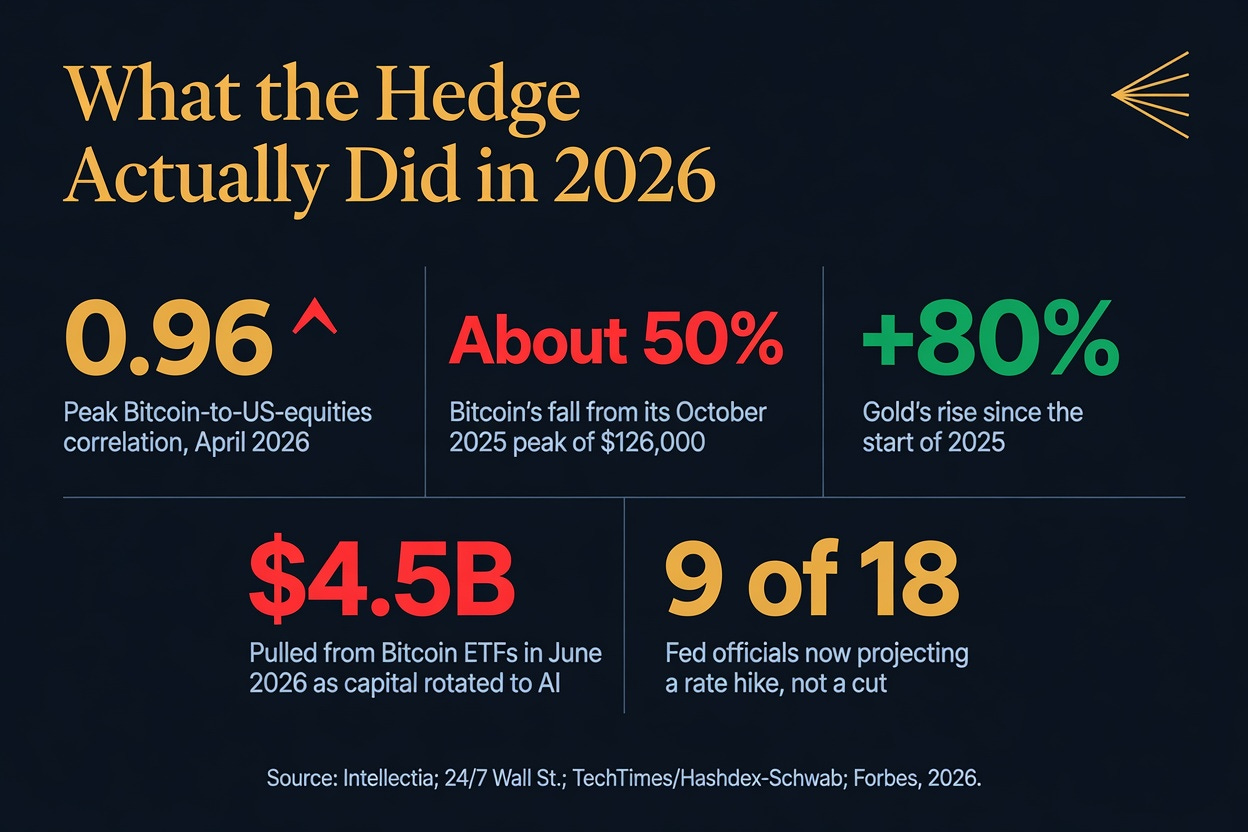
In April 2026 the number hit 0.96.
At 0.96, Bitcoin and the American stock market are very nearly the same trade wearing two names. By that measure, roughly nine tenths of Bitcoin’s daily price movement is now explained by whatever equities happen to be doing, according to correlation data compiled by Intellectia in April 2026. The asset marketed for fifteen years as an escape hatch had quietly become a window looking out at the same fire.
Bitcoin was sold as the thing that rises when everything else falls. In 2026 it has mostly just fallen with everything else, and faster.
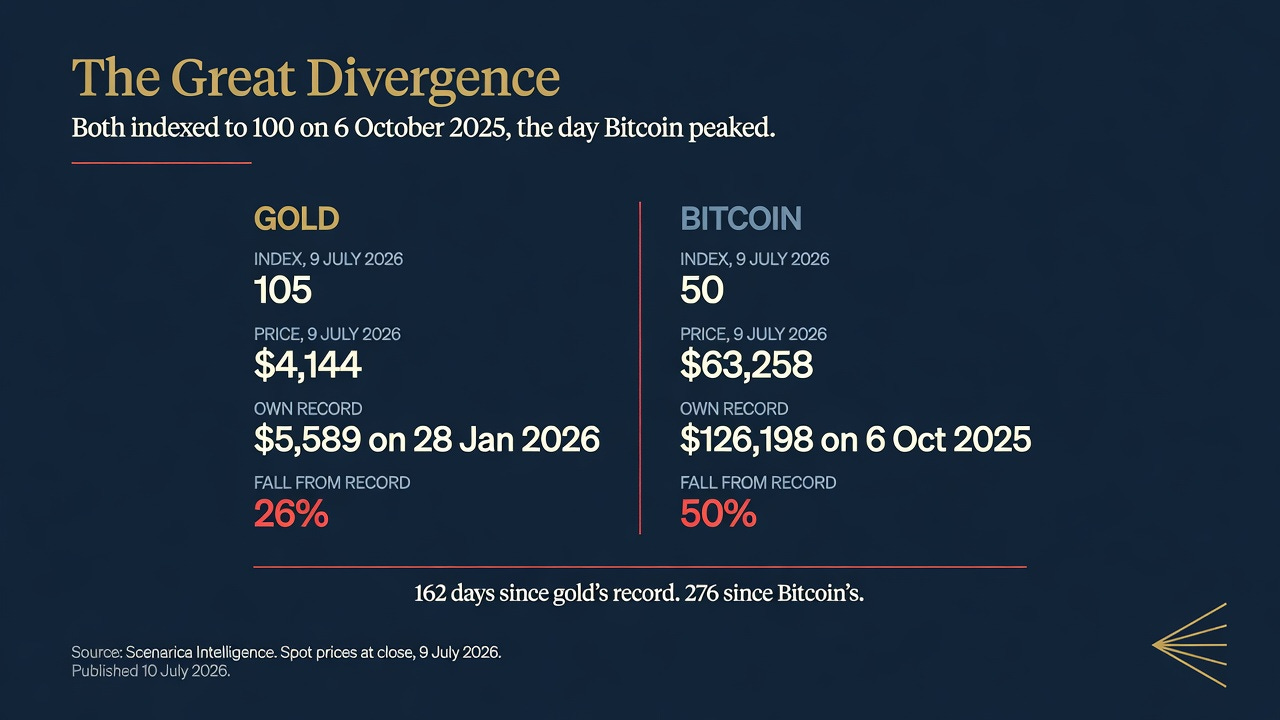
You can see the broken promise cleanly if you put two lines on one chart. Gold, the original hedge, set a record above 5,500 dollars an ounce in late January 2026 and has climbed roughly 80 percent since the start of 2025. Bitcoin, the asset built to make gold obsolete, peaked near 126,000 dollars in October 2025 and has since shed close to half its value, trading in the low 60,000s this month. Same eighteen months, opposite outcomes. Only one of them behaved the way a hedge is supposed to.
If you are a normal investor who added a slice of Bitcoin to a portfolio already heavy in technology stocks, this matters more than any price target you will read this year. You did not buy diversification. You bought a second helping of the risk you already own, seasoned with extra volatility, and you called it protection.
There is a cruel timing to it. Bitcoin arrived in mainstream portfolios, through the ETFs, at the precise moment it stopped behaving like the thing those portfolios were buying it to be. The hedge got its invitation to the party and immediately started dancing to the host’s music. Millions of people now own, as their designated safe corner, the most sensitive expression of the very risk they were trying to offset.
The story institutions were told was that Bitcoin is digital gold: scarce, stateless, a refuge for the day fiat currency is finally debased. The story the market actually told in 2026 is a different one. Bitcoin trades like the most speculative corner of the Nasdaq, rising when traders feel brave and the Federal Reserve sounds gentle, falling when they turn cautious and Kevin Warsh reminds them the future is expensive.
The reason is not mystical, and it is barely about Bitcoin at all. Prices are set at the margin, by whoever is doing the last buying and the last selling. For most of Bitcoin’s life those people were true believers who bought coins and refused, almost as a matter of faith, to let them go. Since the spot exchange-traded funds arrived, the marginal holder changed, and changing the marginal holder changed the asset.
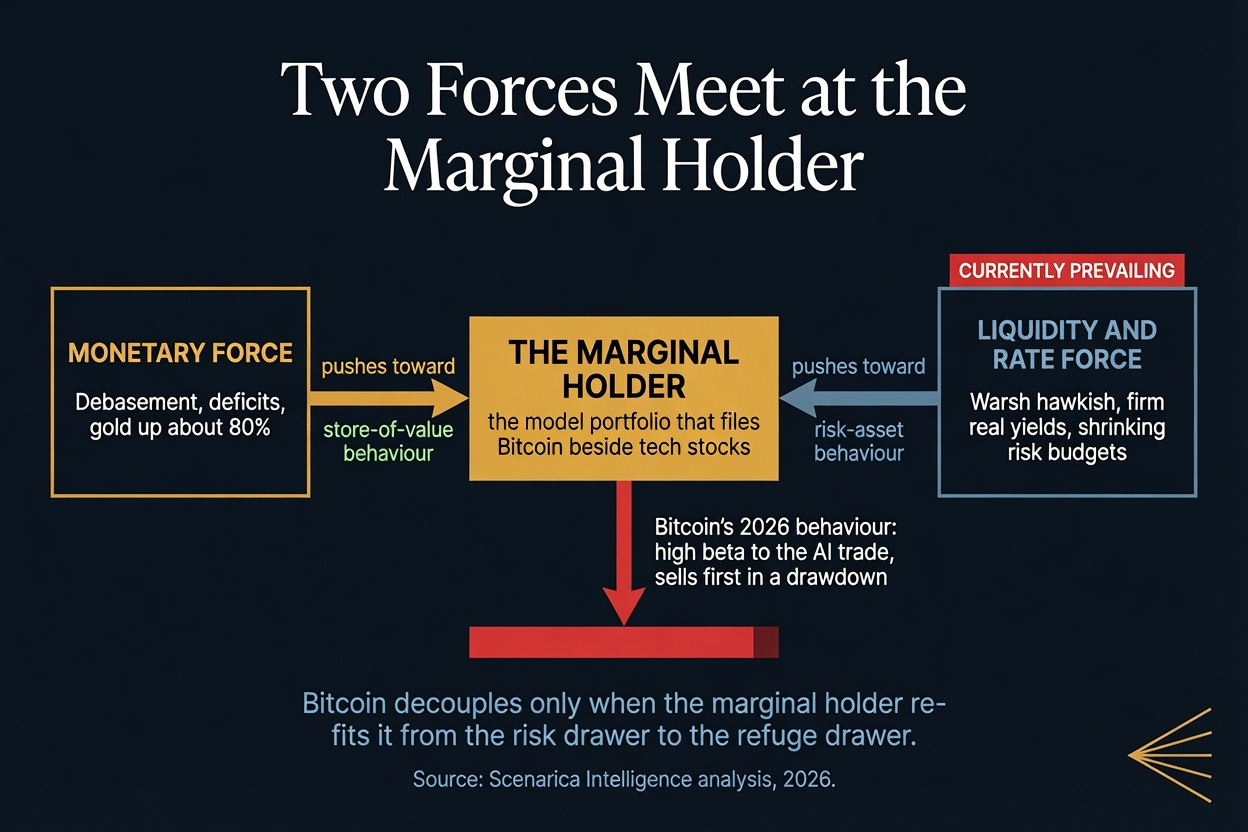
The new marginal holder is a model portfolio. It is a wealth manager’s rebalancing engine, a pension fund’s risk budget, an allocator who put two percent into a Bitcoin ETF and files it, mentally and mechanically, in the same drawer as her technology stocks. When that drawer bulges after a rally, the machine trims it. When markets wobble and risk budgets contract, the machine sells the most volatile thing in the drawer first, and the most volatile thing in the drawer is almost always Bitcoin.
So Bitcoin has inherited two traits it was never meant to carry. It has inherited the beta of the AI trade, the same small cluster of megacap chip and software names whose mood now swings entire indices. And it has inherited a sensitivity to the temperament of one man: Kevin Warsh, the Federal Reserve chair who took this year’s expected rate cut off the table at his first meeting and whose own officials, nine of eighteen at the last projection, now pencil in a hike instead of an ease.
Here is the part that should unsettle anyone holding Bitcoin as insurance. A hedge that moves with the thing it is meant to hedge is not a hedge. It is a leveraged bet in a hedge’s overcoat, and it tends to shrug the coat off in exactly the weather you bought it for.
The structural insight is simple enough to act on. Stop asking whether Bitcoin will go up. Start asking what it is currently tied to. Today it is tied to the AI-led risk trade and to the interest-rate expectations that discount every long-dated bet, which means the honest way to hold Bitcoin in the summer of 2026 is as leverage on a portfolio you already own, not as armour against it. Treating it as armour is how you end up least protected on the day you most need protecting.
For fifteen years the case for Bitcoin rested on a single promise: that it marched to its own drum. In the summer of 2026 the drum it marches to is played by Nvidia and by the Fed. The believers may still be right about where the march ends. They are simply, for now, walking the same road as everyone else, in the same traffic, braced for the same pileup.
The Deep Dive
What remains is the machinery. Why the ETF wrapper turned a monetary experiment into a rate-sensitive risk asset, whether the one historical episode where a hedge briefly stopped hedging offers Bitcoin a road back to its old behaviour, and which of three regimes the coming year most likely delivers, each priced with the reasoning laid bare. The free reader has the diagnosis. What follows is the anatomy, and the odds.
Begin with the wrapper, because the wrapper is where the character change happened. When people say the spot ETFs legitimised Bitcoin, they usually mean access: a financial adviser can now buy it in a normal brokerage account without touching a private key. That is true, and it is the smaller half of the story. The larger half is that the wrapper did not just change who could buy Bitcoin. It changed how Bitcoin is held, and therefore how it is sold.
A coin in a self-custodied wallet is held by a person with a thesis. A coin inside an ETF is held by a share, and that share sits inside portfolios governed by rules the coin has never heard of. Rebalancing bands trim it when it outperforms. Volatility-targeting overlays cut it when markets get choppy, because it raises the measured risk of the whole book faster than anything else in it. Risk-parity sleeves size it against its own volatility, so higher volatility mechanically means a smaller position. None of these rules care what Bitcoin is. They care what it correlates with and how much it moves, and on both counts the machine now files it beside the Nasdaq.
That filing decision is the entire mechanism, and it produces a specific, testable behaviour: forced selling that clusters at quarter-ends and at moments of market stress. It is why US spot Bitcoin funds bled a record amount in June 2026, with roughly 4.5 billion dollars leaving as capital rotated toward the AI complex, according to reporting on Hashdex and Schwab flow data. That was not a referendum on Satoshi. It was a risk desk rebalancing a bucket, and Bitcoin happened to be the loudest thing in the bucket.
The rate sensitivity follows from the same logic, and it is the trait least understood by the people who own it. Bitcoin has no cash flows to discount, which was supposed to make it immune to interest rates the way gold is. But the marginal holder does not value Bitcoin on its cash flows. She values it inside a portfolio where rates set the price of every speculative, long-dated bet at once. When Warsh signals higher-for-longer, the discount rate on the whole risk complex rises, the AI names that carry the market compress, and the most speculative satellite in that complex compresses hardest. Bitcoin behaves like the longest-duration asset in a book precisely because it is treated as one, even though it technically has no duration at all.
You could watch the mechanism operate in real time this spring. Warsh held rates steady at his first meeting in June and took the year’s expected cut off the table, with inflation still running above 4 percent and rates parked in a 3.5 to 3.75 percent band. Bitcoin did not shrug this off as a monetary asset would. It sold, alongside the risk complex it now belongs to, on the news that money would stay expensive. Gold, meanwhile, held near its records. The two assets received the same interest-rate signal and answered to it in opposite directions, which tells you everything about which one the market currently treats as a store of value and which one it prices as a leveraged bet on cheaper money returning. A store of value does not slump because a central banker sounds strict, and the asset that slumped was the one still being sold to institutions as the harder money of the two.
Now put the two forces on the table, because the next year is a contest between them, and the contest has a single chokepoint. The first force is monetary. It is the original thesis, and it is not dead: sovereign deficits are enormous, the debasement argument is intellectually alive, and gold’s own 80 percent run since early 2025 is the market voting, with real money, that hard stores of value are wanted again. If any of that pull reaches Bitcoin, it decouples from stocks and starts trading like the digital gold it was always billed as.
The second force is liquidity, and right now it is winning without breaking a sweat. Liquidity is Warsh, real yields, and the risk budget of every model portfolio that holds an ETF share. As long as the marginal holder treats Bitcoin as a risk allocation, Bitcoin gets the beta and the rate sensitivity of a risk allocation, full stop. The monetary force may be the stronger argument. The liquidity force is the stronger owner, and ownership is what sets the price.
The chokepoint where the two forces meet is the marginal holder’s mental filing cabinet. Bitcoin decouples from the AI trade on the day the dominant buyer stops sorting it beside technology stocks and starts sorting it beside gold. Not before. This is why the debasement thesis can be entirely correct and still lose for a year or more: being right about the destination does nothing if the people setting the daily price are still reading the asset as risk. What moves the price is not the strength of the narrative but the filing decision of whoever owns the marginal coin.
There is one historical episode that both sides of this argument should study, because it is the closest thing to a map, and it is March 2020. In the first panic of the pandemic, gold fell. It fell hard, alongside stocks, as leveraged investors sold everything liquid to raise dollars in a scramble that spared nothing. For about two weeks, the oldest hedge on earth stopped hedging. Then it decoupled, turned, and ran to record after record as the monetary response arrived. Gold’s hedge did not fail in 2020. It was briefly overwhelmed by a liquidity event, and then it did its job.
The bull case for Bitcoin is that 2026 is its March 2020: a liquidity regime is temporarily overwhelming a monetary asset, and when the regime turns, so will the correlation. It is a serious argument, and this is where it breaks. Gold snapped back because its holder base snapped it back. Central banks, long-term allocators, and savers with multi-decade horizons owned gold in 2020 and stepped in when it cheapened. Bitcoin’s marginal holder in 2026 is not that person. It is a rebalancing rule that sells into weakness, not a conviction buyer who buys it. Gold decoupled because the people who owned it wanted it as a hedge. Bitcoin will decouple only when the people who set its price want it as one, and today they do not. The parallel offers a road back, but the road runs through a change of ownership that has not happened yet.
Which brings the question to a number, and the number is really a bet on which force governs the tape over the next twelve months. Read each of the three below as a claim measured against the roughly one-in-three you would assign by blind chance, and notice where the evidence pushes above that line and where it pushes below.
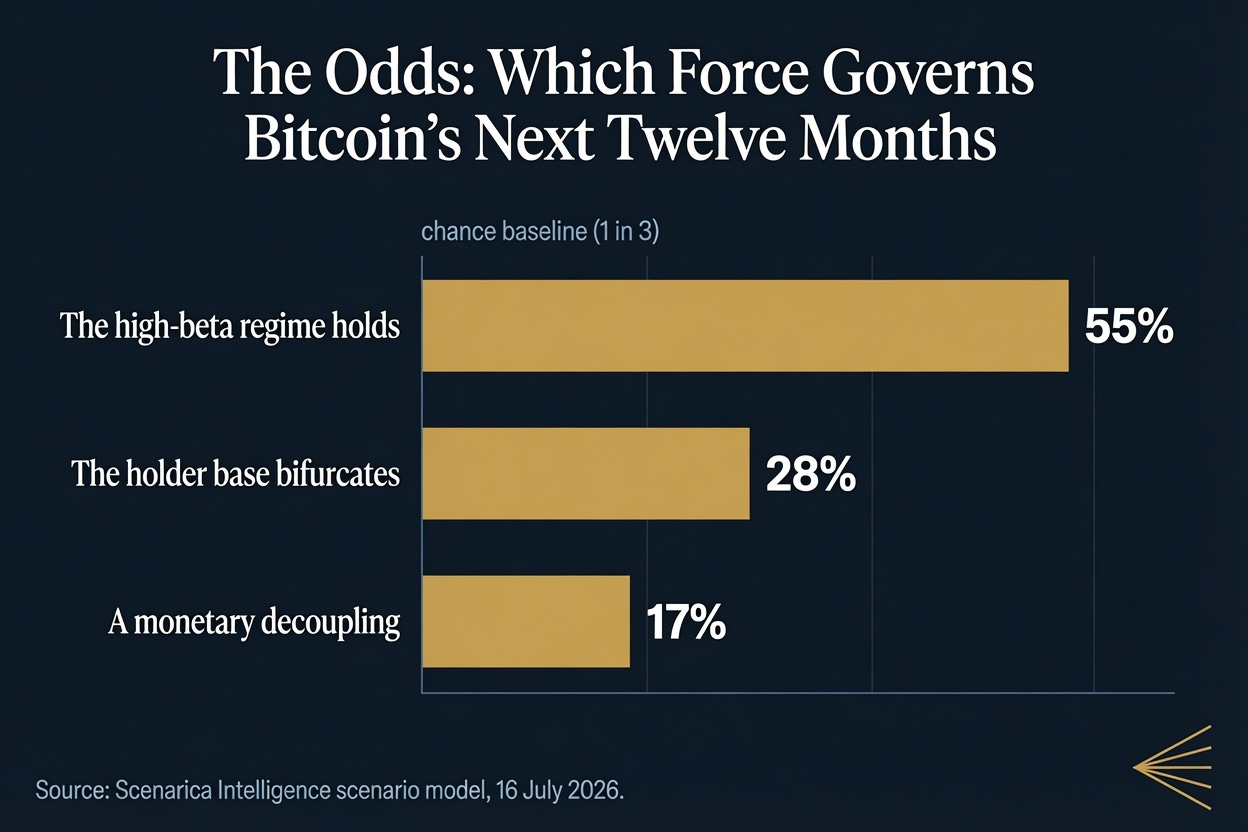
The most likely path, and it clears a majority at 55 percent, is that the high-beta regime simply holds. The correlation you are trading does not unwind in a quarter, because the thing producing it, an ownership base that files Bitcoin as risk, does not change in a quarter. If you own Bitcoin here, this is the world your positioning should assume: it trades as leverage on the AI complex and as a bet against Warsh, it rises on soft inflation prints and dovish surprises, and on any genuine risk-off day it falls at least as hard as the Nasdaq while lagging on the way back up. The tracked variable is Bitcoin’s rolling correlation and beta to the Nasdaq-100. In this world the correlation stays north of 0.6 through the one-month and three-month horizons, and Bitcoin’s fate over twelve months is mostly decided in the AI names and at the July 28 to 29 meeting, not on any chain. This scenario crosses 50 percent for one reason: every alternative requires a specific change that the near-term calendar does not deliver, while continuation requires nothing to happen at all.
Then there is the quieter, stranger world, the one at 28 percent where the holder base splits in two and Bitcoin becomes two assets wearing one ticker. Long-term holders keep accumulating and refusing to sell, firming a spot floor priced on the monetary thesis, while ETF and derivative flow keeps setting the daily tape on the risk thesis. If you are watching for this, the signal is a divergence: on-chain long-term-holder supply rising and steady even as the price stays whippy and correlated. In this regime the floor gets firmer and the beta stays high at the same time, which feels like a contradiction until you remember that two different owners with two different horizons are pricing the same coin. It resolves nothing about correlation in the near term, which is why it sits below the one-in-three line, but over twelve months it is the bridge by which a monetary floor slowly rebuilds underneath a risk-traded surface.
The smallest of the three, at 17 percent, is the one the believers are paying for and the one the next year is least likely to hand them: a genuine monetary decoupling. Here fiscal dominance and dollar debasement finally reach Bitcoin, gold’s run drags it into safe-haven behaviour, its correlation to equities falls toward zero and its correlation to gold turns positive, and it starts to rise when stocks fall. This is the thesis coming true. It sits below chance not because it is implausible over years but because the immediate macro pushes the other way: Warsh is hawkish, real yields are firm, and the marginal holder is still filing the asset as risk. Decoupling needs the discount-rate regime to break in Bitcoin’s favour, and a Fed that just took cuts off the table is the opposite of that break. Price it as the real but deferred prize it is, not as this quarter’s trade.
It is worth naming what would have to be true for that 55 percent base case to be wrong, because a read this confident should be falsifiable. The base case fails if Bitcoin stops falling on hawkish surprises and stops rallying on dovish ones, in other words if the rate sensitivity that defines it right now simply fades while equities stay volatile. It fails if a genuine equity drawdown arrives and Bitcoin holds, or rises, while the Nasdaq drops, the single cleanest signal that the marginal holder has re-sorted it from the risk drawer to the refuge drawer. And it fails if the correlation to gold, deeply negative today, climbs toward positive and stays there through a stress event rather than a calm one. None of those has happened. If two of them happen together, the base case is not merely wrong, it is inverted, and the 17 percent decoupling world becomes the one to price up. Until then, the burden of proof sits on the believers, because the tape is not on their side.
What would move these numbers is a change in the marginal holder, and that is the single thing to watch beneath all the noise. If Warsh pivots dovish and real yields fall while deficits balloon, the 17 percent decoupling world gets live fast, because that is the exact macro that flips the filing decision. If instead the AI trade cracks in earnest, expect the base case to express its cruelest form first: Bitcoin falling harder than the equities it is supposed to hedge, before any decoupling can rescue it. The probabilities are a snapshot of which owner controls the coin, and the owner can change faster than the thesis.
Watch the Federal Open Market Committee on July 28 and 29, the first hard test on the calendar, where a hold reinforces the high-beta base case and any hint of a hike is likely to hit Bitcoin harder than it hits stocks. Watch the megacap AI earnings that land through late July and August, because a stumble there is the most direct route to Bitcoin’s asymmetric downside, the day the hedge falls first and furthest. Watch the rolling Bitcoin-to-gold correlation, which has run deeply negative into 2026, per Aurpay and Mudrex correlation data; a sustained flip to positive would be the earliest real evidence that decoupling has begun. Watch ETF flows, where a durable return to sustained net inflows rather than quarter-end bleed would signal the marginal holder is adding risk rather than trimming it. And watch long-term-holder supply on-chain, whose quiet climb through a falling price is the fingerprint of the bifurcation scenario building beneath the surface.
The believers were promised an asset that answered to no one. What they hold in the summer of 2026 answers to two: a handful of chip stocks in California, and one man in Washington who decides, every six weeks, how expensive the future is allowed to be. On July 29, when Kevin Warsh steps to the microphone, watch which asset flinches first. It will not be gold.
Sources:
Intellectia, “Bitcoin’s Correlation With Stocks Just Hit a Record 0.96,” 2026.
24/7 Wall St., “Bitcoin Price Prediction for July 2026,” 2 July 2026.
Crypto.com US, “Bitcoin in 2026: A Gold-Like Hedge, Tech Follower, or Something Else,” 2026.
Aurpay, “Bitcoin Isn’t Acting Like Digital Gold in 2026, Here’s Why,” 2026.
Mudrex Learn, “Bitcoin Gold Correlation Coefficient 2026: Full Breakdown,” 2026.
Crypto.news, “Bitcoin is trading like a tech stock, not gold,” 2026.
Forbes (Jason Kirsch), “Gold, Bitcoin, And The New Safe-Haven Playbook,” 17 June 2026.
Forbes Digital Assets, “Bitcoin Now Braced For A Critical Fed July Price Pivot Point,” 4 July 2026.
TechTimes, “AI Stocks Pulled $4.5B From Bitcoin ETFs: Hashdex and Schwab Forecast Reversal,” 4 July 2026.
Sunday Guardian, “Bitcoin Price Today (July 8, 2026),” 8 July 2026.
BitKE, “Record Bitcoin ETF Outflows in June 2026 Signal Institutional Pullback,” July 2026.
Disclaimer: This report is published by Scenarica Intelligence for informational purposes only. It does not constitute investment advice, a solicitation to buy or sell any financial instrument, or a recommendation regarding any particular investment strategy. Scenarica Intelligence is not a registered investment adviser or broker-dealer. All scenario probabilities and assessments represent the analytical judgment of Scenarica Intelligence and are subject to change without notice. Past performance of any asset or strategy discussed does not guarantee future results. Readers should conduct their own due diligence and consult with qualified financial advisers before making investment decisions.
Scenarica Premium: The full Scenarica suite includes Geopolitics, Economy, Bitcoin, AI, and Sunday Edition.
Scenarica Intelligence
We don’t predict the future. We price it.