

The Answer Machine
Google is not being replaced. It is being unbundled. And the last time an unbundling started this quietly, newspapers had a decade of classified revenue left to lose.

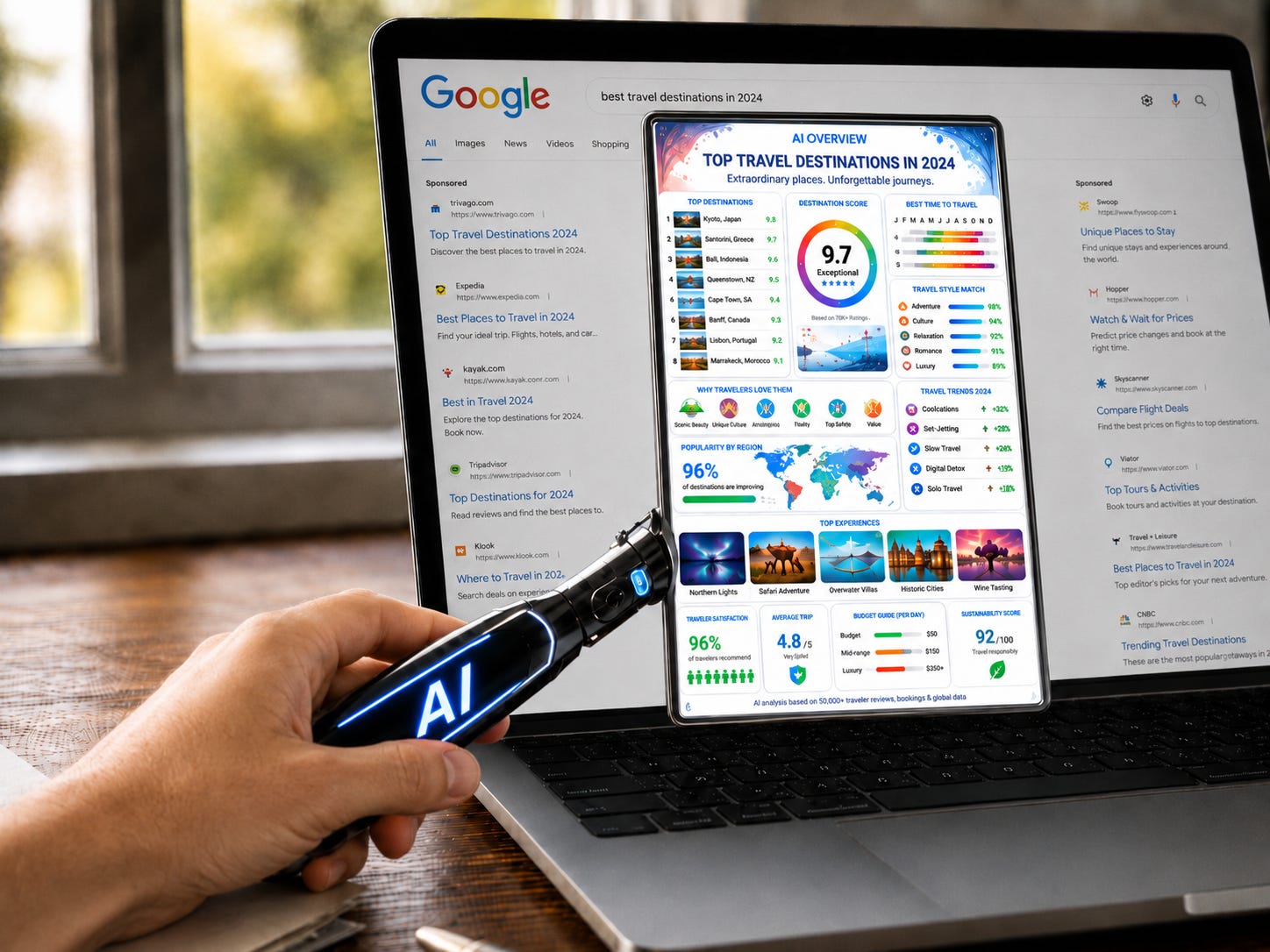
Rena Matsuda had not noticed until her daughter pointed it out. It was a Wednesday evening in late April, the kind of mild Portland night that draws the neighbourhood out onto porches, and Rena was sitting at her kitchen table with a laptop and a legal pad, working through a decision she had been avoiding for two months. She ran a bakery on Southeast Division Street, eleven employees, a line out the door on Saturday mornings, and a question that had kept her awake since March: should she launch her own delivery operation or sign with DoorDash?
The question was not simple. DoorDash would take 15 to 30 percent of every order. Building her own delivery meant hiring drivers, buying insulated bags, building an ordering page on her website, and figuring out a delivery radius that did not destroy her margins on a twelve-dollar loaf of sourdough. She needed to understand delivery economics, local labour costs, liability insurance for drivers, and what other independent bakeries in her price range had done.
She opened Perplexity and typed: “I run a small bakery doing $840,000 in annual revenue. I am deciding between DoorDash and running my own delivery. What are the real costs of each option, and what do independent bakeries in the $500K to $1M range typically choose?”
What came back was not a list of links. It was an answer. Three paragraphs with specific cost breakdowns, margin comparisons, and citations from a National Restaurant Association survey, a Toast payments report, and two case studies from bakery trade publications. The answer noted that DoorDash’s effective commission after marketing fees and tablet rental averaged 26 percent for bakeries in her revenue range, while self-delivery operations typically cost 12 to 18 percent of delivery revenue but required an upfront investment of $8,000 to $15,000 in equipment, insurance, and technology.
Rena’s daughter, a sophomore at Portland State who was home for the evening, watched over her shoulder. “Mom,” she said, “when was the last time you actually googled something?”
Rena thought about it. She could not remember. Not for research. Not for a question that required understanding rather than a URL. She had been using Perplexity for three weeks, ever since a friend at the farmers’ market had mentioned it, and she had not opened Google for a single informational query since. She still used Google to navigate to her bank’s website, to check her bakery’s Google Business listing, and to search for a phone number. But every question that began with “how,” “why,” “what are the costs of,” or “compare” now went to Perplexity.
She had switched without deciding to switch. And she was not alone.
What Rena experienced at her kitchen table is a pattern that has a name, though she would never use it. It is called unbundling, and it has killed every media incumbent it has ever touched. In the late 1990s, newspapers were bundles: classifieds, news, sports, comics, opinion, and local listings wrapped in a single product and monetised by a single advertising model. Then Craigslist took the classifieds. Indeed and Monster took the job listings. Zillow took the real estate ads. Social media took the breaking news. Each piece went to a specialist. No single competitor replaced the newspaper. The bundle was pulled apart, strand by strand, and the advertising revenue that depended on the full bundle collapsed. The New York Times survived by building a subscription business. Most newspapers did not.
Cable television was the next bundle to break. ESPN, HBO, CNN, and dozens of channels were sold together in a package that cost $80 to $150 a month. Then Netflix unbundled the movies. Hulu unbundled the network shows. Disney+ unbundled the family content. Consumers were willing to pay for the pieces they wanted. They were not willing to pay for the bundle. The cable advertising model, built on the captive attention of the full package, degraded as subscribers left.
Google Search, in 2026, is a bundle. It handles navigation (”take me to Amazon.com”), transactions (”buy running shoes”), information (”how does inflation affect housing prices”), research (”compare the arguments for and against remote work”), and commercial investigation (”best laptop for video editing 2026”). For twenty years, all of these query types lived in the same search bar, and the advertising model was built on the combined volume of all of them.
The unbundling has begun. Perplexity, with 45 million monthly active users and more than a billion queries a month, is pulling the informational layer out of the bundle. ChatGPT Search, Claude, and Gemini are pulling the research layer. YouTube and TikTok pulled the entertainment layer years ago. What remains in the Google search bar, increasingly, is navigation and transactions: the queries where the user already knows what they want and needs to be taken there. These are the queries that generate the most advertising revenue per click. They are also the queries that require the least engagement, the least time on page, and the least reason to come back.
Rena’s kitchen table is a data point in this migration. She does not know that Google’s desktop search share has dropped to 79 percent, the lowest figure in over two decades, according to StatCounter. She does not know that Google’s advertising revenue approached $300 billion in 2025, or that AI Overviews, Google’s own attempt to provide direct answers, now reach 2 billion monthly users but risk cannibalising the click-through rates that advertisers pay for. She does not know any of this. She just knows that when she types a question into Perplexity, she gets an answer, and when she types the same question into Google, she gets a page of links, half of which are ads, and she has to click through three websites to assemble the answer herself.
The structural parallel to newspapers is not approximate. It is precise. Newspapers did not lose readers because readers stopped reading. They lost the revenue streams that subsidised the journalism. Classified advertising was the largest single revenue source for American newspapers in the 1990s. When Craigslist offered free classifieds, the revenue disappeared, but the newspaper was still there, still printing, still delivering. The collapse was invisible from the outside until it was too late to reverse. Google is not losing users. Its search share is still 90 percent globally. But if 15 to 20 percent of informational queries have already migrated to AI platforms, the parallel is active. The bundle is being pulled apart. The advertising model has not collapsed yet because navigational and transactional queries still drive enormous revenue. The question is whether a search engine stripped of its informational purpose can sustain the engagement, the session length, and the return visits that justify nearly $300 billion in annual advertising.
In February 2026, Perplexity made a decision that clarified the stakes. The company formally abandoned advertising. It had been testing sponsored results, but CEO Aravind Srinivas concluded that ads would erode the trust that is Perplexity’s only advantage over a competitor with ninety percent market share. The business model would be subscriptions, at $20 per month for Pro, and zero-fee commerce. No ads. No sponsored results. No ambiguity about whether the answer serves the user or the advertiser.
This is the same bet Netflix made against ad-supported cable. Pay for the product, and the product serves you. Accept the product for free, and the product serves the advertiser. Perplexity is betting that users who have tasted an ad-free answer will not go back to a page of sponsored links. The early evidence supports the bet: Perplexity’s annualised revenue reached $200 million by early 2026, driven entirely by subscriptions and commerce, with no advertising revenue at all.
Google’s response has been to absorb AI into the existing model. AI Overviews place a generated answer at the top of the search results page. AI Mode, which crossed 100 million monthly active users in the US and India, offers a more conversational search experience. Both are impressive technically. Both face the same structural problem: every AI-generated answer that satisfies the user at the top of the page reduces the probability that the user clicks on the links below. Fewer clicks means less value for advertisers. Google is cannibalising its own advertising model to prevent users from leaving. This is the innovator’s dilemma made literal: the company must deploy AI to stay relevant, but AI deployment undermines the business model that generates the revenue.
Rena does not think about any of this in these terms. She thinks about it in the terms that matter to a bakery owner making an $8,000 decision. She went back to Perplexity three more times that Wednesday evening. She asked it to calculate the break-even point for self-delivery given her average order size. She asked it to explain the liability insurance requirements for delivery drivers in Oregon. She asked it to find bakeries in the Pacific Northwest that had switched from DoorDash to self-delivery and what happened to their margins.
Each time, she got an answer with citations. Each time, she could read the sources if she wanted to verify. Each time, the answer arrived in seconds, not in a cascade of tabs. She was not using a search engine. She was using something closer to a research assistant that happened to live inside a browser tab.
And here is the turn that Rena discovered without knowing she had discovered it. On Thursday morning, she needed to check something specific: whether Oregon required a separate business licence for delivery operations. She typed the question into Perplexity. The answer was confident, specific, and cited the Oregon Secretary of State’s website. But something nagged her. She opened a new tab, went to the Oregon Secretary of State’s website directly, and read the actual regulation.
The AI had been almost right. The answer had captured the general requirement correctly but had missed a 2025 amendment that created an exemption for businesses with fewer than fifteen employees doing delivery within a five-mile radius. Rena’s bakery, with eleven employees and a planned three-mile delivery zone, would have qualified for the exemption. The AI’s answer would have sent her to apply for a licence she did not need.
She sat with that for a moment. The machine was faster, clearer, and more convenient than Google. It was also, on this particular question, subtly wrong in a way that could have cost her $400 in unnecessary licensing fees and two weeks of paperwork. The answer had been good enough to be trusted and wrong enough to matter.
This is the tension at the centre of the unbundling. AI search is better than traditional search for the queries that require synthesis, comparison, and explanation. It is worse than traditional search for the queries that require precision, recency, and regulatory specificity. The user who needs to understand a topic uses Perplexity. The user who needs to verify a specific fact still needs the primary source. Google, for all its flaws, has always been a gateway to primary sources. Perplexity is a synthesis engine that sometimes gets the synthesis wrong.
Perplexity knows this. The company’s bid to acquire Google Chrome for $34.5 billion, submitted in August 2025 in the context of the DOJ antitrust case, was not just a headline play. Chrome is the gateway to the web. If Perplexity owned Chrome, it could set itself as the default search, the first place 3 billion browser users look when they have a question. The bid may not succeed. But it reveals a theory of victory: control the browser, control the default, and let the quality of the answer do the rest.
The scenarios that follow from this unbundling are not about whether Google survives. Google will survive. It is a $2 trillion company with cloud infrastructure, YouTube, Android, and the world’s most advanced AI lab. The scenarios are about what Google becomes.
Scenarica puts the probability of slow erosion at thirty-five in a hundred. In this world, AI search tools capture a quarter to a third of informational queries by 2028. Google’s search revenue growth slows from double digits to low single digits. No crisis. No collapse. Just a long, quiet decline in the metric that matters most: revenue per query. Google compensates through YouTube, Cloud, and AI infrastructure. Perplexity grows to 100 or 200 million monthly active users but does not threaten Google’s dominance in navigational and transactional search. If you run a small business in 2028, you still advertise on Google. But you advertise to fewer searchers, and they click less often, and you pay more for each click because the pool is shrinking.
Three in ten is the probability of something faster. A catalyst, perhaps the Chrome divestiture, perhaps a major Google AI failure that sends a wave of users to alternatives, accelerates the migration. AI tools capture 40 percent or more of informational queries by 2028. Google’s advertising revenue turns negative in growth for the first time. The company undergoes a structural transformation comparable to IBM’s shift from hardware to services in the 1990s. Google survives but the search monopoly, the thing that has defined the company for a quarter of a century, is broken. If you are a marketer building a strategy around Google search, this is the scenario that forces you to diversify your channels now rather than later.
Two in ten is the probability that Google absorbs AI successfully. AI Overviews and AI Mode prove so good that users have no reason to leave. Perplexity plateaus. The unbundling thesis fails because Google re-bundles AI into the existing search experience without losing the advertising revenue. This requires Google to solve the cannibalisation dilemma, to give users answers and still get them to click. History suggests this is extremely difficult. But Google has solved difficult problems before, and the 2 billion users of AI Overviews are evidence that the strategy is not failing yet.
Fifteen in a hundred is the probability of a Perplexity breakthrough. The Chrome acquisition succeeds, or the Comet browser, Perplexity’s AI-native browsing experience that launched in 2025 and went free across all platforms in 2026, captures enough users to shift the default. Perplexity reaches 500 million monthly active users by 2028. Google’s search share drops below 70 percent for the first time in two decades. The advertising-supported search model enters terminal decline, not because the ads stop working but because the queries that justified the ads are happening somewhere else.
Watch for the DOJ ruling on Chrome divestiture, expected in the coming months. If the judge orders divestiture and Perplexity’s bid is in the running, the probability of the breakthrough scenario doubles overnight. Watch for Google’s quarterly advertising revenue per search, which the company does not disclose directly but which analysts estimate from the gap between total advertising revenue and total query volume. If that number declines for two consecutive quarters, the cannibalisation thesis moves from theory to evidence. Watch for Perplexity’s next funding round or IPO filing, which will disclose user metrics and revenue figures that are currently estimated. And watch for Apple. If Apple builds AI search into Safari’s default experience, the unbundling accelerates in the one market where Google has always paid the most to be the default.
Rena Matsuda did not read any of this. She made her decision on a Friday morning, two days after the conversation with her daughter. She chose self-delivery. The Perplexity research had given her the framework: the margin analysis, the insurance requirements, the case studies. She verified the licensing exemption on the state website herself. She ordered the insulated bags from a restaurant supply company whose URL she found, for the first time in weeks, by typing the name into Google.
She used the answer machine for the questions that required understanding. She used the search engine for the question that required a destination. She did not think of this as a historic shift in the structure of the internet’s most important business model. She thought of it as the obvious way to get things done.
That is how unbundlings always feel from the inside. Obvious. Quiet. And by the time the numbers catch up to the behaviour, irreversible.
ANNEX: WHAT HAPPENS WHEN THE BUNDLE BREAKS?
The advertising model that built Google into a $2 trillion company rests on a single assumption: that users come to Google for every type of query. AI search tools are testing that assumption for the first time. Four paths lead from here, and all of them change how you find information, how businesses reach you, and how much you pay for the convenience.
Slow Erosion: 35%
You keep using Google for most things, but you notice yourself reaching for Perplexity or ChatGPT when you need to understand something rather than find something. So does everyone else. By 2028, a quarter to a third of informational queries have migrated to AI platforms. Google is still dominant, still profitable, still the place you go to buy shoes or find a restaurant. But the growth that investors have priced in for two decades slows to low single digits. If you advertise on Google, you pay more per click because the total volume of high-intent queries is shrinking. If you are a publisher who depends on Google traffic, the referral stream thins as AI answers replace click-throughs.
Variable to watch: Google’s advertising revenue growth rate, reported quarterly in Alphabet earnings. If growth drops below 5% year-over-year for two consecutive quarters, the slow erosion scenario is confirmed. One-month probability of a sub-5% quarter in 2026: 15%. Three-month probability: 20%. Twelve-month probability of at least one sub-5% quarter: 40%.
Accelerated Unbundling: 30%
A catalyst event, most likely the Chrome divestiture ruling or a Google AI failure visible to mainstream users, accelerates the migration. AI search tools capture 40% or more of informational queries by 2028. You find yourself opening Google only for navigation and shopping. Google’s advertising revenue turns negative growth for the first time, triggering a structural transformation. If you run a business, your marketing strategy diversifies away from search because the search audience is fragmenting. If you work in digital advertising, the Google-dominated landscape you trained on no longer exists.
Variable to watch: DOJ Chrome divestiture ruling timeline. One-month probability of a ruling in the next 30 days: 20%. Three-month probability of a definitive ruling: 50%. Twelve-month probability of Chrome divestiture being ordered: 35%. Secondary variable: Perplexity monthly active user growth rate (currently ~45M MAU). If MAU doubles to 90M within six months, acceleration is underway.
Google Absorbs AI: 20%
Google’s AI Overviews and AI Mode prove good enough that you stop experimenting with alternatives. The 2 billion monthly users of AI Overviews represent a moat that no startup can match. Perplexity plateaus at 50 to 70 million users, a respectable niche but not an existential threat. Google solves the cannibalisation dilemma by making AI Overviews generate enough engagement to sustain advertising revenue. If you are a marketer, nothing changes. Google remains the centre of your strategy. If you are a Perplexity subscriber, you keep paying because the ad-free experience is worth $20 a month, but you are a niche user, not the vanguard of a revolution.
Variable to watch: AI Overview click-through rates to advertiser links, trackable via Google Ads performance data. If click-through rates on AI Overview pages match or exceed traditional search results within six months, the absorption scenario gains probability. One-month probability of Google publishing AI Overview performance data: 25%. Three-month probability: 45%. Twelve-month probability of click-through parity: 20%.
Perplexity Breakthrough: 15%
Chrome divestiture gives Perplexity the browser. The Comet browser captures mobile users. Combined with zero-fee commerce and a subscription base willing to pay for an ad-free experience, Perplexity reaches 500 million monthly active users by 2028. Google’s search share drops below 70 percent globally for the first time in two decades. You change your default search engine and forget you ever used anything else. The advertising-supported search model enters terminal decline, not because ads stop working but because the audience that justified the ads is searching somewhere else.
Variable to watch: Perplexity’s Chrome bid outcome and Comet browser download trajectory. One-month probability of a Chrome bid update: 15%. Three-month probability of Comet browser reaching 50M downloads across all platforms: 30%. Twelve-month probability of Perplexity reaching 150M MAU: 25%.
Sources:
DemandSage, “Perplexity AI Statistics 2026: Active Users and Revenue,” 2026.
MacRumors, “Perplexity Abandons AI Advertising Strategy Over Trust Worries,” February 2026.
Financial Times, via Digit.fyi, “Perplexity ditches ads, doubles down on subscriptions,” February 2026.
CNBC, “Perplexity offers to buy Google’s Chrome browser for $34.5 billion,” August 2025.
StatCounter, “Search Engine Market Share Worldwide,” 2026.
TechCrunch, “Google’s AI Overviews have 2B monthly users, AI Mode 100M in the US and India,” July 2025.
Alphabet, “Fourth Quarter and Fiscal Year 2025 Results,” 2026.
First Page Sage, “Top Generative AI Chatbots by Market Share, April 2026,” 2026.
Perplexity, “Introducing Comet: Browse at the speed of thought,” 2025.
Disclaimer: This report is published by Scenarica Intelligence for informational purposes only. It does not constitute investment advice, a solicitation to buy or sell any financial instrument, or a recommendation regarding any particular investment strategy. Scenarica Intelligence is not a registered investment adviser or broker-dealer. All scenario probabilities and assessments represent the analytical judgment of Scenarica Intelligence and are subject to change without notice. Past performance of any asset or strategy discussed does not guarantee future results. Readers should conduct their own due diligence and consult with qualified financial advisers before making investment decisions.
Scenarica Premium: The full Scenarica suite includes Geopolitics, Economy, Bitcoin, AI, and Sunday Edition.
Scenarica Intelligence
We don’t predict the future. We price it.