


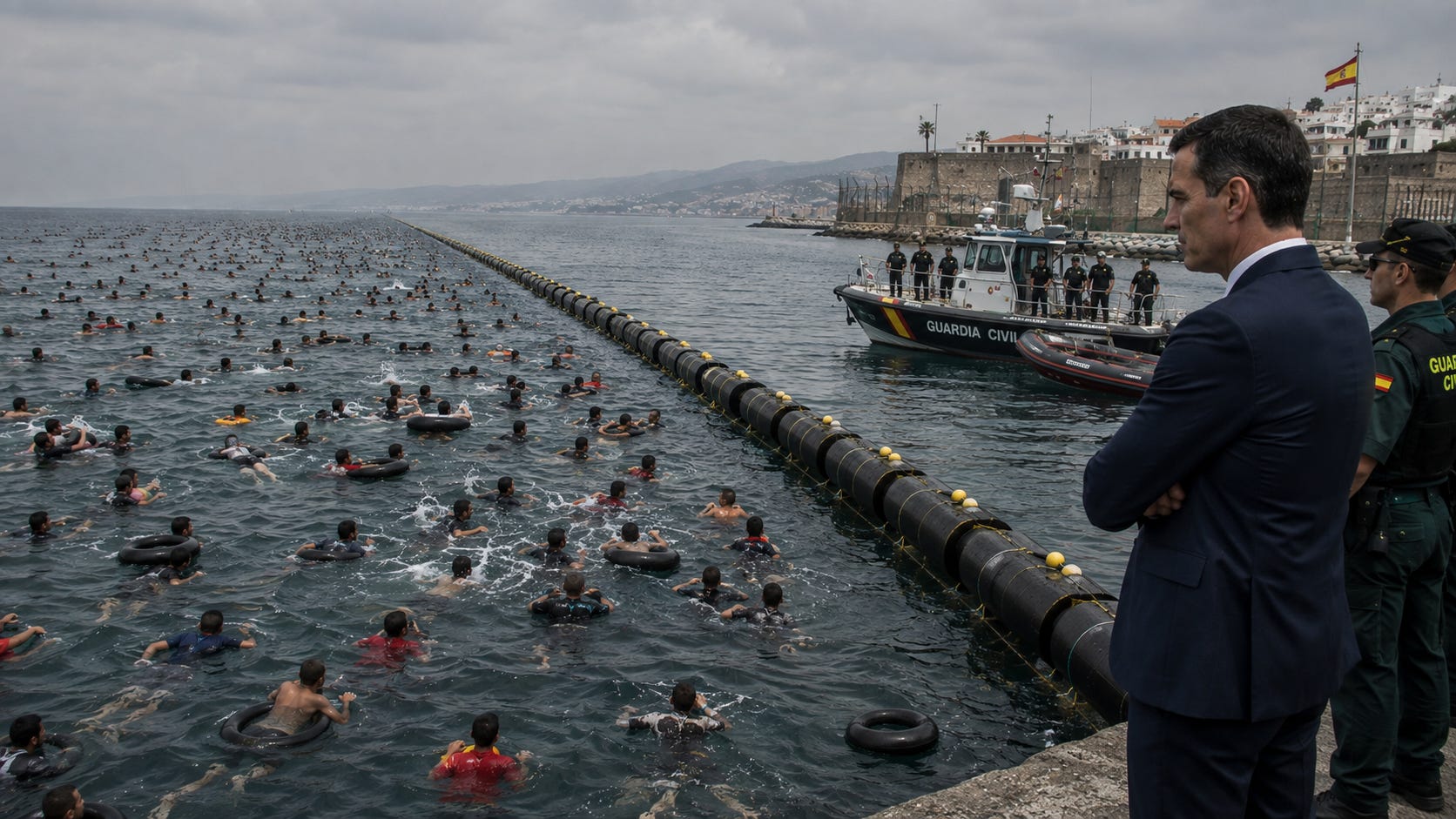
At ten to eight on the morning of Saturday 1 August, a Spanish crew began paying out five hundred metres of pneumatic floating barrier along the Tarajal breakwater in Ceuta. The buoys came from the Navy. The skirt hangs about a metre down, the floats stand thirty to seventy centimetres above the surface, and a channel was left open in the middle so that Guardia Civil boats can pass through and protect it.
By then the water was empty. The crossings had stopped the previous day and most of the people who made them had already gone back.
So the barrier was not laid to stop anyone, and the Guardia Civil’s own professional association says plainly that it cannot. Rachid Sbihu of the AUGC called it a patch that arrives late, useless in practice and frankly vulnerable. Pedro Sanchez was more precise about its purpose. The government, he said, was going to give effect to the judgment.
That judgment is STS 814/2026, handed down on 29 June by the Fifth Section of the Contentious-Administrative Chamber of the Supreme Court, on the state advocate’s appeal in cassation 3795/2025. The case came from an Algerian man who swam toward Ceuta in November 2024 and was passed to Moroccan officers with no written decision, no interpreter and no lawyer.
The court held that Spain’s summary rejection power, the tenth additional provision of the immigration law inserted in 2015, does not reach people intercepted at sea. That provision covers those who overcome elementos de contencion, containment elements, at the frontier. Fences.
Drones, thermal cameras and sensors cannot be equated with them, the judges wrote, because those devices perform surveillance, detection and alert functions rather than any material containment. A swimmer overcomes nothing, so a swimmer falls under the ordinary removal procedure, with its written decision, its interpreter and its lawyer. Then the ruling left one door ajar. Were containment elements to be established in the sea, rejection at the border might apply to whoever tried to get past them.
On 29 June there were none.
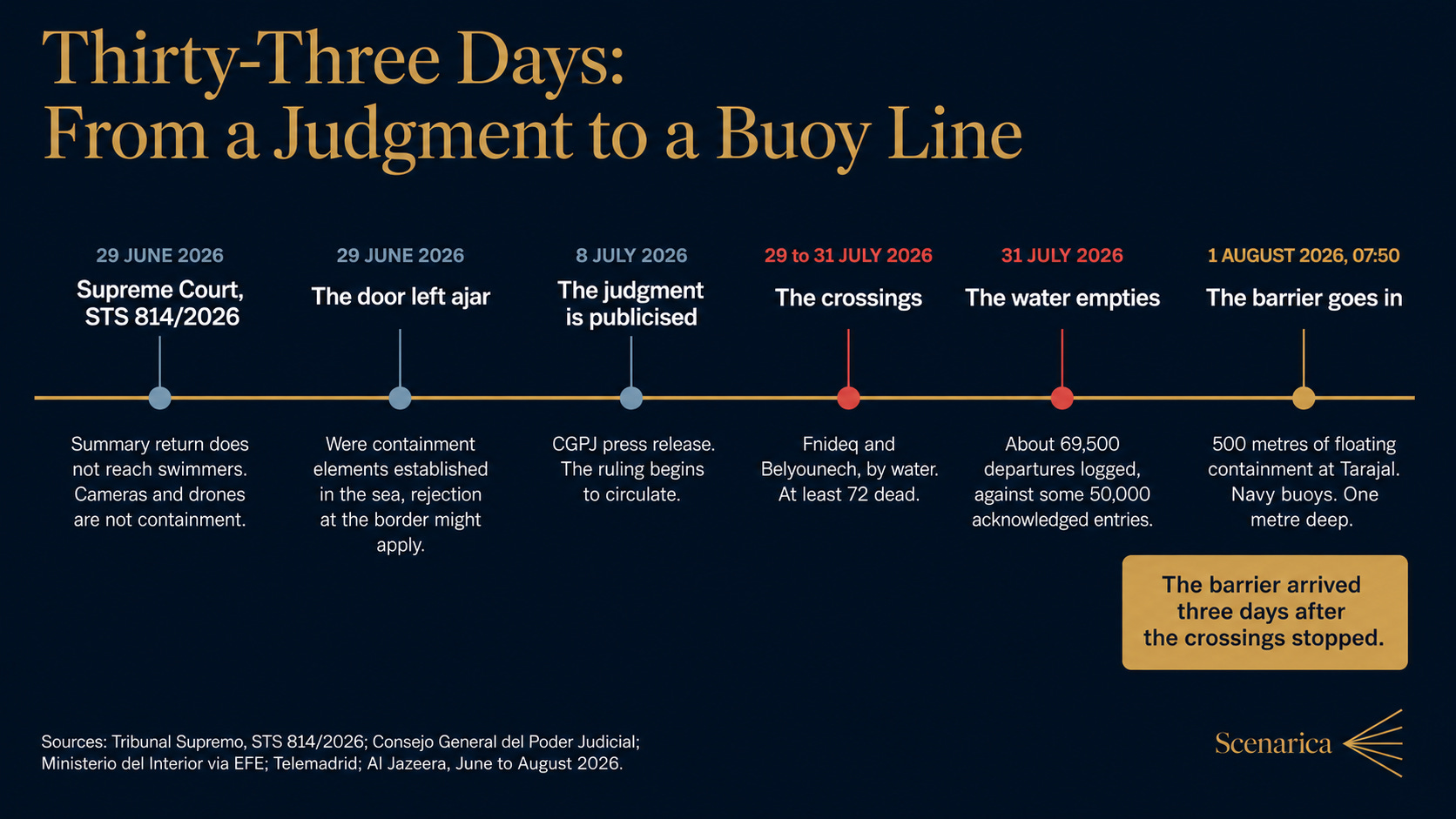
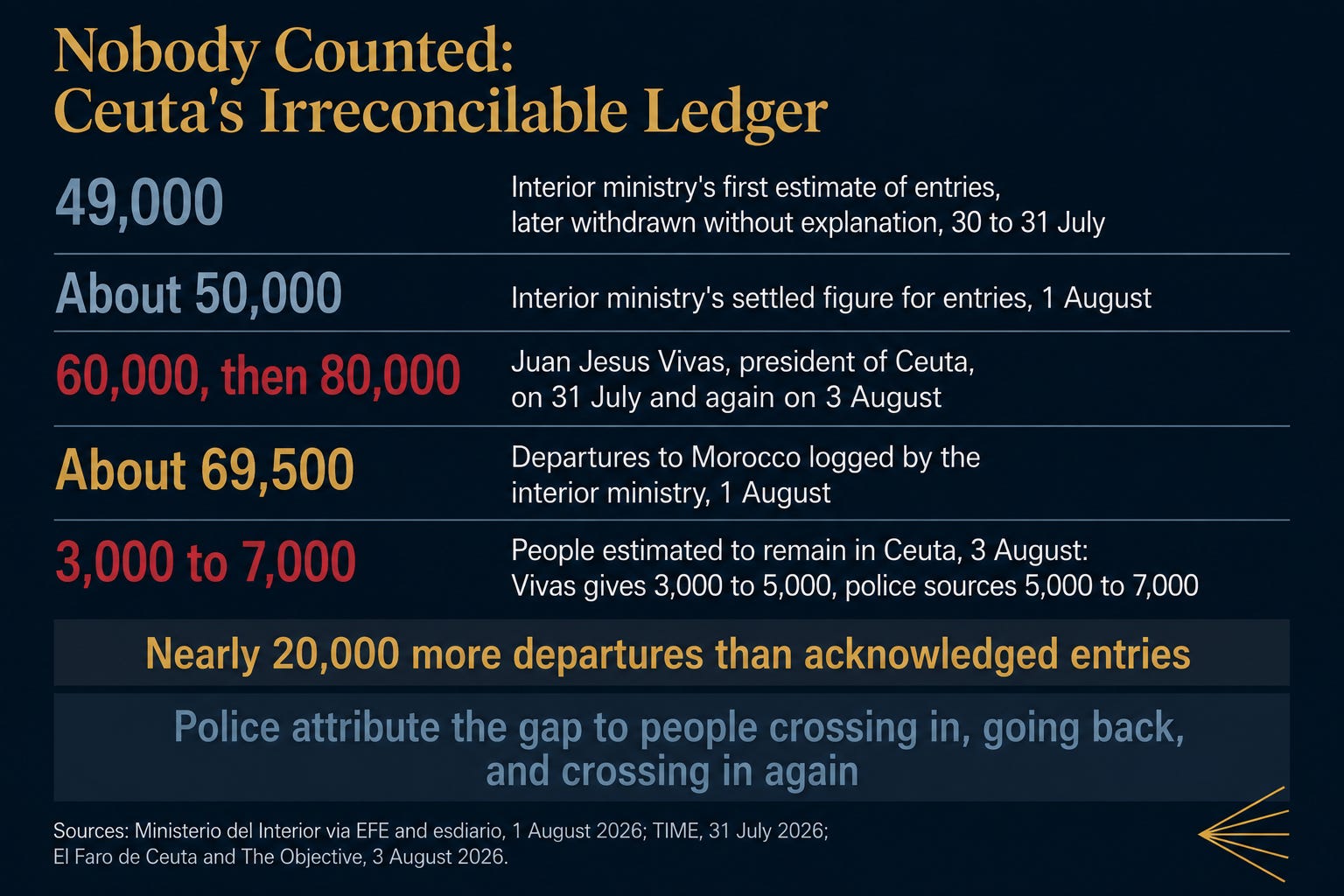
Thirty days later the crossings began. Between Wednesday 29 and Friday 31 July people swam the short water from Fnideq and Belyounech in numbers nobody has been able to fix: the interior ministry first estimated 49,000, withdrew the figure without explanation and settled on around 50,000, while Ceuta’s president Juan Jesus Vivas said 60,000 and by Sunday was saying 80,000. The Spanish government put the dead at at least seventy-two by 3 August, against eleven acknowledged by Morocco.
The exit figures are stranger than the entry figures. By 1 August the interior ministry had logged roughly 69,500 departures to Morocco against the fifty thousand entries it acknowledged, a gap of nearly twenty thousand that police attribute to people crossing in, going back to rest or to see family, and crossing in again. Which means the celebrated return rate is a tally of movements rather than of people, and nobody in Madrid or Rabat can say how many individuals were involved.
Three days after the crossings stopped, the barrier went into the water.
What generalises beyond one enclave is the mechanism rather than the drama. Since 29 June, a Spanish frontier at sea is defined by the presence of a physical object performing a material containment function, and objects can be bought.
Sanchez has no majority, eighty-one bills have sat stalled in the Congress since Junts walked out in November 2025, and he has governed by decree for a year. He did not need a law. He needed a chandlery order and a naval tender, and he had both inside seventy-two hours.
Which runs in both directions. A frontier defined by an object acquires specifications, and specifications are things a judge can measure. Nobody has yet asked in court whether a one metre skirt with a patrol channel cut through it contains anything at all, against a swimmer who can go under it or round the end.
There is a second problem, and the barrier cannot touch it.
Rejection at the border carries no destination of its own. It moves a person across a line into the hands of whoever stands on the far side, and it works only if that person is accepted. Morocco accepts Moroccans, as every state must accept its own nationals, through an arrangement with Spain that has never been written down. For anybody else there is a treaty from 1992, and the treaty is close to a dead letter.
So what Spain bought on Saturday morning was the right to handle next week differently. Last week solved itself, chaotically, in a churn of crossings nobody counted, and it left several thousand people behind who are now outside the fast machinery altogether. The purchase rests on two assumptions: that the object satisfies the definition, and that Rabat keeps standing on the other side.
The Deep Dive
The Spanish government’s stated legal basis for sending those people back is an agreement signed in Madrid on 13 February 1992. Its first article obliges each side’s border authorities to readmit, on formal request, nacionales de paises terceros who entered illegally from the other’s territory. Third-country nationals. The people crossing at Tarajal were overwhelmingly Moroccan, and Moroccans are the one nationality that opening line does not cover.
The gap is not a flaw in the returns. It is the reason they were possible. A state is obliged under general international law to receive its own nationals, so no instrument is needed and nothing has to be negotiated case by case. EuroMed Rights records that returns of Moroccans from Spain run on informal diplomatic cooperation, outside any treaty, and therefore outside parliamentary scrutiny and disclosure.
The 1992 agreement itself has barely been used. EuroMed Rights counts two applications in its entire life, 116 people on 23 August 2018 and 55 that October. Other reconstructions give a longer but equally thin history: three readmissions in 1995, forty-five in 1996, twenty-five in 1997, one in 1998, none between 1999 and 2003, seventy-three in 2005. The accounts contradict each other, which is itself the finding, because Spain has never published a consolidated record of the treaty’s use.
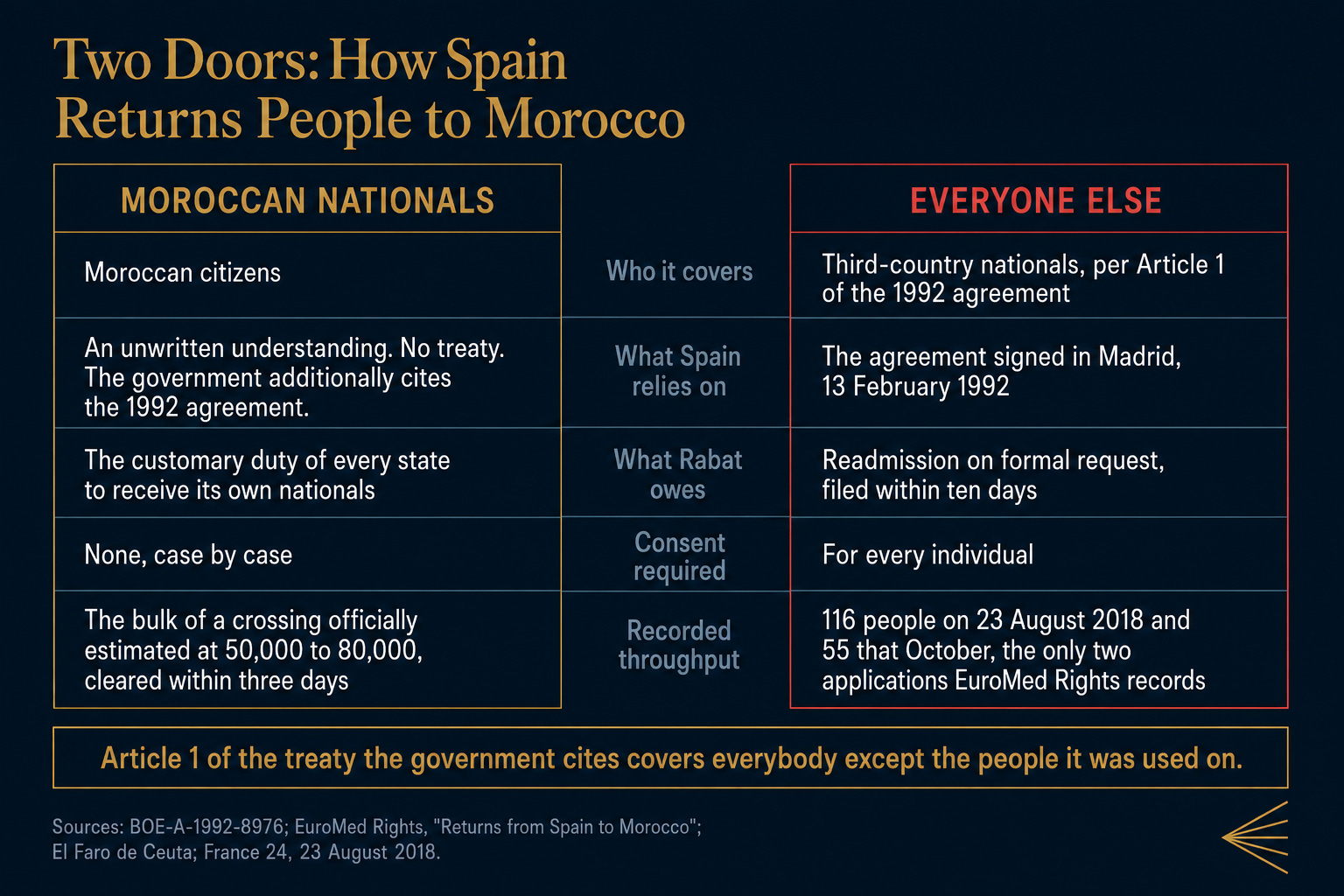
Set the two channels side by side and the asymmetry is total. Moroccan nationals leave through an unwritten understanding that asks nothing of Rabat beyond what customary law already requires, and it moves people at whatever rate the crowd moves. Everybody else leaves through a written treaty with a ten day filing window, individual Moroccan consent, and a documented throughput in the low tens of people per decade.
Which is why the composition of any future crossing decides everything, and why composition is a variable Morocco sets. The water starts at Fnideq and Belyounech, two small coastal towns reachable by road and policed by Moroccan security forces. When social media organised a crossing for 15 September 2024, Moroccan authorities reported intercepting 4,455 people in six days and published the breakdown: 3,795 Moroccan adults, 141 Moroccan minors and 519 foreign nationals. Rabat counts by passport in its communiques because it polices by passport on its roads.
None of that requires a decision in Rabat in July. It requires only that whoever reaches the Moroccan shoreline is a mix Moroccan policing shapes, which it observably is. Europe spent the week reading a flood, and what it was shown is that the flow has two settings, only one of which clears itself.
The second setting is already visible in Ceuta, in miniature. Vivas estimated on 3 August that between three and five thousand people remain, and police sources put it at five to seven thousand. Among them, according to the city’s presidency councillor Alberto Gaitan, are 862 unaccompanied minors in a child protection system with twenty-nine places. The adult reception centre holds 512 and was carrying more than seven hundred by 2 August, with roughly a thousand more sleeping outside it.
Twenty-nine places, eight hundred and sixty-two children. That is a category problem rather than a capacity problem, because minors cannot be summarily returned at all and Spain has already been told so. In a judgment of 22 January 2024 the Supreme Court held that the return of minors from Ceuta to Morocco in August 2021, carried out under a separate bilateral accord of 2007, was unlawful for want of any procedure and amounted to a collective expulsion prohibited by Article 4 of Protocol 4 to the European Convention.
Everyone still in Ceuta now falls under individualised removal with appeal rights and asylum access. Judicial sources quoted in the Spanish press put the timescale at months, and at two to three years where appeals or protection claims are lodged. The residue is the whole problem, and it was created at a scale of roughly five per cent of the crossing.
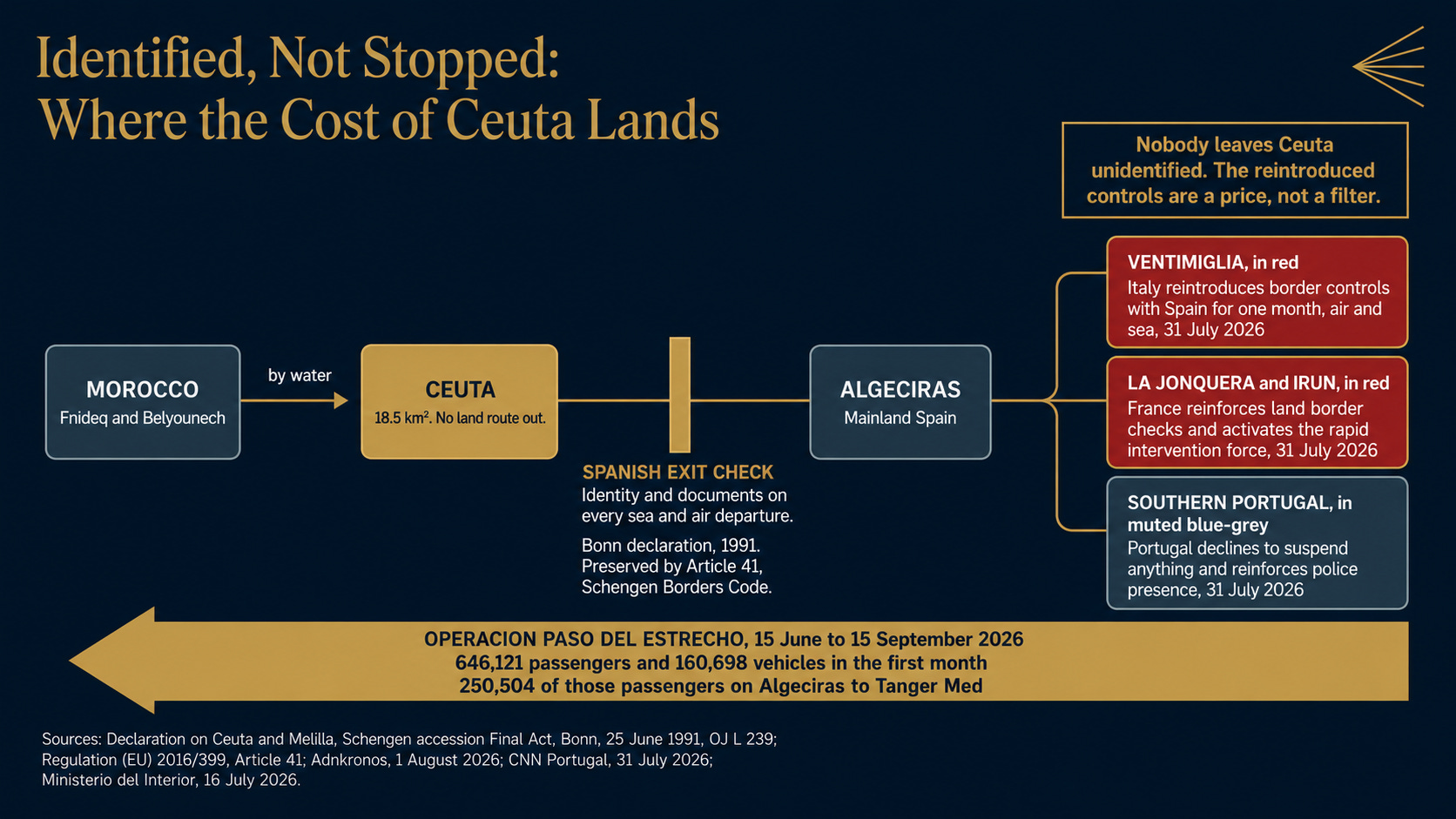
The reaction across Europe, meanwhile, is landing nowhere near the fence. Italy reintroduced border controls with Spain for one month at air and sea entry points, a measure Matteo Piantedosi described as important but precautionary and expressly available to member states, with free movement for EU citizens untouched. France’s interior minister Laurent Nunez reinforced checks at the land border on 31 July and activated the rapid intervention border force. Portugal’s prime minister Luis Montenegro refused to suspend anything and put more police on the southern frontier instead.
All three rest on the same premise, and the premise needs narrowing rather than dismissing. Since 1991, under the declaration Spain attached to its Schengen accession and preserved by Article 41 of the Schengen Borders Code, Spain has maintained identity and document checks on every sea and air departure from Ceuta and Melilla to the rest of its territory. There is no land route out.
Nobody leaves Ceuta unidentified.
So Rome is not policing an unknown flow. It is pricing what Madrid decides to do with people it has already identified, and the price is paid in freight and August traffic at Ventimiglia, La Jonquera and Irun. The exposure runs both ways, which is the part neither capital says out loud: Operacion Paso del Estrecho, running from 15 June to 15 September, carried 646,121 passengers and 160,698 vehicles in its first month alone this year, a quarter of a million of them on the Algeciras to Tanger Med route.
Underneath all of it sits Rabat’s own calendar. Legislative elections were fixed for 23 September by the Government Council in March, and Aziz Akhannouch announced in January that he will not stand. The statistical office put strict unemployment at 10.8 per cent in the first quarter of 2026, with 29.2 per cent among fifteen to twenty-four year olds and 38.0 per cent among urban young people. In the autumn of 2025 the GenZ 212 protests filled streets in more than twenty Moroccan cities, three people were killed at Lqliaa on 1 October, and more than 2,480 were prosecuted.
Against that background the instrumentalisation reading runs into trouble, and Spain’s own ministers keep walking it into more. Fernando Grande-Marlaska said the intelligence service gave no warning and that Morocco remains reliable, and Jose Manuel Albares praised Moroccan collaboration twice in three days. Moroccan forces used water cannon on their own citizens to break the crowds apart.
The most economical explanation is that a Contentious-Administrative judgment travelled through Moroccan social media as an invitation, and that 29.2 per cent did the rest. If that is right it is the harder case rather than the softer one, because a lever has an owner and an owner can be paid, while a viral reading of a Spanish court docket has neither. Which is also why Madrid answered with a purchase order rather than a phone call.
So price the next nine months on the state of the summary return power at Ceuta by 30 April 2027, sorted by whichever event settles it first. Blind chance would give each of four outcomes twenty-five per cent.
The base rate is not that Spain wins in court, because Spain has now lost twice, on the minors in January 2024 and on the swimmers in June 2026. The pattern is narrower and more useful: Spain loses on mechanism and re-engineers around the ruling faster than the ruling can bite. The 2015 law created summary rejection after the courts questioned the practice, and the barrier recreated its predicate thirty-three days after the Supreme Court removed it.
Which is why the leading path is the one where nothing is measured. No challenge reaches the barrier itself, only the individual returns behind it, the residue grinds through removal procedures for years, and smaller attempts in the autumn are turned back under a power nobody has tested. Spanish judicial timelines make that the default rather than an achievement: the swimmer’s case took nineteen months from incident to Supreme Court, the minors’ case took twenty-nine.
Fifty-two per cent, and if you are pricing Spanish political risk on the assumption that Ceuta forces a legislative crisis this autumn, that is the wrong crisis on the sheet. Not sixty-two, because three of the four alternatives carry dated catalysts and this one carries none. Not forty-two, because it requires nothing at all to happen. Track filings in the Ceuta contentious-administrative court that name the barrier rather than a person: none within a month, none within three, one or two by twelve.
Eighteen per cent belongs to the world where a judge measures the boom. The merits are strong, since the government and the Guardia Civil have both effectively conceded the barrier stops nobody, and a power triggered by a physical object invites an argument about that object’s specification. The 862 minors are the likelier vehicle than the adults, because their cases move faster and Spain has an adverse Supreme Court precedent sitting on exactly that ground. It sits below chance only because Spanish administrative litigation rarely produces a merits ruling inside nine months.
Your real exposure is the third path, and it is the one nobody is hedging. Madrid puts the buoys into statute, defining containment elements by law and taking the question away from the courts altogether. Sanchez cannot pass that with his own bloc, and he does not need to: the Partido Popular has already demanded a fast-track reform permitting maritime rejections at Ceuta and Melilla, and a decree-law convalidated on the right would do it.
Nineteen per cent, discounted below chance because the cost to Sanchez of legislating migration with Feijoo’s votes is close to terminal for his own coalition. The signal is the Congress calendar from September, and the first PSOE amendment to a Partido Popular text rather than a rejection of it.
The last path announces itself before it arrives, in weekly interception figures on the Moroccan side that stop falling. A second crossing at scale before any of the above settles would overtake the whole question, and it is the one Morocco has least reason to allow, with an election seven weeks away, an agriculture arrangement provisionally in force since October, a fisheries mandate still unused, and at least seventy-two of its own dead, which together is where the eleven per cent comes from.
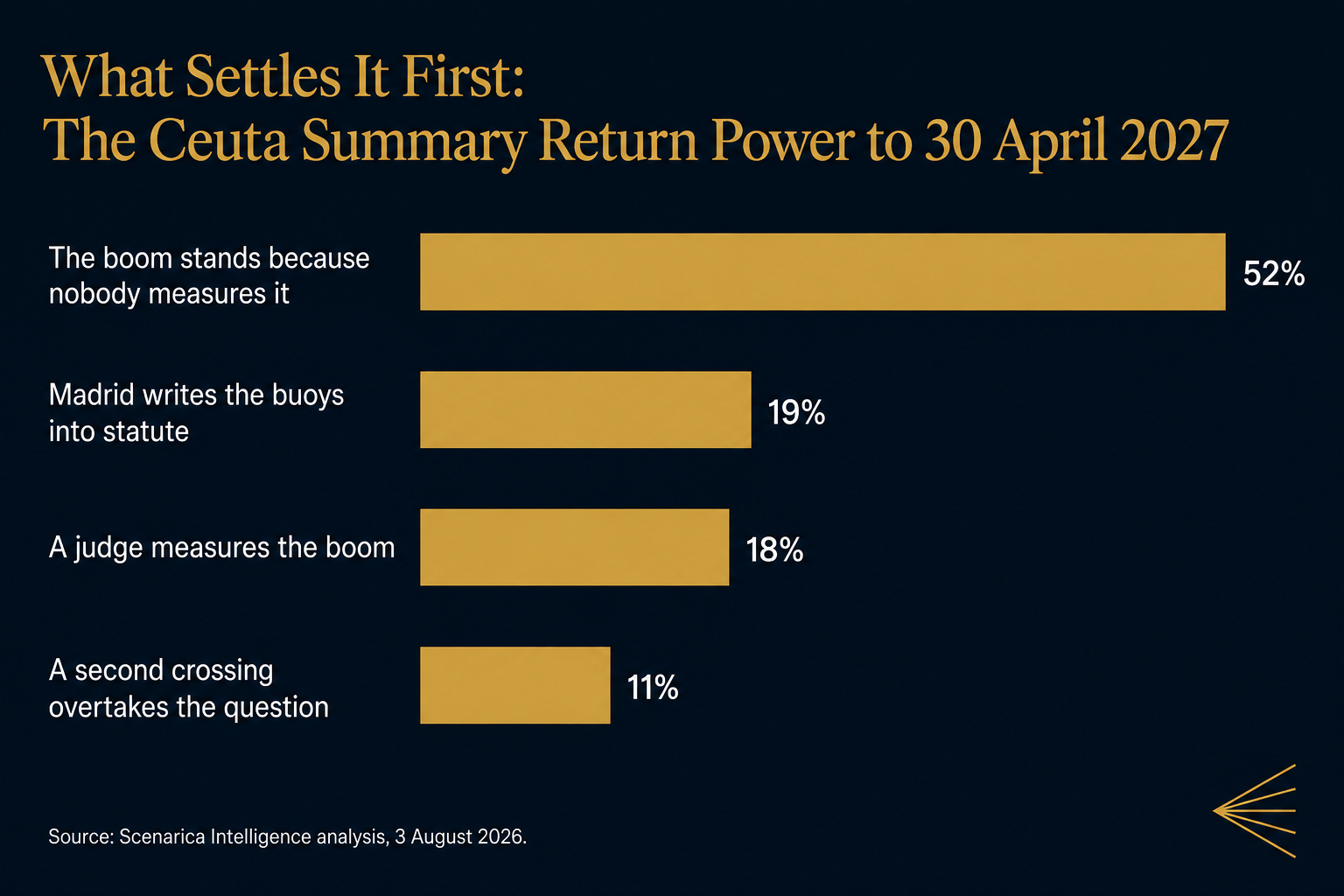
Those numbers move on evidence rather than mood. A single admitted challenge naming the barrier would move the second path above thirty and take the leader below fifty, and a PSOE decision to negotiate migration legislation with the Partido Popular would do the same to the third.
The confirming signals are dull and specific. If the Defensor del Pueblo opens an actuacion on the 862 minors within weeks and it produces recommendations rather than litigation, the leading path is intact. If Italy lets its one-month reintroduction lapse at the end of August rather than renewing it, Rome has decided the invoice has been paid. And if EU and Morocco fisheries talks finally open in the autumn, after a Council mandate granted in January that had produced no negotiations by mid-June, that is the price being settled on a file where nobody has to call it a price.
What would break the read is equally concrete. A Ceuta administrative court admitting a challenge to the barrier itself, rather than to the individual returns behind it, collapses the cheap solution and forces Madrid into the legislative fight it has been avoiding. Moroccan weekly interception data that stops falling in early September, with the campaign under way, would mean a second crossing is being prepared rather than avoided.
Europe’s external frontier now has specifications. Five hundred metres, thirty to seventy centimetres proud of the water, a metre down, with a gap in it for the patrol boats. Specifications are cheap to meet, which is the lesson every interior ministry on the Mediterranean took from Saturday morning. They are also, for the first time, something a judge can hold a tape measure against.
Sources:
Tribunal Supremo, Sala de lo Contencioso-Administrativo, Seccion Quinta, sentencia 814/2026 of 29 June 2026, recurso de casacion 3795/2025, ECLI:ES:TS:2026:2965; Consejo General del Poder Judicial press release of 8 July 2026, “El Tribunal Supremo confirma que la ley no permite las devoluciones en caliente de los migrantes que pretenden entrar a nado en Ceuta y Melilla.”
Tribunal Supremo, judgment of 22 January 2024, ECLI:ES:TS:2024:114, on the unlawful return of minors from Ceuta to Morocco in August 2021.
Tribunal Constitucional, STC 172/2020 of 19 November 2020, and STC 13/2021, on the regimen especial de Ceuta y Melilla.
EFE, via naiz and Infobae, 1 and 2 August 2026, on the installation of the containment barrier and on approximately 69,500 departures from Ceuta.
Vozpopuli, “Asi es la barrera maritima que ha puesto Espana en Ceuta,” 1 August 2026, for the barrier’s dimensions.
Telemadrid, “Asi es la linea de boyas instalada en Ceuta como barrera de contencion,” 1 August 2026.
Euronews, “El sistema de boyas en Ceuta no frenara a los inmigrantes pero si permitira su expulsion directa,” 1 August 2026.
El Debate, 2 August 2026, for Rachid Sbihu of the Asociacion Unificada de Guardias Civiles on the barrier.
esdiario, 1 August 2026, on the interior ministry’s 69,500 departures against 50,000 acknowledged entries.
TIME, “Why Thousands of Moroccan Migrants Crossed Into the Spanish Exclave Ceuta,” 31 July 2026, on the withdrawn 49,000 estimate.
El Faro de Ceuta, on the government’s reliance on the 1992 agreement, and “Vivas estima que aun quedan entre 3.000 y 5.000 inmigrantes en Ceuta,” 3 August 2026.
The Objective, 3 August 2026, on police estimates of the remaining population and on judicial timescales for individualised returns.
Infobae, 2 August 2026, on the CETI’s 512 places and on the twenty-nine places in Ceuta’s unaccompanied minors system; Cadena SER, 3 August 2026, for Alberto Gaitan on 862 minors sheltered.
Al Jazeera, “Migrant deaths in Ceuta rise to 72 after border surge from Morocco,” 2 August 2026; Euronews, 3 August 2026, on the death toll.
Acuerdo entre el Reino de Espana y el Reino de Marruecos relativo a la circulacion de personas, el transito y la readmision de extranjeros entrados ilegalmente, signed Madrid 13 February 1992, BOE-A-1992-8976; definitive entry into force 21 October 2012, BOE-A-2012-15050.
EuroMed Rights, “Returns from Spain to Morocco,” on the treaty’s recorded use and on informal returns of Moroccan nationals; cuartopoder, 24 August 2018, and eldiario.es for the competing reconstructions of its history.
France 24, 23 August 2018, on the readmission of 116 people.
Declaration by the Kingdom of Spain on the cities of Ceuta and Melilla, Final Act to the Agreement on the Accession of the Kingdom of Spain to the 1990 Schengen Implementing Convention, Bonn, 25 June 1991, OJ L 239, 22 September 2000; Regulation (EU) 2016/399, Article 41.
Adnkronos, 1 August 2026, for Matteo Piantedosi on Italy’s reintroduction of controls; CNN Portugal, 31 July 2026, for Luis Montenegro’s refusal to suspend Schengen; Al Jazeera and Euronews, 31 July 2026, for Laurent Nunez and the French measures.
Yabiladi and Morocco World News, September 2024, on Moroccan interceptions at Fnideq between 11 and 16 September 2024.
Ministerio del Interior, “La Operacion Paso del Estrecho supera los 640.000 pasajeros y 160.000 vehiculos embarcados durante su primer mes,” 16 July 2026.
Haut-Commissariat au Plan, labour market situation for the first quarter of 2026, published 5 May 2026, on the new EMO2026 series.
Hespress, 5 March 2026, on the 23 September 2026 legislative elections, and January 2026 on Aziz Akhannouch.
Council of the European Union, document ST 10711/2026, 17 June 2026, on the EU-Morocco fisheries negotiating mandate.
Infobae and El Espanol, 31 July and 2 August 2026, for the demands of Alberto Nunez Feijoo and Santiago Abascal.
Disclaimer: This report is published by Scenarica Intelligence for informational purposes only. It does not constitute investment advice, a solicitation to buy or sell any financial instrument, or a recommendation regarding any particular investment strategy. Scenarica Intelligence is not a registered investment adviser or broker-dealer. All scenario probabilities and assessments represent the analytical judgment of Scenarica Intelligence and are subject to change without notice. Past performance of any asset or strategy discussed does not guarantee future results. Readers should conduct their own due diligence and consult with qualified financial advisers before making investment decisions.
Scenarica Premium: The full Scenarica suite includes Geopolitics, Economy, Bitcoin, AI, and Sunday Edition.
Scenarica Intelligence
We don’t predict the future. We price it.