

The Energy War
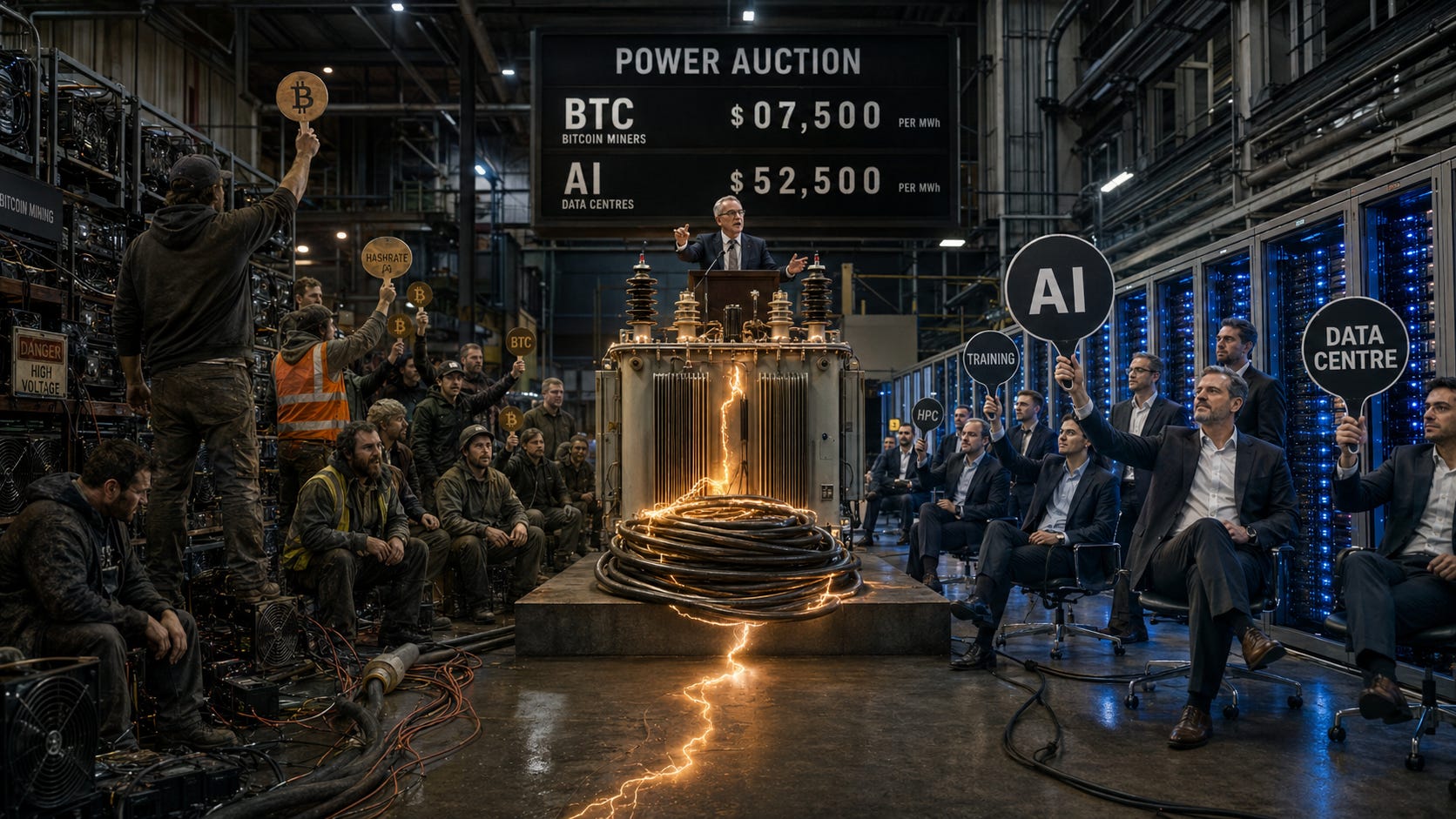
The two most energy-hungry industries on earth are fighting over the same power sources. Bitcoin is losing.

A single Bitcoin now requires 209 megawatt-hours of electricity to mine, roughly twenty years of average US household consumption compressed into the production of one digital asset. The global network burns approximately 175.9 terawatt-hours annually, more than Poland, more than Argentina, approximately 0.5 percent of all electricity generated on earth.
That energy was once cheap enough to make mining profitable. It is no longer cheap enough to win a bidding war.
Global data centre electricity consumption surged from 460 TWh in 2022 to a projected 1,000 TWh in 2026, with AI accounting for nearly forty percent of that demand. AI training clusters are willing to pay three to five times more per megawatt-hour than Bitcoin miners, backed by multi-year contracts with creditworthy counterparties: Microsoft, Google, Amazon. AI hosting offers eighty to ninety percent operating margins with fixed USD revenue. Mining offers volatile returns from a deflationary block reward that halves every four years.
The economic logic is decisive. A rational infrastructure owner given the choice between hosting AI workloads and mining Bitcoin chooses AI every time. The mining industry has chosen accordingly.
Over $70 billion in cumulative AI and high-performance computing contracts have been signed across the public mining sector. CoreWeave’s expanded deal with Core Scientific is worth $10.2 billion over twelve years, TeraWulf has $12.8 billion in contracted HPC revenue, and Hut 8 signed a $7 billion, fifteen-year lease for AI infrastructure at its River Bend campus. AI and HPC could account for seventy percent of revenue for transformed miners by year-end 2026.
The hashrate tells the story of what is leaving. Bitcoin’s network peaked at approximately 1,045 exahashes per second in October 2025, then fell roughly ten percent to 850 EH/s by early February 2026. It has partially recovered to approximately 1,004 EH/s but remains below the peak. The decline was the first Q1 hashrate drop in six years.
The 2024 halving cut block rewards from 6.25 to 3.125 BTC, halving mining revenue overnight. With production costs near $88,000 per Bitcoin and the spot price around $80,000, margins are negative for most operators. Only industrial miners with sub-$0.045 per kWh contracts in Texas, Paraguay, Iceland, or Oman remain viable as pure miners. Everyone else is pivoting or shutting down.
The geographic competition reinforces the pattern. Texas is both the largest mining hub in the US and the fastest-growing data centre market. Nordic countries with cheap hydro and the Middle East with cheap gas attract both miners and AI companies. In every geography where Bitcoin miners found cheap power, AI companies are arriving with deeper pockets and longer contracts.
The security question sits at the end of this trajectory. Bitcoin’s proof-of-work model requires sufficient hashrate to make a fifty-one percent attack economically irrational. At 1,000 EH/s, such an attack would cost over $10 billion in hardware and electricity. But the hashrate has already declined from its peak, and the economic forces driving that decline are structural, not cyclical.
The irony is precise. The AI industry is simultaneously threatening Bitcoin’s mining economics and rescuing Bitcoin miners from bankruptcy: without AI contracts, many facilities would have shut down entirely after the halving. But once a facility is reconfigured for AI hosting, it does not switch back to mining. Every contract signed is mining capacity that exits the Bitcoin network permanently.
Bitcoin’s proof-of-work security model was designed for a world where cheap electricity had no better use than mining. That world no longer exists. AI has given cheap electricity a higher-value application, and the question is whether Bitcoin’s price can rise fast enough to keep mining competitive, or whether the energy war has a structural winner that no price rally can overcome.
The thirty-five percent base case is managed coexistence: miners concentrate in regions with the cheapest stranded energy where AI companies have not yet expanded, and hashrate stabilises between 800 and 1,000 EH/s. A twenty-five percent scenario sees AI winning the energy war decisively, with hashrate declining to 500 to 600 EH/s by 2028 as the majority of infrastructure pivots. A twenty-five percent scenario has Bitcoin’s price appreciation compensating, making mining profitable even at higher energy costs. The fifteen percent tail risk is a security crisis where hashrate declines to levels where fifty-one percent attack feasibility enters mainstream discourse.
ANNEX: THE ENERGY AUCTION
Bitcoin mining and AI data centres are competing for the same scarce resource: cheap, reliable electricity at scale. The four scenarios below, summing to 100%, map how this competition reshapes Bitcoin’s hashrate, security model, and mining economics over the next three to five years.
Managed coexistence: 35%
If you believe miners will find niches that AI cannot reach, this is the scenario where Bitcoin’s security survives the energy war intact. Miners concentrate in regions with stranded energy: remote hydro sites, flared natural gas, geothermal in Iceland, excess solar in the Middle East. These locations lack the fibre connectivity, cooling infrastructure, or grid reliability that AI data centres require. Hashrate stabilises at 800 to 1,000 EH/s, and network security remains robust.
The variable to watch is the geographic distribution of new mining deployments. If miners are establishing operations in locations where data centre construction is impractical, the coexistence thesis is forming. Probability of hashrate remaining above 800 EH/s through 2028: 40%.
AI wins the energy war: 25%
If you believe the economic advantage of AI hosting is decisive and permanent, this is the scenario that erodes Bitcoin’s security margin over time. Hashrate declines to 500 to 600 EH/s by 2028 as the majority of mining infrastructure pivots to AI. The 2028 halving triggers a further wave of mining exits. Bitcoin’s security remains technically sufficient at these levels but the margin of safety narrows considerably.
The variable to watch is the rate of AI contract announcements by publicly listed miners. If cumulative AI contracts exceed $100 billion by end of 2027, the pivot is accelerating beyond the point of reversal. Probability of hashrate declining below 600 EH/s by 2028: 20%.
Bitcoin price compensates: 25%
If you believe Bitcoin’s price appreciation will outpace the energy bidding war, this is the scenario where mining remains competitive. At $150,000 or above, mining is profitable even at elevated energy costs. Institutional adoption, regulatory clarity, and structural demand drive price high enough to retain miners and attract new entrants. Hashrate recovers and sets new highs despite AI competition.
The variable to watch is Bitcoin’s price relative to mining production cost. If price sustains a twenty percent or greater premium above average production cost for two consecutive quarters, mining economics are healthy regardless of AI competition. Probability of Bitcoin sustaining above $120,000 through 2027: 25%.
Security crisis: 15%
If you worry about the long-term viability of proof-of-work in a world where AI outbids miners for energy, this is the tail risk. Hashrate declines below 300 EH/s, a credible fifty-one percent attack cost assessment is published, and Bitcoin’s price declines on security fears, creating a negative feedback loop. This scenario requires both sustained hashrate decline and Bitcoin price stagnation, making it unlikely but structurally possible if the energy war and a prolonged bear market coincide.
The variable to watch is published security analyses of fifty-one percent attack costs at various hashrate levels. If credible researchers publish feasibility assessments below current hashrate, the security discourse shifts. Probability of hashrate declining below 300 EH/s by 2030: 10%.
Sources:
CoinDesk, “Bitcoin Miners Are Becoming AI Companies and Selling Their BTC to Fund the Transition,” March 27, 2026.
CoinDesk, “Bitcoin Hashrate Posts First Quarter Drop in Six Years as Miners Pivot to AI,” March 30, 2026.
CoinShares, “Bitcoin Mining Report Q1 2026,” 2026.
BlockEden, “Bitcoin’s First Q1 Hashrate Drop in Six Years: How the AI Pivot Is Rewriting Mining,” May 4, 2026.
CoinDesk, “Bitcoin Miners Are Losing $19,000 on Every BTC Produced as Difficulty Drops 7.8%,” March 22, 2026.
Digiconomist, Bitcoin Energy Consumption Index, 2026.
PANews, “Bitcoin 2026 Insights: The Decline of Mining, the Rise of AI, and a Structural Migration,” 2026.
Disclaimer: This report is published by Scenarica Intelligence for informational purposes only. It does not constitute investment advice, a solicitation to buy or sell any financial instrument, or a recommendation regarding any particular investment strategy. Scenarica Intelligence is not a registered investment adviser or broker-dealer. All scenario probabilities and assessments represent the analytical judgment of Scenarica Intelligence and are subject to change without notice. Past performance of any asset or strategy discussed does not guarantee future results. Readers should conduct their own due diligence and consult with qualified financial advisers before making investment decisions.
Scenarica Premium: The full Scenarica suite includes Geopolitics, Economy, Bitcoin, AI, and Sunday Edition.
Scenarica Intelligence
We don’t predict the future. We price it.