

The Fading Flinch
War returned to the Gulf and oil barely moved. The calm is the dangerous part.


The tanker was still burning in the shipping lanes east of the Strait of Hormuz when the only number that mattered stopped moving. On the morning of July 8, United States aircraft struck roughly ninety targets across Iran, Donald Trump declared the two-month ceasefire over, and Iranian missiles answered against three Gulf states. Somewhere inside that sequence, a second Gulf war in a single year quietly became a fact.
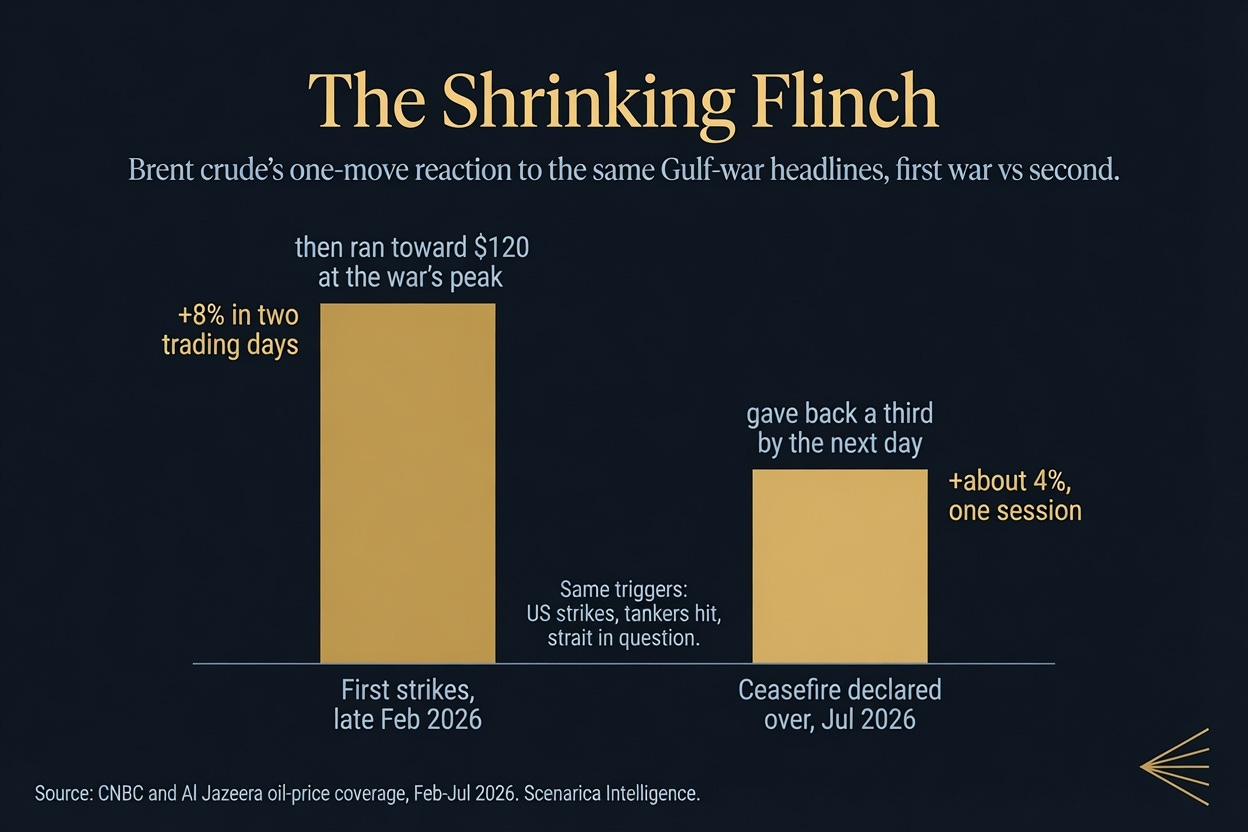
And on the screens where the world prices a barrel of oil, Brent ticked up about four percent, held the move for a day, and handed a third of it back by Thursday.
That is the story. Not the ninety targets, not the smoke off the strait. The story of this week is how little the price cared.
Rewind five months. When the first strikes landed at the end of February, the same headlines, American bombers over Iran, tankers alight, the world’s most important chokepoint in question, moved Brent eight percent in two trading days and then kept climbing, all the way toward one hundred and twenty dollars a barrel at the peak of the war. This time the market flinched for a single session and went back to its book, settling comfortably inside the seventy-five to eighty-five dollar band that analysts had already drawn for the summer.
A market that stops reacting to a war gets described in flattering terms. Mature. Calm. Having priced the risk. Reach for whichever word you prefer. What actually happened is that traders learned something across the first war, and the thing they learned is correct, which is precisely what makes it dangerous.
They learned three lessons. Flows survive: even at the height of the fighting, crude kept moving through the strait, because a full closure strangles Iran’s own exports and its own customers before it touches anyone else. Bypass exists: Saudi Arabia and the United Arab Emirates can route several million barrels a day around Hormuz through pipelines to the Red Sea and to Fujairah, a pragmatic piece of plumbing built by pragmatic states for exactly this contingency. And the politics deflate on cue: within hours of calling the ceasefire dead, Trump was talking the temperature back down, telling reporters he did not think the war would restart, and the tape took him at his word.
Every one of those lessons is true. Assemble them and you get a reaction function that shrinks a little each time it is tested. The first crisis is a shock. The second is a rerun the audience has already seen. By the third, the market barely turns its head toward the screen.
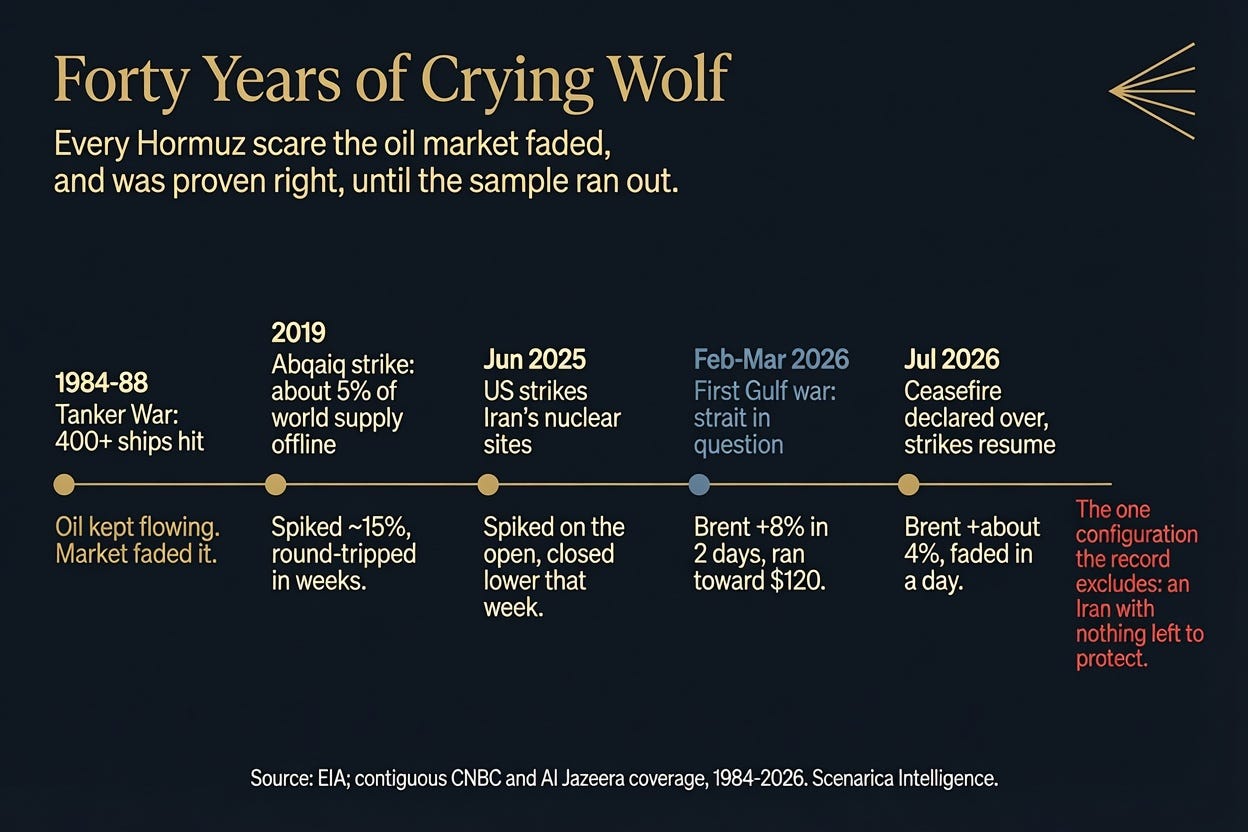
None of this is new behaviour, which is exactly what makes it seductive. The market faded the Tanker War of the 1980s, when Iran and Iraq struck hundreds of vessels and the oil flowed anyway. It faded the 2019 strike that knocked out a large share of Saudi processing capacity for a fortnight, then watched the barrels come back. It faded the June 2025 strikes on Iran’s nuclear sites, when crude spiked on the open and closed lower inside the same week. Each time, the calm was vindicated, and each vindication taught the reflex to fire a little faster.
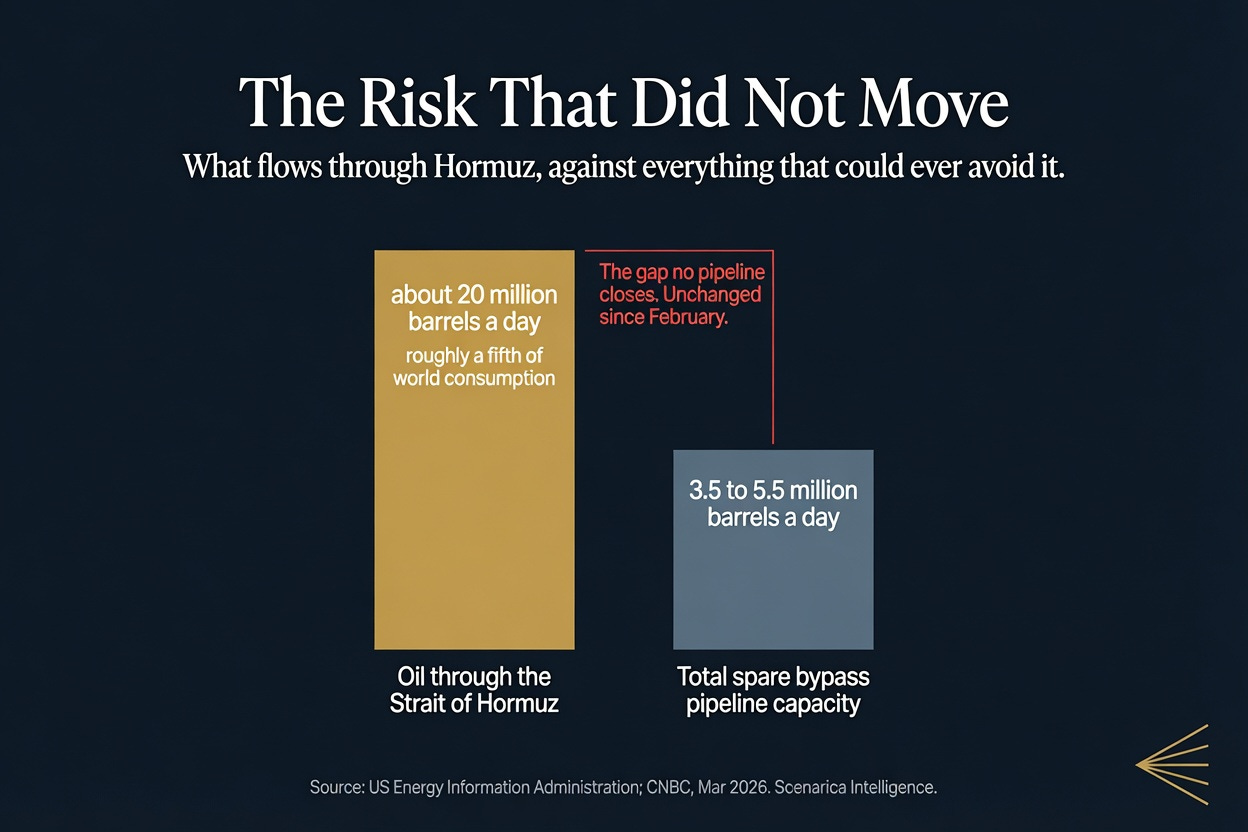
Here is what did not fade. Roughly twenty million barrels a day still pass through a channel about twenty-one nautical miles wide at its narrowest point, close to a fifth of everything the world burns. The combined spare capacity of every pipeline ever built to go around it sits somewhere between three and a half and five and a half million barrels a day. The distance between what moves through the strait and what could ever avoid it has not narrowed by a single barrel. The tankers are the same size, the channel is the same width, the alternatives are the same handful of pipelines running near capacity. Only the price premium that used to guard that gap has changed, and it has quietly bled out.
So here is the turn, and it is not the reassuring kind. The market is not wrong that the strait has always reopened. It is wrong to let that record set the price, because the first thing a shrinking reaction function destroys is the warning. When Brent ran toward one hundred and twenty dollars in March, the price was doing real work: it screamed that something rare and violent might be underway, and it pulled capital, attention, and hedging toward the danger. A price that merely shrugs performs none of that labour.
The premium and the peril have come apart. The physical odds that a shooting war eventually shuts the strait for real are, if anything, higher today than in February, because this time the tankers are actually being hit rather than merely threatened. The priced odds have fallen toward a rounding error. That space, between a risk premium that is fading and a physical risk that has not moved, is the most dangerous position in global commodities right now, and almost no one is being paid to sit in it.
The market has watched this movie twice and stopped buying tickets. The trouble is that the showing which ends differently is the one the theatre is emptiest for, and the exits are exactly as narrow as they always were.
A quieter oil market did not become a safer one this week. It became a market that has trained itself not to look up.
The Deep Dive
What remains is the arithmetic the flat-price move hid. How a war premium is really an option, and what the market has quietly done to the price of that option. Who is exposed by a premium that no longer warns them, three steps down a chain almost nobody is tracing. Where the forty-year habit of fading Hormuz finally breaks, and why the base rate everyone leans on excludes the exact situation now on the table. And which of four outcomes the next quarter most likely delivers, priced against a tape that has half stopped pricing at all.
Begin with what the geopolitical premium actually is, because the word premium hides the machinery. It is not a mood or a headline tax. It is the same object an insurer sells: a probability multiplied by a payoff. The probability is the market’s estimate that the strait, or a serious slice of its throughput, goes offline for a meaningful stretch. The payoff is how far oil travels if it does. Strip out demand, inventories, and the dollar, and what is left in the price is an option on closure, and an option is worth less the moment the market marks down the odds of the event that would pay it out.
That is the gearing the flat-price calm obscures. Every crisis the strait survives is a data point the market feeds back into its estimate, and each one lowers the implied probability of the next closure. After the first war reopened the strait on schedule, the implied odds fell. This second time, the muted four percent pop that gave back a third of itself implies the market now assigns something close to single-digit odds to a genuine multi-week disruption over the horizon that matters. The reaction function did not just shrink. It re-rated the entire distribution toward calm.
Now weigh the other side of the option, the payoff, which has not shrunk at all. Suppose Hormuz throughput fell by even a quarter, roughly five million barrels a day. That single quarter is larger than every barrel of spare bypass capacity in the region combined. There is no pipeline, no strategic release, and no OPEC spare that replaces it inside the weeks that would matter, which means the price would not have to clear at eighty-five dollars. It would have to rise until it destroyed five million barrels a day of demand, and demand destruction on that scale does not happen in the eighties. March supplied the lower bound: Brent ran toward one hundred and twenty on fear alone, without a single day of genuine sustained closure. A real one starts near there and keeps going.
The obvious objection is that the strait has never actually closed, so the option is worth close to nothing. But an option whose underlying risk is still live carries value even when it has never paid out, and marking it to zero is not prudence, it is a short volatility position wearing the costume of common sense. The market has, in effect, sold the closure option down to almost nothing while the thing it insures against sits fully intact. Cheap insurance on an unchanged risk is not a bargain. It is the mechanism that quietly transfers wealth from the many who stopped paying attention to the few who did not.
Trace who is standing under that gap, because the exposure runs further than the oil desks. Crude is the single most important geopolitical input to headline inflation, which makes the war premium an early-warning system that central banks rely on without ever admitting it. When the premium moved, it did the monetary authority’s flinching in advance, pricing a supply shock before it arrived and giving the rate path time to bend. A premium that no longer moves strips that lead time out. A Gulf shock that finally lands would then arrive not as a slow build the curve had time to absorb, but as an inflation surprise dropped into a market positioned for calm, and surprises are precisely what force central banks into the abrupt, credibility-bruising moves they most want to avoid.
One step down from the central bank sits the corporate treasurer, and this is where the compression bites first. Hedging the tail costs carry, and carry is hard to defend to a board when the screen is flat and the last two scares came to nothing. So the treasurer who bought Gulf protection in March and watched it expire worthless after the April ceasefire is, right now, being told by every incentive to let the hedge lapse. The desensitised premium makes the protection look overpriced at the exact moment the underlying risk is richest. Multiply that one decision across every airline, every refiner, and every industrial buyer running the same arithmetic, and the system as a whole is quietly getting shorter the tail just as the tail fattens.
Then there is the tell the flat-price calm is hiding, and it lives in the insurance market rather than the futures market. War-risk underwriters do not price the barrel. They price the ship, and a hull that takes a missile is a total loss whether or not the strait technically stays open to traffic. So while flat-price desensitised, the war-risk rate for a Gulf transit answers to a different question, one that cannot pretend the tankers are not burning, because the tankers are the collateral. If Lloyd’s listed-area rates for Hormuz climb while Brent sits still, that divergence is not noise. The underwriters and the futures market are pricing two different wars, and the underwriters are the ones who have to pay when the ship is actually hit.
The habit of fading all of this is genuinely well earned, which is why it deserves to be taken apart carefully rather than mocked. Run the record. The Tanker War of 1984 to 1988 saw more than four hundred vessels attacked, and the oil kept moving, because both Iran and Iraq needed the export revenue too badly to choke the route entirely. The 2019 Abqaiq strike removed something like five percent of world supply in an afternoon, spiked crude around fifteen percent, and round-tripped within weeks once the repairs held. June 2025 delivered strikes on Iran’s nuclear program and a same-week reversal lower. The base rate of a Hormuz scare resolving without a sustained closure is, on this sample, close to one.
But look at what every entry in that sample shares, because it is the one thing the current situation may not. In each case, the party with its hand on the strait had something it was protecting. The Tanker War combatants needed the revenue. Abqaiq was an infrastructure accident, not a decision, and Saudi Arabia raced to reverse it. The 2025 episode ended because both sides still wanted an off-ramp. The configuration the forty-year base rate does not contain is an Iran that has already absorbed the strikes, already forfeited the export revenue, and comes to see closing the strait as the last coercive card it holds rather than an asset it must preserve. That is a different regime entirely, and a base rate assembled exclusively from situations where the closer had something to lose does not price the situation where it has almost nothing left. The market is extrapolating from a sample that carefully excludes the exact scenario now sitting on the table.
Which is why the next quarter does not resolve into a single forecast but into four genuinely different worlds, separated not by how loud the war gets but by which force ends up setting the price. Hold that distinction, because it is the one the escalation-obsessed coverage keeps missing.
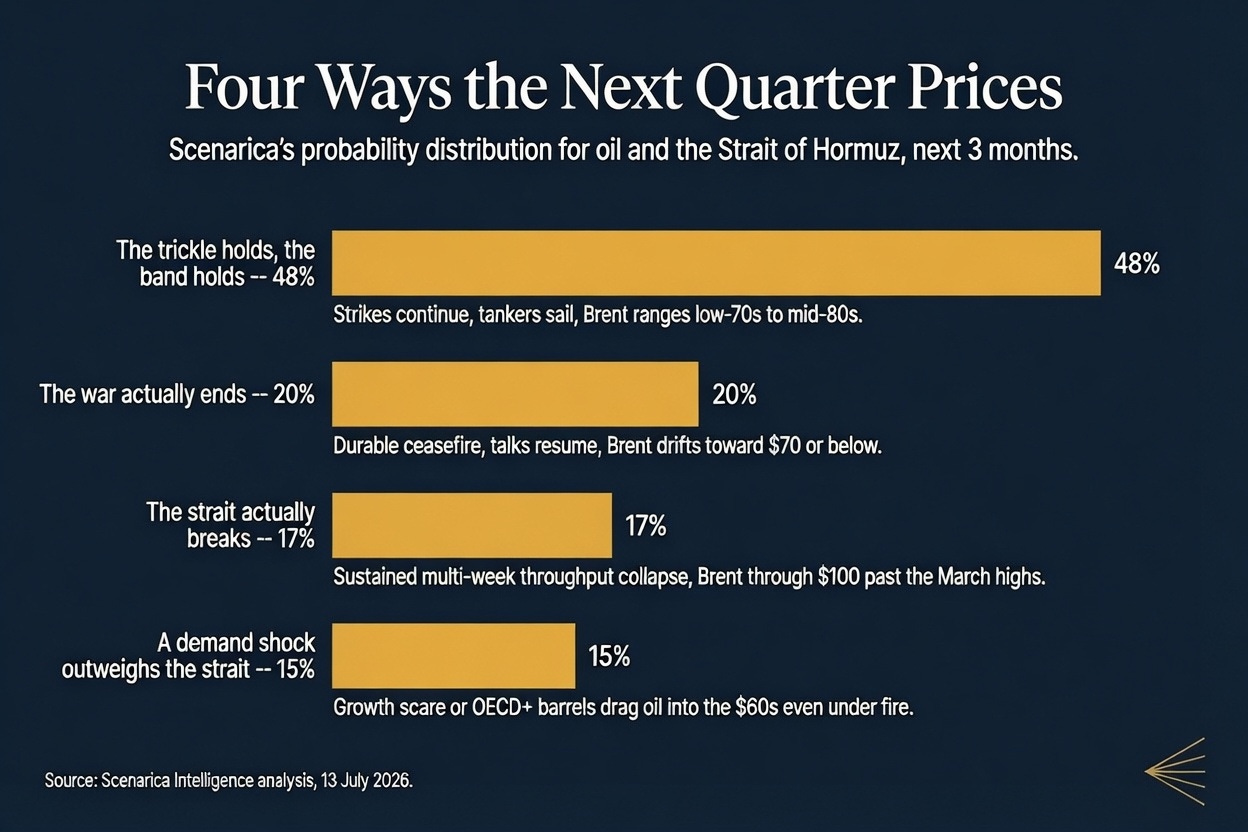
Start with the world the tape is already living in. Strikes come intermittently, tankers keep sailing under a fatter war-risk rate and some quiet rerouting, and Brent oscillates inside a band that runs from the low seventies to the mid eighties. Nothing breaks, nothing resolves, and the market’s calm is vindicated a fourth time. This is the path the whole weight of history points at, and it is why, if you are running a crude book or a corporate hedge, the base case you are already modelling is probably the right one: roughly forty-eight percent, anchored by the same three lessons the market learned, by Iran’s own interest in keeping the export taps open, and by the pipeline bypass that gives the system a partial floor. Your tracked variable is daily throughput. As long as Kpler and Vortexa show Hormuz flows holding above roughly fifteen million barrels a day, this world stays intact across the one-month and three-month horizons, though the band widens the further you push toward twelve months and the war grinds on.
If you unwound your protection in April, the second world is the one that rewards you, and it is also the one you should not lean on. A durable ceasefire takes hold, the postponed diplomatic channel reconvenes, the premium bleeds out completely, and Brent drifts back toward seventy dollars or below as the war is filed away as a scare that passed. This carries perhaps twenty percent, and the reason it is not higher is written into the recent record: the first ceasefire held for exactly two months before the tankers were burning again. Watch the diplomatic calendar rather than the battlefield, because a confirmed return to talks before the end of July is the signal that this path is opening, and its silence is the signal that it is closing.
Then there is the world where the strait loses its grip on the price from the other direction entirely. A global growth scare, or an OPEC+ decision to put more barrels on the water, drags oil down into the sixties even as missiles keep flying, and the geopolitical input that used to dominate the tape is simply drowned out by demand and supply doing what they were always going to do. Fifteen percent belongs here, and it is not a footnote, because it is the erosion thesis running in reverse: proof that the strait is losing its power to move the market whichever way the news breaks. The confirming signal is an OPEC+ meeting that adds supply into a live shooting war, a decision that would have been unthinkable a decade ago and is merely plausible now.
And then there is the world the compressed premium is no longer carrying at all. Iran, stripped of the revenue and the off-ramp, moves from harassing tankers to genuinely denying the strait, mining, swarming, or sinking enough tonnage to collapse throughput for weeks rather than hours. No bypass covers the hole, the payoff side of the option detonates, and Brent tears through one hundred dollars toward the March highs and past them, because this time the move is not fear, it is fact. Assign this seventeen percent. That number sits below the twenty-five you would get from pure chance across four outcomes, and it should, because a sustained intentional closure has genuinely never happened and deserves respect for never having happened. But seventeen sits far above the single-digit odds the market’s shrug is actually pricing, and that distance is the entire trade. The affirmative case for a number this high, rather than the rounding error the tape implies, is specific: the tankers are already being struck, and Iran’s incentive to preserve the route weakens with every barrel of export income the strikes take from it.
What moves these numbers is not the volume of the fighting but the identity of the force in control. A throughput series that holds tells you the first world is winning. A war-risk rate that climbs while flat-price sleeps tells you the underwriters have started pricing the fourth world before the futures market will admit it. A diplomatic reopening pulls weight toward the second world, an OPEC+ supply surprise toward the third. The escalation everyone is watching is the least informative variable in the entire set.
So watch these, in the order they are likely to speak. The next OPEC+ meeting, when the group convenes at the start of August, will reveal whether the supply cushion the market is quietly leaning on is real or rhetorical, and a decision to add barrels into a live war would tell you the producers see slack the price does not. Over the next two to four weeks, track Gulf war-risk insurance rates and Lloyd’s listed-area notices, because if hull cover climbs while Brent stays flat, the money on the physical side is pricing a war the paper side is still ignoring. On the tankers themselves, a sustained fall in Hormuz throughput below roughly fifteen million barrels a day for more than a handful of days, visible on tracking data long before it reaches a headline, is the first hard evidence the trickle equilibrium is cracking. On the diplomacy, whether the postponed United States and Iran channel reconvenes before the end of July will tell you if the second world is genuinely in play or merely hoped for. And on the politics, the thirty-day window into mid-August is the test of whether Trump’s promise that the war will go very quickly means a decisive end or an open-ended campaign that keeps the tankers in range.
The tanker off Hormuz will stop burning in a day or two, the way the last one did, and the one before that. The market will file it with the others and go back to its book, calm, mature, having priced the risk, which is the phrase it now uses for having decided to stop watching. Keep the receipt. The next time the screen barely moves is not evidence the danger has passed. It is only evidence that the audience has learned to sit very still while the reel runs, in a theatre nobody thought to widen the exits of, waiting on the one showing that does not end the way the others did.
Sources:
U.S. Energy Information Administration, “Amid regional conflict, the Strait of Hormuz remains critical oil chokepoint,” 2025.
U.S. Energy Information Administration, “World Oil Transit Chokepoints,” 2025.
CNBC, “The two oil pipelines helping Saudi Arabia and UAE bypass the Strait of Hormuz,” March 12, 2026.
Al Jazeera, “Saudi, UAE, Iraq: Can three pipelines help oil escape Strait of Hormuz?” March 27, 2026.
CNBC, “A timeline of how the Iran war shook oil prices and what comes next,” April 21, 2026.
Al Jazeera, “Oil surges as US strikes Iran, reversing return to pre-war prices,” July 8, 2026.
NBC News, “Oil prices surge, stocks slide after Trump says Iran ceasefire is ‘over’,” July 8, 2026.
Axios, “Oil jumps after Trump’s Iran ceasefire comments,” July 8, 2026.
The Washington Post, “Trump warns Iran that US is preparing for more strikes after saying ceasefire is over,” July 7, 2026.
CNBC, “Oil prices ease after spiking over fresh U.S. strikes against Iran,” July 9, 2026.
CNN, “Ceasefire with Iran hangs in the balance. Can the US ever deliver a knockout blow?” July 9, 2026.
Disclaimer: This report is published by Scenarica Intelligence for informational purposes only. It does not constitute investment advice, a solicitation to buy or sell any financial instrument, or a recommendation regarding any particular investment strategy. Scenarica Intelligence is not a registered investment adviser or broker-dealer. All scenario probabilities and assessments represent the analytical judgment of Scenarica Intelligence and are subject to change without notice. Past performance of any asset or strategy discussed does not guarantee future results. Readers should conduct their own due diligence and consult with qualified financial advisers before making investment decisions.
Scenarica Premium: The full Scenarica suite includes Geopolitics, Economy, Bitcoin, AI, and Sunday Edition.
Scenarica Intelligence
We don’t predict the future. We price it.
I think the war premium has moved to a different place. Insurance premiums and/or spot freight rates. It’s also in the risk assessments of the shipping companies and not in the financial markets anymore. That makes things more tricky, but in a way is expected when the markets are not performing a totally free price discovery.