

The Ghost Patient
Surgical robots now train on patients who bleed and breathe. Those patients were never born.

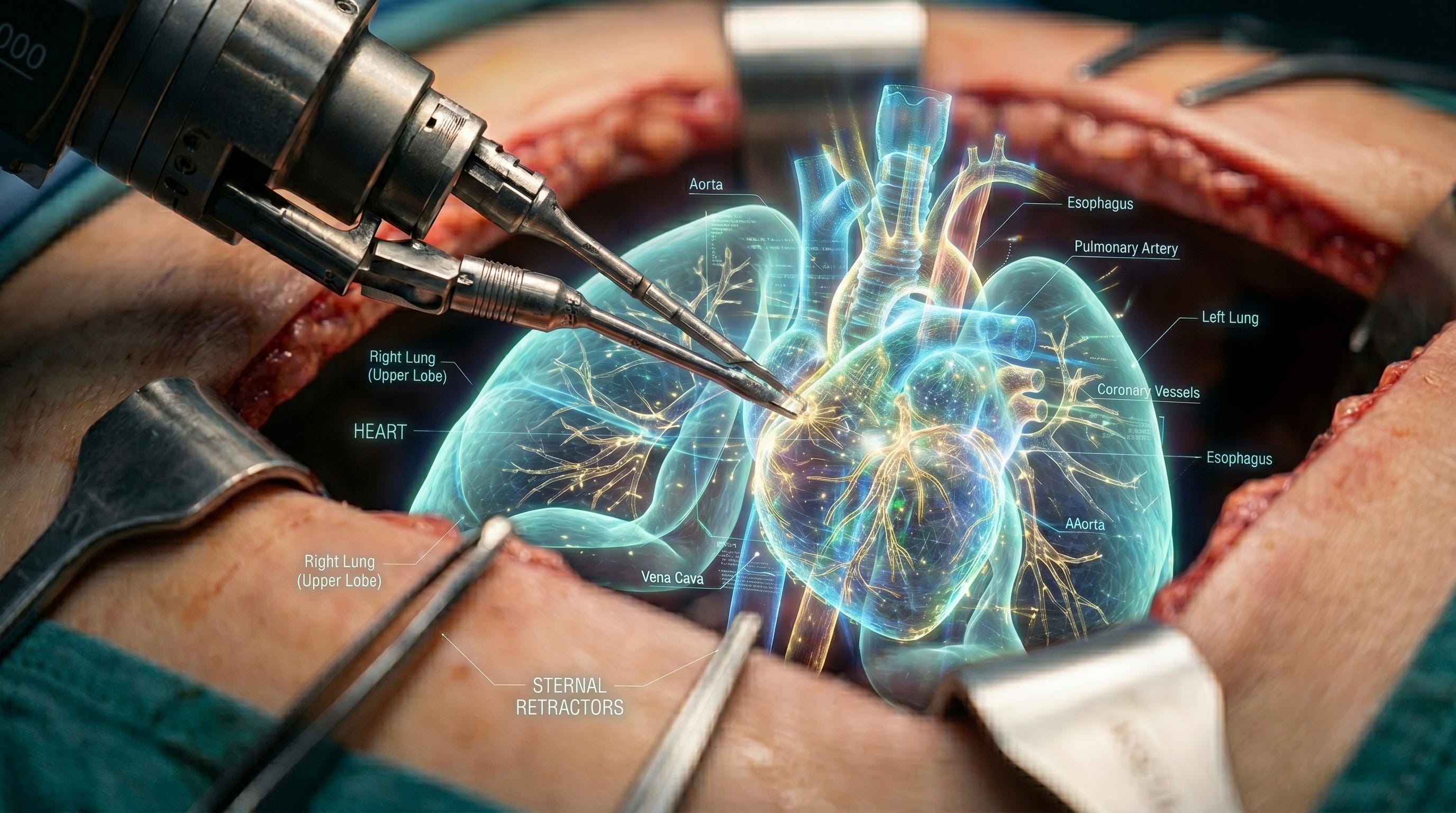
The gallbladder was giving her trouble. Lena Okonkwo leaned closer to her monitor in a windowless lab on the second floor of a converted mill building in Cambridge, the kind of room where the ceiling pipes were older than the computers beneath them, and watched a surgical robot peel tissue from a liver bed with the particular slowness of a difficult dissection. Inflammatory adhesions had fused the gallbladder wall to surrounding structures. The cautery smoke drifted across the camera view exactly the way it does in a real operating room, thinning as it rose, catching the light of the laparoscope. The tissue bled in small, convincing pulses when the instrument pressed too hard.
Lena had been reviewing surgical video for three years. She worked for a small medtech company building machine learning models for the CMR Versius surgical robot, and she knew what real surgery looked like the way a film editor knows what real footage looks like, not from performing it but from studying every pixel of hundreds of procedures. This video looked real. She had to remind herself: it was not. The patient on her screen had never been born.
Forty minutes earlier, she had typed a clinical descriptor into a configuration file: “Cholecystectomy, moderate adhesions, Versius platform.” She uploaded a computer-generated render of the initial surgical field and fed the model a kinematic sequence, 44 numbers per timestep encoding the precise coordinates of the robot’s end-effector poses and gripper commands. What came back was not a rendering or a diagram. It was ninety-two frames of photorealistic surgical video in which tissue responded to every instrument with the micro-hesitations and resistances she had spent three years learning to recognise in real operating room footage.
The model that produced it is called Cosmos-H-Surgical. NVIDIA unveiled it at GTC in San Jose on March 16, 2026, alongside a companion dataset and a vision-language-action model designed to work together as a training pipeline for surgical robotics. Cosmos-H-Surgical is fine-tuned from Cosmos Predict 2.5 2B, a 2-billion-parameter world foundation model that has learned to predict what happens next in a physical environment given a set of initial conditions and a sequence of actions. The surgical version was trained on the Open-H-Embodiment dataset: 778 hours of surgical robotics video contributed under a Creative Commons license by 35 organisations, spanning five tiers of realism from pure digital simulation to video captured during 400 actual human procedures. CMR Surgical alone contributed roughly 500 hours.
Give the model a first frame and a kinematic sequence, and it generates what the surgery would look like if the robot performed those actions on a real patient. The physics are not perfect. Lena found artefacts at the edges of the frame and occasional moments where the tissue behaved with a plasticity that felt slightly wrong. But the fidelity was high enough that the machine learning models she was training downstream could not distinguish the synthetic video from the real footage in her hand-curated library.
The model’s unification across nine different robotic platforms is what makes the implications systemic rather than incremental. Previously, each surgical robot required its own training pipeline. A model trained on da Vinci footage was useless for Versius procedures, because the robots have different kinematics, different instrument geometries, different camera perspectives. Cosmos-H-Surgical collapses this by encoding all robot behaviour as standardised 44-dimensional action vectors. The model has learned not what a specific robot looks like when it operates, but what surgery looks like when any robot operates. NVIDIA is positioning itself as the shared foundation layer beneath every surgical robotics company, an operating system for simulated flesh.
The companies are already building on it. Johnson and Johnson MedTech is using Cosmos-based models to generate training data for its MONARCH Platform in urology. CMR Surgical is feeding its footage back into the Open-H-Embodiment dataset and using Cosmos-H to generate synthetic rollouts for policy evaluation. Proximie is building vision-language models that combine operating room images with surgical video, using Cosmos-H to fill the gaps where real data does not exist. PeritasAI has partnered with AdventHealth and Zimmer Biomet to train humanoid robots for sterile instrument handling, rehearsing coordination in synthetic environments before a physical robot enters a real theatre.
Lena ran 600 rollouts of her suturing algorithm in 40 minutes of simulation time. The same test on her lab’s physical benchtop, using silicone tissue phantoms and a real Versius robot, would have taken two full days. The cost difference was sharper still. Two days of benchtop testing ran close to 8,000 pounds when she added equipment, personnel, and consumables. The 600 synthetic rollouts ran on cloud A100 hardware. At current spot pricing, the compute bill came to less than a hundred pounds. For two decades, surgical AI development had been locked behind a single bottleneck: access to real data. Every minute of usable training video required a real patient, a real surgeon, a real operating room, and the months of institutional review board approval that precede any study involving human tissue. Data was the moat. Cosmos-H-Surgical moves the moat.
On rollout 147, something happened that Lena did not expect. The model generated an anatomy she had never seen in three years of reviewing real surgical video: a gallbladder with an unusually short cystic duct positioned at an angle that partially obscured the common bile duct. It was the kind of anatomical variation that, in a real operating room, can lead to a bile duct injury, one of the most feared complications in laparoscopic surgery. Her algorithm handled it poorly. The robot hesitated, then clipped tissue it should not have clipped.
She paused the video and sat with a question she could not resolve. Was this a real anatomical variation that the model had learned from the 778 hours of training data, an edge case buried in one of the 400 clinical procedures? Or was it a hallucination, a tissue configuration the neural network had invented by interpolating between real anatomies it had seen? If it was real, the ghost patient had just taught her something that three years of reviewing actual surgical footage had not. If it was invented, she was training her robot to handle a complication that does not exist in human bodies.
She could not tell. The model does not label its edge cases as real or imagined. It generates tissue with the same statistical confidence whether the anatomy comes from a pattern in the data or from the latent space between patterns. Some of the dreams are memories. Some of them are inventions. The model does not distinguish between the two, because in every measurable dimension, there is nothing to distinguish.
This is the threshold Lena is watching cross. The constraint on surgical AI development has not disappeared. It has moved. The question is no longer how much real data you can collect. It is how good your generative model is at capturing the physics of tissue, blood, and instrument interaction. And that question carries a shadow: how do you validate a training environment whose accuracy you cannot independently verify for cases you have never observed in life?
NVIDIA has drawn a deliberate line. The Cosmos-H-Surgical model card states that the system is “not intended for clinical diagnostic purposes.” The model generates synthetic data for training other models. It does not guide a surgeon’s hand. But the models trained on its output will eventually guide surgical robots, and the quality of their decisions will trace directly to the fidelity of the synthetic training data. If a surgical AI system makes an error that originated in a flawed synthetic scenario, the chain of responsibility runs through multiple organisations: the company that deployed the AI, the team that trained it, and NVIDIA, whose foundation model generated the tissue the robot learned to cut.
The FDA’s current framework was not designed for this kind of layered responsibility. The agency has approved more than 1,350 AI-enabled devices as of early 2026, but none were trained primarily on synthetic data generated by a world foundation model. Meanwhile, Medtronic’s Hugo and CMR’s Versius Plus have both received FDA 510(k) clearance in the past year, Intuitive’s Da Vinci 5 carries 10,000 times the on-board compute of its predecessor with force feedback at the instrument tip, and new categories of surgical data are entering training pipelines faster than the regulatory architecture can absorb them.
The most probable outcome, Scenarica assigns it 35 percent, is that synthetic data from models like Cosmos-H-Surgical becomes the primary training source for surgical AI within three to four years. If you work in medical device development, your competitive advantage is about to shift from who has the most hospital partnerships to who has the best foundation model access. Real surgical video will still matter, but as validation data, not training data. The 778-hour seed dataset becomes the raw material. The model does the manufacturing.
There is a more cautious version of this future, and Scenarica puts it at 25 percent. In this world, regulatory agencies require minimum thresholds of real-world validation data before granting clearance to any surgical AI system. If you are a surgeon or a hospital administrator, this scenario preserves the value of clinical experience. The ghost patient is useful but not sufficient. The institution with thousands of real surgical cases still has something the startup with a GPU cluster does not.
Then there is the regulatory friction path, at 20 percent. The FDA and international regulators impose strict requirements on synthetic data provenance, quality validation, and chain-of-custody documentation. Proving that synthetic training data meets the standard of real clinical data becomes so expensive that the cost advantage narrows to nothing. If you run a surgical AI company, this scenario extends your timelines and favours competitors with deep regulatory expertise over competitors with deep compute budgets.
Two narrower paths complete the picture. A 12 percent probability that the major surgical robotics companies, Intuitive, Medtronic, and Johnson and Johnson, develop proprietary foundation models optimised for their own platforms, fragmenting the market into competing synthetic data ecosystems. And at 8 percent, the scenario the industry discusses only in private: the combination of high-fidelity synthetic training and next-generation haptic data accelerates the timeline for semi-autonomous surgical procedures. Within five years, specific low-risk steps like suturing and tissue retraction are performed autonomously under surgeon supervision. The ghost patient becomes not just a training tool but the proving ground for the autonomous surgeon.
What would shift these probabilities? Two signals above all others. An FDA guidance document with permissive language on synthetic training data pushes the synthetic dominance scenario above 40 percent overnight. Intuitive Surgical announcing a proprietary foundation model, rather than partnering with NVIDIA, pushes platform fragmentation from 12 to 25 percent and restructures the entire competitive landscape.
Watch for the FDA’s updated guidance agenda on AI-enabled medical devices, expected before Q4 2026. Any language addressing synthetic training data provenance will be the first regulatory signal for whether the ghost patient enters the clearance pathway or remains outside it.
CMR Surgical’s deployment timeline for Cosmos-H-trained models in clinical Versius Plus settings will be the first commercial test of whether synthetic training translates to real surgical performance. The company’s rate of contribution to the Open-H-Embodiment dataset, measured in hours per quarter, will indicate how seriously the industry treats the shared-data model.
Intuitive Surgical’s next major platform announcement will reveal whether the company intends to build on NVIDIA’s foundation layer or compete with it. A proprietary foundation model trained on Intuitive’s unmatched library of real surgical data would be the strongest signal that platform fragmentation is the leading path.
The first peer-reviewed study benchmarking synthetic versus real training data for surgical AI accuracy will be the empirical threshold moment. If synthetic-trained models match or exceed the performance of models trained on real data, the economics of surgical AI development change permanently.
The Open-H-Embodiment dataset itself is the barometer. At 778 hours and 35 contributing organisations at launch, its growth rate will tell you whether the industry is converging on a shared standard or fragmenting behind proprietary walls. Watch the contributor count more than the hour count.
Lena closed the tab on rollout 147. She had work to do: the algorithm needed retraining, the edge case needed documentation, and somewhere in the latent space of a 2-billion-parameter model, more ghost patients were waiting to be generated. She would produce another 600 of them before lunch.
What struck her was not the strangeness. It was how quickly the strangeness had become routine. Three years of collecting surgical video, negotiating IRB protocols, and hand-labelling tissue planes frame by frame, and a model had learned to do in 40 minutes what her entire team could not do in a quarter. The ghost patient is not a shortcut. It is a curriculum, broader, faster, and more varied than anything a human surgical career could accumulate. Whether that curriculum is truthful enough to trust with a life is a question no model card can answer. The answer will come from operating rooms, from regulatory agencies, from the first generation of surgical AI systems trained predominantly on patients who never existed. The ghost patient does not die on the table. The ghost patient does not have a family in the waiting room. And somewhere in a converted mill building in Cambridge, a robotics engineer has stopped asking whether the tissue on her screen was real, because for the machine she is building, the question no longer matters.
ANNEX: WHAT HAPPENS WHEN SURGERY LEARNS FROM PATIENTS WHO NEVER EXISTED
Scenarica identifies five scenarios for the next three to four years of synthetic surgical training data, summing to 100 percent. The question facing Lena and every surgical AI developer is which path the industry takes from the threshold it just crossed.
Synthetic Dominance: 35%
If you work in surgical AI, the next three years will feel like a phase change. Synthetic data generated by world foundation models becomes the primary training source, and real surgical video shifts to a validation role. Your competitive advantage migrates from hospital partnerships and IRB access to foundation model architecture and compute infrastructure. NVIDIA’s shared layer becomes the default. Companies that once guarded proprietary surgical video libraries discover that the moat has not just moved but dissolved. Startups with GPU budgets and model expertise enter surgical AI without ever setting foot in an operating room. The cost of training a surgical policy drops by an order of magnitude, and the pace of iteration accelerates from quarterly release cycles to weekly.
The variable to track is the ratio of synthetic to real training data in FDA submissions for surgical AI devices. If any submission filed before Q2 2027 lists synthetic data as the majority training source, this scenario is materialising. At one month, Scenarica estimates a 15 percent probability that such a submission has been filed. At three months, 25 percent. At twelve months, 50 percent.
Hybrid Equilibrium: 25%
If you are a surgeon, a hospital administrator, or a patient, this scenario preserves something you care about: the primacy of real clinical experience. Regulatory agencies require minimum thresholds of real-world validation data for any surgical AI seeking clearance. Synthetic data supplements real data, compressing development timelines and expanding edge-case coverage, but it does not replace the hard-won institutional knowledge embedded in thousands of hours of real surgical footage. The institutions with the deepest clinical partnerships, Intuitive chief among them, retain their data advantage. The ghost patient is a useful training partner but not a sufficient one. You still need a real operating room to prove your system works.
The variable to track is FDA clearance conditions for surgical AI devices. If the next clearance requires a specific ratio of real-to-synthetic validation data, this scenario gains probability mass. At one month, a 10 percent chance such a condition appears. At three months, 20 percent. At twelve months, 40 percent.
Regulatory Friction: 20%
If you run a surgical AI company with a lean regulatory team, this scenario is the one that keeps you up at night. The FDA and the EU’s MDR framework impose strict requirements on synthetic data provenance: chain-of-custody documentation, statistical validation against real-world benchmarks, and independent auditing of generative model fidelity. The cost of proving synthetic data meets the regulatory bar approaches the cost of collecting real data in the first place. Your 40-minute, 100-pound simulation advantage narrows to a modest efficiency gain buried under compliance overhead. Development timelines extend by 12 to 18 months. Companies with deep regulatory expertise and established FDA relationships gain advantage over pure compute players.
The variable to track is the appearance of draft FDA guidance specifically addressing synthetic training data for AI-enabled medical devices. At one month, a 5 percent probability. At three months, 15 percent. At twelve months, 35 percent. A draft guidance with restrictive provenance language would shift this scenario from 20 to 30 percent probability overnight.
Platform Fragmentation: 12%
If you are a health system evaluating surgical robotics vendors, this scenario means vendor lock-in extends from hardware to the AI training layer. Intuitive, Medtronic, and Johnson and Johnson each develop proprietary foundation models optimised for their own platforms. The industry fragments into competing synthetic data ecosystems rather than converging on NVIDIA’s shared standard. Your da Vinci-trained AI cannot transfer insights to a Hugo system. Cross-platform interoperability, the promise of NVIDIA’s 44-dimensional action vector abstraction, dies in the competitive trenches. Surgeons trained on one system’s synthetic curriculum cannot carry that experience to another.
The variable to track is whether Intuitive Surgical announces a proprietary surgical world foundation model. At one month, a 5 percent probability. At three months, 10 percent. At twelve months, 25 percent. A single announcement from Intuitive would shift this scenario from 12 to 25 percent and restructure the competitive landscape entirely.
Autonomy Acceleration: 8%
If you are a patient scheduled for surgery in 2030, this scenario changes what happens when you are wheeled into the operating room. High-fidelity synthetic training data, combined with next-generation haptic feedback and force-sensing instruments, compresses the validation timeline for semi-autonomous surgical procedures. Specific low-risk steps, suturing closed an incision, retracting tissue during a dissection, are performed autonomously under surgeon supervision within five years. The ghost patient is no longer just a training partner. It is the proving ground on which the autonomous surgeon earned its credentials, having encountered more edge cases in a week of synthetic rollouts than a human surgeon encounters in a decade of practice. The liability question becomes acute: who is responsible when the autonomous system was trained entirely on patients who never existed?
The variable to track is preclinical trial announcements for semi-autonomous surgical procedures using foundation-model-trained policies. At one month, a 2 percent probability. At three months, 5 percent. At twelve months, 15 percent. The first such announcement, likely from NVIDIA in partnership with a major surgical robotics company, would shift this scenario from 8 to 15 percent and trigger immediate regulatory attention.
Sources:
NVIDIA, “Cosmos-H-Surgical: Learning Surgical Robot Policies from Videos via World Modeling,” ArXiv 2512.23162.
Open-H-Embodiment Project, open-h.github.io, March 2026.
NVIDIA, “The First Healthcare Robotics Dataset and Foundational Physical AI Models for Healthcare Robotics,” Hugging Face Blog, March 2026.
NVIDIA, “GTC 2026: Live Updates on What’s Next in AI,” NVIDIA Blog, March 16, 2026.
CMR Surgical, “CMR Surgical Advances Physical AI to Support the Future of Robotic Surgery with NVIDIA,” GlobeNewswire, March 17, 2026.
MedTech Dive, “CMR Surgical gains FDA clearance for new robot,” December 2025.
MedTech Dive, “Medtronic’s Hugo surgical robot earns FDA clearance,” December 2025.
Johnson and Johnson MedTech, “Johnson and Johnson to Advance Robotics Development with NVIDIA Isaac for Healthcare,” press release, October 2025.
Proximie, “Global Healthtech Proximie Advances the Intelligent Operating Room of the Future With NVIDIA,” BusinessWire, April 2026.
Peritas AI, “Peritas AI and AdventHealth Partner to Test AI and Humanoid Robotics in Support of Surgical Care,” March 2026.
Medical Design and Outsourcing, “The Intuitive da Vinci 5’s 10,000x computing leap,” 2025.
Spheron Network, “GPU Cloud Pricing 2026: H100 from $1.03/hr, B200 from $2.12/hr,” June 2026.
Disclaimer: This report is published by Scenarica Intelligence for informational purposes only. It does not constitute investment advice, a solicitation to buy or sell any financial instrument, or a recommendation regarding any particular investment strategy. Scenarica Intelligence is not a registered investment adviser or broker-dealer. All scenario probabilities and assessments represent the analytical judgment of Scenarica Intelligence and are subject to change without notice. Past performance of any asset or strategy discussed does not guarantee future results. Readers should conduct their own due diligence and consult with qualified financial advisers before making investment decisions.
Scenarica Premium: The full Scenarica suite includes Geopolitics, Economy, Bitcoin, AI, and Sunday Edition.
Scenarica Intelligence
We don’t predict the future. We price it.