

The Great Pivot
The miners who secure Bitcoin took billions in AI debt. The door back to mining is welded shut.

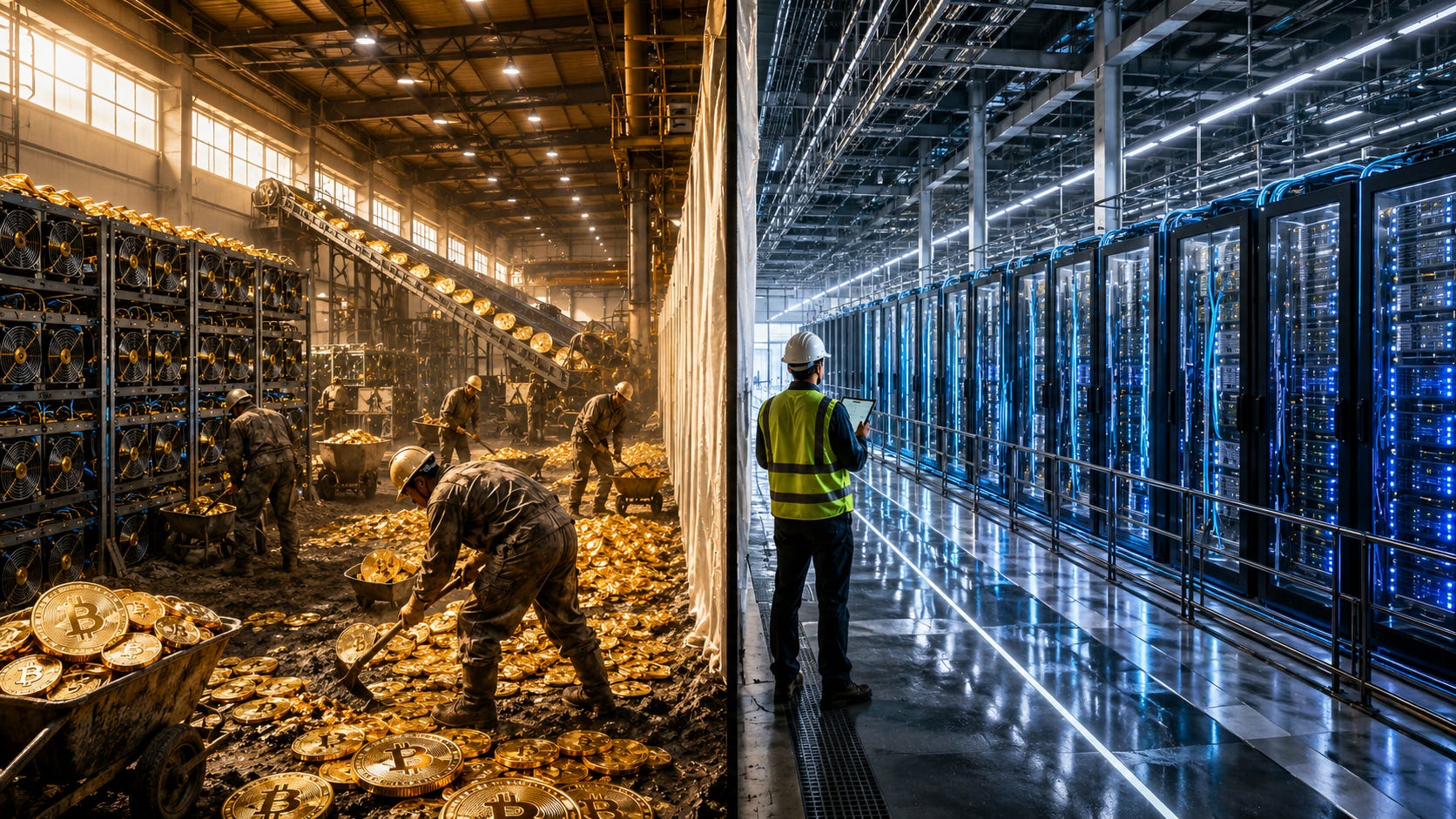
On the 576-acre freehold site in Childress, Texas, where IREN operates a 750-megawatt campus connected directly to the ERCOT grid, the shipping containers arriving through the spring of 2026 did not carry Antminer S21 units. They carried NVIDIA GB300 GPUs, 76,000 of them, each one a piece of silicon designed to train artificial intelligence and incapable of mining a single Bitcoin. The liquid cooling systems being installed alongside them, the fibre optic networking, the enterprise data centre certifications, all of it was purpose-built for one customer: Microsoft, under a $9.7 billion contract that IREN signed in November 2025. The facility was built to mine Bitcoin. It now exists to serve AI.
The conversion at Childress is not an anomaly. It is the physical expression of a structural shift that became measurable on Saturday, when Bitcoin’s mining difficulty dropped approximately 10 percent at block height 953,568. The adjustment brought difficulty from roughly 139 trillion to 126 trillion, the second major decline of 2026, following an 11.16 percent drop in February. If the magnitude holds, it ranks among the largest negative difficulty adjustments in Bitcoin’s sixteen-year history.
The network’s total hashrate has fallen to approximately 979 exahashes per second, dropping below the psychologically significant 1 zettahash threshold for the first time since early 2025. In the second quarter of 2026, hashrate declined 5.8 percent, marking the first quarterly hashrate drop in six years. The sharpest short-term drawdown since China banned Bitcoin mining in 2021.
The economics explain the departure. Hash price, the standard metric for mining revenue per unit of computational power, has fallen to its lowest level since 2018, below $30 per petahash per second per day according to CoinShares’ Q1 2026 mining report, down from a peak of $63 in July 2025. The weighted average cash cost of producing one Bitcoin reached approximately $79,995 in the fourth quarter of 2025, per the same report. With Bitcoin trading near $63,500, listed miners are losing roughly $16,500 on every coin they produce.
CoinShares estimates that 15 to 20 percent of the global mining fleet, any machine below an Antminer S19 XP class running at electricity costs above six cents per kilowatt-hour, is now operating at a loss. These are not conditions that encourage new entrants. These are conditions that accelerate exits.
Miners have faced unprofitable conditions before. After every halving, the least efficient operators shut down, difficulty adjusts downward, and the remaining miners find a new equilibrium at lower cost. This is Bitcoin’s self-healing mechanism, the elegant automatic stabiliser that has kept the network running since 2009.
In 2021, when China banned mining overnight, hashrate dropped roughly 50 percent. Within six months, miners had relocated to the United States, Kazakhstan, and Russia. By December 2021, hashrate hit new all-time highs. The mechanism worked because the infrastructure was portable. Miners were leaving a jurisdiction, not an industry.
What is happening in 2026 is different in kind, not degree. The miners are not shutting down and waiting. They are converting their infrastructure to serve artificial intelligence, financing that conversion with billions in non-reversible debt, and signing contracts that make returning to Bitcoin mining economically and contractually impossible.
The numbers describe a one-way migration. IREN’s co-CEOs, Daniel and Will Roberts, signed the $9.7 billion Microsoft contract to deploy 76,000 NVIDIA GB300 GPUs at Childress in four phases through 2026. To finance the buildout, IREN raised $3.65 billion in GPU-backed financing and issued $3 billion in convertible senior notes.
The company projects AI cloud revenue will constitute 71 percent of total revenue in 2026, up from 3 percent in 2024. The debt covenants are tied to AI infrastructure delivery. The power purchase agreements specify 99.99 percent uptime commitments that prohibit opportunistic reallocation to Bitcoin mining.
TeraWulf, under CEO Paul Prager, has followed the same trajectory with $12.8 billion in HPC contracts and approximately $5.7 billion in total debt split between convertible notes and senior secured notes at its compute subsidiary. The company already derives 27 percent of its revenue from AI and projects 70 percent by year end. Core Scientific reported $77.5 million in AI colocation revenue out of $115.2 million total in Q1 2026 and projects 71 percent from AI and HPC by year end.
Across the public mining sector, more than $70 billion in cumulative AI and HPC contracts have been signed. CoinShares estimates that 70 percent of listed miner revenues will come from AI by the end of 2026, up from approximately 30 percent at the start of the year.
Listed miners have sold more than 15,000 Bitcoin to fund these transitions, according to CoinDesk. Core Scientific reduced its holdings from 2,537 BTC to roughly 630. Bitdeer liquidated its entire treasury to zero. Riot Platforms sold all monthly production and liquidated balance sheet holdings.
This is not bear-market capitulation. This is strategic selling: miners converting Bitcoin into GPU purchases and data centre retrofits that will generate AI revenue regardless of what Bitcoin’s price does next. The selling does not stop when the price recovers. It continues as long as the pivot requires capital.
The guards are not being fired. They are being poached. And the employer that poached them pays better, demands exclusivity, and writes contracts measured in decades.
The standard response to hashrate concerns is that the difficulty adjustment creates a natural floor. When miners leave, difficulty drops, mining becomes cheaper, and the remaining operators find profitability. This is mechanically true. Saturday’s adjustment made mining approximately 10 percent cheaper per hash for every miner still running. For efficient operators with electricity below eight cents per kilowatt-hour and hardware below 15 joules per terahash, the adjustment restored marginal profitability.
But the mechanism rests on an assumption: that the miners who left can return when conditions improve. The difficulty adjustment is a thermostat. It regulates temperature by assuming the furnace still exists. When Daniel Roberts committed 750 megawatts of power capacity to Microsoft under a contract specifying 99.99 percent uptime, that capacity did not go dormant. It went to a different industry. When TeraWulf took on $5.7 billion in debt to build AI infrastructure, the covenants created obligations requiring AI revenue generation for years. The GPUs are not convertible to ASICs. The cooling systems are not swappable. The certifications are not transferable.
Bitcoin’s difficulty adjustment can make mining cheaper. It cannot conjure miners who no longer exist.
The pool of infrastructure that can respond to improved mining economics is structurally smaller than it was a year ago. The elasticity of hashrate supply, the speed with which new capacity enters when mining becomes profitable, declines when infrastructure is permanently committed to alternative uses. Future price spikes will produce slower and weaker hashrate responses. The adjustment works. It works less well when the infrastructure it expects to attract back has been welded into a different industry.
The geographic dimension sharpens the concern. The miners pivoting to AI are disproportionately US-based, publicly listed, and SEC-reporting. IREN, Core Scientific, TeraWulf, Cipher Mining, Riot Platforms: these are the companies that institutional allocators point to when asked who secures Bitcoin. The United States accounts for approximately 37 percent of global hashrate, according to Hashrate Index. Russia and China account for roughly 17 and 12 percent respectively, together representing approximately 66 percent of total hashrate.
As the most transparent operators shift capacity to AI, the remaining hashrate concentrates in jurisdictions with less regulatory disclosure and less public accountability. The network does not just become less secure in aggregate.
When the most transparent miners leave, what remains is not less mining. It is less visibility into who is mining.
If you hold Bitcoin or are considering a position, the next twelve months present four distinct paths.
The most likely, at roughly 35 percent, is a managed transition. Bitcoin’s price stabilises between $70,000 and $80,000, hashrate finds a floor between 850 and 950 exahashes per second, and difficulty adjustments restore profitability for the efficient operators who remain. The security budget is lower in absolute terms but sufficient to prevent practical attacks. If you are a long-term holder, your thesis survives, though the network securing your position is measurably weaker than it was in January.
At 25 percent, the security budget question becomes an institutional talking point. Hashrate continues declining through 2027, falling below 700 exahashes per second, as additional miners pivot. Academic researchers quantify the reduced cost of a 51 percent attack, and the theoretical vulnerability enters risk committee slide decks and ETF prospectus risk factors. If you manage fiduciary capital allocated to Bitcoin, this is the scenario that forces you to defend a position that was previously uncontested.
A third path, also at 25 percent, sees equilibrium restored through price. Bitcoin rises above $90,000 on macro tailwinds, and new miners enter with next-generation sub-10 joule-per-terahash ASICs that are already shipping: Bitmain’s S23 series at 9.5 joules per terahash and Bitdeer’s Sealminer A4 at 9.45. Hashrate recovers to 1.1 to 1.2 zettahashes per second by mid-2027 with new entrants replacing those who left. The self-healing mechanism proves sufficient, even if the miners who pivoted to AI never return.
The tail path, at 15 percent, is the one that tests your conviction. AI demand overwhelms even profitable miners with contract offers they cannot refuse, hashrate falls below 600 exahashes per second, and a minor chain reorganisation signals reduced security margin. Institutional selling follows as fiduciaries question network security guarantees. If you justified your Bitcoin position on proof-of-work security, this is the scenario that puts that justification on trial.
What would shift these probabilities: a sustained Bitcoin rally above $85,000 pulls weight toward the third path. A second consecutive quarterly hashrate decline exceeding five percent shifts probability toward the second. New AI contracts from currently profitable Bitcoin miners increase the likelihood of the fourth.
The confirmed magnitude of Saturday’s difficulty adjustment is the first signal to watch. Whether the final figure lands closer to 9 percent or 11 percent tells you whether hashrate stabilisation is beginning or whether the departure is accelerating. Watch the two weeks following the adjustment for the hashrate trend.
IREN’s next quarterly earnings will reveal whether AI cloud revenue is recognising on schedule and whether additional Bitcoin holdings have been sold. The same scrutiny applies to TeraWulf and Core Scientific, whose debt service costs relative to AI revenue will indicate whether the financing structure is sustainable or whether further BTC treasury liquidation is required.
Cambridge Centre for Alternative Finance updates on geographic hashrate distribution will show whether the US share is declining as listed miners pivot. A measurable drop in the US share, combined with stable total hashrate, confirms geographic redistribution is underway.
Watch for Bitcoin spot ETF prospectus amendments. If any major issuer adds language about hashrate decline or security budget risk to its risk factors, that is the institutional market formally acknowledging what the mining data already shows. The amendment will be quiet, buried in a filing. It will matter more than any price movement this quarter.
New ASIC hardware in the sub-10 joule-per-terahash range could restore mining profitability at current prices and attract entrants who were not previously in the business. Volume shipments from Bitmain’s S23 series and Auradine’s Teraflux generation are expected by late 2026. Anything materially better than 9.5 joules per terahash shifts the equilibrium restoration scenario upward.
Daniel Roberts built IREN as a Bitcoin mining company. He is building it now as an AI infrastructure company, with $9.7 billion in Microsoft contracts, $3.4 billion in NVIDIA commitments, and a debt structure that makes the word “pivot” inadequate. The Childress campus, 750 megawatts on 576 acres of Texas freehold, will run NVIDIA GB300 GPUs for the rest of this decade. It will not run Antminers again.
Bitcoin’s difficulty adjustment was designed for a world where miners leave and come back. The question nobody at block height 953,568 can answer is what happens when the leaving is the last thing they do.
ANNEX: WHAT HAPPENS TO YOUR BITCOIN WHEN THE MINERS DO NOT COME BACK?
Scenarica assigns probability-weighted outcomes to four scenarios for Bitcoin’s mining security over the next twelve months. The scenarios are mutually exclusive and sum to 100 percent.
Managed Transition: 35%
If you hold Bitcoin through the next year and the price stabilises between $70,000 and $80,000, you are likely living in this scenario. Hashrate finds a floor between 850 and 950 exahashes per second. The difficulty adjustment does its job for the efficient miners who remain, those running sub-15 joule-per-terahash hardware at sub-eight-cent electricity. Your position is intact, your thesis is intact, but the asset you hold is defended by fewer joules of energy than it was six months ago. The risk is directional, not immediate. You do not need to act. You need to watch.
Track the seven-day average hashrate on CoinWarz or Hashrate Index. If it holds above 900 EH/s through July 2026, the one-month probability of this scenario rises to 45 percent. If hashrate stabilises above 950 EH/s by September, the three-month probability reaches 50 percent. By June 2027, if hashrate has not fallen below 800 EH/s, the twelve-month probability reaches 60 percent.
Security Budget Concern: 25%
If you manage institutional capital allocated to Bitcoin, this is the scenario that generates new work for your compliance team. Hashrate continues declining below 700 EH/s through 2027. Academic and industry research quantifies the reduced cost of a theoretical 51 percent attack. No attack occurs, but the vulnerability enters risk committee documentation. ETF allocators cite security budget concerns in prospectus risk factors. Your fiduciary obligation requires you to document why you are maintaining a position in an asset whose security guarantees are measurably weaker than when you initiated the allocation. Bitcoin’s price remains range-bound between $55,000 and $65,000 as the security narrative weighs on demand.
Track CoinShares and Luxor research publications for updated 51 percent attack cost estimates. If a Bitcoin spot ETF prospectus is amended to include hashrate decline language within three months, the probability rises to 35 percent. If two or more issuers add security budget language within twelve months, this scenario’s probability reaches 40 percent.
Equilibrium Restoration: 25%
If Bitcoin’s price rises above $90,000 on macro tailwinds, you are watching this scenario unfold. New miners enter with next-generation hardware. The Antminer S23 at 9.5 joules per terahash and Bitdeer’s Sealminer A4 at 9.45 are already available. Sub-10 joule hardware from MicroBT and Auradine is expected by late 2026. Hashrate recovers to 1.1 to 1.2 zettahashes per second by mid-2027. The miners who pivoted to AI are not among those returning, but new entrants replace them. The question of who provides the hashrate changes. The quantity does not.
Track Bitcoin spot price against the $85,000 level on CoinGecko or CoinMarketCap. If BTC sustains above $85,000 for 30 consecutive days, the one-month probability rises to 35 percent. Track sub-10 J/TH hardware shipment announcements from Bitmain and MicroBT. If volume shipping begins by Q3 2026, the three-month probability rises to 35 percent. If hashrate recovers above 1.1 ZH/s within twelve months, this scenario reaches 45 percent.
Accelerated Migration: 15%
This is the tail scenario that reprices everything. AI demand overwhelms even profitable mining operations with offers they cannot refuse. Hashrate falls below 600 EH/s. A minor chain reorganisation or selfish mining event demonstrates the reduced security margin. Institutional response is severe. Bitcoin ETFs face redemption pressure as fiduciaries question network security guarantees. A vicious cycle emerges: lower prices push more miners toward AI, which further reduces hashrate, which further erodes the security argument. If you are an allocator who justified your Bitcoin position on the basis of proof-of-work security, this is the scenario that puts that justification on trial.
Track new AI contract announcements from Riot Platforms, the slowest pivoter among major listed miners. If Riot redirects more than 50 percent of its capacity to AI, the one-month probability rises to 20 percent. If total industry AI contracts exceed $100 billion by Q4 2026, the three-month probability reaches 25 percent. If hashrate falls below 700 EH/s within twelve months, this scenario’s probability rises to 30 percent.
Sources:
CoinShares, “Bitcoin Mining Report Q1 2026.”
CoinWarz, “Bitcoin Difficulty Chart” and “Bitcoin Hashrate Chart,” June 2026.
IREN Limited, “IREN Secures $9.7bn AI Cloud Contract with Microsoft,” GlobeNewsWire, November 3, 2025.
IREN Limited, SEC Form 8-K filings, FY2026.
IREN Limited, “Childress Data Center,” iren.com.
TeraWulf Inc., SEC Form 8-K filings, FY2026.
Core Scientific Inc., SEC Form 8-K, Q1 2026 earnings release.
CoinDesk, “Over 15,000 BTC Sold and More Coming as Public Miners Pivot to AI,” March 3, 2026.
CoinDesk, “Bitcoin Miners Are Becoming AI Companies and Selling Their BTC to Fund the Transition,” March 27, 2026.
Hashrate Index, “Top 10 Bitcoin Mining Countries of 2026.”
Cambridge Centre for Alternative Finance, Bitcoin Mining Map.
KuCoin News, “Bitcoin Mining Difficulty to Drop 10.3% on June 13 Amid Price Decline.”
S&P Global Market Intelligence, “Bitcoin Miners Pivot to AI and HPC as Cryptocurrency Market Slumps,” February 2026.
Disclaimer: This report is published by Scenarica Intelligence for informational purposes only. It does not constitute investment advice, a solicitation to buy or sell any financial instrument, or a recommendation regarding any particular investment strategy. Scenarica Intelligence is not a registered investment adviser or broker-dealer. All scenario probabilities and assessments represent the analytical judgment of Scenarica Intelligence and are subject to change without notice. Past performance of any asset or strategy discussed does not guarantee future results. Readers should conduct their own due diligence and consult with qualified financial advisers before making investment decisions.
Scenarica Premium: The full Scenarica suite includes Geopolitics, Economy, Bitcoin, AI, and Sunday Edition.
Scenarica Intelligence
We don’t predict the future. We price it.