

The Hinge
NATO held its summit in Ankara, and the venue was the most honest thing said all week.

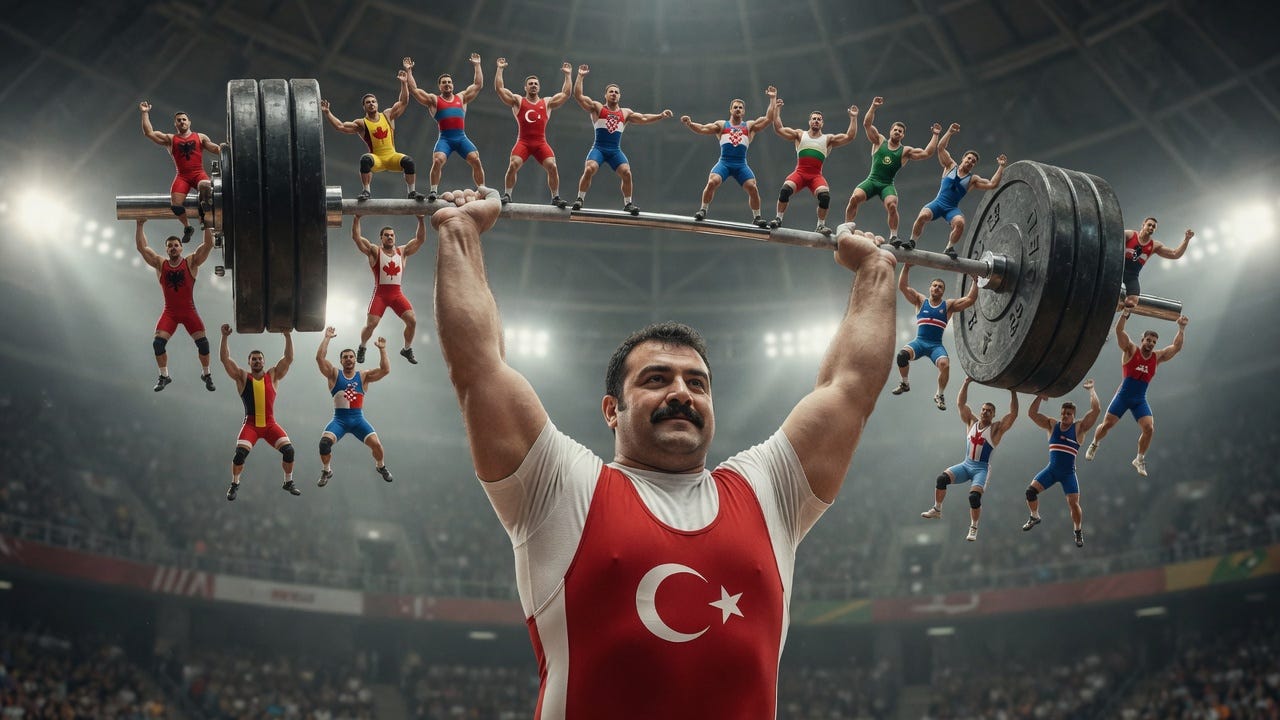
The Presidential Complex on the western edge of Ankara has 1,150 rooms, and for two days last week the one that mattered was a reception hall where thirty-one heads of state and government arrived to be photographed with the thirty-second, who was standing at the door. Recep Tayyip Erdogan hosted the thirty-sixth NATO summit as the host of a dinner party hosts it, deciding the seating, setting the menu, choosing which conversations happened in the corners. It was the second time an alliance summit had been held on Turkish soil, the first since Istanbul in 2004. The distance between those two summits is the story.
In 2004 Turkey was a supplicant, a candidate for a European Union it would never be allowed to join, a junior partner whose value was a long southern border and a large army. Last week Turkey was the room. The alliance did not choose Ankara for its hotels. It chose Ankara because Ankara had become the only capital where every fire the West is fighting was visible from the same window.
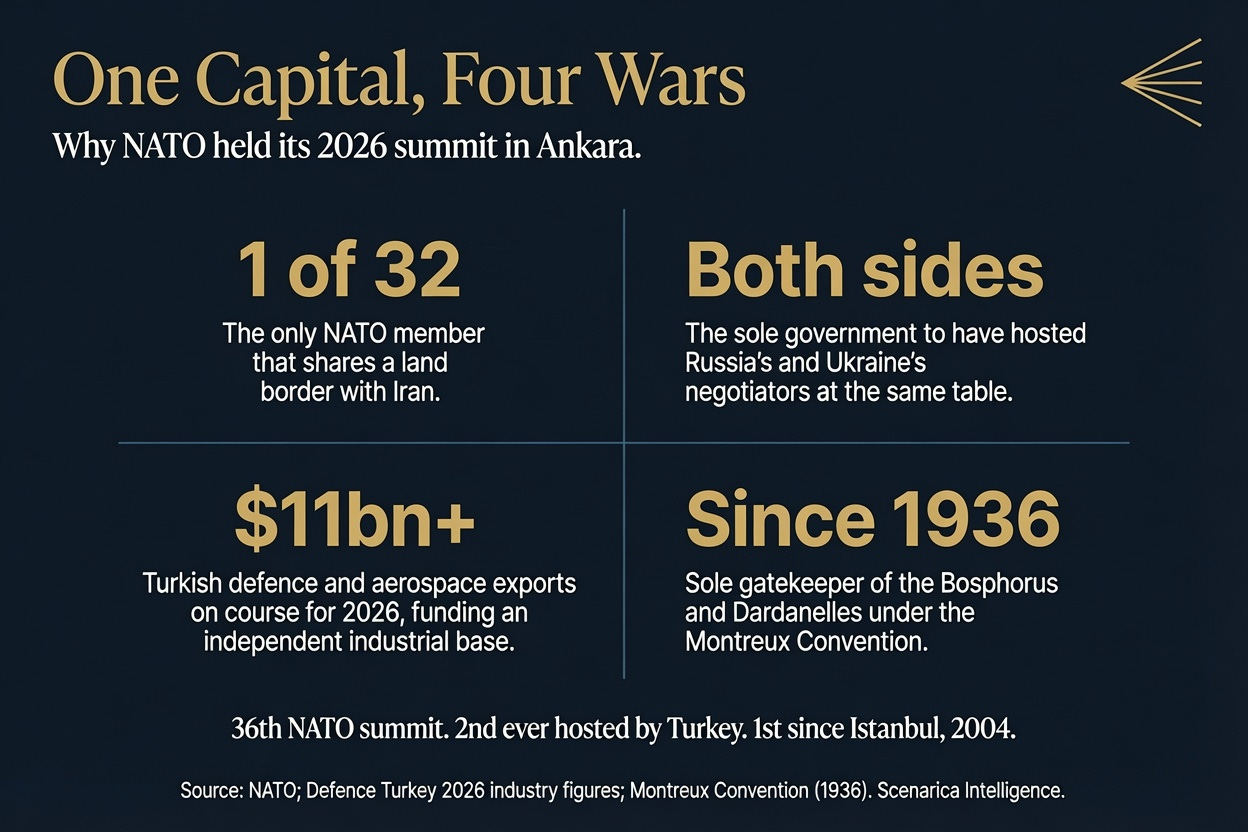
Look at what borders that window. To the east, Turkey is the only NATO member that shares a land frontier with Iran, and the war the United States reopened this month is being fought within artillery range of it. Across the Black Sea sits the Russia-Ukraine war, and Turkey is the sole government on earth that has hosted the top negotiators of both sides at the same table, most recently through the Istanbul talks that Foreign Minister Hakan Fidan chaired. To the south lies Syria, where the government that replaced Bashar al-Assad survives on Turkish patronage and where Turkish trainers are rebuilding the new Syrian army. And running through the middle of the country are the two waterways, the Bosphorus and the Dardanelles, that Turkey has controlled under the 1936 Montreux Convention since before the alliance existed.
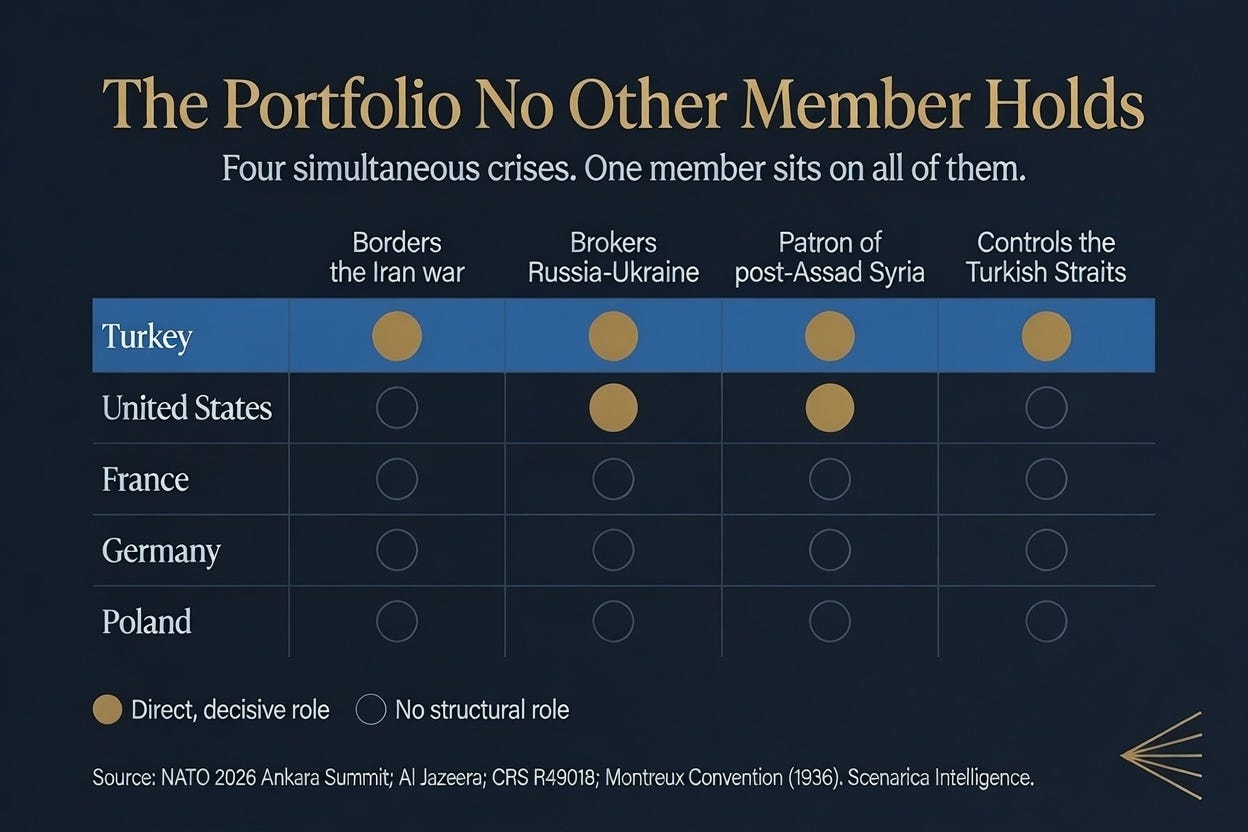
No other member holds that portfolio. France has reach and a nuclear force, but it does not border the Iran war. Poland is the eastern shield, but it does not broker with Moscow. Germany writes the largest cheques, but it holds no file the way Turkey holds four. The United States can bomb anything on the map, and it did, hitting more than eighty Iranian targets on the day the summit opened. What Washington cannot do is any of the four things Ankara does simply by existing where it exists.
This is the fact the summit was arranged around, and everyone in the hall knew it. Secretary General Mark Rutte came to Ankara with three priorities, more allied spending, more defence industrial production, more support for Ukraine, and Turkey sat at the centre of all three. The alliance pledged a package worth roughly seventy billion euros for Kyiv across this year and 2027. It announced tens of billions in new counter-drone and air defence contracts, a market Turkish industry is now large enough to feed. And it did all of this in a building chosen to make one point without saying it aloud.
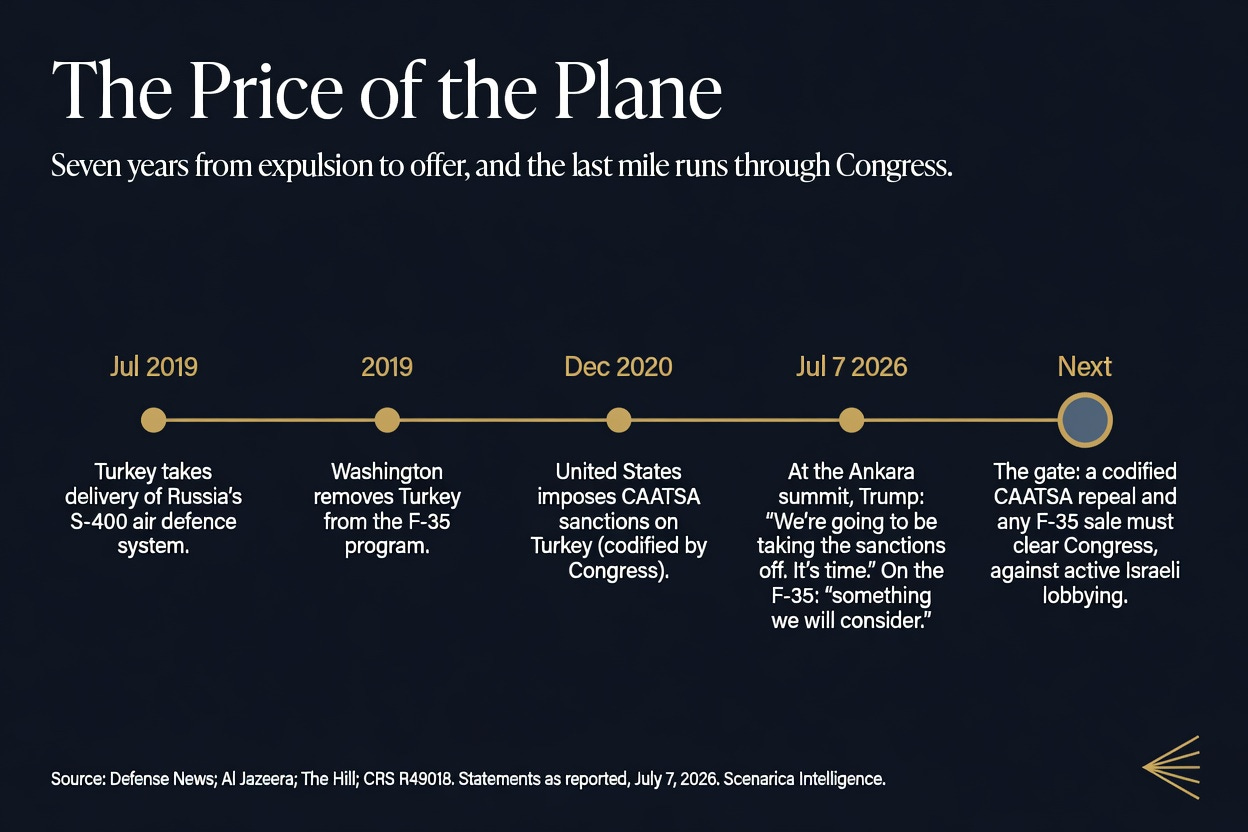
The point arrived, as these things do, in a bilateral. Sitting beside Erdogan on the summit’s first day, President Trump said the words that had been withheld since 2019. “We’re going to be taking the sanctions off,” he said of the CAATSA penalties Washington imposed in December 2020, after Turkey bought Russia’s S-400 air defence system. “It’s time.” On the F-35, the fighter Turkey helped build and was then expelled from acquiring, he was cooler but not closed: “certainly something we will consider.” A president who spent most of the week attacking allies for failing to help him against Iran spent part of it offering the alliance’s most independent member its most coveted weapon.
Read that trade slowly, because it is the whole mechanism. Turkey did not ask to be indispensable. Geography and a decade of patient positioning made it so. But indispensability is a currency, and the more crises route through a single capital, the more that capital can charge for its cooperation and the less anyone can compel it. The plane is the price. Every file Ankara holds raises the price, and there is no committee in Brussels or Washington that can lower it, because the leverage is not granted by the alliance. It is granted by the map.
Here is where the comfortable reading breaks. The instinct, watching the summit, is to call Turkey’s centrality a strength for the West, an anchor on a dangerous southern flank, a bridge to adversaries no one else can reach. That reading assumes the anchor wants to hold. Indispensability is not loyalty. A pivot you cannot discipline is not an anchor. It is a single point of failure wearing an anchor’s uniform.
The alliance has spent seventy years running on a simple assumption, that its members, whatever their squabbles, share a floor of common purpose that holds under stress. Turkey is the member for whom that assumption is now openly conditional. It kept its Russian air defences through every American protest. It kept its Moscow energy channel through every round of sanctions. It is the one government in the alliance that can credibly threaten to do nothing, to sit out a crisis, to keep talking to the other side, and doing nothing is the only threat that has ever moved this alliance, because NATO has no mechanism to make a sovereign member act against its own read of its own interest.
So the summit’s real message was not the spending numbers or the Ukraine package or even the sanctions relief. It was the address on the invitation. For the first time, the alliance travelled to the member it needs more than that member needs it, and held its most important meeting of the year in a hall whose host does not take orders. That is not a crisis. It is a repricing, and the thing being repriced is the reliability of the West’s own southern hinge.
The Deep Dive
What remains is the arithmetic. If Ankara now sets the price of its own cooperation, the questions that decide the next year are precise: what exactly does Erdogan want, what can Washington actually deliver against a Congress and an Israeli lobby that both object, how far does Turkey’s structural leverage still have to run, and which of three futures the alliance most likely walks into once the summit lights are off. The map made Turkey indispensable. What Turkey does with that is a choice, and the choice is more constrained, and more dangerous, than the handshake in the hall suggested.
Start with the man, because in this system the man is the variable. Erdogan is twenty-three years into power, past the point where he answers to a faction, and he reads Turkey’s position the way a landlord reads a housing shortage. He is not trying to leave NATO. Leaving is worthless. The entire value of Turkey’s position comes from being inside the alliance while behaving as though membership were a series of individually negotiable contracts rather than a covenant. Inside the tent, the S-400 is a bargaining chip and the F-35 is a reward to be extracted. Outside it, the S-400 is just a Russian radar in a country with no allies. He knows the difference precisely, which is why every Turkish provocation over the past decade has stopped exactly short of the door.
His decision tree at Ankara was therefore narrower than it looked. He wants three things that the alliance can supply and one it cannot. He wants the CAATSA sanctions gone, because they lock Turkish firms out of American components and financing. He wants a path back into the F-35 program, or failing that a green light for continued co-production and a steady flow of engines and avionics for the KAAN, Turkey’s own fighter. He wants European defence money to stop being ring-fenced against non-EU members, a demand his defence minister, Yasar Guler, made explicitly in April when he warned that excluding Turkey would harm European security more than the American drawdown. And the thing the alliance cannot give him is a free hand in Syria and against the Syrian Kurdish forces Washington still partners with, because that pits Turkey’s core aim against a standing American commitment.
Notice what that list does to the usual picture of a difficult ally. Erdogan is not being obstinate for its own sake. He is running a rational extraction strategy against a counterparty that has, this month, more reason than usual to pay. Trump wants Turkish acquiescence on Iran, Turkish logistics for whatever comes after the strikes, and a summit that photographs as a triumph rather than a brawl. Each of those wants is a lever in Erdogan’s hand. The more the Iran war escalates, the more Washington needs the one NATO member next door, and the higher the price of the plane climbs. Indispensability compounds.
The counterparty most people misread, though, is not Erdogan. It is Turkey itself as a defence power, because the leverage on display at the summit is not a fixed quantity. It is growing. Turkish defence and aerospace exports are on course to pass eleven billion dollars this year, according to the industry’s own 2026 figures. The KAAN fighter has its first export customer, Indonesia, which signed for forty-eight aircraft over a ten-year schedule. Baykar, the drone manufacturer, has bought Italy’s Piaggio Aerospace and partnered with Leonardo, planting itself inside the European industrial base it is simultaneously demanding access to. A country that a decade ago imported most of its major systems now sells fighters, drones, warships, and air defence to a widening list of buyers.
That matters to the pricing in a way the summit communique will never capture. The old leverage Turkey held over NATO was leverage of vulnerability, a weak economy and a threatened border that the alliance had to prop up. The new leverage is leverage of capability. Turkey is becoming a country the alliance needs for what it can build and sell, not merely for where it sits. When European rearmament runs through 2035 toward the five percent of GDP the alliance committed to at The Hague last year, Turkey wants to be a supplier, not a customer, and it has the industrial base to insist. The vulnerability leverage could be answered with money and reassurance. The capability leverage cannot be answered at all, because you do not reassure a competitor out of competing.
This is why the F-35 offer is so double-edged for Washington, and why it may stall exactly where Erdogan needs it most. Lifting CAATSA is not a presidential signature. Congress codified those sanctions, which means a clean removal runs through Capitol Hill, where a bipartisan bloc remembers the S-400 and a well-organised Israeli lobbying effort is already working against any F-35 transfer that would erode Israel’s qualitative military edge in the eastern Mediterranean. Trump can announce intent in a bilateral. He cannot deliver the outcome alone, and Erdogan, who has watched American presidents promise and Congress refuse before, knows the gap between the sentence and the signature is where his leverage either pays out or curdles.
There is a historical shape to all of this, and it is worth naming precisely because it tells you where the analogy stops. In March 1966, Charles de Gaulle pulled France out of NATO’s integrated military command, expelled alliance headquarters from French soil, and built an independent nuclear force, all without leaving the alliance itself. He had concluded that a Europe subordinate to American strategy was a Europe that had surrendered its sovereignty, and he converted France’s centrality, its geography, its army, its veto, into autonomy. France stayed a member and became ungovernable inside the structure at the same time. For forty-three years, until 2009, France sat in the alliance on its own terms. Erdogan is running a version of the same play: maximum extraction, minimum compliance, no exit.
But the analogy breaks at the one place that matters, and the break is the whole risk. De Gaulle’s France was hedging within a bipolar world against its own protector, the United States. Its autonomy pointed away from Washington but never toward Moscow. Turkey’s autonomy points in a genuinely different direction. Its hedge runs toward the actual adversaries the alliance is organised against: the Russian air defence in its inventory, the energy and grain channels it keeps open to Moscow, the mediation lines it maintains to a Tehran the United States is bombing. De Gaulle wanted a stronger Western pole. It is not clear Turkey wants a Western pole at all, as opposed to a multipolar board on which it is one of the players. A France that will not take orders is an alliance management problem. A pivot state that keeps working relationships with both sides of every war the alliance is fighting is something the alliance has no doctrine for.
Follow the exposure outward and the second-order effects sharpen. The Syrian Kurdish forces, the SDF, are the most immediately exposed: as American troops draw down and Washington trades away its leverage for Turkish cooperation elsewhere, the partner that did most of the ground fighting against the Islamic State becomes the bargaining chip most easily spent. Israel is exposed on two fronts, the F-35 transfer that would narrow its air dominance and the Turkish military presence creeping toward its Syrian flank, which Israeli officials have called a red line. Greece and Cyprus watch every Turkish gain inside the alliance as a loss in their own long confrontation. And the European defence-industrial debate, the argument over whether Turkish firms get inside the rearmament wave or are walled out, is now a first-order fight, because Guler has made Turkish inclusion the price of Turkish goodwill on everything else.
For the reader with a position, the translation is direct. If you are pricing European defence contractors, Turkish inclusion or exclusion in the EU instruments is a live catalyst that reallocates tens of billions. If you hold Turkish assets, the sanctions-relief path is the single largest swing factor on the lira and on Turkish bank access to dollar funding, and it runs through Congress, not the White House. If you are watching the Iran war, Ankara is the swing capital, the one that can widen or narrow the corridor of the possible depending on whether it lends its border and its airspace or withholds them. In each case the variable to track is the same: not what NATO decides, but what Ankara permits.
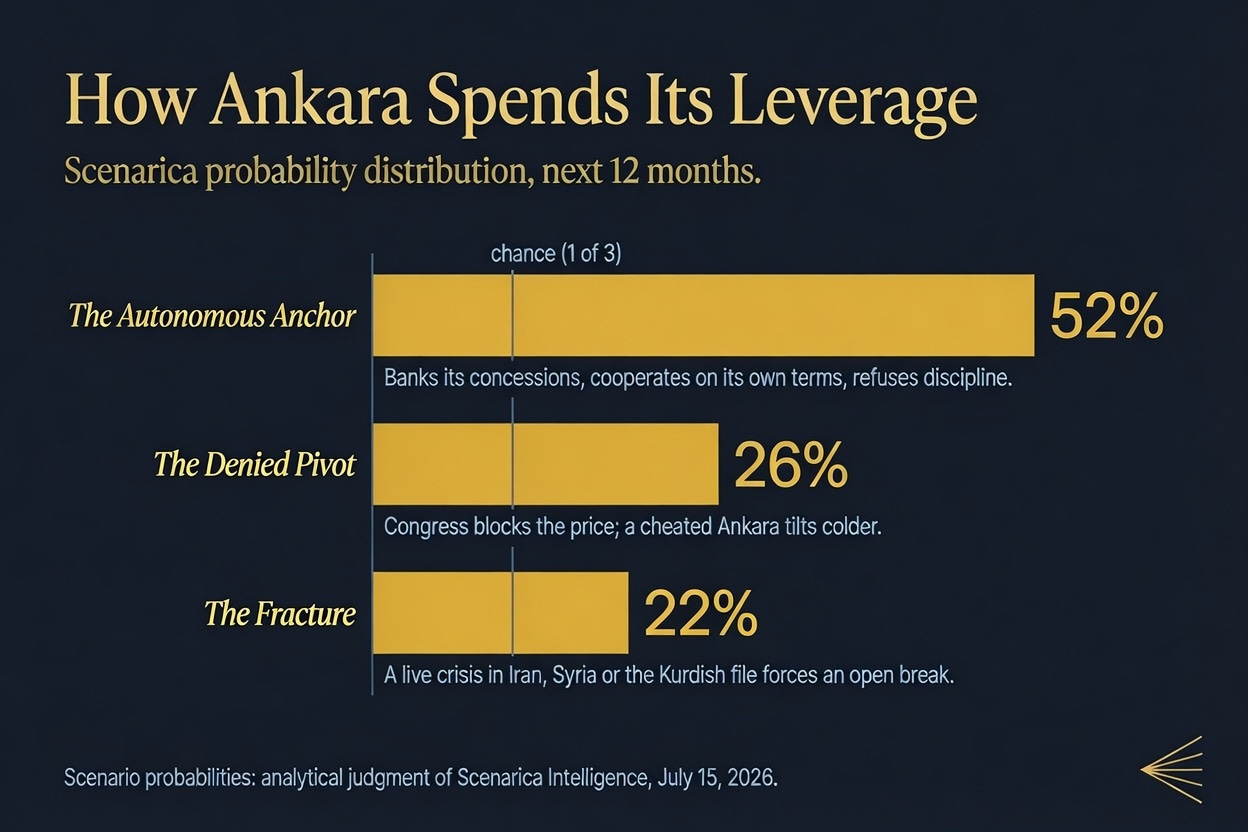
So how does the year actually resolve. Weigh the three genuinely distinct paths, because they do not sum to a happy consensus.
The likeliest, and it clears fifty percent, is the path where Erdogan does what he has done for a decade, only from a stronger position. Call it the autonomous anchor. Turkey banks its concessions, CAATSA relief advances even if the F-35 stays “under consideration,” defence-industrial integration deepens, and in return Ankara uses its pivot role in ways that broadly stabilise its own neighbourhood, mediating where mediation serves it, anchoring the southern flank against a weakened Iran, keeping the straits and the corridors open. It cooperates. It also flatly refuses discipline, keeps its Russian systems and its Moscow and Tehran channels, and acts on its own regional logic whenever that logic and the alliance’s diverge. The base rate here is Turkey’s own revealed behaviour since 2016, which is exactly this, and the current alignment of incentives, a president who wants the win and a host who wants the plane and the free hand, points the same way. One actor largely controls this outcome and his interests point unambiguously at it, which is why the number sits above half rather than in the comfortable thirties. If you are the alliance, this is not relief. It is a manageable dependency on a member who cooperates strictly on his own terms, and the tracked variable is the pace of CAATSA relief: partial motion within three months, a codified path or its clear failure within twelve.
Then there is the path where Washington cannot pay. Around a quarter of the probability belongs to the denied pivot, the world where the price Erdogan named is blocked at the source, where Congress refuses to unwind CAATSA, the Israeli lobbying holds, and the F-35 offer dies in committee. A Turkey cheated of its concession does not sit still. It tilts colder, deepens the Russian and Chinese defence and energy relationships it has been careful to keep warm, presses its advantages in Syria and against the SDF without the restraint that a live American deal would buy, and turns the straits and the energy corridors from cooperation into leverage. This scenario sits below the one-in-three baseline for a specific reason, which is that Trump’s personal investment in the relationship and his stated intent are real countervailing forces. But it sits well within reach, because the president does not control the legislature, and the gap between his sentence and Congress’s signature is exactly where this outcome lives. Watch the autumn defence authorisation cycle, and watch whether any F-35 letter of offer is formally transmitted before year end.
The last path is the one the summit’s warmth was designed to obscure, and it carries a fatter tail than usual because the catalysts are already live. A little over a fifth of the probability belongs to the fracture, the world where a crisis forces a binary and Turkey’s independent line collides with the alliance in public. The triggers are on the board right now: a Turkish clash with Israel over a base south of Damascus, a unilateral Turkish move against the SDF as American forces thin out, an open break with Washington over how far to push the Iran war, or a Turkish veto on an alliance decision at the moment cohesion matters most. Any one of them turns the indispensable member into the one that cracks the alliance at peak stress. The reason this is not a remote tail is that three separate hot files, Iran, Syria, and the Kurdish question, are all capable of firing inside twelve months, and Erdogan’s incentive to avoid an open break weakens precisely if he concludes the concessions are not coming. If the denied pivot arrives first, the odds on the fracture rise behind it.
What would move these numbers. A formal F-35 letter of offer transmitted to Congress, or a clean CAATSA repeal vote scheduled, would pull weight toward the autonomous anchor and cut the fracture tail. A congressional block, an Israeli lobbying win, or a public Trump reversal would swing the distribution toward the denied pivot within a single news cycle. And any Turkish military action inside Syria that crosses an Israeli red line, or any Turkish move against the SDF as the drawdown proceeds, would pull probability directly into the fracture, faster than any summit communique could contain.
Watch four things between now and the end of the year. Watch the autumn US defence authorisation cycle for whether CAATSA relief is written into law or quietly buried, the single clearest signal of which path is winning. Watch the eastern Mediterranean for any Israeli statement treating a Turkish deployment in southern Syria as a crossed line, because that is the fracture’s most likely ignition point. Watch the European Union’s defence-industrial instruments through the autumn for whether Turkish firms are admitted or walled out, the quiet fight that determines how much of the rearmament wave Ankara captures. And watch Ankara’s own posture toward the Iran war: a Turkish mediation initiative would signal the anchor, while a closed border and a withheld airspace would signal the pivot deciding it is owed more than it has been paid.
The alliance came to Ankara to project unity and left having demonstrated dependence. The next NATO summit will be somewhere else, in a capital chosen for its safety rather than its centrality, and the leaders will tell themselves the Ankara summit was a one-off, a courtesy to a valued partner. It was not a courtesy. It was a preview. The West’s next crisis will not be decided only in Washington or Brussels. It will be decided, in part, in a 1,150-room complex on the western edge of Ankara, by a host who chooses the seating, and the alliance will find out which future it is living in the moment it asks him to act and he decides what that will cost.
Sources:
NATO, “2026 NATO Summit in Ankara, Overview,” July 2026.
Al Jazeera, “NATO summit begins in Turkiye’s Ankara: Who is attending, what is at stake?” July 7, 2026.
Al Jazeera, “Five key takeaways from the NATO summit in Ankara,” July 8, 2026.
Al Jazeera, “Trump says will lift sanctions on Turkiye, ‘consider’ selling F-35s,” July 7, 2026.
Defense News, “US will lift sanctions on Turkey, possibly sell F-35 fighter jets, Trump says,” July 7, 2026.
The Hill, “Donald Trump’s potential F-35 sale to Turkey faces backlash ahead of NATO summit,” July 2026.
CNN, “July 7, 2026: US hits more than 80 Iran targets, reimposes oil sanctions,” July 7, 2026.
CNN, “July 8, 2026: US, Iran threaten more attacks as strikes continue, Trump attends NATO summit,” July 8, 2026.
NPR, “US launches new airstrikes on Iran and Tehran fires back at Gulf Arab states,” July 9, 2026.
NPR, “Trump won spending promises from NATO last year. This week, he’ll try to enforce them,” July 6, 2026.
Foreign Policy, “NATO Summit in Ankara Sees Big Defense Investment Push,” July 7, 2026.
The Washington Post, “NATO readies for a ‘big reveal’ on arms deals to prove its firepower to Trump,” July 7, 2026.
CNBC, “Trump renews Greenland threats at NATO summit, says U.S. could remove troops from Europe,” July 7, 2026.
Congressional Research Service, “NATO: Issues for the July 2026 Ankara Summit,” R49018, 2026.
Al Jazeera, “Russia and Ukraine agree to prisoner swap but peace talks stall in Istanbul,” June 2, 2025.
The Times of Israel, “NATO summit and Trump’s support for F-35s sale boost Turkey’s standing,” July 2026.
INSS, “The New Syria, One Year After al-Sharaa’s Rise to Power,” 2026.
Alma Research and Education Center, “A New Sunni-Islamist Axis? Turkey’s Involvement in Syria’s Military Force Buildup,” 2026.
Defence Turkey, “General Assessment of the Turkish Defense and Aerospace Industry in 2025 and Targets for 2026,” 2026.
Turkiye Today, “What are Turkish defense industry’s targets for 2026?” 2026.
The Jerusalem Post, “As Europe rearms, Turkey pushes for deeper integration into Western defense markets,” 2026.
Disclaimer: This report is published by Scenarica Intelligence for informational purposes only. It does not constitute investment advice, a solicitation to buy or sell any financial instrument, or a recommendation regarding any particular investment strategy. Scenarica Intelligence is not a registered investment adviser or broker-dealer. All scenario probabilities and assessments represent the analytical judgment of Scenarica Intelligence and are subject to change without notice. Past performance of any asset or strategy discussed does not guarantee future results. Readers should conduct their own due diligence and consult with qualified financial advisers before making investment decisions.
Scenarica Premium: The full Scenarica suite includes Geopolitics, Economy, Bitcoin, AI, and Sunday Edition.
Scenarica Intelligence
We don’t predict the future. We price it.