

The Hostage Chair
The Fed's one rate can fight inflation or protect the AI boom carrying the economy, but not both.


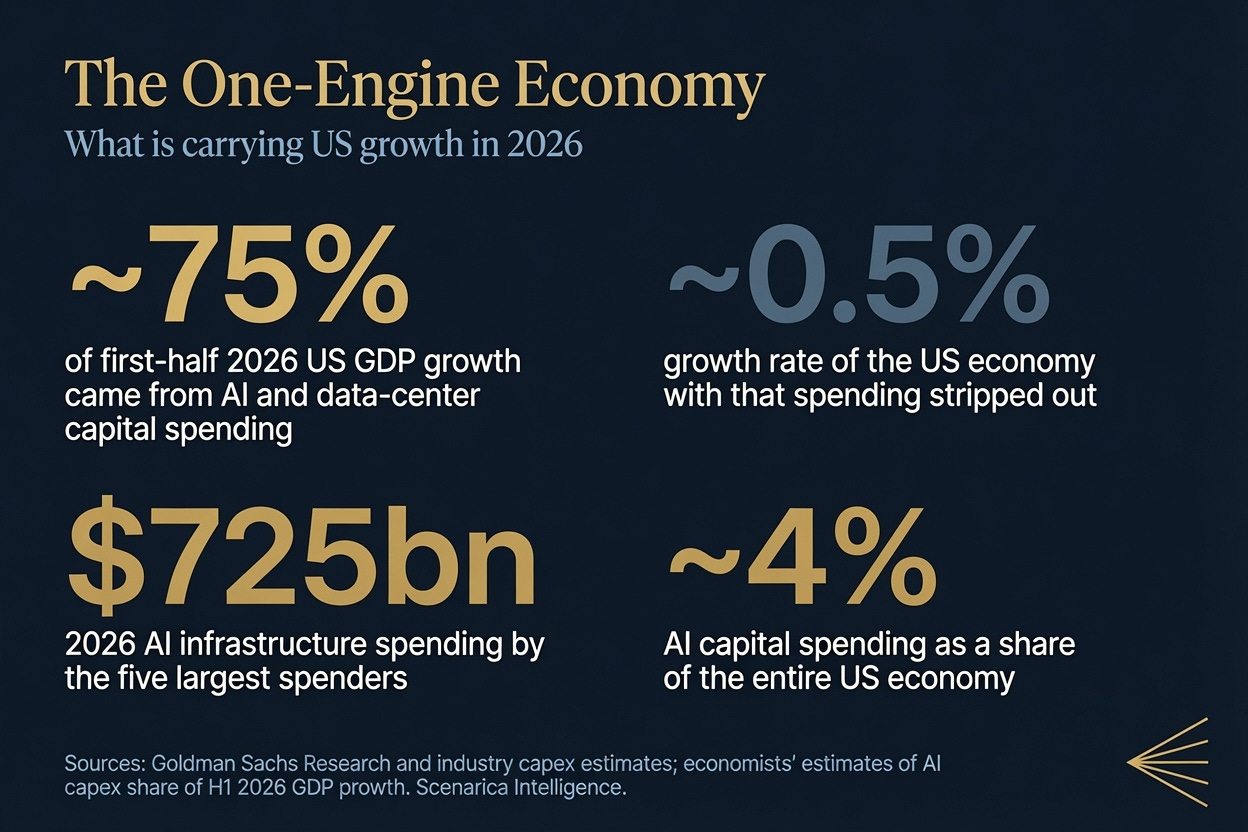
Strip artificial-intelligence spending out of the American economy and the growth that remains is close to nothing. By several economists’ estimates, data-center and AI-related capital investment accounted for roughly three-quarters of US GDP growth in the first half of 2026. Take that spending away, and the largest economy on Earth is expanding at something near half a percent.
That is the fact that should frame everything you read this morning about the Consumer Price Index. At 8:30 Eastern the Bureau of Labor Statistics releases the June inflation print, the last major data point before the Federal Reserve meets on the 28th and 29th. Every headline will treat it as a question about prices. It is really a question about a single engine, and whether the Fed is about to stall it.
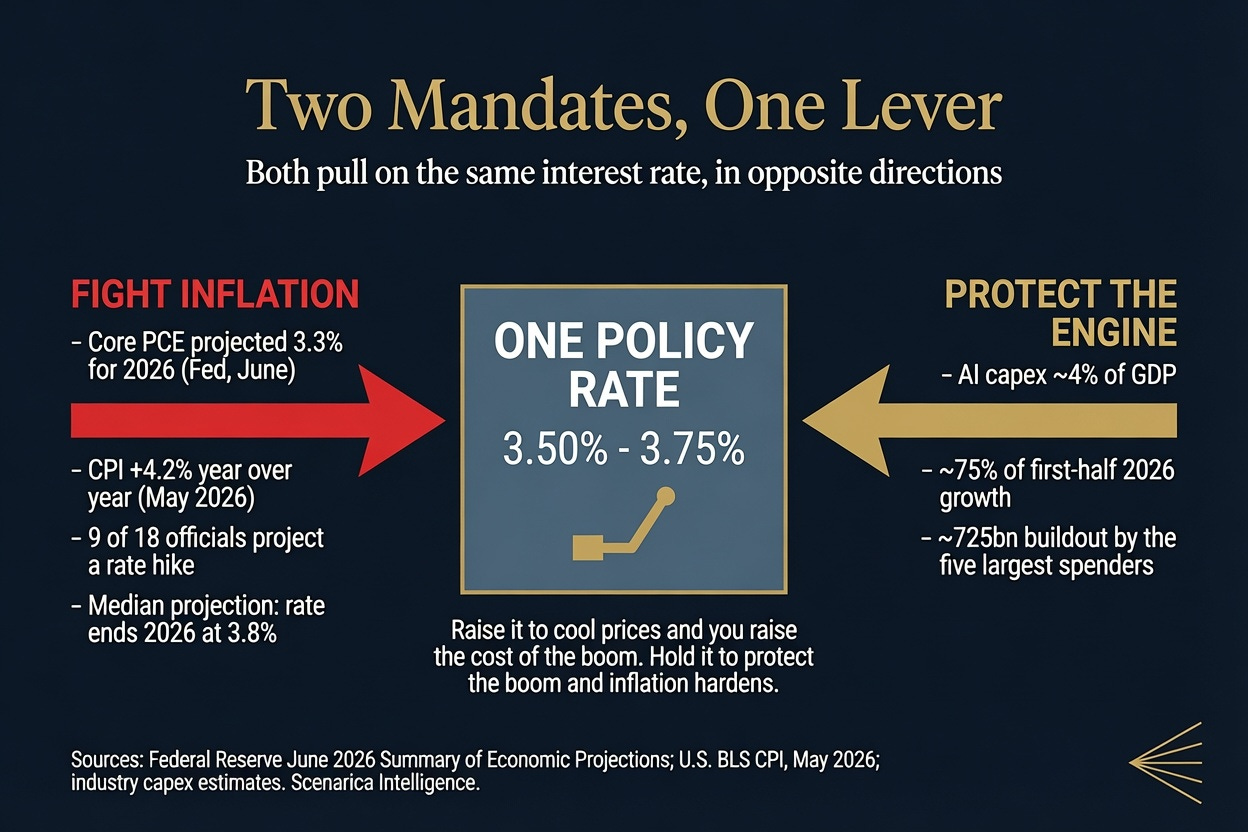
Here is the thing almost nobody is saying out loud. The interest-rate decision and the AI boom have become the same decision. The Fed has one instrument, the price of money, and that price now sets the hurdle for hundreds of billions of dollars of AI construction while simultaneously deciding whether inflation running well above target gets tamed. Move the rate to cool prices and you raise the cost of the capital pouring into data centers, chips, and power. Hold the rate to protect that capital and you leave inflation to harden. There is no setting of one lever that serves both goals, because the two goals now pull in opposite directions on the same wire.
Consider the numbers the Fed is actually staring at. Its own June projections lifted the forecast for core inflation, the measure it watches most closely, to 3.3 percent for this year, a full point higher than it had guessed in March. Baseline: the May CPI, released on June 10, showed consumer prices up 4.2 percent over the year, a three-year high, pushed along by the energy costs of the war in Iran. Nine of the eighteen officials around the table now pencil in a rate increase before December. The median of them sees the policy rate ending the year at 3.8 percent, above where it sits today.
On paper, that is a straightforward story. Inflation is too high, so the central bank leans toward tightening. A first-year textbook could write the next chapter.
The textbook does not know how this economy is built.
Because the same June projections sit on top of a growth base narrower than any in modern memory. The five largest technology spenders are on track to lay out around 725 billion dollars on AI infrastructure this year, a sum approaching four percent of the entire economy, and the market gains, the hiring, the electricity demand, and the GDP line all lean on that one column of spending. When a handful of firms and their capital budgets carry the expansion, the central bank cannot touch the cost of capital without touching them, and it cannot touch them without touching the expansion that rests on their spending.
This is why the person in the hardest seat in Washington is Kevin Warsh. He was sworn in as Fed chair on the 22nd of May, and he arrived carrying a very specific idea. Last November, before the job was his, he argued in print that artificial intelligence would be “a significant disinflationary force,” that it would “make almost everything cost less,” and that the Fed should therefore cut rates to help households and small businesses. It was an elegant thesis. It offered a way to have cheap money and falling prices at the same time, the productivity boom paying for the party.
Seven months later, the thesis is running in reverse. The AI buildout is not making things cheaper yet. It is bidding up electricity, straining the power grid, pulling in construction and chips, and adding to the very inflation Warsh expected it to cure. The productivity payoff he is counting on lies somewhere in the future. The costs of building toward it are landing now.
So the chair who staked his framework on cutting rates finds himself unable to. At his first meeting in June, he did something telling. He stripped the Fed’s statement down, removed the language hinting at future cuts, and refused to offer any forecast of his own. The Fed calls this the end of forward guidance. Read it more plainly and it is the sound of a man who cannot say where rates are going because he genuinely cannot choose.
That is the trap, and it is worth being precise about why it closes. If Warsh raises rates hard enough to break the back of 3.3 percent inflation, he raises the discount rate on the most rate-sensitive spending cycle in the economy, and he risks cracking both the AI capex boom and the equity wealth that has been quietly holding up consumer spending. If he holds, or cuts as his own writing suggested, he protects that engine and pumps an asset boom that is already stretched, while letting inflation settle in. Every door out of the room opens onto a different fire.
Here is the part that should unsettle you most, and it is the opposite of reassuring. Warsh’s escape hatch, the productivity miracle that is supposed to make all of this painless, is the same capital boom that has tied his hands. For AI to disinflate the economy the way the 1990s internet eventually did, the building has to continue for years, which requires capital to stay cheap, which requires the Fed not to fight the inflation the building is currently helping to create. The cure and the disease are the same spending cycle. The thing that is meant to rescue the chair is the thing holding him hostage.
For a decision-maker, this reframes what the July print and the July meeting actually are. Stop reading the Fed purely through the CPI, and start reading it through the fragility of the AI trade. The number that will tell you where policy is heading is not core services inflation. It is the correlation between rate expectations and the AI-linked equity complex. On the days a hawkish signal sends those shares down hardest, you are watching the Fed’s real constraint reveal itself in real time, because a committee that cannot let the market fall is a committee that cannot deliver the hikes its own dots advertise. The projections say the rate ends the year at 3.8 percent. The structure of the economy says the chair cannot get there without breaking the thing he is trying to protect.
The Deep Dive
What remains is the machinery underneath the trap: exactly why AI spending is more sensitive to the price of money than any other engine an economy has ever leaned on, how a wobble in a few large stocks now travels straight to the checkout line, why the one historical rhyme everyone reaches for actually breaks in the most important place, and how to price the four ways this resolves over the next year. The pricing comes last, because only after the mechanism is on the table can the numbers mean anything.
Begin with the gearing, because it is the load underneath everything else. Most of the value in an AI buildout sits far out in the future. A data center laid down in 2026 is a bet on cash flows in 2030 and beyond, financed heavily, depreciating fast, and justified only if the eventual return clears the cost of the capital sunk into it. That structure makes the whole enterprise acutely sensitive to the discount rate, which is another name for the interest rate the Fed sets. When money is cheap, distant cash flows are worth a great deal today and the hurdle a project must clear is low. When money is dear, those same future dollars shrink in present value and the hurdle rises. A boom built on long-dated promises is the single most rate-sensitive kind of boom there is.
Now put a number on the stakes. Roughly 725 billion dollars of AI infrastructure spending this year is not a rounding error on the economy, it is close to four percent of it, and it is the marginal dollar of growth. The Fed’s projected path lifts the policy rate toward 3.8 percent and, more importantly, signals that it stays elevated rather than falling. That shift does not have to trigger a formal recession to bite. It only has to raise the return that a marginal data center must earn to be worth building. Push the hurdle up far enough and the least-justified projects at the edge of the boom stop penciling. Because this is the marginal growth in the economy, trimming the edge of the boom trims the edge of the expansion itself.
This is the mechanism the market has half-noticed and not fully priced. When several Fed officials signaled a possible hike in June, the sharpest losses did not land on the interest-rate-sensitive corners you would expect from a textbook. They landed on the largest AI names, the very companies whose spending is the growth. Treasury yields rose and the AI complex fell together, in the same session, for the same reason. That co-movement is the tell. It is the market pricing, in miniature, exactly the linkage the Fed would prefer nobody notice: that the rate and the AI trade are now bolted to the same lever.
The second piece of machinery is the one that turns a market event into a kitchen-table event, and it is where most observers stop too early. It is not enough to say an AI selloff would hurt portfolios. The question is how a fall in a few large stocks reaches the spending of people who own none of them.
The channel runs through concentration of wealth and concentration of consumption. The top tenth of American households now account for close to half of all consumer spending, by Moody’s Analytics estimates, and a large and rising share of that group’s paper wealth sits in exactly the equity complex the AI boom has inflated. When that wealth rises, the top decile spends freely, and their spending has been a load-bearing wall under the entire consumer economy through a period when the bottom half has been leaning on credit. When that wealth falls, the same households pull back, and because they are half the market, their caution does not ripple through the economy so much as pull the tide out from under it.
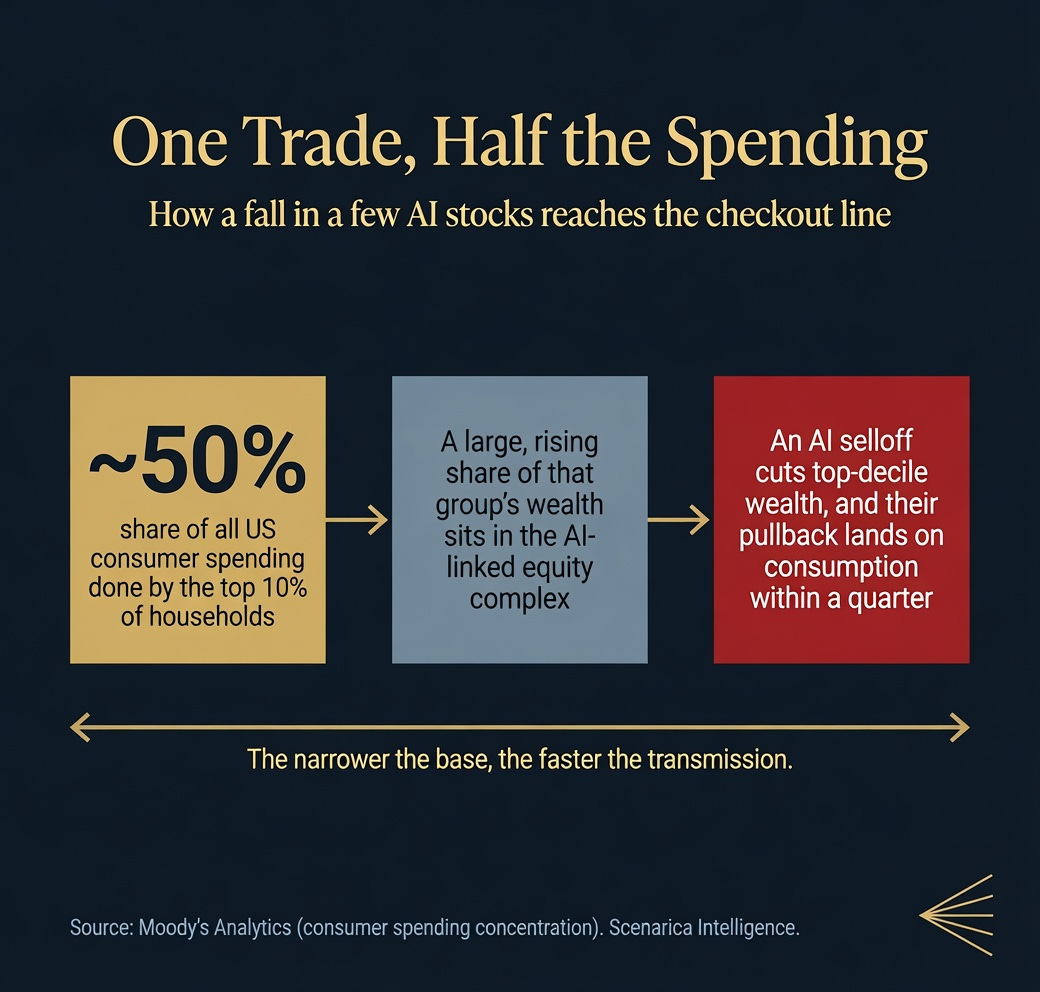
So trace the full chain, link by link. A hike raises the discount rate. The discount rate cracks the marginal AI project and, with it, the AI equity complex. The equity complex is where the top decile keeps its wealth. The top decile is half of consumption. Their retreat pulls down the spending that has masked the weakness in everyone else’s. Follow the wire from the Fed’s boardroom all the way to a restaurant table in a mid-tier city, and you find that the interest-rate decision arrives there faster and harder than it would in any prior cycle, not despite the concentration of the boom but because of it. The narrower the base, the more violent the transmission when it is touched.
Which is why the chair’s real reaction function is narrower than the market believes, and reading him correctly matters more than reading the CPI. Warsh removed forward guidance and abstained from the dots not out of humility but out of genuine entrapment, and the tell is worth dwelling on. A chair who believed he could hike would let the projections speak for him and stand behind them. A chair who believed he could cut would say so, as Warsh himself did in print only months ago. A chair who says nothing, who tears the guidance out of the statement and declines to forecast, is a chair who has looked at both doors and found a fire behind each. His silence is not a communications strategy. It is the institutional expression of a bind.
That bind is deeper than it looks, because it is partly one of his own making. Warsh spent last autumn arguing publicly that AI justified rate cuts. Having made that argument the intellectual foundation of his chairmanship, he cannot now cut without looking as though he is bailing out the very bubble his thesis inflated, and he cannot hike without repudiating the framework he was appointed carrying. His freedom of action is fenced not only by the economy but by his own published words. When you assess his likely path, weight that heavily. A chair defending a thesis moves more slowly than a chair following the data, and this chair has a thesis to defend and nine colleagues pulling the other way.
Now the historical rhyme, because everyone reaches for it and almost everyone stops before the part that matters. The obvious parallel is Alan Greenspan and the late-1990s technology boom. Greenspan, too, made a productivity bet. He argued that the internet was lifting the economy’s speed limit, held rates lower than the old rules demanded, cut into the 1998 market scare, and watched the final melt-up and then the 2000 bust. Warsh is making the same wager on a new technology, with the same optimism about productivity, and the same hope that the boom pays for itself. The rhyme is real, and it is seductive.
It breaks in two places, and both make today more dangerous, not less. The first break is concentration. In 1999 the bubble lived in stock valuations, but the real economy did not depend on technology capital spending for most of its growth, so when the bubble burst the result was a mild, shallow recession. Today the boom is not just in the share prices. It is in the GDP line itself, three-quarters of the expansion resting on the capital budgets of a few firms. A market break now does not deflate a side pocket of the economy. It deflates the main chamber.
The second break is the one that should frighten a policymaker most. Greenspan had room. When the dot-com bust came, inflation was running around two percent, which meant he could slash rates hard and fast to cushion the fall, and he did. Warsh has no such room. With core inflation at 3.3 percent and headline CPI above four, a chair facing an AI bust could not cut aggressively without pouring fuel on a fire that is already burning. The escape route Greenspan used to walk out of his bubble is bricked up. That is the difference between a productivity bet you can afford to lose and one you cannot, and it is the reason this episode does not end the way the last one did.
Put the mechanism, the transmission, the reaction function, and the broken parallel together, and the shape of the next twelve months resolves into four genuinely different worlds. They divide not on whether the Fed is hawkish or dovish, the axis everyone defaults to, but on how the trap itself resolves: tolerated, sprung from one side, sprung from the other, or dissolved.
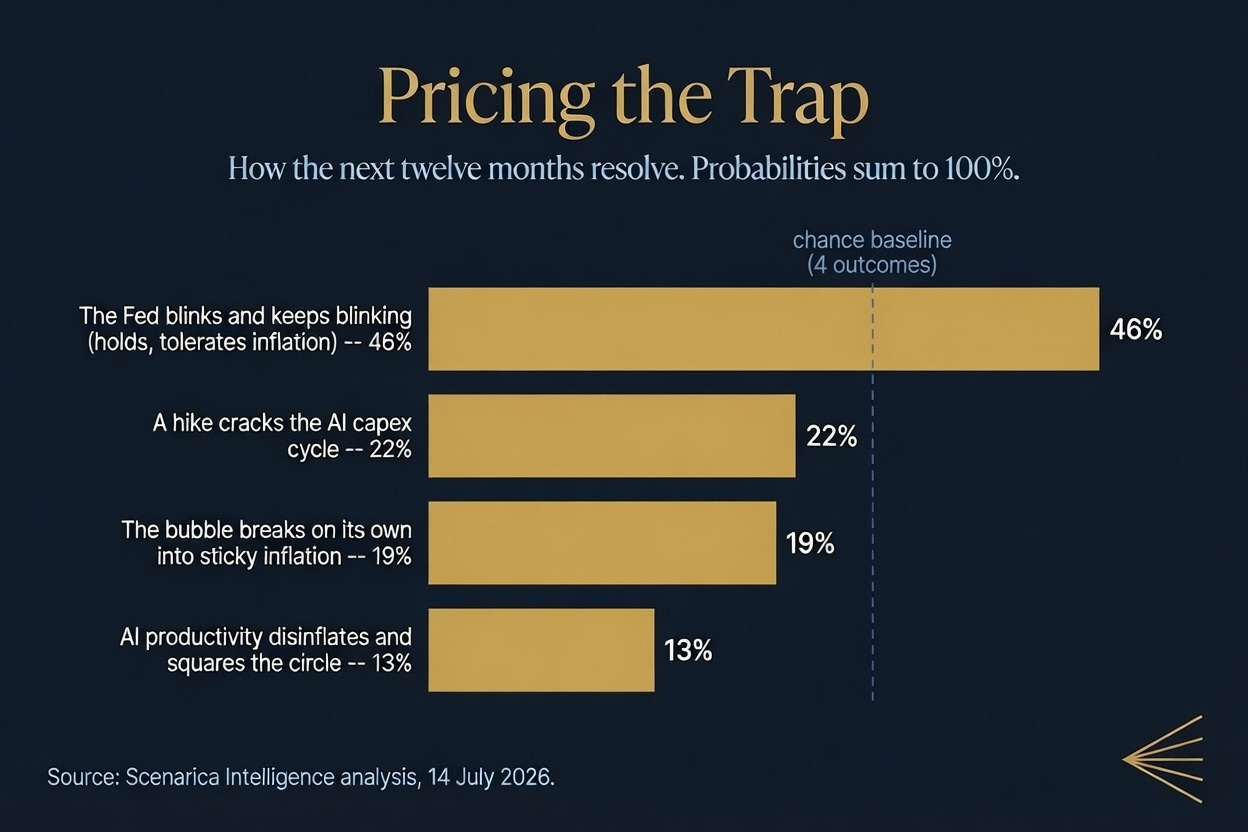
The most likely of them, and the one your positioning should default to, is that the Fed blinks and keeps blinking. Faced on the 29th with the choice its own projections tee up, the committee holds again, wraps the hold in hawkish language to satisfy the nine who want a hike, and quietly tolerates inflation in the low threes rather than risk the engine. This is the capture outcome, and it earns a probability near 46 percent because the path of least resistance for a dovish-leaning chair sitting on a fragile growth base is to talk tough and do nothing, and the market’s own pricing of only a one-in-four chance of a July move already leans this way. If you are running duration, this world is kinder to the front end than the dots imply and rewards the view that the terminal rate is lower than 3.8 percent, because the Fed simply cannot get there. Watch the gap between the projected path and the market path over one to three months. It is the price of the Fed’s captivity, and in this world it stays wide.
Then there is the world where the nine prevail, or a hot print this morning forces the issue, and the Fed actually hikes into the boom. Here the discount-rate gearing does its work in reverse, the marginal AI projects stop penciling, the equity complex that holds the top decile’s wealth cracks, and the transmission chain runs all the way to consumption within a quarter or two. It is the cleaner policy choice and the more dangerous one, and it sits at around 22 percent, below the one-in-four baseline, precisely because Warsh’s framework and the committee’s evident fear of the fragility make a genuine hike less likely than a coin flip, not more. If you carry credit risk in the aggregate or lean long the growth complex, this is the scenario that forces a rebalancing before you would choose one, and the tripwire is a June core CPI that accelerates rather than eases.
Smaller, and quieter, is the world Warsh actually prayed for. In it, the productivity gains show up in the data faster than the skeptics expect, inflation eases toward target because AI genuinely makes things cheaper rather than because the Fed inflicted pain, and the circle squares itself. The chair gets to hold or even cut without feeding a mania, because prices are falling for honest reasons. It would vindicate the whole thesis. It also runs against the current evidence, which shows the buildout adding to inflation rather than subtracting from it, and against the research houses now publicly disputing the disinflation case. That is why it carries only about 13 percent. Do not price it to zero, because a real productivity surprise is exactly the kind of thing forecasters miss, but do not build a portfolio on a hope the data is actively contradicting.
The last world is the one the Fed cannot control and would least like to discuss. The bubble breaks on its own, not because the Fed hiked but because a mania exhausts itself, a capital-spending plan gets trimmed, or a financing strain in the AI complex snaps a nerve, and it happens while the committee is still holding. This is the stagflation trap, and it is the reason the tail here is fatter than reflex would suggest. It earns close to 19 percent because the boom is stretched, its funding increasingly creative, and history is blunt that concentrated manias tend to end on their own schedule rather than the central bank’s. If it lands, the Fed is forced to ease into a downturn with inflation still in the threes, the worst chair a policymaker can be handed, and Greenspan’s bricked-up escape route becomes the whole story. If you hold long-dated exposure, this is the world that hurts in two directions at once.
What moves these probabilities is now a small set of dated signals, and they are worth watching in order. The first is already here. This morning’s June CPI, at 8:30 Eastern, is the immediate test: a core reading that accelerates toward or past 0.3 percent on the month hardens the hawks and lifts the odds of the hike scenario, while a soft print buys the chair another few weeks of blinking. Two weeks later, on the 29th, the meeting itself will show whether the hawkish hold turns into an actual move and whether Warsh restores any forward guidance at all, because the day he can describe the path again is the day the trap has resolved one way or the other.
Watch, through late July and August, the capital-spending guidance in the large technology earnings reports, not the profits but the buildout plans, because a single meaningful cut to 2026 AI capex is the earliest signal that the engine is idling on its own and the fourth scenario is arriving. Watch the correlation between rate expectations and the AI equity complex, and treat any session where a hawkish surprise sends those shares down hardest as confirmation that the Fed’s hands are tied and its cut optionality is worth more than the dots say. And watch Jackson Hole in late August, where Warsh will either reassert the AI-disinflation thesis or begin, carefully, to walk away from it. His framing there is the clearest tell you will get on which fire he has decided to let burn.
Independence, on paper, is intact. Warsh answers to no one, the statute is unchanged, and the committee votes as it always has. But a central bank that cannot raise rates without breaking the economy it is charged with stabilizing is not exercising independence. It is managing a hostage situation in which it is also the hostage, and the ransom is an inflation rate it has quietly agreed to tolerate. The lever still moves. It is what sits on the other end of it, the whole American expansion balanced on a few firms’ capital budgets, that has taken the choice away. Warsh inherited a bubble he did not create and a mandate he cannot fully serve, and the first task of his chairmanship is not to fight inflation or to protect growth. It is to decide, quietly and without ever quite admitting it, which one he is willing to lose.
Sources:
U.S. Bureau of Labor Statistics, “Consumer Price Index Summary, May 2026,” released 10 June 2026; CPI release schedule showing June 2026 CPI due 14 July 2026.
Federal Reserve, “FOMC Statement and Summary of Economic Projections,” 17 June 2026 (core PCE revised to 3.3% for 2026, headline PCE 3.6%, median year-end funds rate projection 3.8%, nine of eighteen participants projecting a hike).
Federal Reserve, “Chair Warsh Press Conference Transcript,” 17 June 2026 (removal of forward guidance; abstention from rate forecast).
Kevin Warsh, opinion essay, The Wall Street Journal, November 2025 (”AI will be a significant disinflationary force”; call for lower interest rates).
Goldman Sachs Research and industry estimates, “AI infrastructure capital spending 2026” (five largest spenders on track for roughly $725 billion; AI capex approaching 4% of GDP).
Economists’ estimates of AI and data-center capital spending as a share of first-half 2026 US GDP growth (roughly three-quarters; economy ex-AI-capex growing near 0.5%).
Moody’s Analytics, consumer spending concentration (top decile of households accounting for close to half of US consumer spending).
CME Group FedWatch, July 2026 meeting-probability estimates (roughly one-in-four to one-in-three odds of a July hike).
BCA Research, strategy note disputing the AI-as-disinflation thesis, May 2026.
Historical reference: Federal Reserve and BLS data on inflation and the federal funds rate, 1998-2001.
Disclaimer: This report is published by Scenarica Intelligence for informational purposes only. It does not constitute investment advice, a solicitation to buy or sell any financial instrument, or a recommendation regarding any particular investment strategy. Scenarica Intelligence is not a registered investment adviser or broker-dealer. All scenario probabilities and assessments represent the analytical judgment of Scenarica Intelligence and are subject to change without notice. Past performance of any asset or strategy discussed does not guarantee future results. Readers should conduct their own due diligence and consult with qualified financial advisers before making investment decisions.
Scenarica Premium: The full Scenarica suite includes Geopolitics, Economy, Bitcoin, AI, and Sunday Edition.
Scenarica Intelligence
We don’t predict the future. We price it.
That’s a really insightful post. I learnt so much from reading through it.