

The New Tenants
VW closed a factory that built 360,000 cars. BYD shipped a million overseas. In the same six months.

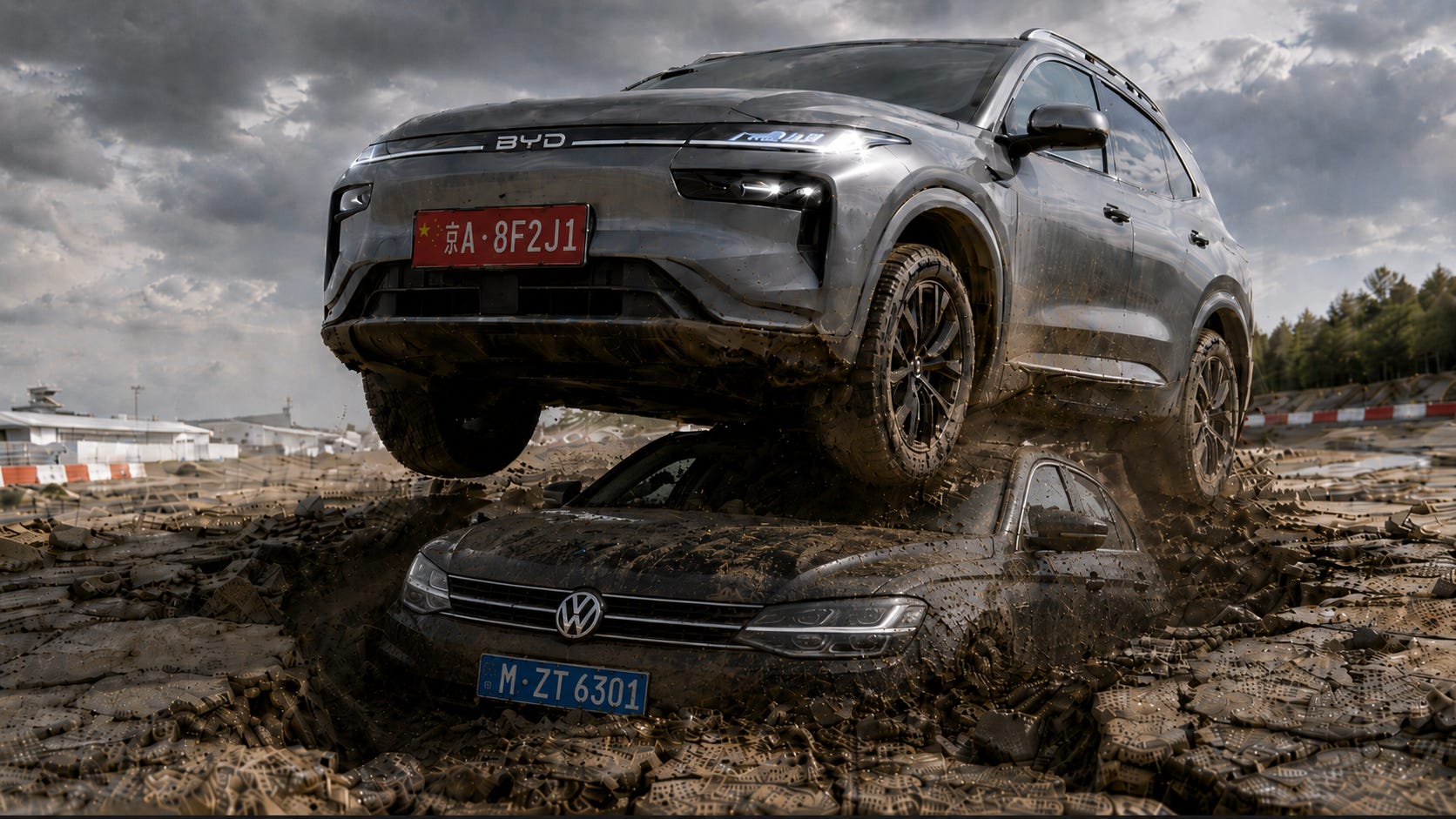
The Nanjing plant is quiet now. Built in 2008 on the outskirts of a city of nine million people, designed for 360,000 vehicles a year, it produced Volkswagen Passats and Skoda Superbs for seventeen years. By the first half of 2025, utilisation had collapsed. The assembly lines that once ran three shifts were running fragments of one. In July, Volkswagen and its partner SAIC announced the closure. The building remains. The workers have dispersed. The machinery sits.
Seventy kilometres away, in Yizheng, Passat production continues in a smaller facility. But the Nanjing plant itself, too dense in its urban setting to be extended or converted for electric vehicle production, has become something else entirely: a monument to a strategy that assumed Western brands would always be the tenants and Chinese firms would always be the landlords. That assumption inverted sometime around 2023. By 2025, the inversion was complete.
The dominant narrative frames what is happening in the global auto industry as competition. Chinese electric vehicles are cheaper, the story goes, so they win market share. The real story is not competition. It is architectural capture. Chinese manufacturers have not merely won the price war. They have acquired control of the stack: batteries, lithium refining, platform engineering, and increasingly the physical factories and brand nameplates of their Western predecessors. The question for the next five years is not who sells more cars. It is whether Western legacy manufacturers survive as independent companies or become what their Chinese counterparts once were to them: licensed assemblers operating on someone else’s architecture.
A senior auto-sector strategist at one of London’s largest pension fund consultancies spent the first week of May updating her coverage model for European legacy OEMs. The numbers she was running told a story that her clients, holding billions in Volkswagen, Stellantis, and BMW equity, were not yet pricing. Every quarter, the model showed the same directional shift: Chinese manufacturers gaining share not through a single dramatic event but through a slow, compounding infiltration of the value chain that left the headline brand names intact while hollowing out the economic substance beneath them.
The scale of the infiltration is now measurable. BYD sold 4.6 million vehicles globally in 2025, making it the first Chinese manufacturer to enter the global top five by volume. Of those, 1.05 million were exported, a 145 percent increase year on year. Geely’s holding company, which controls Volvo, Polestar, Lotus, Zeekr, and Lynk and Co, moved 4.1 million units. Chery exported 1.34 million vehicles, roughly 48 percent of its total production, maintaining its position as China’s largest passenger vehicle exporter for the twenty-third consecutive year. These are not niche players entering Western markets cautiously. They are industrial conglomerates operating at a scale that matches or exceeds the legacy brands they are displacing.
The displacement operates through three interlocking forces. The first is vertical control of inputs. China commands more than 70 percent of global lithium refining capacity. BYD manufactures its own batteries, holding 16.4 percent of the global EV battery market in 2025, second only to CATL. Together, those two Chinese firms account for more than 55 percent of all EV batteries installed worldwide. When Toyota sells its bZ3X in China at a starting price of 99,800 yuan, roughly 14,500 dollars, with 65 percent or more of its components sourced from Chinese suppliers and only one percent imported, it is not competing with BYD. It is renting BYD’s supply chain and calling the result a Toyota.
The second force is the acquisition of Western physical assets through patient capital deployment. BYD began trial production at its Szeged plant in Hungary in January 2026, with series production commencing in the second quarter, targeting annual capacity of 200,000 to 300,000 vehicles. Chery’s joint venture occupies the former Nissan factory in Barcelona’s Zona Franca, targeting 50,000 vehicles by 2027 and 150,000 by 2029, employing the same workers Nissan left behind. Geely does not need to build European factories. It bought Volvo in 2010 and now distributes Chinese-engineered vehicles through a Swedish marque that European consumers trust implicitly.
The third force is the tariff arbitrage that makes the first two inevitable. The European Union imposed countervailing duties on Chinese-manufactured EVs in October 2024: 17 percent on BYD, 18.8 percent on Geely, 35.3 percent on SAIC. The duties were designed to protect European manufacturers. Instead, they are accelerating Chinese capital investment into European soil. A BYD vehicle manufactured in Szeged pays zero countervailing duty. A Chery vehicle assembled in Barcelona pays nothing extra. The tariff wall, built to keep Chinese cars out, has become the incentive that brings Chinese factories in. The higher the wall, the faster the capital crosses it through the gate marked “local production.”
The pension fund strategist in London saw this pattern clearly. Her model showed that within three years, every major Chinese EV manufacturer would have European production capacity sufficient to serve the entire EU market from inside the tariff perimeter. The wall would still be standing. It would simply have nobody left to keep out.
The evidence is accumulating across geographies simultaneously. In Australia, BYD’s Sealion 7 outsold the Tesla Model Y in April 2026 by more than two to one: 1,780 deliveries against 822. BYD became Australia’s second-best-selling auto brand that month, behind only Toyota, with registrations up 140 percent year on year. In Thailand, Chinese manufacturers command approximately 85 percent of the EV market. In Southeast Asia broadly, the displacement is so complete that the competitive question has shifted from “can Chinese brands win?” to “which Chinese brand wins against which other Chinese brand?”
Meanwhile, the legacy brands are contracting. Nissan ceased production at its Wuhan plant by March 2026 after barely producing 10,000 vehicles annually from a facility designed for 300,000. The company is forecasting a record net loss of up to 750 billion yen. Stellantis has experienced an average annual decline of 4 percent in global vehicle sales since 2022. General Motors’ worldwide market share fell to 6.7 percent in 2024, its lowest level in a decade. The pattern is not cyclical. It is structural. Factories closing in China. Market share eroding in Europe. Margins compressing everywhere the Chinese supply chain reaches, which is everywhere.
If you are allocating capital to this sector, the probability distribution for 2030 resolves into three worlds. The most likely path, at roughly forty-five percent, is managed decline. Western legacy OEMs survive as independent listed entities but become increasingly reliant on Chinese battery technology, Chinese platform engineering, and Chinese joint ventures for their electric vehicle programmes. Volkswagen’s extension of its SAIC partnership to 2040 is the template. Toyota’s bZ3X, built almost entirely on Chinese components at a Chinese price point, is the product archetype. You still see the Western badge on the car. The economic value accrues to the supply chain beneath it, which is Chinese. In this world, legacy OEM equity is a slow bleed rather than a crash: margins compress, R&D spend cannot keep pace, and the stocks trade at permanent discounts to replacement value.
At thirty percent, the inversion accelerates. One or more major Western legacy OEMs, most likely Stellantis or Nissan, enters a formal restructuring or is acquired by a Chinese consortium before 2030. The European production facilities they own become Chinese manufacturing capacity under a new parent. Brand nameplates survive but ownership transfers. The EV transition becomes the mechanism through which Chinese industrial conglomerates achieve what Japanese manufacturers achieved in the 1980s: permanent structural dominance of a sector that the West assumed would always belong to it. If you hold concentrated positions in legacy auto equity, this is the scenario that produces a discontinuous repricing.
At twenty-five percent, policy intervention arrests the inversion. The EU moves beyond tariffs toward outright ownership restrictions on automotive assets, mirroring the approach the United States has taken with its 135 percent tariff wall on Chinese EVs. European governments designate automotive manufacturing as critical infrastructure and block Chinese acquisitions of dormant factories. In this world, the architectural inversion still proceeds in Asia, Africa, and Latin America, but the European and North American markets become walled gardens where legacy OEMs survive through regulatory protection rather than competitive capability. The stocks rally on the intervention, but the underlying technology gap widens with every year the wall stands.
What shifts the probabilities across these scenarios is the pace of European factory announcements. Every new BYD, Chery, or SAIC facility that breaks ground inside the EU moves probability from the twenty-five percent intervention scenario toward the forty-five percent managed decline. The political window for ownership restrictions narrows each time a Chinese manufacturer hires a thousand European workers. Szeged employs 960 locals today. Barcelona will employ 1,250 former Nissan workers by year end. Each hire is a vote against intervention.
The May 12 EU Commission meeting on the future of the automotive industrial strategy is the first tripwire. Watch for language distinguishing between tariffs on imports, which are already in place, and restrictions on inbound investment, which would signal a shift from the current framework. Watch BYD’s Q1 2026 earnings call in late May for updated European capacity guidance. If Szeged’s ramp exceeds 5,000 units per month by June, the timeline for full capacity moves forward by a year. Watch Volkswagen’s capital markets day on June 4 for any announcement of expanded Chinese technology licensing, which would confirm the managed-decline path is accelerating. Watch Thailand’s mid-year auto registration data in July for evidence of whether 85 percent Chinese market share has a ceiling.
The London strategist finished her model update on a Friday afternoon. The output was a single number: the year by which her base case showed zero Western legacy OEMs operating a fully independent EV platform without Chinese supply-chain participation. The number was 2029. She had run the model expecting 2032. The inputs had not changed dramatically from quarter to quarter. They had compounded.
She thought of the Nanjing plant. A factory built for 360,000 cars a year, making almost none of them when it closed. BYD shipped a million overseas in the same period. The arithmetic was simple. What it described was not competition. It was succession.
ANNEX: WHAT DOES THE CHINESE AUTOMOTIVE STACK MEAN FOR YOUR PORTFOLIO?
Three scenarios for Western legacy OEM positioning through 2030, summing to 100 percent.
Managed Decline: 45%
If you hold European or American legacy auto equity, this is the world where you own a slowly depreciating asset rather than a collapsing one. Volkswagen, Toyota, and BMW continue operating as independent listed companies through 2030, but their EV margins compress annually as Chinese battery costs fall faster than their own. R&D spending cannot match the output of vertically integrated Chinese competitors. Joint ventures with Chinese firms, which already provide the battery and platform technology for their most competitive products, become the default rather than the exception. Your position loses value at roughly 5 to 8 percent per year in real terms, offset partially by dividends that the boards maintain for as long as cash flow permits. This is not a crash. It is a decade of slow water damage.
Track the ratio of Chinese-sourced components in new Western EV launches. If Toyota, Volkswagen, or Stellantis announce any 2027 model with more than 70 percent Chinese-origin content, this scenario confirms. Probability of confirmation by end 2027: 55 percent. At the 3-month horizon, probability of a legacy OEM announcing expanded Chinese technology licensing: 40 percent. At 12 months, probability that at least two Western OEMs formally abandon independent EV platform development: 30 percent.
Accelerated Inversion: 30%
If you are short legacy auto or long Chinese manufacturer equity, this is the scenario where the trade pays before 2030. One or more Western OEMs enters formal restructuring, is acquired, or announces a strategic partnership that amounts to Chinese operational control under a Western brand name. Nissan, already forecasting record losses and closing Chinese plants, is the most likely first mover. Stellantis, with annual declines compounding since 2022, is next. The restructuring triggers a repricing across the entire sector as the market recognises that the competitive dynamics are not cyclical but terminal for the weakest players. Your short position delivers 40 to 60 percent returns. Your long Chinese manufacturer position benefits from the acquired distribution networks and brand equity.
Track Nissan’s quarterly cash flow statements and Stellantis’s European market share data. If Nissan reports negative free cash flow for two consecutive quarters in 2026, or if Stellantis’s European share drops below 14 percent, this scenario’s probability increases to 40 percent. At 3 months: probability of a formal restructuring announcement from a top-ten global OEM: 15 percent. At 12 months: 35 percent.
Policy Arrest: 25%
If you believe European and American governments will intervene before the inversion completes, this is the world where legacy auto equity rallies on regulatory protection. The EU moves beyond import tariffs toward investment screening specifically targeting automotive acquisitions. The United States maintains its 135 percent tariff wall. Legacy OEMs survive in protected regional markets but the technology gap widens annually. Your long position in European auto benefits from the intervention premium but suffers from the widening capability gap. This is a trade that works for 18 to 24 months before the protected companies begin losing even their home-market customers to locally manufactured Chinese alternatives.
Track the EU Commission’s automotive industrial strategy communications. If language shifts from “level playing field” to “strategic autonomy” or “critical industrial infrastructure” in reference to automotive assets, the regulatory window is opening. Probability of formal EU investment screening for automotive by end 2026: 20 percent. At 3 months: probability of a specific EU statement on Chinese automotive investment: 35 percent. At 12 months: probability of binding ownership restrictions: 25 percent.
Sources:
Gasgoo, “BYD wraps up 2025: global sales 4.6 million, overseas market becomes new growth engine,” January 2026.
Geely Holding Group, “Geely Holding Brands 2025 Sales Reach Record 4.11m Units, Up 26% YoY,” January 2026.
Dubicars, “Chery Exports 1.34 Million Vehicles in 2025, 23-Year Export Leader,” January 2026.
Euronews, “Volkswagen and Chinese partner SAIC to close Nanjing production plant,” July 2025.
Electrive, “BYD begins passenger car trial production in Hungary,” February 2026.
Automotive News, “Chery to start production in Spain this year in old Nissan plant,” February 2026.
EU Commission, Implementing Regulation 2024/2754, Countervailing Duties on Battery Electric Vehicles from China, October 2024.
CnEVPost, “Global EV battery market share in 2025: CATL 39.2%, BYD 16.4%,” February 2026.
CarExpert, “VFACTS April 2026: Rising EV, PHEV demand boosts new-vehicle market, BYD takes second spot,” May 2026.
Electrek, “Toyota sells this EV in China for $15,000, using nearly 90% local parts,” March 2026.
Automotive Logistics, “Nissan is to cease Wuhan production by March 2026,” 2025.
Visual Capitalist, “China Still Dominates Critical Mineral Refining in 2030,” 2025.
IEA, “Global EV Outlook 2025: Trends in electric car markets,” 2025.
Carbon Credits, “China Now Controls 69% of the Global EV Battery Market,” 2025.
Disclaimer: This report is published by Scenarica Intelligence for informational purposes only. It does not constitute investment advice, a solicitation to buy or sell any financial instrument, or a recommendation regarding any particular investment strategy. Scenarica Intelligence is not a registered investment adviser or broker-dealer. All scenario probabilities and assessments represent the analytical judgment of Scenarica Intelligence and are subject to change without notice. Past performance of any asset or strategy discussed does not guarantee future results. Readers should conduct their own due diligence and consult with qualified financial advisers before making investment decisions.
Scenarica Premium: The full Scenarica suite includes Geopolitics, Economy, Bitcoin, AI, and Sunday Edition.
Scenarica Intelligence
We don’t predict the future. We price it.
That’s a fair analysis of the situation. China has been strategic for some time now. EU has been bureaucratic. Not sure how easy is to revert the direction of the flow. So I think your probabilities look reasonable.