

The Ouroboros
Meta Is Firing Workers to Fund the Machines That Replace Them, and the Loop Has No Off Switch

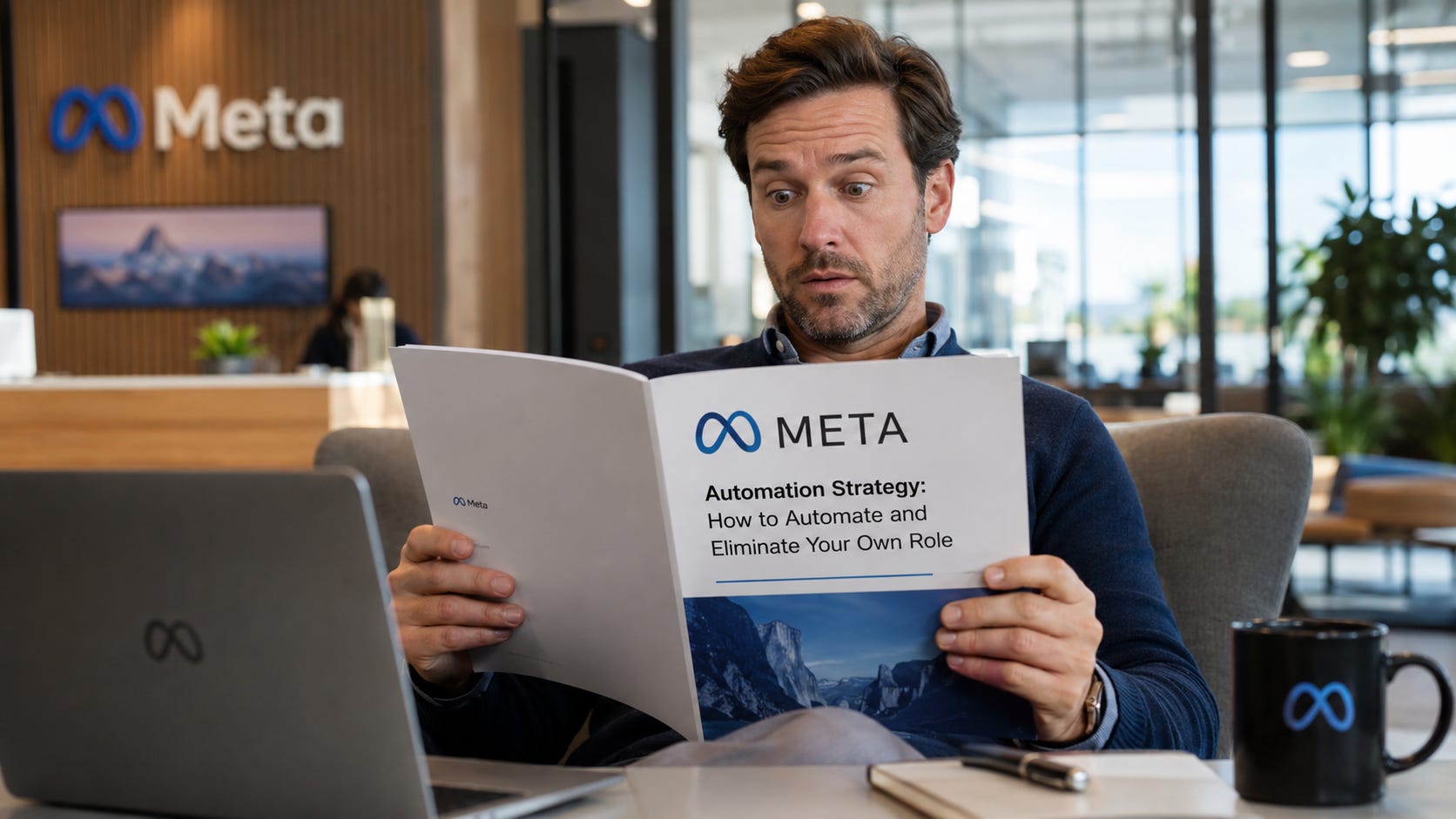
The notification arrived at 4:00 AM local time. It was a calendar invitation, automatically generated, for a fifteen-minute meeting with a human resources representative the recipient had never spoken to. The subject line contained no words. It contained a case number. Across Meta’s global offices, from Menlo Park to London to Singapore, eight thousand of these calendar invitations landed in employee inboxes on May 20, each one generated by the same internal system, each one the output of a performance monitoring tool called the Model Capability Initiative. The MCI tracks mouse movements, clicks, keystrokes, and screen activity across workplace applications. It was designed to train AI systems on how employees perform digital tasks. On May 20, it performed its final function for eight thousand of them: it identified which humans to replace.
On the same day, Meta confirmed that its 2026 capital expenditure guidance had been raised to $125 billion to $145 billion, the upper end representing roughly five times what the company spends on its entire human workforce. Mark Zuckerberg told investors on the most recent earnings call that one or two people can now build something in a week that previously required dozens of people and months of work. Read those two announcements as a single sentence. Meta is financing the machines that replace its workers by firing its workers. The savings from the layoffs fund the infrastructure that makes the next round of layoffs possible.
This is the mechanism the article names: a self-reinforcing feedback loop between workforce reduction and AI investment that has no precedent in corporate history and no natural stopping point. Fire workers. Automate their workflows. Collect the usage data the automation generates. Use the data to improve the AI. Deploy the improved AI to handle more complex tasks. Identify the next tranche of workers whose roles the AI can now absorb. Fire them. The loop closes. The next iteration begins. Each cycle is faster and cheaper than the one before it because each cycle produces the training data that makes the next cycle more efficient.
Previous automation waves in manufacturing, banking, and retail replaced workers in one department while the company continued hiring in others. Robots displaced assembly line workers at General Motors in the 1980s, but GM hired more engineers, more software developers, more supply chain managers. ATMs reduced the number of bank tellers per branch, but banks opened more branches and hired more relationship managers. The substitution was partial and the institutional response was reallocation. Meta’s 2026 is structurally different. The company is cutting across every non-AI function simultaneously: content moderation, customer support, quality assurance, project management, marketing, cybersecurity. It is redirecting approximately 7,000 remaining employees into AI-focused roles, according to Meta’s chief people officer Janelle Gale. And it is spending more on AI infrastructure than its entire remaining human payroll. The ratio is 5.4 to 1. For every dollar Meta spends on a human worker, it spends $5.40 on the infrastructure designed to make that worker unnecessary.
That ratio has never existed at any company at any point in industrial history.
Even during peak factory automation in the automotive industry, capital spending on robots never exceeded labour spending by this margin, because robots required human operators, maintainers, programmers, and supervisors. The robot could weld a chassis but it could not debug its own control software, rewrite its operating procedures when the model year changed, or negotiate with a parts supplier when a shipment was delayed. AI does not share those constraints. The entire premise of the Meta experiment is that AI can eventually handle not just the routine cognitive work but the supervisory, coordinative, and judgment-laden work that kept humans in the loop during every previous automation cycle.
The stock market’s response to the experiment was immediate and unambiguous. Meta’s share price rose on the layoff announcement. This is not a passive observation. It is an active endorsement that creates a second feedback loop running in parallel with the first. Stock price rises on layoff announcement. The rise validates the strategy in the eyes of the board and the market. The validation encourages replication by other companies. More companies replicate. More layoffs follow. More AI spending follows. Stock prices rise across the sector. The market is not merely observing the experiment. It is reinforcing it.
Over 1,000 Meta employees signed petitions against the Model Capability Initiative before the layoffs began, according to reporting by InsightCrunch and TechJournal. The petitions protested the use of workplace surveillance data to train AI systems that would then be used to eliminate the jobs of the workers being surveilled. The employees who signed understood the mechanism. They could see the loop forming around them: their keystrokes were training the models, the models were learning their workflows, and the workflows would soon not require them. The petitions were acknowledged by management. They changed nothing. The market’s verdict, expressed in the stock price, carried more weight than the workforce’s objection, expressed in signatures.
The human resistance data point matters not because it will alter the outcome but because it documents what institutional knowledge looks like at the moment it is about to be destroyed. The content moderators who were cut understood Meta’s community standards in ways that no training dataset fully captures. The quality assurance engineers who were cut understood the edge cases in Meta’s codebase that no automated test suite has been written to cover. The project managers who were cut understood the informal dependencies between teams that no organisational chart reflects. This knowledge left the building on May 20. It did not leave behind a manual. It left behind a gap, and the gap is precisely the kind of gap that AI must now fill, which produces precisely the kind of usage data that improves the AI, which brings the loop back to its starting position.
The question the Nvidia contradiction forces into the analysis is whether the loop is economically rational at current prices or whether the entire experiment is a forward bet on cost curves that have not yet materialised. Bryan Catanzaro, Nvidia’s vice president of applied deep learning research, told Axios in April that for his team, the cost of compute is far beyond the costs of the employees. This is a remarkable admission from the company that manufactures the hardware on which the experiment depends. It means that Meta, and every other company replicating the pattern, is currently paying more for AI than it was paying for the humans the AI replaced. The substitution is not yet economically rational. Companies are firing cheaper inputs and buying more expensive ones because they are betting that the more expensive input will become cheaper faster than the cheaper input will become more productive.
The most probable outcome, weighted at 40 percent, is the one that keeps the sophisticated reader awake at night not because it is catastrophic but because it is ambiguous. If you are running a portfolio with exposure to the AI infrastructure trade and you are watching Meta’s Q3 2026 earnings for validation, this is the scenario that refuses to give you a clean signal. The loop produces dysfunction. AI systems make errors that the remaining human workforce cannot catch because the institutional knowledge required to identify those errors left with the people who were fired. Customer satisfaction scores drift downward. Product velocity slows because the AI handles the routine tasks efficiently but stalls on the cross-functional coordination that the project managers used to navigate informally. Revenue holds because the cost cuts mask the quality degradation. Earnings look acceptable. The underlying product is quietly deteriorating. The loop does not stop. It pauses, because Meta discovers that some of the functions it eliminated were load-bearing in ways the performance monitoring system was not designed to measure.
At 35 percent, the loop works. If you are a chief executive studying Meta’s playbook for replication, this is the scenario that justifies the memo to your board. Q3 shows genuine productivity gains. Revenue per remaining employee rises 15 to 30 percent. The AI handles the automated workflows without catastrophic errors. Quality metrics hold or decline within acceptable tolerances. Meta’s template is validated. The implication is immediate: every S&P 500 company with significant knowledge-worker headcount begins replication planning before the Q3 call ends. A second wave of 200,000 or more layoffs follows in 2027 across finance, consulting, legal, and media.
At 25 percent, the loop stabilises at a new equilibrium. If you are a labour economist or a workforce strategist, this is the scenario that maps most closely to how previous automation waves resolved. Meta discovers that approximately 30 to 40 percent of its pre-layoff workforce was genuinely replaceable by AI, and the remaining 60 to 70 percent was not. Headcount settles at a permanently lower level. The AI handles routine cognitive work. Humans handle judgment, creativity, negotiation, and cross-functional coordination. The augmentation thesis proves correct, but with a significant and permanent human cost during the transition. The workers who were displaced do not return to equivalent roles. They find employment elsewhere, at lower salaries, after longer search periods.
Meta’s experiment is not occurring in isolation. Intuit announced 3,000 layoffs on the same day as Meta’s, cutting 17 percent of its workforce while simultaneously signing multi-year AI partnerships with Anthropic and OpenAI. Atlassian cut 1,600 positions in March, concentrated in content, support, and quality assurance, and hired 800 AI engineers, a net reduction of 800 people but a complete reshaping of what the company pays for. Oracle began notifying between 20,000 and 30,000 employees in late March, according to TD Cowen estimates, via 6:00 AM termination emails. Amazon eliminated approximately 16,000 corporate positions in January. In total, more than 140,000 tech workers have been laid off in 2026 alongside $725 billion in combined capital expenditure from the four hyperscalers alone, according to reporting by 24/7 Wall Street and Trueup tracking data.
The pattern across every company is identical. Cut the humans. Redirect the budget to AI. Hire a smaller number of AI specialists to maintain the systems that replaced the larger number of generalists. Declare the restructuring necessary for the AI transition. Watch the stock respond.
The broader question is whether Meta has invented a template or an error. The Nvidia contradiction suggests the substitution is not yet cost-effective. The stock market endorsement suggests the market does not care about current cost-effectiveness because it is pricing future cost curves. The employee petitions suggest the institutional knowledge being destroyed may not be recoverable. The Q3 earnings call will be the first full quarter reflecting simultaneous mass layoffs and AI deployment at Meta’s scale. Revenue per remaining employee is the number that will determine which scenario the market prices for the next cycle.
Watch for Meta’s Q3 2026 earnings, expected in late October, for the first clean read on revenue per remaining employee after the restructuring. If the number rises 15 percent or more, replication announcements from other major tech companies will follow within weeks.
Track customer satisfaction and product quality metrics at Meta through the summer. A decline in App Store ratings, advertiser satisfaction surveys, or content moderation effectiveness would be the earliest signal that the loop is producing dysfunction faster than it is producing efficiency.
Monitor competitor announcements through Q3. If Google, Microsoft, or Amazon announce layoff-and-redirect programmes that explicitly cite Meta’s model, the template has been validated by imitation before the earnings data arrives.
Follow Nvidia’s inference pricing trajectory through the second half of 2026. If the cost of running AI workloads at Meta’s scale falls 30 percent or more by year end, the economic rationale for the substitution shifts from forward bet to current reality. If costs hold or rise, the 5.4-to-1 ratio becomes harder to sustain.
The ouroboros, the ancient serpent consuming its own tail, was a symbol of eternal renewal in Egyptian and Greek mythology. The creature sustains itself by eating itself, a closed loop with no beginning and no end. Meta’s version of the loop is less mythological and more mechanical: fire the workers, train the models on their workflows, deploy the models, identify the next workers to fire. The serpent does not know whether it is feeding itself or destroying itself. It will not know until Q3. Neither will the market.
ANNEX: WHAT HAPPENS WHEN THE SERPENT FINISHES ITS TAIL?
Meta’s simultaneous 8,000-person layoff and $125 to $145 billion AI infrastructure investment have created a self-reinforcing loop between workforce reduction and AI deployment. The three scenarios below represent Scenarica’s probability-weighted assessment of how Meta’s experiment resolves through Q3 2026 and beyond. They sum to 100 percent.
Dysfunction Loop -- 40%
If you are an institutional investor holding Meta through Q3 and you are trying to determine whether the restructuring improved or degraded the company’s operating capacity, this is the scenario that produces the most uncomfortable earnings call. The AI systems handle routine workflows competently but fail on edge cases that require the institutional knowledge the fired employees carried. Content moderation errors increase. Product launches slow because the informal coordination networks that connected teams were severed when the project managers were cut. Revenue holds because cost savings mask quality degradation. The stock trades sideways. The loop does not reverse because reversing it would mean admitting the layoffs were premature, which would destroy more shareholder value than the quality degradation. Meta enters a period of quiet institutional decay that is invisible in the headline numbers and visible only in the product.
Variable to watch: Meta’s content moderation error rate and advertiser satisfaction metrics, tracked through Q3 and Q4 2026. If content moderation incidents requiring public response increase by 20 percent or more relative to Q1 2026 baseline, this scenario’s probability rises to 50 percent. Also track Glassdoor ratings and employee sentiment surveys for remaining Meta employees. A decline of 0.5 points or more in overall rating by September would signal internal dysfunction. At the 3-month horizon, there is a 55 percent chance content quality metrics show measurable degradation. At the 12-month horizon, there is a 45 percent chance Meta reverses some portion of the cuts through targeted rehiring in specific functions.
Validated Template -- 35%
If you are a chief executive at a Fortune 500 company with 10,000 or more knowledge workers and you have been waiting for proof that the AI substitution works before presenting a restructuring plan to your board, this is the scenario that gives you the slide deck. Meta’s Q3 earnings show revenue per remaining employee up 15 to 30 percent. AI-driven workflows handle 80 percent of the tasks previously performed by the eliminated roles without measurable quality loss. The stock rises on the earnings beat. Within 60 days of the call, at least three other S&P 500 companies announce similar restructuring programmes explicitly modelled on Meta’s approach. The second wave of AI-driven layoffs begins in Q1 2027 and is larger than the first.
Variable to watch: Meta’s Q3 2026 revenue per employee, calculated as total revenue divided by average headcount for the quarter. Baseline: Meta’s Q1 2026 revenue per employee was approximately $590,000 annualised. If Q3 shows $680,000 or above, the template is validated. At the 1-month horizon after Q3 earnings, there is a 60 percent chance at least one major competitor announces a similar programme. At the 12-month horizon, there is a 50 percent chance that total tech industry layoffs in 2027 exceed 200,000, driven by Meta-template replication.
Equilibrium Reset -- 25%
If you are a workforce strategist, a labour economist, or a policy adviser evaluating the long-term employment effects of AI-driven restructuring, this is the scenario that matches the historical pattern of every previous automation wave. Meta discovers through trial and operational friction that approximately 30 to 40 percent of the eliminated roles were genuinely replaceable by AI and the remaining 60 to 70 percent were not. The company quietly rehires or contracts for specific functions, particularly in content moderation, cross-functional coordination, and customer-facing support, where AI performance falls short of human capability in nuanced situations. Headcount stabilises at a permanently lower level but not at the level the May 2026 cuts implied. The augmentation thesis proves correct: AI handles the routine, humans handle the judgment calls. The transition cost is borne entirely by the displaced workers, whose re-employment takes an average of 6 to 9 months and comes at salaries 15 to 25 percent below their Meta compensation.
Variable to watch: LinkedIn job posting data for roles matching the titles and skill sets of Meta’s laid-off employees. If more than 40 percent of displaced workers have accepted new positions within 6 months at 85 percent or more of their prior compensation, the labour market is absorbing the shock without structural damage. If fewer than 25 percent have found comparable roles by November 2026, the displacement is structural rather than frictional. At the 3-month horizon, there is a 40 percent chance Meta posts job listings in at least two of the functional areas it cut. At the 12-month horizon, there is a 55 percent chance Meta’s total headcount is higher than its immediate post-layoff level but still 15 to 20 percent below its pre-layoff peak.
Sources:
Al Jazeera, “Meta cuts 8,000 jobs in sweeping global layoffs,” 20 May 2026.
NPR, “Meta slashes 8,000 jobs as it pivots towards AI,” 20 May 2026.
Yahoo Finance, “Meta layoffs 2026: 8,000 jobs cut in AI restructuring,” May 2026.
IBTimes, “Mark Zuckerberg Claims One AI Worker Now Replaces Dozens as 8,000 Layoffs Loom,” May 2026.
TechJournal, “Meta Layoffs Begin Today: 8,000 Jobs Cut as $145B Goes to AI,” May 2026.
InsightCrunch, “Meta Layoffs May 2026: 8000 Jobs Cut, AI Pivot,” May 2026.
Fortune, “Meta just bumped its 2026 capex forecast up to as much as $145 billion,” 29 April 2026.
Data Center Dynamics, “Meta estimates 2026 capex to be between $115-135bn,” April 2026.
Fortune, “Nvidia executive: cost of compute is far beyond the costs of the employees,” 28 April 2026.
Entrepreneur, “Nvidia VP Says AI Costs ‘Far’ More Than Human Employees,” April 2026.
TechCrunch, “Intuit to lay off over 3,000 employees to refocus on AI,” 20 May 2026.
TechCrunch, “Atlassian follows Block’s footsteps and cuts staff in the name of AI,” 12 March 2026.
Yahoo Finance, “Oracle eliminates 30,000 roles in 6 A.M. layoff notice,” March 2026.
24/7 Wall Street, “Tens of Thousands of Tech Workers Are Being Laid Off in 2026. The $725 Billion That Replaced Them Is Going to Four Companies,” 7 May 2026.
Trueup, tech layoff tracker data, May 2026.
CFO Dive, “Meta sees accelerated employee compensation growth,” 2026.
Meta Platforms 10-Q, Q1 FY2026, SEC filing.
Disclaimer: This report is published by Scenarica Intelligence for informational purposes only. It does not constitute investment advice, a solicitation to buy or sell any financial instrument, or a recommendation regarding any particular investment strategy. Scenarica Intelligence is not a registered investment adviser or broker-dealer. All scenario probabilities and assessments represent the analytical judgment of Scenarica Intelligence and are subject to change without notice. Past performance of any asset or strategy discussed does not guarantee future results. Readers should conduct their own due diligence and consult with qualified financial advisers before making investment decisions.
Scenarica Premium: The full Scenarica suite includes Geopolitics, Economy, Bitcoin, AI, and Sunday Edition.
Scenarica Intelligence
We don’t predict the future. We price it.