


The number that runs the gold market is roughly a hundred to one.
For every ounce of gold actually available for delivery in COMEX vaults, the exchange carries on the order of a hundred ounces of open paper claims, and in stressed periods that coverage ratio has blown out into the several hundreds. The figure is not fixed, and it punishes anyone who quotes it too precisely, because it depends entirely on what goes in the numerator and the denominator. The honest range, documented across sources from Intelligent Partnership’s survey work to COMEX’s own vault reports, runs from the low double digits in calm markets to more than five hundred claims per deliverable ounce in a squeeze. Fewer than one in a hundred futures contracts ever ends in someone taking delivery of metal. The rest are settled the way most things on Wall Street are settled, as bookkeeping entries that cancel each other out before any gold has to move.
This is the open secret of the gold market. The price you see quoted is not really the price of gold. It is the price of paper that references gold, and there is vastly more paper than gold. The scarcity is real. The trading is synthetic. And the synthetic layer is a hundred times larger than the thing underneath it.
Bitcoin was designed to make exactly this impossible.
There will only ever be twenty-one million coins. That limit is not a promise from a custodian or a line in a prospectus. It is enforced by code that anyone can audit, on a ledger anyone can read, in real time, from a laptop. The entire point, the thing that separated Bitcoin from every currency and commodity before it, was that no bank, no exchange, and no government could ever conjure a single extra unit. You cannot print what you can count.
Then, in January 2024, Bitcoin got wrapped in an exchange-traded fund. And the wrapper does something the coin was built to prevent.
Robbie Mitchnick runs the digital assets desk at BlackRock, the firm whose iShares Bitcoin Trust is now the largest Bitcoin fund on earth. In February, he said something that landed as a warning to anyone paying attention. Bitcoin, he told CoinDesk, was increasingly trading like a “levered NASDAQ,” its price driven less by the asset itself than by the derivatives and leverage stacked on top of it. The man whose product did more than any other to legitimise Bitcoin was describing a market that had started to behave like paper.
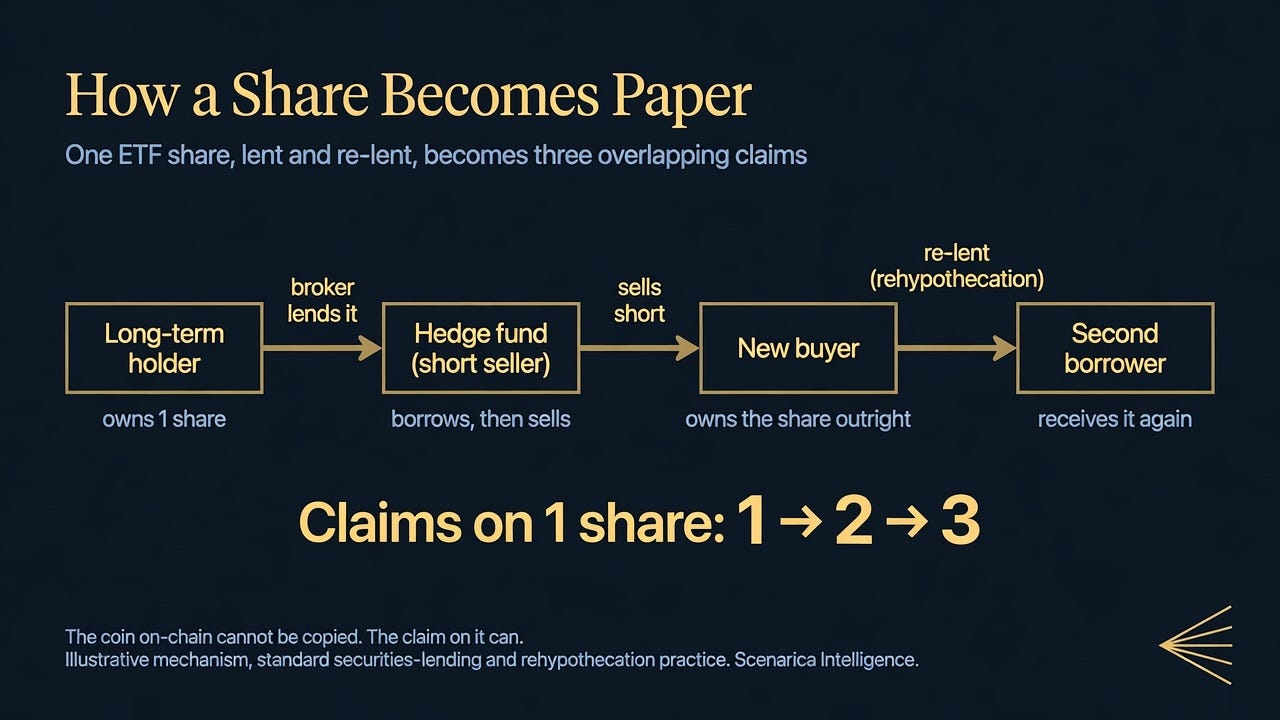
Here is the mechanism, and it is simpler than it sounds. The coins the fund owns sit on the blockchain, where supply is fixed and every unit is accounted for. But the shares of the fund do not sit there. They sit in the ordinary machinery of the stock market, and in that machinery, claims multiply. A share can be lent to a short seller. The short seller sells it to someone else. Now two people reasonably believe they own that share: the original holder, whose brokerage statement still shows it, and the buyer who just paid for it. Lend it again, layer an option on top, and the claims keep breeding. The coin cannot be copied. The claim on the coin can.
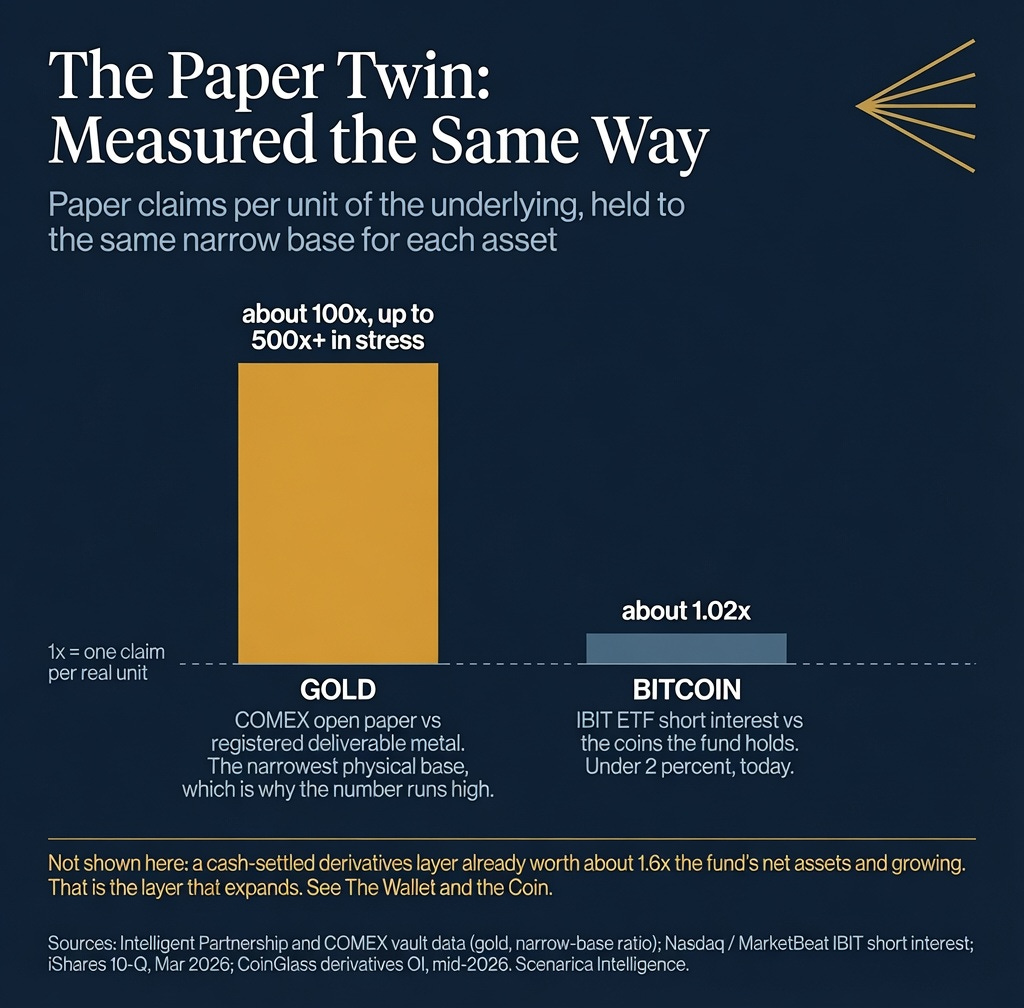
So how big is Bitcoin’s paper layer today? This is where honesty matters more than drama. As of the most recent reporting period, short interest in the iShares Bitcoin Trust stood at about 27 million shares, up from roughly 24 million, according to Nasdaq and MarketBeat data. That sounds enormous until you set it against the 1.38 billion shares the fund had outstanding at the end of March, per its own SEC filing. The shorted shares represent under two percent of the total. Translated into coins, it is on the order of fifteen thousand bitcoin of synthetic exposure standing against roughly three quarters of a million coins the fund actually holds.
Two percent is not a hundred times. It is a rounding error next to gold. If the story were simply that Bitcoin has a paper problem as bad as gold’s, the story would be false, and you should distrust anyone selling it to you.
But that is not the story. The two percent also measures only one layer, the lending of ETF shares, and says nothing about the cash-settled derivatives stack sitting beside the fund, which is already a different order of magnitude. The story is the direction, and the machinery.
Gold’s paper market did not begin at a hundred to one. It began at close to one to one, in an age when a banknote was a receipt for metal you could walk in and collect. The multiple grew over decades, quietly, as each new layer of financial convenience was added and each one proved profitable, until the paper market became so much larger than the physical one that the paper market set the price and the metal simply followed. Nobody decided to build a hundredfold claim structure. It accreted, one reasonable step at a time.
Bitcoin has now taken the first of those steps. The wrapper exists. The lending desks are open. The short interest is real and rising. The derivatives stack, as Mitchnick warned, is already large enough to move the price of the thing it references. What keeps Bitcoin’s multiple near one instead of near a hundred is not any law of nature. It is a small set of frictions that happen, for now, to hold: coins can be redeemed for real bitcoin rather than cash, the holdings are disclosed daily, and anyone can verify on-chain that the coins are actually there. Those frictions are exactly the things financialisation is very good at wearing away.
The coin still cannot be printed. That was always true and remains true. But verifiable scarcity turns out to be a property of the coin, not of the claim on the coin, and the market increasingly trades the claim. Bitcoin’s great innovation was to make the ledger the source of truth. The ETF quietly moved a growing share of the action off that ledger, into a system where truth is a brokerage statement and brokerage statements can overlap.
The thing built to make paper money impossible has grown a paper version of itself. It is still small. The machinery for it to stop being small is now fully assembled, legally blessed, and profitable to run.
The Deep Dive
What remains is the part the headline number hides: how the synthetic layer actually forms, who profits from minting it, why the exact reform that was celebrated as a milestone last summer also removed a brake, where the gold parallel holds and the precise point where it breaks, and which of four futures the next year most likely delivers. The two percent is a snapshot. The forces that decide whether it stays two percent or becomes twenty are what a serious position has to price.
Start with the plumbing, because the plumbing is where the paper is made.
When you buy a share of a Bitcoin ETF, you are not buying bitcoin. You are buying a security that entitles you, through a chain of intermediaries, to a slice of a pool of bitcoin held by a custodian. That security lives in the Depository Trust Company and moves through the same prime brokerage system as any other stock. And that system has an entire industry, securities lending, whose business is to take a share sitting idle in one account and lend it to someone who wants to sell it short, for a fee split between the lender, the broker, and the fund. BlackRock, like most large asset managers, runs a securities-lending operation. The same institution that built the vehicle can earn a spread lending out the vehicle’s shares.
Follow one share through that process. It begins in a long-term holder’s account. The broker lends it to a hedge fund, which sells it short to a third party who now holds it outright. The original holder’s statement still shows the share, because the loan is invisible to them and the broker guarantees its return. Two parties now have a legitimate claim to one share. If the short seller’s counterparty lends it out again, which prime brokerage rules in many jurisdictions permit through rehypothecation, a third claim appears. None of these people has done anything improper. Each link is a standard, regulated transaction. But the sum of the links is more ownership of the fund than the fund has shares, and more indirect claim on bitcoin than there is bitcoin in the vault.
The reason this looks harmless today is liquidity. IBIT trades something like 60 million shares on an average day, which means the 27 million shares sold short could theoretically be bought back in well under a session. Days-to-cover of roughly one is the market’s way of saying the paper can be unwound faster than it accumulated. That is true precisely as long as the market is calm and the shares are easy to find. Liquidity is not a permanent property. It is a fair-weather one, and the paper layer is invisible in fair weather and violently visible in a storm. The gap between a claim and the asset behind it never matters until the day everyone tries to close it at once.
Now layer on the part that does not even pretend to hold a coin. The lending of ETF shares is the small, honest, on-shore version of synthetic Bitcoin. The large version is the derivatives complex. Total open interest in bitcoin futures stood at roughly 42.6 billion dollars in mid-2026, down from a late-2025 peak near 95 billion, according to exchange data aggregated by CoinGlass and others, and bitcoin options open interest was reported above 30 billion dollars. Set those against IBIT’s roughly 44.9 billion dollars in net assets. The notional paper market in Bitcoin is already comparable in size to the flagship spot vehicle, and most of it is cash-settled, meaning no coin is ever posted, delivered, or even touched. A cash-settled contract is a bet on the price of Bitcoin that requires no Bitcoin to exist. It is pure claim.
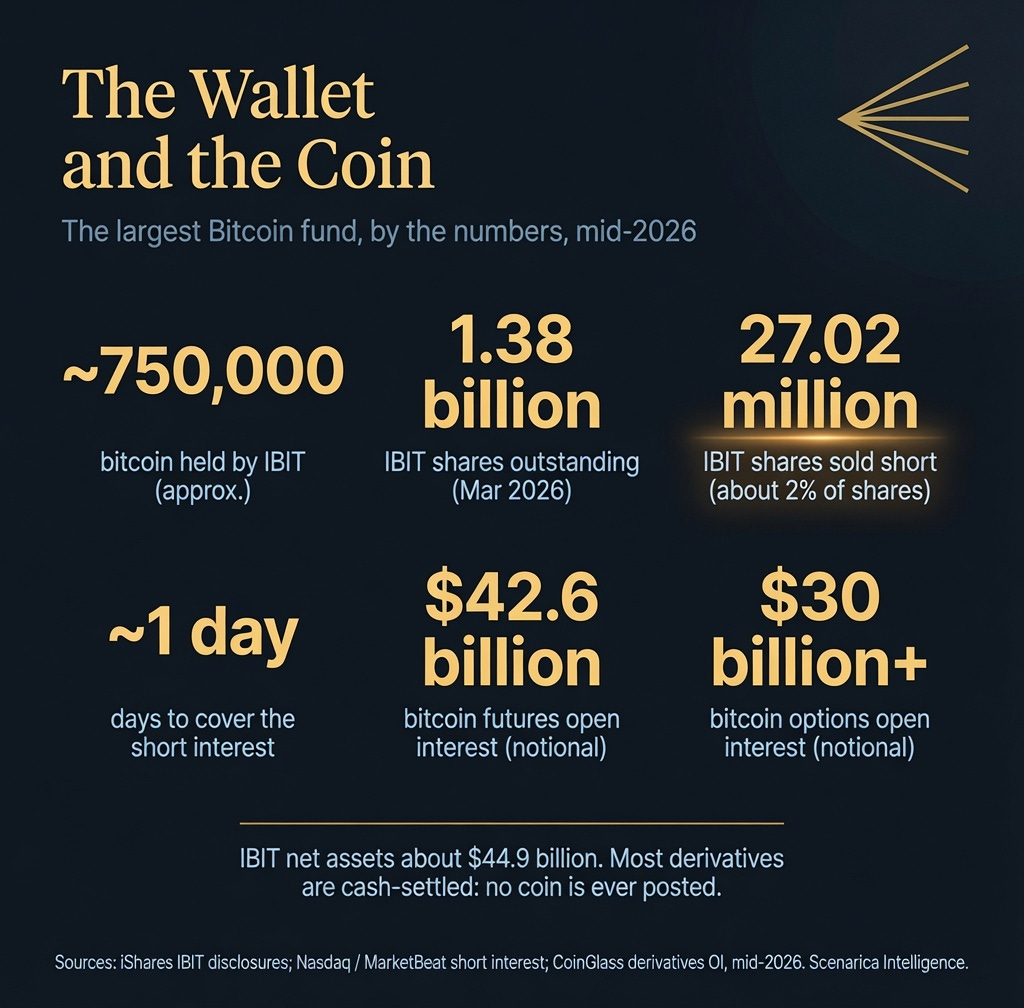
This is what Mitchnick meant by a levered NASDAQ. When the traded universe of an asset is dominated by instruments that reference the price without holding the thing, the price stops being set by people buying and selling the thing. It gets set in the paper layer, where positions are larger, leverage is available, and the marginal trade is a synthetic one. The coin becomes the settlement reference for a market that has floated some distance above it. That is not a prediction about Bitcoin. It is a description of what already happened to gold, and the mechanism is identical.
Which is where the historical parallel earns its keep, and also where it breaks, and the break is the most important thing in this article.
The gold parallel holds in every structural particular. A scarce physical asset. A financial wrapper that offers convenient exposure. A lending and derivatives ecosystem that grows on top of the wrapper. A gradual migration of price discovery from the metal to the paper. A multiple that creeps from one toward a hundred over years, never in a single dramatic step, each increment justified by liquidity and efficiency. If you had described the LBMA and COMEX systems to a gold buyer in 1975, they would have found it absurd that the paper claims would one day dwarf the metal a hundred to one. It happened anyway, quietly, because every individual step made sense.
That hundred-to-one figure is worth stating precisely, because it is the number most often quoted and most often abused. It is COMEX paper measured against registered deliverable metal, the narrowest physical base there is. Set the same paper against all the gold ever mined and the multiple all but vanishes. The number depends entirely on the base you choose, which is why the only honest comparison holds each asset to the same narrow base, paper claims against the specific metal or coins standing behind the vehicle that issues them. On that footing, gold sits in the hundreds and Bitcoin’s ETF layer sits near one, today. The comparison is not rigged in Bitcoin’s favour. It is measured the same way on both sides, and Bitcoin genuinely wins it, for now.
Here is where Bitcoin diverges, and why its paper multiple is not fated to reach gold’s. Gold cannot audit itself. No one actually knows how much registered gold sits behind the LBMA’s unallocated accounts, because unallocated gold is by definition a claim on a bank’s balance sheet rather than a specific bar, and the banks do not open the vaults for a live count. Bitcoin can be counted by anyone, at any moment, for free. The ETF’s coins sit at known addresses. The supply is fixed at the protocol level. And since July 2025, when the SEC under Chair Paul Atkins approved in-kind creation and redemption for spot Bitcoin and Ether funds, an authorised participant can hand back shares and receive actual bitcoin rather than cash, which means the paper can, in principle, always be forced back down into coin. Physical delivery is not a rare and cumbersome exception as it is on the COMEX. It is a daily, designed feature.
So Bitcoin has a structural ceiling on its paper multiple that gold never had: transparency of the underlying and cheap convertibility of the claim into the asset. That is the good news, and it is real.
The break in the parallel is that this ceiling only binds the on-shore, ETF-centred part of the market. It does nothing to the cash-settled derivatives, the offshore synthetic products, the lending chains in jurisdictions with looser rehypothecation limits, or the structured notes that pay out against Bitcoin’s price without ever holding a satoshi. That is precisely the layer that is growing fastest, and it is the layer where no coin is ever posted and no on-chain audit is possible. The July 2025 in-kind approval, celebrated across the industry as the moment Bitcoin ETFs grew up, also quietly did something else. By making the ETF wrapper more efficient and more attractive to institutions, it accelerated the migration of Bitcoin trading into exactly the financial system where synthetic claims are manufactured. The reform that made the wrapper better also made the paper factory bigger. Both things are true, and the market has priced only the first.
That is the counterparty reassessment a serious allocator has to make, and it is uncomfortable, because it points at the most credible institution in the room. BlackRock did more than any other firm to legitimise Bitcoin, and Robbie Mitchnick has been unusually candid about the leverage problem. But the firm’s own securities-lending economics, and the broader industry’s, depend on the shares being lent, which is the on-shore seed of the synthetic layer. The institution warning about the levered NASDAQ is structurally positioned to benefit from the very lending that helps build it. This is not hypocrisy. It is the ordinary incentive geometry of finance, and it is exactly the geometry that took gold from one to a hundred. The warning and the profit motive live in the same building.
So price it.
The dominant near-term outcome, and the one your positioning should assume as a base case, is that the frictions hold and the coin stays the anchor. Give this a little under half the weight, in the region of forty-six percent. The reasoning is specific rather than reflexive: in-kind redemption is newly in force, daily disclosure is mandatory, on-chain verification is trivial, and the measured synthetic layer inside the flagship vehicle is genuinely tiny at under two percent of coins with days-to-cover near one. Against a random baseline of twenty-five percent across four outcomes, this sits well above chance because three independent brakes are all currently engaged. It does not sit higher than the mid-forties because the competing drift is real and dated, and over a twelve-month window the honest read is a genuine contest between stability now and erosion later, not a settled question. Over one month, expect the paper share to stay in low single digits; over three months, watch whether short interest holds near current levels or pushes through the mid-thirty-millions of shares; over twelve months, this outcome means IBIT’s premium to net asset value stays tight and price discovery stays visibly on-chain.
The second path, and the one that should worry a long-term holder more than any crash, is the slow goldification. Assign this around twenty-seven percent. In this world nothing breaks and no headline announces it. The cash-settled derivatives complex keeps growing against a roughly stable pile of actual coins, offshore synthetic products proliferate, lending chains lengthen, and the notional paper market drifts from comparable-to-spot toward a multiple of it. Price discovery migrates, one efficient step at a time, into the layer that holds no bitcoin. You would recognise it not by a gap that suddenly opens but by a Bitcoin that increasingly trades on positioning and funding rates rather than coin supply, exactly the levered-NASDAQ behaviour already visible. The twelve-month tell is the ratio of aggregate cash-settled open interest to ETF net assets climbing steadily through the year without any single dramatic session.
Then there is the sharp corrective event, the one that is loud instead of quiet. Put it near sixteen percent. A redemption run on a specific vehicle, or a short squeeze in a thin tape, exposes a claims-versus-coins gap in one product and forces a violent repricing as everyone tries to convert paper back into coin at once. This is above a naive floor because the ingredients are present today: puts are already stacked against the sixty-thousand-dollar level on the CME, liquidity is fair-weather, and the derivatives overhang is large. It is not the base case because the on-shore vehicles have the in-kind escape valve that lets stress bleed off through redemption rather than rupture. If it fires, it fires on a timescale of days, and its signature is an ETF trading at a sharp, persistent discount to its stated net asset value while on-chain flows spike as coins are pulled toward self-custody.
The smallest branch, near eleven percent, is reassertion by design: regulators or issuers move deliberately to cap the paper layer before it matters, through mandatory on-chain proof-of-reserves standards, tighter limits on the rehypothecation of fund shares, or disclosure rules that make synthetic exposure visible and therefore constrainable. It is the least likely not because it is undesirable but because it requires foresight and coordination against a profitable status quo, and finance rarely constrains a profit center before the profit center causes a visible problem. If it happens, it most likely follows the corrective event rather than preceding it, which is the usual order in which markets get their rules.
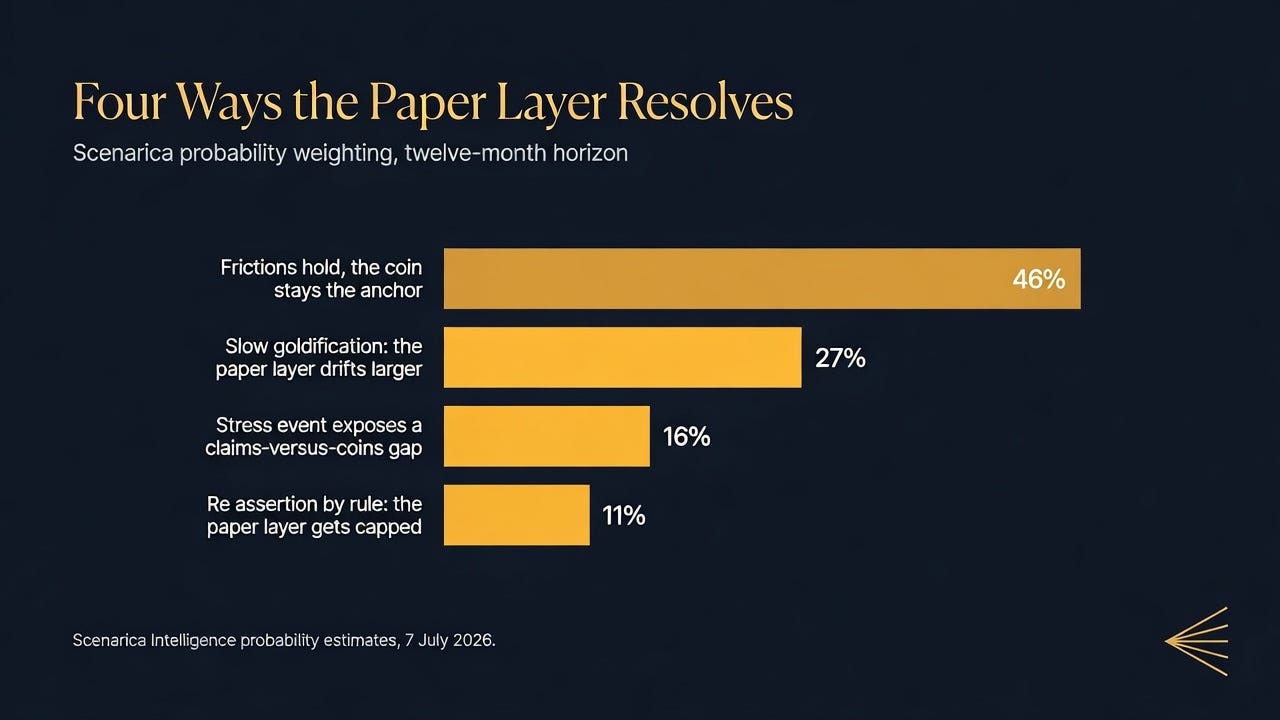
Those four exhaust the space: the paper stays marginal, the paper grows quietly, the paper breaks loudly, or the paper gets capped by rule. What would move the distribution is concrete and watchable.
Watch the next Nasdaq short-interest report for IBIT, published on the exchange’s twice-monthly schedule through July. A move from the current 27 million shares toward the high thirty-millions would be the clearest early sign that the synthetic layer is scaling rather than holding, and would shift weight from the base case toward slow goldification.
Track aggregate cash-settled bitcoin derivatives open interest against ETF net assets through the third quarter. The mid-2026 starting point is roughly 42.6 billion dollars of futures and above 30 billion in options against about 44.9 billion in IBIT assets. If the paper ratio climbs while coin holdings stay flat, goldification is underway regardless of what any single day’s price does.
Read the Bitcoin ETF quarterly filings due in August for any language about redemption backlogs, settlement delays, or in-kind processing friction. The in-kind valve is the whole reason the corrective scenario is not the base case. The first sign that the valve is sticking would reprice the tail sharply upward.
Monitor IBIT’s premium or discount to net asset value daily, not monthly. A tight band means the arbitrage that keeps claim and coin married is working. A persistent discount that will not close is the market telling you the paper and the coin have started to trade as different things.
And watch for any SEC or issuer move on proof-of-reserves or share-lending rules. Silence favors drift. Action, if it comes, is the eleven-percent branch arriving early, and it would most plausibly arrive in the wake of a scare rather than ahead of one.
Gold teaches the ending, but Bitcoin gets to choose whether to accept it. Every scarce asset that Wall Street has ever learned to love, it has eventually learned to copy, not by counterfeiting the thing but by manufacturing claims on it until the claims became the market and the thing became a footnote that settles the trade. Bitcoin is the first scarce asset in history that can prove its twin apart from itself, coin by coin, address by address, in public, at no cost. The paper version now exists. Whether it stays a curiosity or becomes the market is the only question that matters, and for the first time with any asset of this kind, the tools to answer it honestly are sitting in plain sight on a ledger anyone can open. The metal never had that. The coin does. What no one yet knows is whether transparency is a strong enough brake to stop a profit that badly wants to grow.
Sources:
Intelligent Partnership, “Paper Gold Volumes Vs Physical Gold Volumes,” accessed July 2026.
MoneyMetals, “The Precious Paper Problem: The Divergence in Western Bullion Markets,” 5 May 2026.
Nasdaq and MarketBeat, “iShares Bitcoin Trust ETF (IBIT) Short Interest,” updated June 2026.
iShares Bitcoin Trust ETF, Form 10-Q, filing for period ending 31 March 2026, U.S. Securities and Exchange Commission.
BlackRock iShares, “iShares Bitcoin Trust ETF (IBIT)” product and net-asset data, June 2026.
CoinDesk, “BlackRock’s head of digital assets warns leverage-driven volatility risks undermine Bitcoin’s institutional narrative,” 13 February 2026.
U.S. Securities and Exchange Commission, “SEC Permits In-Kind Creations and Redemptions for Crypto ETPs,” Press Release 2025-101, 29 July 2025.
CoinGlass and exchange data, bitcoin futures and options open interest, mid-2026.
Cryptonews / Bitcoin.com, “CME Puts Dominate Bitcoin Options as Traders Bet Against $60K Floor,” 2026.
Disclaimer: This report is published by Scenarica Intelligence for informational purposes only. It does not constitute investment advice, a solicitation to buy or sell any financial instrument, or a recommendation regarding any particular investment strategy. Scenarica Intelligence is not a registered investment adviser or broker-dealer. All scenario probabilities and assessments represent the analytical judgment of Scenarica Intelligence and are subject to change without notice. Past performance of any asset or strategy discussed does not guarantee future results. Readers should conduct their own due diligence and consult with qualified financial advisers before making investment decisions.
Scenarica Premium: The full Scenarica suite includes Geopolitics, Economy, Bitcoin, AI, and Sunday Edition.
Scenarica Intelligence
We don’t predict the future. We price it.