


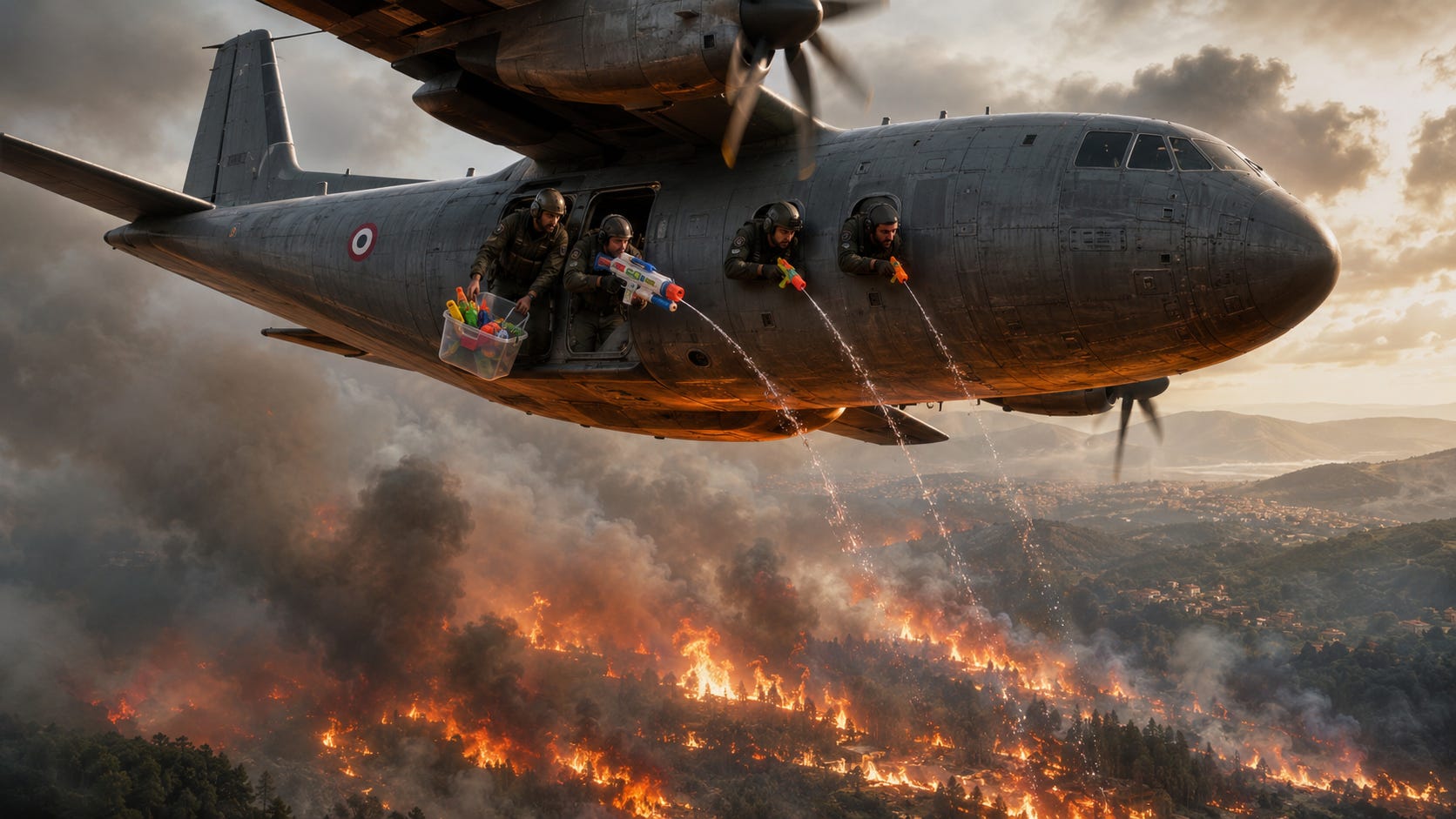
The maritime pine west of Bordeaux grows in rows, planted for resin and then for timber, and on 26 July it burns in rows. The front that started at Saumos four days earlier has covered forty-two thousand hectares and is standing roughly fifteen kilometres from the western edge of the city. As many as two hundred and twenty thousand people are out of their houses across the Gironde and the Landes. The Gironde prefecture reports seventy-five firefighters treated for injuries.
Overhead, working the flank: seven French Canadairs, two Croatian ones, two Portuguese Air Tractors, a Czech heavy helicopter, a Slovak one, and an Airbus A400M military transport flying with a bolt-in water kit, the first time a French fire has been fought with one.
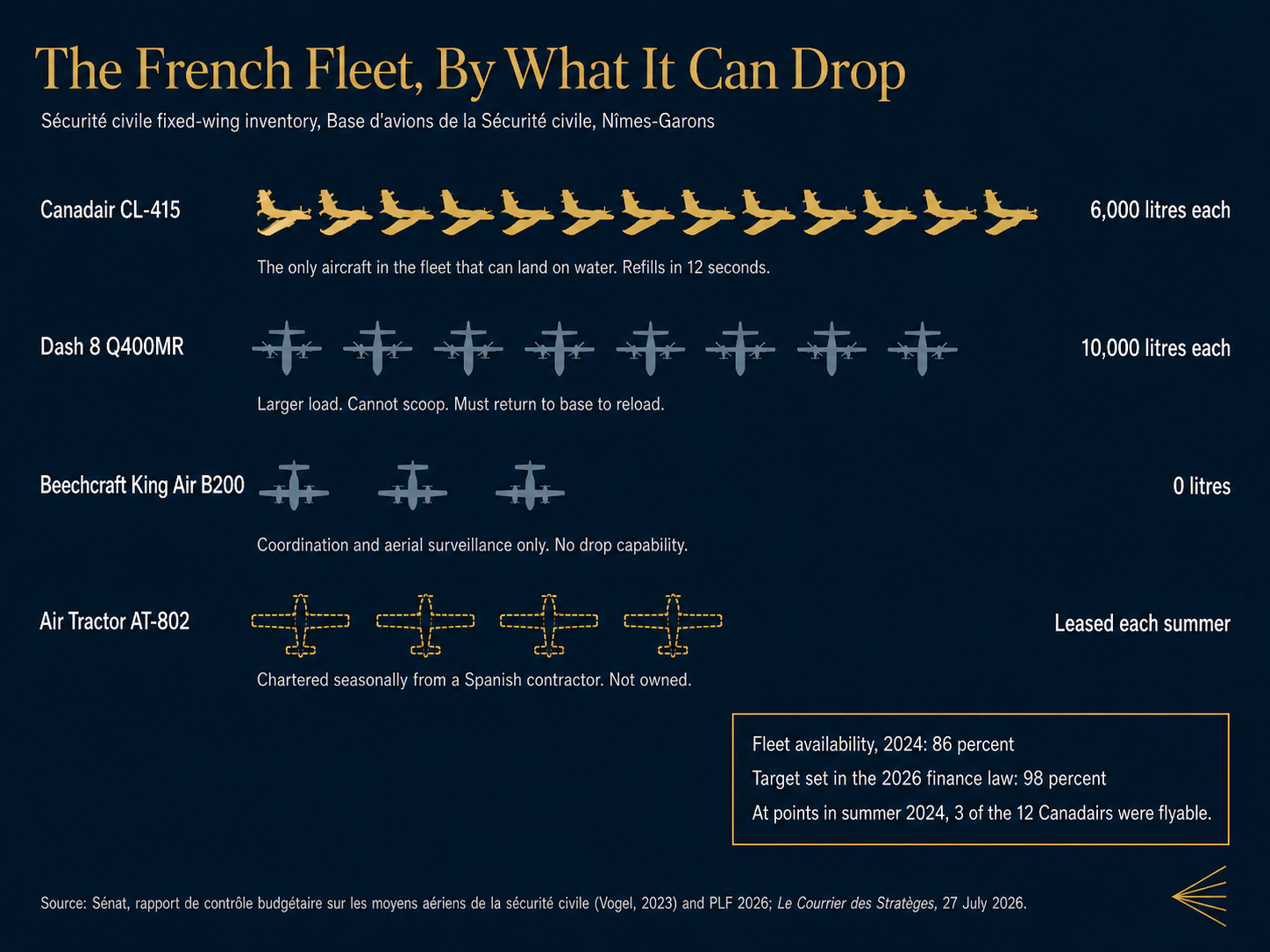
Seven French Canadairs. The national fleet is twelve.
All twelve live at a single address, the Base d’avions de la Sécurité civile at Nîmes-Garons, along with eight Dash 8 Q400MR retardant aircraft, three unarmed King Air spotters, and whatever Air Tractors the state has leased from a Spanish contractor for the season. The Canadairs are the only aircraft in that inventory that can land on water. In 2023 the Senate’s special rapporteur for civil security, Jean-Pierre Vogel, put their average age at twenty-five years and four months. The last one was delivered on 15 May 2007.
Fleet availability ran at 86 percent in 2024 against a target of 98. At points during the summer of 2024, three of the twelve were flyable. In July 2025 the duty officers had to choose between simultaneous requests from the Aude and the Bouches-du-Rhône, and Vogel’s conclusion on that episode was flat: the risk of a capability rupture had been demonstrated.
So the political fight was always going to arrive, and in July it did. On 21 February 2024 a decree of the Attal government cancelled ten billion euros of credits, of which 52.8 million came off Programme 161, Sécurité civile. Two additional Canadairs were not ordered, and the Directorate General for Civil Security confirmed the figure to fact-checkers.
Through July, deputies from three opposition groups put it to ministers on the floor of the Assembly, week after week, while Fontainebleau burned in one of their constituencies.
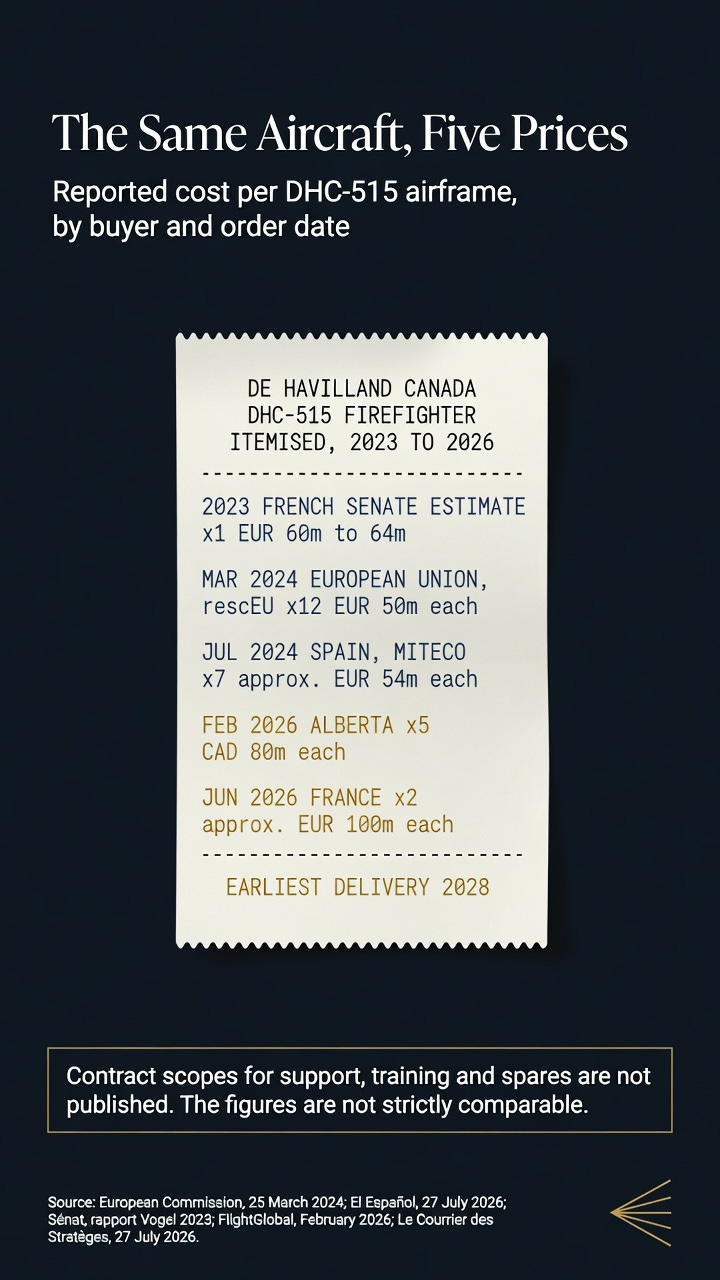
The complication for all of them is that the money came back eighteen months ago. The 2026 finance law carries 209 million euros in commitment authority to order exactly those two aircraft. Programme 161 rose to 994.9 million in commitment authority against 860.1 million the year before, up 15.7 percent, and investment authorisations inside it rose by 428 percent. On 4 June the interior minister, Laurent Nuñez, stood at Nîmes-Garons and signed for the two aeroplanes at roughly a hundred million euros each.
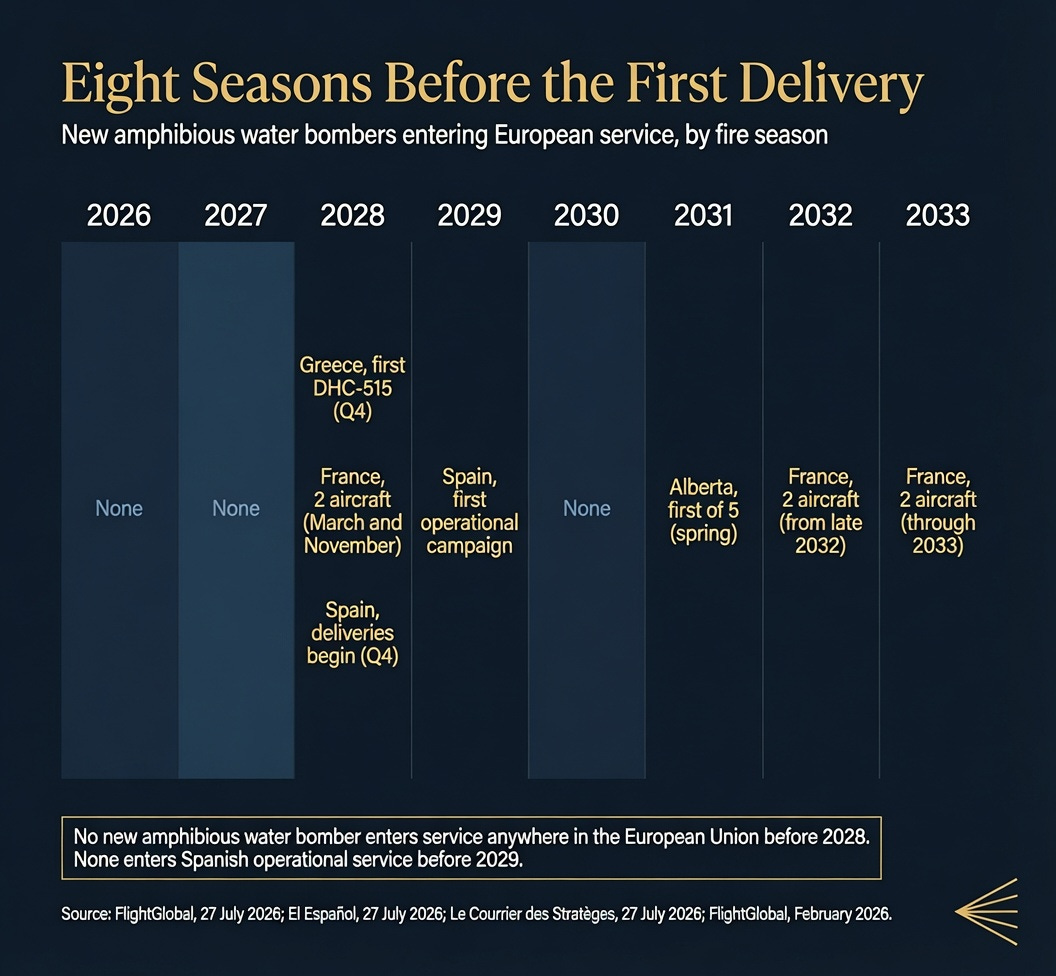
Delivery is announced for the end of 2032, or during 2033.
That is the whole distance between the fiscal argument and the physical one. A parliament restored the credits, a minister signed the contract, the aircraft arrive nine fire seasons later, and no further appropriation moves that date by a single week, because the thing standing between Bordeaux and another water bomber is no longer a line in a French budget.
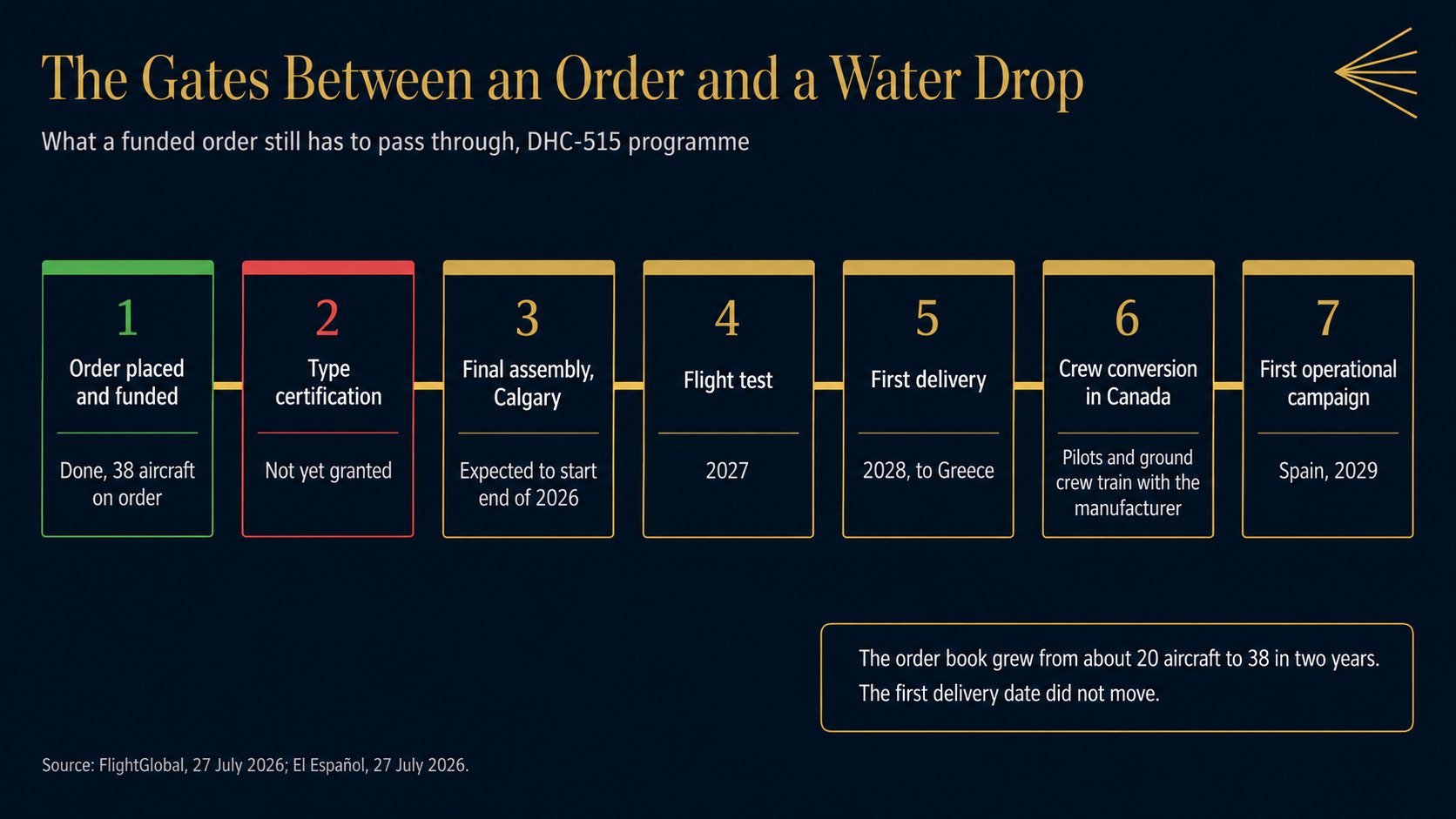
It is an assembly hall in Calgary. De Havilland Canada has spent this year joining the cockpit of the first DHC-515 to its hull, integrating the mid-fuselage into the forward section, and completing a 28.6-metre wing box. Neil Sweeney, the company’s vice-president of corporate affairs, told Farnborough on 21 July that final assembly should start by the end of the year, that flight testing follows next year, that the aircraft is on track for delivery in 2028, and that the first one goes to Greece.
Sweeney also disclosed the order book: thirty-eight aircraft, up from about twenty two years ago. European governments nearly doubled their orders across a stretch that included 2025, the most destructive fire season the union has ever recorded at just over 1.08 million hectares, and the first delivery date did not move at all. Orders are not the binding input here. There is one production line for this aircraft anywhere on earth, it is not yet certified, and the queue behind the certification gate lengthens without the gate opening any sooner.
Spain is running the same experiment with different paperwork. In July 2024 the Council of Ministers authorised a 375 million euro contract for seven aircraft, two of them jointly with other European states, to replace a fleet of ten CL-215Ts and four CL-415s flown by the air force’s 43 Group. Madrid signed a few months after Athens, so Madrid is second in line.
Deliveries are expected from the last quarter of 2028, after which Spanish pilots and ground crews travel to Canada to convert onto the type and then come home to teach everyone else. The realistic first Spanish campaign with a new aircraft is 2029.
Which leaves a specific and unusually knowable fact sitting underneath every promise made this summer. Between the fire now burning outside Bordeaux and the arrival of a single additional amphibious water bomber anywhere in the European Union, there are at least two more full fire seasons, and for most of the states making promises there are three or four. Every euro announced between now and then buys something else, or it buys nothing.
The Deep Dive
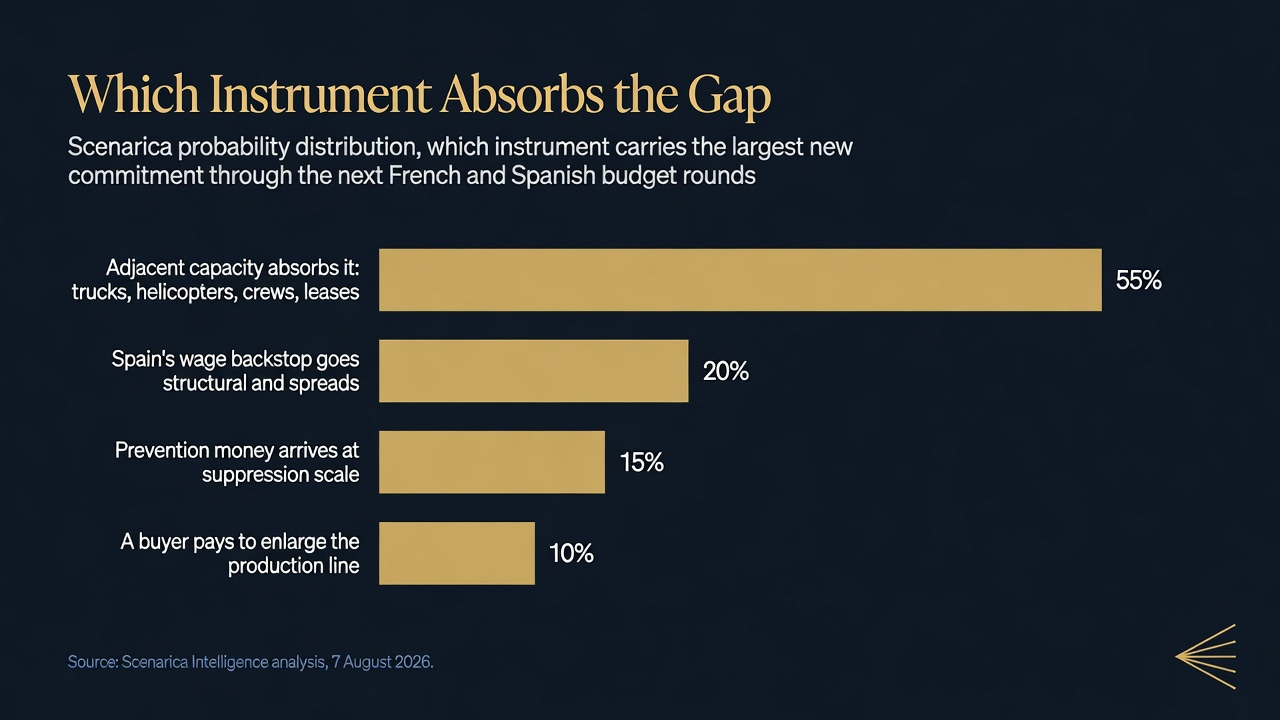
No European state adds an amphibious water bomber it does not already have on order before the 2029 campaign. That is a production schedule rather than a forecast, and it converts the interesting question from how much money governments will spend into which instrument absorbs an eight-season gap. Four instruments are competing for it, and they can be separated cleanly by asking which one carries the largest new financial commitment through the French and Spanish budget rounds that close in the next eighteen months.
The revealed answer is the least glamorous one. Money flows to adjacent capacity, meaning ground fleets, rotary wing, crews and leases, while the amphibious layer stays exactly where the queue put it. Put that at 55 percent, which is more than double the 25 percent a four-way coin toss would assign, and the case for concentrating it that hard is behavioural rather than rhetorical.
After the La Teste-de-Buch and Landiras fires of 2022, President Macron announced on 28 October that year that all twelve Canadairs would be replaced and the fleet raised to sixteen. That target has never been revised, never been attached to a programming document, and on current schedules will be reached at best eleven years after it was announced. What the 2022 shock actually produced was 150 million euros of commitment authority for capacity pacts that bought ground equipment, of which 120 million has been consumed and more than three hundred vehicles delivered against a target of roughly a thousand forest-fire trucks.
It also produced an order for thirty-six H145 helicopters under the 2023 to 2027 interior ministry programming law, worth 471 million euros, arriving eight this year, six next, eight in 2028 and three in 2029. Those helicopters are on time because helicopters can be bought.
Continuity leading a distribution normally deserves suspicion, because live catalysts on the calendar tend to break it. This one survives the check, for an unusual reason. The catalysts are real and dated, a fourth heatwave arriving on 29 July with peaks forecast near 42 degrees and August still ahead, a Spanish emergency decree going to the Council of Ministers, a French budget cycle reopening when the Assembly returns in October. Not one of them touches the queue, and a catalyst can only break continuity in the thing it acts upon.
The obvious objection is that a rich state can buy around a supply constraint, and it deserves a serious hearing because it is partly correct. France has been buying around it for years, through a thirty million euro annual envelope for leased aircraft that the 2026 finance law makes permanent. Portugal sent Air Tractors to Gironde. The A400M that dropped water on 26 July is a genuine substitution, taking a military transport and giving it a firefighting role.
Follow each substitute to its limit, though, and the picture narrows. Vogel’s report found the leasing route costly and unsuitable as a long-term extension, partly because the contracted crews are usually not French-speaking, which matters when four aircraft are running a relay over a single fire at ninety-second intervals. The A400M kit exists as a single prototype, which is why Spain, which flies the A400M, cannot currently deploy the same solution. And Spain’s own interim path failed on procurement law rather than physics: a 22 million euro contract to modernise ten CL-215Ts was extinguished in July after the Central Administrative Tribunal for Contractual Appeals upheld a challenge by Avincis to an irregular two million euro extension granted to the winning bidder.
The honest version of the constraint is therefore narrower than the political version, and considerably more useful. Helicopters, trucks, crews, retardant, spotter aircraft and cross-border pooling are all things a treasury can convert into capability inside a budget cycle. What it cannot convert is the one layer that scoops six thousand litres off a lake in twelve seconds and comes back, which happens to be the layer every minister promises after every fire, because it is the layer the television cameras follow.
Colonel Andrés Gamboa de la Calleja of the Spanish logistics support command put the market structure plainly in the defence ministry’s own journal in January 2025, describing a segment of aviation with barely any alternatives in which the only viable aircraft was the enhanced version of the CL-415. He was explaining why Spain chose the DHC-515, and in doing so he described a monopoly the buyers had themselves helped build, by standardising across Europe on a single airframe for interoperability. Interoperability is an enormous operational advantage right up to the moment the production line stops, at which point it becomes a shared single point of failure with a nine-year lead time.
If the aircraft cannot arrive, something else has to carry the cost of the seasons that arrive anyway, and the most consequential policy move of this summer was made by a labour ministry rather than an interior one. In the last week of July, Yolanda Díaz’s department took to the Council of Ministers a royal decree-law creating an extraordinary benefit in which the state assumes both the wages and the social security contributions of workers who cannot reach their workplace because of fire, funded by the labour ministry and imposing no additional cost on employers. It reaches people whose homes burned, people who were evacuated, and people whose workplace is intact but unreachable.
Structurally, that is a state absorbing business interruption from a peril the private market largely declines to pool. Spain’s Consorcio de Compensación de Seguros mandatorily covers extraordinary risks including floods, earthquakes and volcanic eruption, and wildfire is not classified among them, so a burned household or business recovers only to the extent it bought a private multirisk policy beforehand. The decree does not close that gap. It routes around it, through the payroll, which is the fastest channel a government has to a population that cannot reach its own work.
Whether it becomes permanent is being fought inside the Spanish cabinet now, and that fight matters more to how Europe adapts than any aircraft order. The labour ministry has pressed for a structural instrument and has so far been held to this summer’s emergencies by colleagues in other departments. A temporary benefit is disaster relief, which every European state already does. The same benefit made permanent reclassifies wildfire from emergency to recurring economic condition, with a standing budget line, an actuarial expectation, and a claim on the deficit every August.
Twenty percent belongs to the world where that reclassification wins, in Madrid and then in at least one more member state. It sits well below the leader because the instrument has already been narrowed once, and because the natural European template for permanent catastrophe cover, the Consorcio itself, has excluded this peril for decades without changing its mind under pressure.
The reinsurance market is telling the same story from the other end. Aon put global reinsurance capital at a record 790 billion dollars as of 31 March 2026, and buyers took double-digit risk-adjusted price reductions across the June and July renewals, with property facultative down between 20 and 40 percent. Europe is burning into a softening market.
Nothing about this summer will show up as a capital event, because wildfire is a frequency peril that grinds down catastrophe budgets in many small pieces without ever triggering the large excess-of-loss layers that reprice a market. Underwriters absorb it in earnings, and governments absorb the uninsured remainder in payroll and reconstruction. If you are pricing European sovereign contingent liabilities, that second absorption is the line item to model, and it does not appear anywhere near the procurement budget where the political argument is being conducted.
A genuine prevention pivot, meaning new multi-year money for land management and clearance enforcement at a scale comparable to suppression, is not a rhetorical scenario, and it earns fifteen percent. Standing in the burned pine on 27 July, Macron said France would rebuild a different kind of forest. The country’s legal clearance obligations already run in fifty-two departments, with fines up to fifty euros per square metre, and since 1 January 2025 sellers and landlords must disclose fire-risk obligations when a transaction opens.
Spain’s forestry contractors have argued for roughly three billion euros a year on forest management explicitly instead of aircraft. It stays a minority path because prevention money is diffuse, unphotographable, and mostly lands on private owners who hold about seventy-two percent of Spanish forest.
The last ten percent goes to the outcome no institution is currently built to deliver: a state or the Commission paying to enlarge the production line itself, funding a rate increase or a second source rather than joining the queue behind Alberta, which ordered five aircraft in February for 400 million Canadian dollars with first delivery in spring 2031. Pricing anything below the twenty-five percent baseline needs affirmative justification, and there is some. The union has already tried the money route, committing 600 million euros for twelve aircraft hosted across six member states, and that purchase bought a 2028 date rather than an earlier one.
The gate is certification and industrial ramp, not order volume. No European instrument exists for capitalising the production line of a privately held foreign manufacturer, and that instrument would have to be written into law before the cheque could be written at all.
The calendar between here and the first delivery carries five dates worth holding. Through August, the operational read is whether the fourth heatwave forces a second national-interest emergency declaration in Spain, the mechanism first used for wildfire on 24 July, because a repeat inside a single season converts an exception into a precedent. In September, the Spanish decree is either extended past this summer’s emergencies or allowed to lapse, and that is the cleanest available signal on the reclassification path.
In October, when the French Assembly returns, the question is whether the long-delayed civil security bill following the Beauvau review is finally tabled, and whether any deputy asks a minister on the record when the aircraft actually land rather than when they were ordered. By the fourth quarter, De Havilland should have moved the first airframe into final assembly, and any slippage there pushes every European delivery date behind it. Then the January renewals, where the thing to look for is whether European wildfire is priced as a distinct peril rather than absorbed inside general property catastrophe, because the day it gets its own line is the day the private market agrees with the labour ministry.
The first DHC-515 will be flying test profiles over Alberta while Greece runs the 2027 season on aircraft built in the last century. It reaches Athens in 2028, Madrid the year after, and the two French machines ordered from Nîmes-Garons this June sometime in 2033. Every fire between now and then will be fought with the fleet that already exists, by governments that have correctly identified the instrument they need and cannot obtain it, and the honest sentence none of them has said out loud is that the appropriation was never the problem.
Sources:
Le Courrier des Stratèges, “Canadair : ce que la France a, ce qu’elle a commandé, et quand elle le recevra,” 27 July 2026.
Sénat, Projet de loi de finances pour 2026, Sécurité civile, rapport de Jean-Pierre Vogel, rapporteur spécial; and Rapport de contrôle budgétaire sur les moyens aériens de la sécurité civile, July 2023.
NosParlementaires, “Canadair : ce que le Parlement a vraiment voté sur la sécurité civile,” 20 July 2026, updated 26 July 2026.
FlightGlobal, Jon Hemmerdinger, “De Havilland poised to start final assembly of first DHC-515, eyes 2028 delivery,” 27 July 2026.
FlightGlobal, “Alberta orders five DHC-515 water bombers from De Havilland,” February 2026.
El Español, Izan González, “El MITECO no tendrá nuevos aviones contraincendios hasta la campaña de 2029 y planea recibir siete antes de 2032,” 27 July 2026.
El Español, Eduardo Ortega Socorro, “El Gobierno creará una ayuda para los trabajadores afectados por los incendios que cubrirá su salario y sus cotizaciones,” 27 July 2026.
Revista Española de Defensa, remarks of Colonel Andrés Gamboa de la Calleja, Mando de Apoyo Logístico, January 2025.
European Commission, DG ECHO, “EU deploys largest ever wildfire response for 2026 summer,” 2 June 2026; “The EU sends planes and firefighters as wildfires ravage France and Spain,” 27 July 2026; “EU provides EUR 600 million to strengthen rescEU firefighting fleet,” 25 March 2024.
Joint Research Centre, “2025 was the EU’s most destructive wildfire season on record,” 31 March 2026.
France 24, “Wildfires have scorched 115,000 hectares across France this year, interior minister says,” 25 July 2026; and live coverage of the presidential visit to south-west France, 27 July 2026.
Euronews, “More than 320,000 now evacuated in France and Spain as wildfires continue to spread,” 26 July 2026.
Aon, Reinsurance Market Dynamics, midyear 2026 report, and associated release on record USD 790bn reinsurance capital at 31 March 2026.
Consorcio de Compensación de Seguros, published guidance on forest fires and extraordinary risks.
Greenpeace with data from Asemfo, 2026 report on Spanish wildfire suppression costs and forest management spending.
Connexion France, “France heads for fourth heatwave of year next week: highs of 40C forecast,” 27 July 2026.
Disclaimer: This report is published by Scenarica Intelligence for informational purposes only. It does not constitute investment advice, a solicitation to buy or sell any financial instrument, or a recommendation regarding any particular investment strategy. Scenarica Intelligence is not a registered investment adviser or broker-dealer. All scenario probabilities and assessments represent the analytical judgment of Scenarica Intelligence and are subject to change without notice. Past performance of any asset or strategy discussed does not guarantee future results. Readers should conduct their own due diligence and consult with qualified financial advisers before making investment decisions.
Scenarica Premium: The full Scenarica suite includes Geopolitics, Economy, Bitcoin, AI, and Sunday Edition.
Scenarica Intelligence
We don’t predict the future. We price it.