

The Referee That Never Blinks
The 2026 World Cup will be the most fairly officiated tournament in history. Whether it will be the most memorable is a different question.

The camera cost Luis Herrera nine hundred and forty-nine dollars, and it arrived on a Tuesday. He set it up on an aluminium tripod behind the far goal at Riverside Park in Aurora, Colorado, angled it toward the centre circle, tapped the green button on his phone, and walked away. The camera would do the rest. It would track the ball, follow the runs, pan and tilt on its own, and by the time his U-16 boys finished their league semifinal that evening, the footage would be waiting in a cloud folder with heat maps, passing networks, and possession percentages broken down by half.
Luis had coached youth football for eleven years. He had never had a scouting department, a video analyst, or a budget for anything beyond cones and pinnies. The Pixellot Air NXT and its forty-dollar monthly subscription were the first pieces of technology he had ever purchased for the team. He bought them because a parent had forwarded him a YouTube video about Football AI Pro, the generative AI system that FIFA and Lenovo built to serve all 48 teams at the 2026 World Cup. The parent’s message was three words long: “We can do this?”
The answer, Luis discovered over the following six weeks, was yes and no.
The AI showed him things he had never seen. After the semifinal, he opened the dashboard on his laptop and watched a replay of the first half with player movement trails overlaid in coloured threads. His centre midfielder, a kid named Ethan who Luis had always thought of as his engine, had covered more ground than anyone else on the pitch but had touched the ball fewer times than the left back. The AI had drawn a heat map that looked like a bruise spreading from the centre circle to both touchlines. Ethan was running constantly and arriving nowhere. Luis had watched every minute of that half from the sideline and had not noticed.
He typed a question into the analysis chat: “Why is my number 8 covering so much distance but receiving so few passes?” The system replied in two seconds. It identified three patterns. Ethan’s movement was pulling him into channels already occupied by the wingers. His off-the-ball runs were starting too early, arriving in space before the passer was ready. And his positioning at the start of attacking transitions was consistently three to five metres deeper than the system’s model predicted would be optimal for a number 8 in a 4-3-3.
Luis stared at the screen for a long time. Eleven years of coaching, and a nine-hundred-dollar camera had just told him something about his best player that he had never seen with his own eyes.
This is the world the 2026 FIFA World Cup is about to put on display for six billion viewers. When the tournament opens at Estadio Azteca in Mexico City on June 11, every one of the 104 matches will be played under a level of technological surveillance that no previous sporting event has approached. Twelve dedicated tracking cameras per stadium will feed positional data on every player to an AI system that maps up to 10,000 data points per athlete. The official match ball, the Adidas TRIONDA, carries a 500 Hz inertial measurement sensor that transmits its position to the video assistant referee in real time, identifying every touch within milliseconds. Semi-automated offside technology will scan all 1,248 players, each digitally scanned before the tournament to create precise 3D avatars with accurate body-part dimensions. Referee body cameras will stream stabilised footage to a global audience. And Football AI Pro, built on FIFA’s proprietary Football Language Model and trained on hundreds of millions of data points, will generate pre-match and post-match analysis in text, video, graphs, and 3D visualisations for every participating team, in multiple languages.
The most important word in that last sentence is “every.” Football AI Pro is designed to give Jamaica the same analytical baseline as Germany. New Zealand gets the same pre-match tactical breakdown as Brazil. For the first time in World Cup history, the intelligence gap between rich federations and poor ones will be closed by a machine that does not care which anthem played before kickoff. FIFA’s stated design principle is democratisation: the same AI, the same data, the same insights, available equally to all 48 squads.
Luis Herrera, standing on a park sideline in Aurora with a phone in his hand and a forty-dollar subscription, is living the grassroots version of the same experiment. The tools that were once reserved for clubs with six-figure analytics budgets are now available to anyone with a credit card and a Wi-Fi connection. In 2026, the global AI in sports market is valued at roughly $10.6 billion. Pixellot alone has more than 30,000 camera installations streaming 1.5 million games a year across 14 sports. Veo, Once Sport, Hudl, and a dozen other platforms offer automated video capture and AI-driven analysis at price points that range from free to a few hundred dollars a month.
The analytical playing field, in other words, is being levelled from the top of the pyramid all the way down to Riverside Park on a Tuesday evening.
Two forces are colliding inside that levelling, and neither is winning cleanly. The first force is accuracy. AI makes officiating more correct, analysis more precise, injury prevention more effective. The NFL’s Digital Athlete programme, a partnership with AWS that creates virtual representations of every player and simulates millions of injury scenarios, helped the league achieve its lowest concussion rate on record in 2024, a 17 percent reduction from the previous year. Tennis has already completed the transition: since 2025, the ATP Tour has mandated electronic line calling at every event, eliminating human line judges entirely. No more dramatic “Out!” calls from the baseline. No more players screaming at officials. Every call is right. Every match is fair.
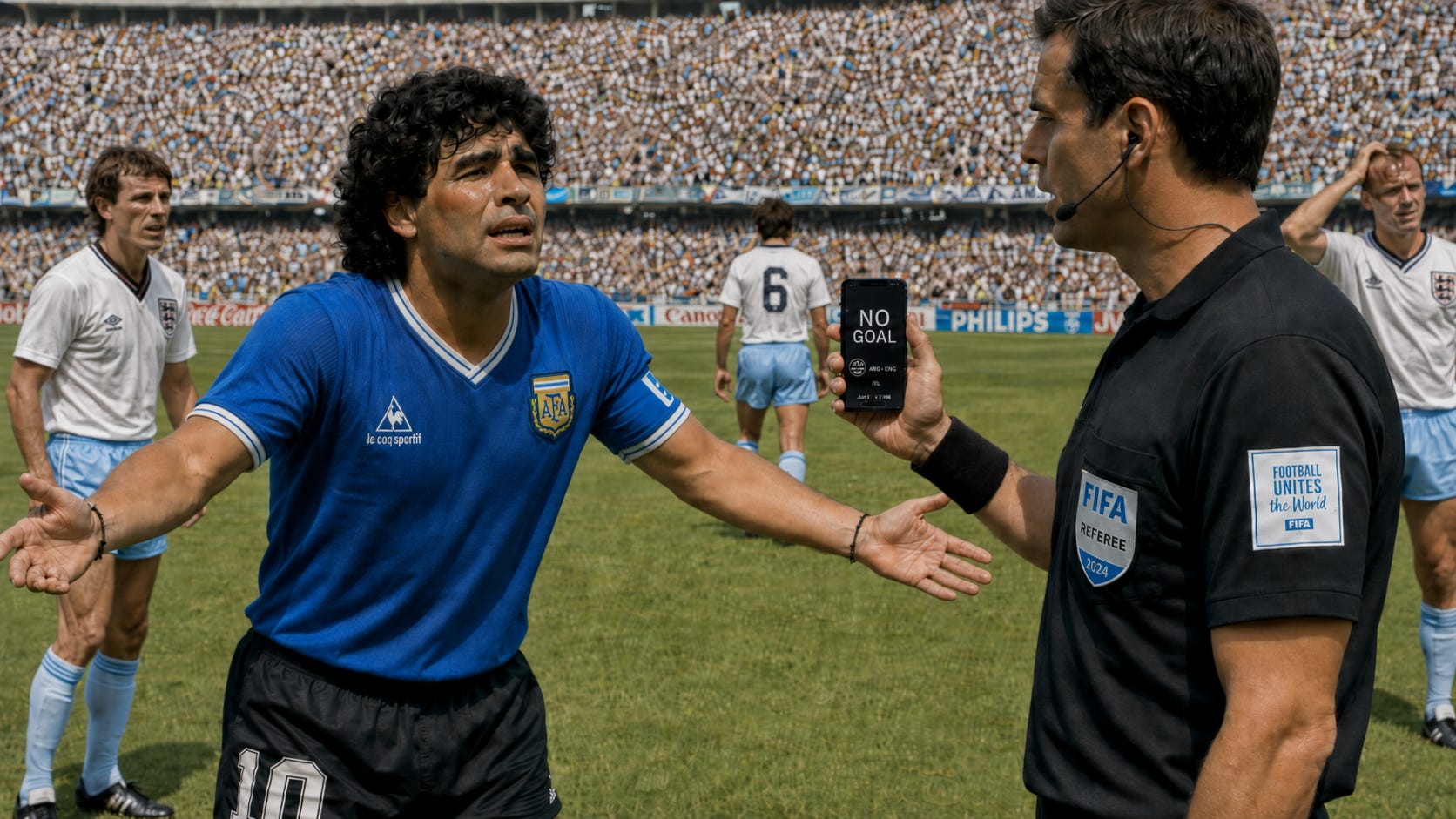
The second force is something harder to name. Call it drama, call it narrative, call it the human element. Sport’s emotional power has always derived partly from its imperfection. On June 22, 1986, Diego Maradona punched a football into the net with his left fist in a World Cup quarter-final against England at the Estadio Azteca, the same stadium where the 2026 tournament will open. The referee did not see it. The goal stood. Argentina won. Maradona called it “the Hand of God.” Forty years later, it remains one of the most discussed moments in the history of organised sport. If the 2026 semi-automated offside system had existed in 1986, the goal would have been disallowed before the crowd finished its intake of breath. The match would have been more fair. It would also, almost certainly, have been forgotten.
This is the tension the 2026 World Cup inherits, not invents. VAR, the Video Assistant Referee system introduced at the 2018 World Cup, already taught football a painful lesson about the gap between accuracy and acceptance. In the 2025-26 Premier League season, the Key Match Incidents Panel identified more than a dozen confirmed VAR errors across the campaign, and the controversies that followed each one dominated the news cycle for days. The “armpit offside,” in which a goal is disallowed because a player’s shoulder or torso is millimetres beyond the last defender, has become a symbol of everything fans distrust about technological precision applied to a physical game. Fans do not celebrate in the moment anymore. They wait. They watch the referee touch his earpiece. They look at the screen. The two-to-four-minute delay between a goal and its confirmation has introduced a new emotional experience that did not exist before 2018: the celebration that might be taken away.
Luis Herrera encountered his own version of this tension on the night of the semifinal. His team won 3-1. The boys were elated. But when Luis opened the AI analysis that evening, the dashboard told a different story. His team had been outpossessed. They had completed fewer passes. Their expected goals metric, based on the quality and location of their shots, was 1.4. They had scored three goals on 1.4 expected goals. The AI’s verdict, if an algorithm can have a verdict, was that his team had been lucky.
Luis closed the laptop. He had watched that match. He had seen the goalkeeper’s save in the 34th minute that turned the momentum. He had seen the substitute winger, a boy named Marco who had been on the bench all season, come on at halftime and change the shape of the game with nothing more than willingness to run at defenders. He had felt the shift in energy when the second goal went in, the way the opposing team’s body language collapsed and his boys began to play as if the pitch belonged to them.
The AI had not measured any of that. It had measured distance, velocity, position, and probability. It had not measured heart.
And yet. The next morning, Luis went back to the dashboard and watched the replay of Ethan’s movement patterns again. He redesigned the training session for Thursday. He moved Ethan ten metres higher up the pitch and told the wingers to hold their width. In the final the following Saturday, Ethan touched the ball 47 times, 22 more than in the semifinal. The team won 2-0.
The AI had been wrong about what the semifinal meant. It had been right about what it showed.
This is the competing forces problem that every sport is now navigating, and the 2026 World Cup will dramatise it on the largest possible stage. The probability that you will care about, if you watch any of the 104 matches this summer, is not a number on a dashboard. It is a feeling. It is whether the moment a goal is scored still belongs to the players and the crowd, or whether it belongs to the twelve cameras and the 500 Hz sensor and the 3D avatar that will tell you, within one second, whether the scorer’s armpit was onside.
Scenarica puts the probability of gradual acceptance at four in ten. In this world, the World Cup’s AI systems work well enough, and fast enough, that fans adjust. The semi-automated offside decisions take one to two seconds instead of two to four minutes. The AI referees every offside correctly. The controversy shifts from “that was wrong” to “that was harsh but correct.” After the tournament, other sports accelerate their adoption timelines. By 2028, AI-assisted officiating is standard across every major professional league. Human referees remain on the pitch, but they implement AI recommendations rather than making independent calls. If you referee youth football in 2030, you will have an earpiece. The voice in it will not be human.
There is a more volatile version, and Scenarica assigns it a probability of roughly one in four. A high-profile AI decision at the World Cup, a disallowed goal in a semifinal, a marginal offside call in the final, produces a backlash that travels faster than the tournament itself. FIFA is forced to introduce a tolerance margin for offside decisions, perhaps five centimetres of grace. The episode becomes shorthand for the limits of precision in a game built on human judgment. Other sports take note and slow their timelines. The lesson is not that the AI was wrong. The lesson is that being right is not enough when the audience does not feel that justice was done.
Two in ten is the probability Scenarica assigns to the scenario that would rewrite how we think about AI in sport entirely. Football AI Pro’s equalisation effect, giving every team the same analytical baseline, produces genuine upsets. A Caribbean or Pacific Island nation uses AI-generated tactical analysis to neutralise a European giant. The group stage is the most unpredictable in World Cup history. The narrative flips. AI is no longer the technology that kills drama by getting every call right. It is the technology that creates drama by giving every team the same brain. If you follow a smaller footballing nation into this tournament, this is the scenario you are hoping for. It is also the one that would make Luis Herrera’s nine-hundred-dollar camera feel like the beginning of something, not just a gadget.
The remaining probability, about fifteen in a hundred, belongs to the scenario nobody in football governance wants to discuss publicly but everyone in the technology partnerships is thinking about. A referee error that AI could have prevented, but did not because the current system limits AI to an advisory role, leads to calls for fully automated officiating. No human referee on the pitch. All decisions made by the system in real time. The debate splits the sporting world along a line that has nothing to do with technology and everything to do with philosophy: is sport a contest between humans, judged by humans, or is it a contest between humans, judged by whatever produces the most accurate result? Tennis has already answered that question. Football, the world’s most popular sport, has not. The 2026 World Cup may be the event that forces it to.
What will shift these probabilities is not a software update. It is a moment. Watch for the first disallowed goal of the tournament, which will likely come during the group stage in the second week of June. The speed of the decision and the reaction of the crowd will set the tone for everything that follows. Watch for FIFA’s post-group-stage press conference on AI system performance, expected in the first week of July. If FIFA publishes accuracy metrics (number of correct interventions, average decision time, number of overturned calls), the numbers will tell you whether the technology is ahead of the controversy or behind it. Watch for how smaller nations perform through the group stage and into the round of 16. If the analytical democratisation thesis holds, the upset rate in the group stage should be measurably higher than in 2022. If it is not, the equalisation argument loses its strongest evidence. Watch for player and manager comments on Football AI Pro in post-match press conferences. The first manager to publicly credit the AI system with a tactical insight will be a signal that the tool has crossed from novelty to utility. The first manager to dismiss it will be equally telling.
Luis Herrera will be watching the World Cup from his living room in Aurora with a notebook on his knee, the same notebook he uses to sketch formations at practice. The Pixellot camera will be back on its tripod at Riverside Park the following Tuesday. His boys will run, and the AI will track them, and the heat maps will bloom on his screen like weather systems. He will study the passing networks and redesign the training sessions and move players five metres forward or back based on what the data reveals.
But on the night of the World Cup final, when the ball crosses the line and the stadium holds its breath for the one second it takes the system to confirm the goal is good, Luis will not be thinking about data points or 3D avatars or 500 Hz sensors. He will be thinking about whether the moment still belongs to the players. Whether the roar that follows the confirmation is the same roar that would have followed if no confirmation were needed. Whether his boys, when they score on a Saturday morning at Riverside Park, celebrate the goal or wait for the whistle.
He does not know the answer. Neither, it turns out, does anyone else.
ANNEX: WHEN THE REFEREE NEVER BLINKS, WHAT DOES THE CROWD DO?
The 2026 World Cup will test four possible futures for AI in sport simultaneously. Together they account for every path from the tournament to the end of the decade. Here is what each one looks like if you are the person watching.
Gradual Acceptance with Friction: 40%
You watch the World Cup this summer and the AI decisions come fast. One second, maybe two. You barely notice the offside reviews because they resolve before the replay finishes. By the quarter-finals, the system has become background noise, like goal-line technology before it. You stop complaining. You do not stop noticing that something has changed, that the moment between the ball crossing the line and the crowd’s permission to celebrate now passes through a machine, but you accept the trade. The officiating is more fair. The game is slightly less spontaneous. By 2028, every major professional league has adopted some version of AI-assisted officiating. You watch your sport with the quiet understanding that the referee in the earpiece is no longer fully human.
Variable to watch: FIFA’s post-tournament AI accuracy report, expected August 2026. If the system’s correct-intervention rate exceeds 98%, the acceptance timeline accelerates. One-month probability of report release: 70%. Three-month probability of adoption announcements from at least two other major leagues: 45%. Twelve-month probability of AI-assisted officiating becoming standard in the top five European football leagues: 55%.
Fan Backlash Slows Adoption: 25%
You watch a semifinal and a goal is disallowed by a margin so small the broadcast cameras cannot show it without digital enhancement. The crowd’s silence is louder than the stadium’s capacity. Social media moves faster than the tournament’s crisis communications team. Within 48 hours, “tolerance margin” enters the football vocabulary. FIFA announces a review. Other sports push their AI officiating timelines back by 12 to 18 months. You learn a new lesson about technology: being right is necessary but not sufficient. The system needs to feel right, too, and millimetre precision applied to a game of centimetre margins does not feel right to the people paying for tickets.
Variable to watch: social media sentiment analysis around the first controversial AI offside decision, trackable via FIFA’s own digital engagement metrics and third-party platforms (CrowdTangle, Brandwatch). One-month probability of a high-profile controversial decision during the group stage: 60%. Three-month probability of FIFA announcing a formal review of offside tolerance if backlash occurs: 50%. Twelve-month probability of at least one major league introducing a tolerance margin: 35%.
Competitive Revolution: 20%
You watch the group stage and something unexpected happens. Teams you have never heard of are winning matches against teams you assumed would cruise through. The tactical preparation gap, the thing that always separated the rich federations from the rest, has been compressed by a machine that gives everyone the same scouting report. The World Cup is remembered not for its technology but for its unpredictability. AI’s reputation in sport shifts from “the thing that kills drama” to “the thing that creates it.” You start wondering whether your own team’s next opponent has already watched the AI analysis of your weaknesses.
Variable to watch: upset rate in the 2026 World Cup group stage compared to 2022 (defined as victories by teams ranked 20+ places lower in the FIFA rankings). The 2022 group stage produced notable upsets (Saudi Arabia over Argentina, Japan over Germany and Spain). One-month probability of a higher upset rate than 2022: 40%. Three-month probability of Football AI Pro being cited by a manager in a post-match press conference: 75%. Twelve-month probability of FIFA expanding AI analytics access to qualification campaigns: 30%.
Full Automation Debate: 15%
You watch a match where a referee makes a clear error that AI could have corrected but did not, because the current system limits AI to an advisory role on non-offside decisions. The call changes the outcome of the match. The debate that follows is not about this match. It is about all future matches. Should the human referee be removed entirely? Tennis already did it. Cricket’s DRS is a halfway house. Football, the largest sport on earth, is forced to answer a question it has been deferring: is the referee’s judgment part of the game, or is it an obstacle to the game’s fairness? You do not know where you stand on this until the moment arrives. Then you discover it is the most important question in sport.
Variable to watch: the number and severity of uncorrected referee errors during the tournament, trackable via FIFA’s post-match referee assessment reports and independent analysis (Referee Review, ESPN FC). One-month probability of at least one match-changing uncorrected error: 30%. Three-month probability of a formal proposal for expanded AI authority at the FIFA Congress: 20%. Twelve-month probability of any major sport adopting fully automated officiating beyond line calls: 10%.
Sources:
Lenovo, “The Future of Football Is Here: AI Solutions To Power FIFA World Cup 2026,” 2026.
FIFA, “FIFA and Lenovo unveil multiple AI-powered innovations ahead of FIFA World Cup 2026,” 2026.
Lenovo, “Leveling the Playing Field: Football AI Pro Powers Intelligence Across the Game,” 2026.
Vocal Media, “World Cup 2026: All 1,248 Players to Be Digitally Scanned by FIFA for AI Offside Technology,” 2026.
ITV News, “World Cup 2026: Fifa unveils new ball that uses AI to help referees make decisions,” 2025.
ESPN, “ATP dropping line judges, to use all electronic calls by 2025,” 2023.
NFL Player Health and Safety, “Building a Digital Athlete: Using AI to rewrite the playbook on NFL player safety,” 2024.
SUCCESS Magazine, “How AI Helped the NFL Cut Concussions by 17% in 2024,” 2024.
GiveMeSport, “How Many VAR Errors Every Premier League Club Has Suffered (2025/26),” 2026.
Pixellot, “AI-Powered Sports Coaching Software,” 2026.
FIFA, “FIFA World Cup 2026 Fixtures, Groups, Teams,” 2026.
Disclaimer: This report is published by Scenarica Intelligence for informational purposes only. It does not constitute investment advice, a solicitation to buy or sell any financial instrument, or a recommendation regarding any particular investment strategy. Scenarica Intelligence is not a registered investment adviser or broker-dealer. All scenario probabilities and assessments represent the analytical judgment of Scenarica Intelligence and are subject to change without notice. Past performance of any asset or strategy discussed does not guarantee future results. Readers should conduct their own due diligence and consult with qualified financial advisers before making investment decisions.
Scenarica Premium: The full Scenarica suite includes Geopolitics, Economy, Bitcoin, AI, and Sunday Edition.
Scenarica Intelligence
We don’t predict the future. We price it.