

The Shareholder's Brake
Washington may soon own 5% of the AI labs it regulates. Every safety brake becomes a write-down.


In 1976, the voters of Alaska amended their own constitution to become part-owners of an oil boom. A share of every royalty dollar from the North Slope would flow into a permanent fund, invested for the public and paid back each year as a cheque to every resident. It was a genuinely radical idea at the time: the citizen as shareholder in the resource beneath the floor of the state. And it worked, in no small part because oil sitting in the ground never asks anyone to decide whether it is safe to pump.
Fifty years later, Sam Altman pointed at that fund and proposed building one for artificial intelligence. On 2 July, the Financial Times reported that OpenAI had floated handing the United States government roughly five percent of the company, a stake worth about 42.6 billion dollars against the 852 billion valuation OpenAI reached in its March funding round. The pitch did not stop at OpenAI. Altman’s idea, discussed in early conversations with President Trump, Commerce Secretary Howard Lutnick and Treasury Secretary Scott Bessent, was that every leading American lab would cede a similar slice into an Alaska-style vehicle, a sovereign fund that would share the profits of the AI boom with the public. The President reportedly called it a beautiful thing that would make Americans partners in the revolution.
Most of the argument since has been about fairness. Is five percent a generous gift or a cheap insurance policy? Is it a public windfall or a shakedown dressed as philanthropy? Those are real questions. They are also the wrong ones, because they treat the fund as a transfer of money when the important thing it transfers is a relationship.
Here is the mechanism almost nobody is pricing. A government that regulates an industry and a government that owns a piece of it are two different animals, and the proposal quietly turns the first into the second. The moment the Treasury holds equity in a frontier lab, the state acquires a fiscal stake in the very capability it is also supposed to constrain. Every safety brake it might pull is now, in part, a markdown of a public asset. The referee has been handed a jersey.
The timing makes the point for you. Only days before the stake was floated, the White House had asked OpenAI to slow the rollout of its newest model, GPT-5.6, after the model crossed the company’s own high-risk threshold on cyber capability. OpenAI shipped it to around twenty vetted partners and held broad release behind a government review, a process set up by an executive order President Trump signed on 2 June that lets the government preview frontier models for up to thirty days before launch. OpenAI complied and said plainly that it did not want this to become the default. So the state has already shown it can put a hand on the wheel. Now imagine it also owns five percent of the car.
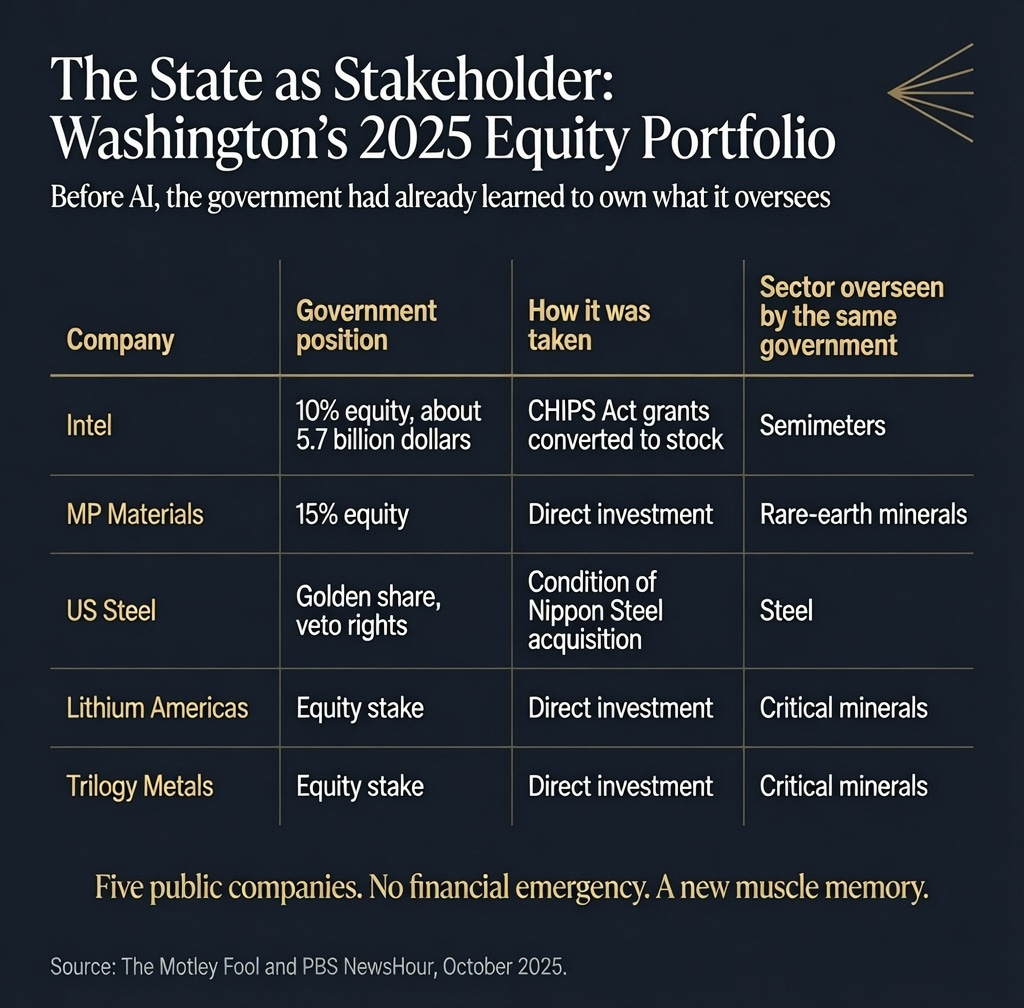
This is not hypothetical machinery. Over the course of 2025 the administration took direct equity in a string of companies it also oversees: a ten percent stake in Intel, converted out of CHIPS Act grants for about 5.7 billion dollars; fifteen percent of the rare-earth producer MP Materials; a golden share in US Steel; positions in Lithium Americas and Trilogy Metals. Five public companies, no financial emergency, a new muscle memory in Washington for owning what it wants to steer. The AI proposal is that muscle reaching for the most valuable industry on Earth.
And OpenAI’s five percent is the polite end of the conversation. In June, Senator Bernie Sanders introduced the American AI Sovereign Wealth Fund Act, which would take a one-time fifty percent stake, payable in stock, from any AI company booking more than 200 million dollars in annual revenue, building a public fund his office values at around seven trillion dollars and paying every American an annual dividend. Anthropic, meanwhile, has refused to discuss equity at all, and floated a different structure entirely: a digital dividend funded by taxing the AI sector rather than owning it.
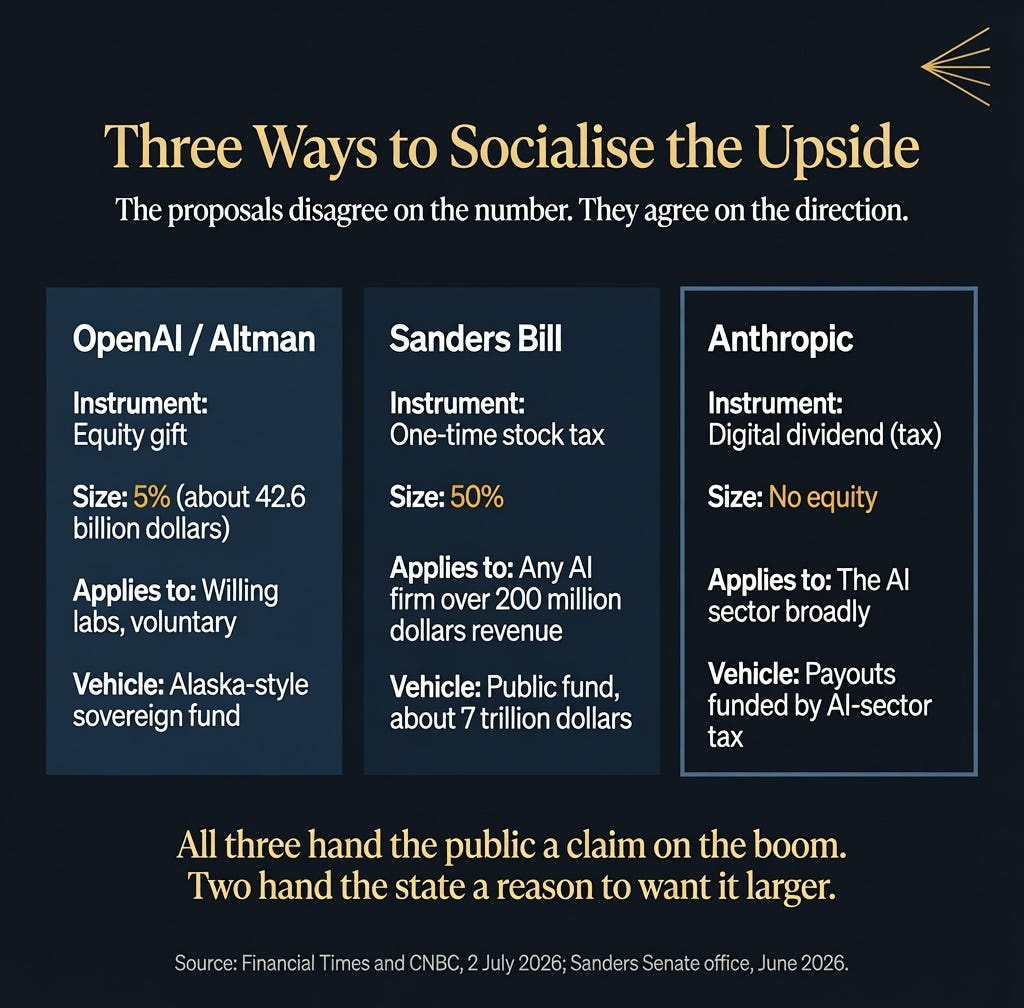
Line those three proposals up and the disagreement between them starts to look smaller than the thing they share. Altman’s five percent, Sanders’s fifty percent, and the fight over both point the same direction. The public gets a claim on the upside, and in exchange the state acquires a reason to want that upside to be as large as possible. That is a wonderful alignment when the product is an oil field or a rare-earth mine, where the government’s job and the government’s wallet both want the thing to thrive. It becomes a dangerous one when part of the government’s job is to occasionally decide the product is moving too fast.
Nat Purser, who advises on AI policy at Public Knowledge, put the hazard plainly: you do not want a situation where the government becomes less willing to enforce safety rules because doing so would cut the value of its own investment. The elegance of the Alaska fund was that Alaska never had to ask whether the oil was too dangerous to sell. Washington would be buying into an asset whose whole value rests on the state rarely, if ever, asking that question of the labs.
Which is why the fund does not need to pass to have already told you something. Washington does not require ownership to control the labs. It proved, with GPT-5.6, that a phone call and an executive order will do. What equity adds is not a lever. It is an appetite. The danger is not a state that can say no to the labs. It is a state that slowly stops wanting to.
The Deep Dive
What remains is the machinery underneath the idea: how the conflict actually scores when someone has to put it on a balance sheet, which labs can afford to buy their way in and which get frozen out, what the 2025 precedents tell you about how fast this can move without Congress at all, and which of four governance architectures the next year most plausibly delivers.
Start with the history, because the state has been a shareholder in things it regulates many times, and the pattern is remarkably consistent. During the Depression, the Reconstruction Finance Corporation took equity in thousands of banks the government also supervised. In 2008 and 2009, the Treasury ended up owning most of General Motors and large slices of the banking system while simultaneously writing the fuel-economy and capital rules those firms lived under. Norway built the largest sovereign wealth fund on Earth out of oil it also regulated. In every one of these cases the state sat on both sides of the table, and in almost every one it resolved the tension the same way: by behaving as a passive, upside-seeking owner and letting the ownership hand quietly outweigh the regulatory one. The TARP stakes were deliberately built to be temporary and largely non-voting precisely because everyone understood that a permanent government owner is a compromised regulator.
The reason those arrangements mostly held is the feature that does not carry over to AI. When the state owns a bank, a carmaker or an oil field, its regulatory job and its ownership interest point in the same direction. A solvent bank, a profitable automaker, a productive well: healthy is what both the rulebook and the shareholder want. The regulation is economic, and economics and equity agree. The whole tension dissolves because there is no moment when the good regulator and the good shareholder are forced to disagree.
Frontier AI is the case where they are. The state’s job here is not only to keep the labs solvent. It is, at least sometimes, to slow them down, to hold a model back, to insist a capability is too dangerous to ship on the vendor’s timeline. That is precisely what happened to GPT-5.6, and to Anthropic’s restricted Mythos model before it. The regulatory act that AI safety demands is the deliberate destruction of near-term value. And the moment the Treasury owns five percent, that destruction lands on the government’s own books. This is the point where the Alaska rhyme breaks, and it does not break gently. Oil in the ground and a frontier model are opposites in the one way that matters: the oil is worth more the faster you extract it, and the model can be worth less to society the faster you release it. Alignment becomes collision.
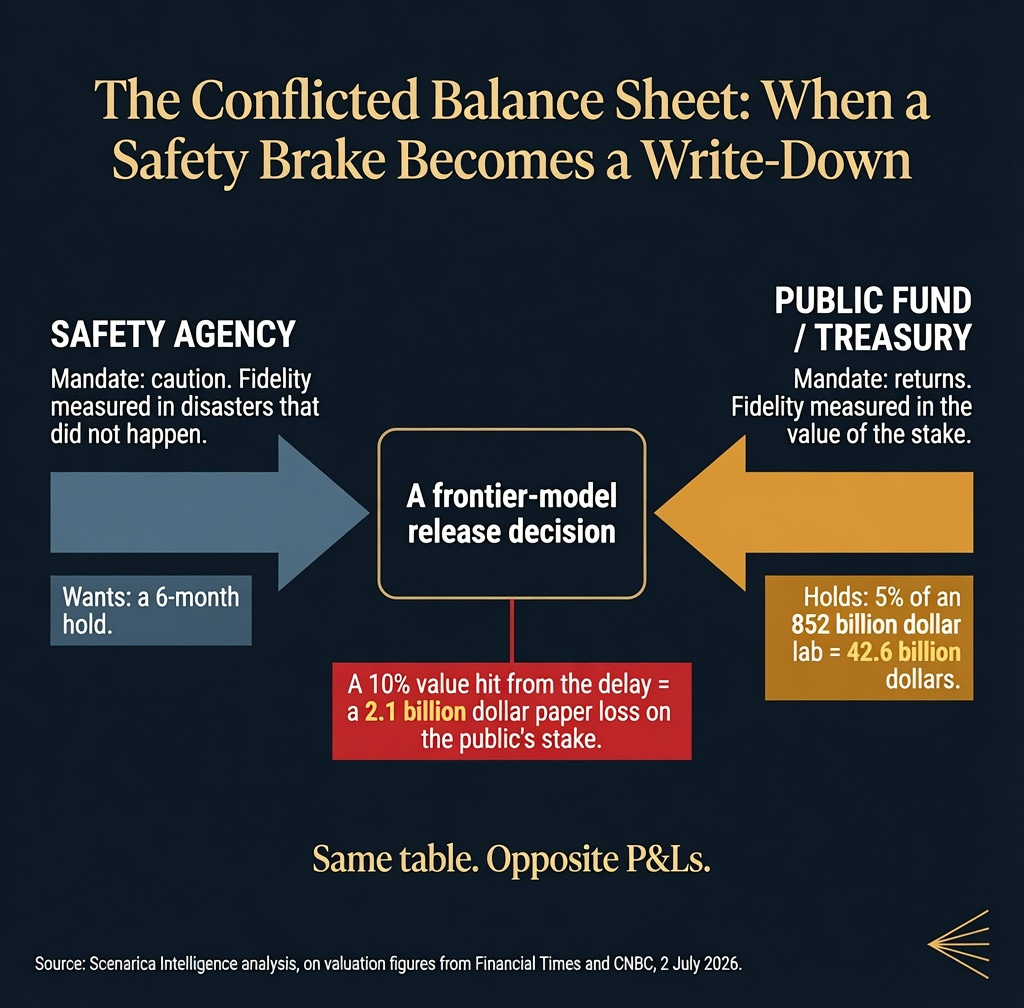
Watch how that collision institutionalises when you put the arithmetic in the room. If a public fund holds five percent of a lab valued at 852 billion dollars, it is holding 42.6 billion dollars of citizens’ money in that single position. Now the safety agency proposes a six-month hold on a release the market has already priced as a revenue event. Suppose that hold knocks ten percent off the lab’s implied value, a routine swing for a company at this valuation. The public’s stake has just fallen by more than two billion dollars on paper. Someone whose mandate is to manage that fund for returns is now sitting in the interagency meeting, and their job, honestly performed, is to point out that caution has a number and the number is large.
They are not corrupt. They are doing exactly what a fund manager is supposed to do. That is the whole problem: the pull to under-weight safety is no longer a temptation to be resisted, it is a fiduciary duty to be discharged. Sanders’s own bill supplies the body that would carry that duty, an Independent Commission for Democratic AI, seven members, to run the fund in the public interest. Read the mandate closely and the trap is visible. A fund manager’s fidelity is measured in returns. A safety regulator’s fidelity is measured in disasters that did not happen. Seat them at the same table with a claim on the same companies, and you have built an institution whose left hand is paid to grow the asset and whose right hand is paid to occasionally break it.
Over a single decision, professionalism holds the line. Over a hundred decisions, across a decade of budget cycles and confirmation hearings and quarterly marks, the incentive gradient does its patient work. Nobody decides to go easy on the labs. The system drifts there, one defensible call at a time, until the safety case has to clear a bar the oil field never had to: proving that the danger it is guarding against is worth more than the value it is about to erase from a fund with the public’s name on it.
The second-order consequence is the one that should worry a smaller company more than a larger one. Only a lab big enough to give away five percent and keep raising can afford this arrangement at all. OpenAI can hand Washington 42.6 billion dollars and still close another round by autumn. A Series B startup with a genuinely safer architecture has no five percent worth having and no seat at the table that goodwill buys. The fund, sold as public ownership, functions in practice as a membership fee for incumbency, and the members are exactly the handful of labs already large enough to make a regulator nervous. You have taken the frontier’s natural tendency toward concentration and written it into the government’s cap table.
It tightens from there, because once the Treasury owns the incumbents it inherits their commercial interest in staying incumbent. A challenger that threatens to undercut OpenAI now also threatens a line in the federal accounts. The oldest dynamic in regulation, the regulated firm capturing its regulator, normally has to work through lobbying and revolving doors and captured attention. Here it would be capitalised directly, sitting on the public balance sheet as an asset the government has a fiscal reason to defend. And there is a ready-made justification waiting to make that defence sound like strategy. Frame the fund as an industrial-policy moat, a state-backed national champion against the tide of cheap Chinese open-weight models, and suddenly closing the domestic field to disruptive challengers is not capture, it is sovereignty. That framing is the most dangerous part of the whole proposal, because it is the part that could actually pass.
This is the light in which Anthropic’s refusal reads differently than the coverage suggested. Declining to discuss equity, and proposing to be taxed instead, looks at first like a company being difficult with an administration it already has a strained history with, after the Defense Department briefly flagged it as a supply-chain risk when it refused certain surveillance and autonomous-weapons uses. Look again through the mechanism and it is a coherent structural bet. A state that taxes you wants you to earn. A state that owns you wants you to grow, including into the uses you have refused. Anthropic is choosing to keep the regulator off its cap table because an owner-government is one that has a permanent, compounding reason to want it to say yes. Whether that is principle or positioning, it is the correct read of where the leverage flows.
So where does this actually land over the next year. If you sit anywhere near this, at a lab weighing whether to match OpenAI’s offer, in an agency that will one day have to enforce against a company the Treasury may own, on a policy desk pricing the governance of the whole sector, these are the paths and the weights I would put on them.
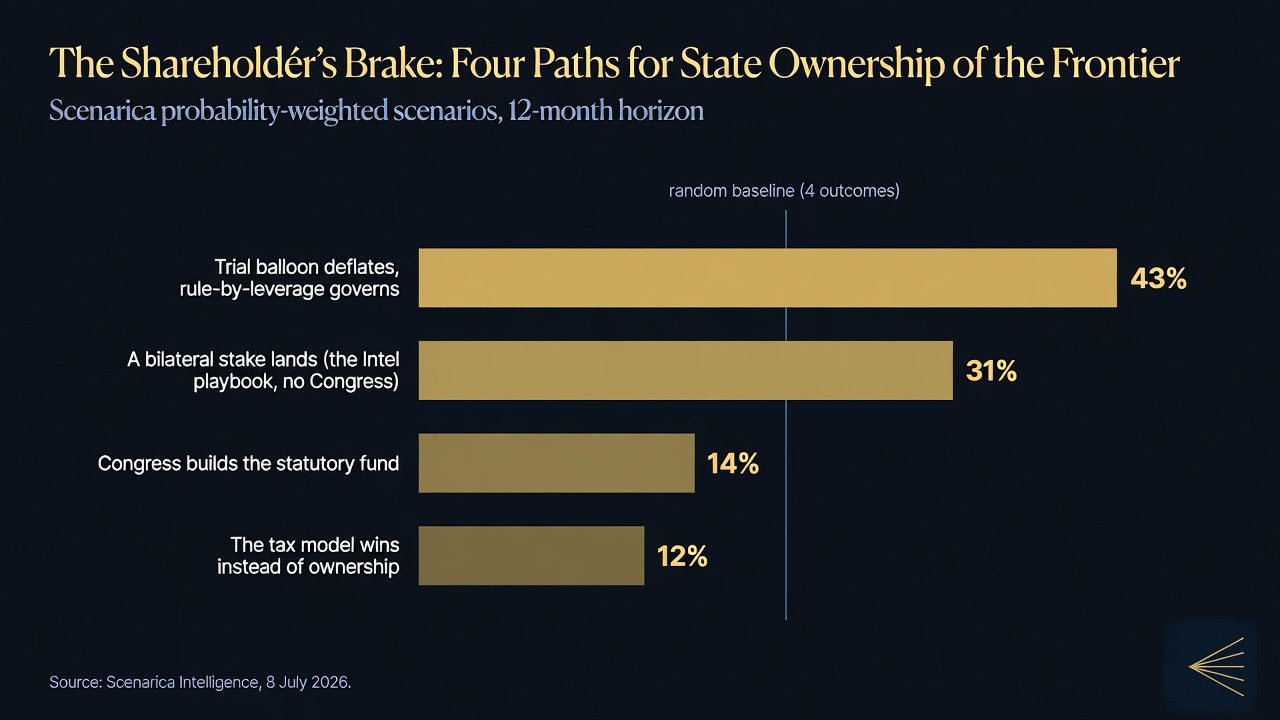
The most probable, at forty-three percent, is that the trial balloon quietly deflates and nothing changes hands. The proposal is still conceptual, an act of Congress is the likeliest route to any broad fund, the other labs are cool to hostile, and the administration already holds the lever it actually wanted. It slowed GPT-5.6 without owning a share of anything. In this world the pre-release review regime, the thirty-day preview, the call before launch, hardens into the real instrument of control, and the equity talk is remembered as the moment the industry offered Washington a seat it decided it did not need to buy. Watch the interagency posture over the next one to three months and the absence of any term sheet by the autumn; governance-by-review continuing with no equity attached is this scenario confirming itself. The reason it leads without dominating is that this is a functioning status quo, and each rival path needs an affirmative, friction-heavy act to beat it.
Then there is the path the 2025 precedents make far more live than the conceptual framing suggests, and I put it at thirty-one percent: a bilateral stake lands without waiting for Congress at all. Washington took ten percent of Intel by converting grants, not by passing a law. A motivated seller in OpenAI and a proven buyer in this Treasury can construct a narrow deal the same way, an equity position in one or two willing labs rather than a universal fund. If you are inside a lab, this is the scenario that forces the question you cannot defer, whether being owned buys enough regulatory peace to justify handing the state a permanent reason to want you unleashed. A reported OpenAI term sheet, or a named Treasury vehicle, before the end of the third quarter is the tell.
Fourteen percent belongs to the version where Congress actually builds the fund, some negotiated creature between Altman’s five percent and Sanders’s fifty, capturing every lab above a revenue line and formalising the soft nationalisation of the frontier in statute. It is not the base case, because legislation is slow, the constitutional and antitrust questions are enormous, and the labs will spend heavily to shape or stall it. But a seven-trillion-dollar number and a thousand-dollar cheque to every voter is the kind of politics that does not stay in a subcommittee forever. Movement of the Sanders bill out of committee, or the appearance of a rival administration-backed statute, over the next twelve months would put this path in play.
The smallest live path, at twelve percent, is that the tax model wins instead of the ownership model. Anthropic’s digital dividend, or something shaped like it, becomes the template, and the public gets its claim on the boom through the tax code rather than the cap table. This is the outcome that actually preserves the regulator’s independence, because a taxing state can still afford to say no. That it is the least likely of the four is the quiet irony of the whole episode: the cleanest answer to the conflict is the one with the weakest constituency, because ownership offers politicians a headline number and a dividend cheque, while a tax offers them only an argument.
Watch a handful of specific things from here. The breadth of GPT-5.6’s release, expected around the middle of July, and whether it arrives with an explicit government sign-off, will tell you whether the review regime is loosening or hardening into a permanent gate. Any public term sheet or named Treasury vehicle touching an OpenAI stake before the end of September would move the bilateral path from possible to probable. A committee vote on the Sanders act, or the surfacing of an administration-drafted alternative, at any point in the next two quarters would signal that the statutory fund is alive rather than symbolic. A second lab, Google or Meta or xAI, publicly accepting or refusing equity would tell you whether this is becoming a universal architecture or a bespoke bargain for one company. And if Anthropic’s tax proposal picks up a serious legislative sponsor, the one path that keeps the regulator honest will finally have a champion.
The Alaska fund turns fifty this year and has never once had to decide that the oil was too dangerous to sell. Washington is now being offered a piece of an asset whose entire value depends on it almost never asking that question of the labs. The public may well deserve a share of what the frontier earns. But in a room where every regulator has quietly become an owner, and every brake has quietly become a write-down, who is left to speak for the downside?
Sources:
Financial Times / CNBC, “OpenAI proposes U.S. government own 5% stake to address political blowback,” 2 July 2026.
Forbes, “OpenAI Reportedly Pitches Granting U.S. Government 5% Stake,” 2 July 2026.
TechCrunch, “OpenAI proposed donating 5% of its equity to a US sovereign wealth fund,” 2 July 2026.
Tom’s Hardware, “OpenAI floats 5 percent government stake days after Washington delayed GPT-5.6,” 2 July 2026.
TechCrunch, “OpenAI limits GPT-5.6 rollout after government request, says restrictions shouldn’t be the norm,” 26 June 2026.
CNN Business, “White House asks OpenAI to limit its next model release,” 25 June 2026.
Techtimes, “OpenAI Offers Washington a $42.6 Billion Stake: Experts Warn Safety Rules Face Conflict Risk” (Nat Purser, Public Knowledge), 2 July 2026.
Sanders Senate office, “Sanders Introduces Legislation to Create $7 Trillion AI Sovereign Wealth Fund,” June 2026.
Fox Business, “Sanders unveils plan to take 50% stake in AI companies for government wealth fund,” June 2026.
The Motley Fool, “The Trump Administration Purchased Stakes in Intel, MP Materials, Lithium Americas, and Trilogy Metals,” 19 October 2025.
PBS NewsHour, “What you need to know about the government’s 10% stake in Intel,” 2025.
Fortune, “Sam Altman seeks new world order for AI as OpenAI slowly loses ground to Google and Anthropic,” 2 July 2026.
Disclaimer: This report is published by Scenarica Intelligence for informational purposes only. It does not constitute investment advice, a solicitation to buy or sell any financial instrument, or a recommendation regarding any particular investment strategy. Scenarica Intelligence is not a registered investment adviser or broker-dealer. All scenario probabilities and assessments represent the analytical judgment of Scenarica Intelligence and are subject to change without notice. Past performance of any asset or strategy discussed does not guarantee future results. Readers should conduct their own due diligence and consult with qualified financial advisers before making investment decisions.
Scenarica Premium: The full Scenarica suite includes Geopolitics, Economy, Bitcoin, AI, and Sunday Edition.
Scenarica Intelligence
We don’t predict the future. We price it.