

The Textbook Error
The ECB raised rates to fight wartime inflation. Higher rates cannot reopen the Strait of Hormuz.

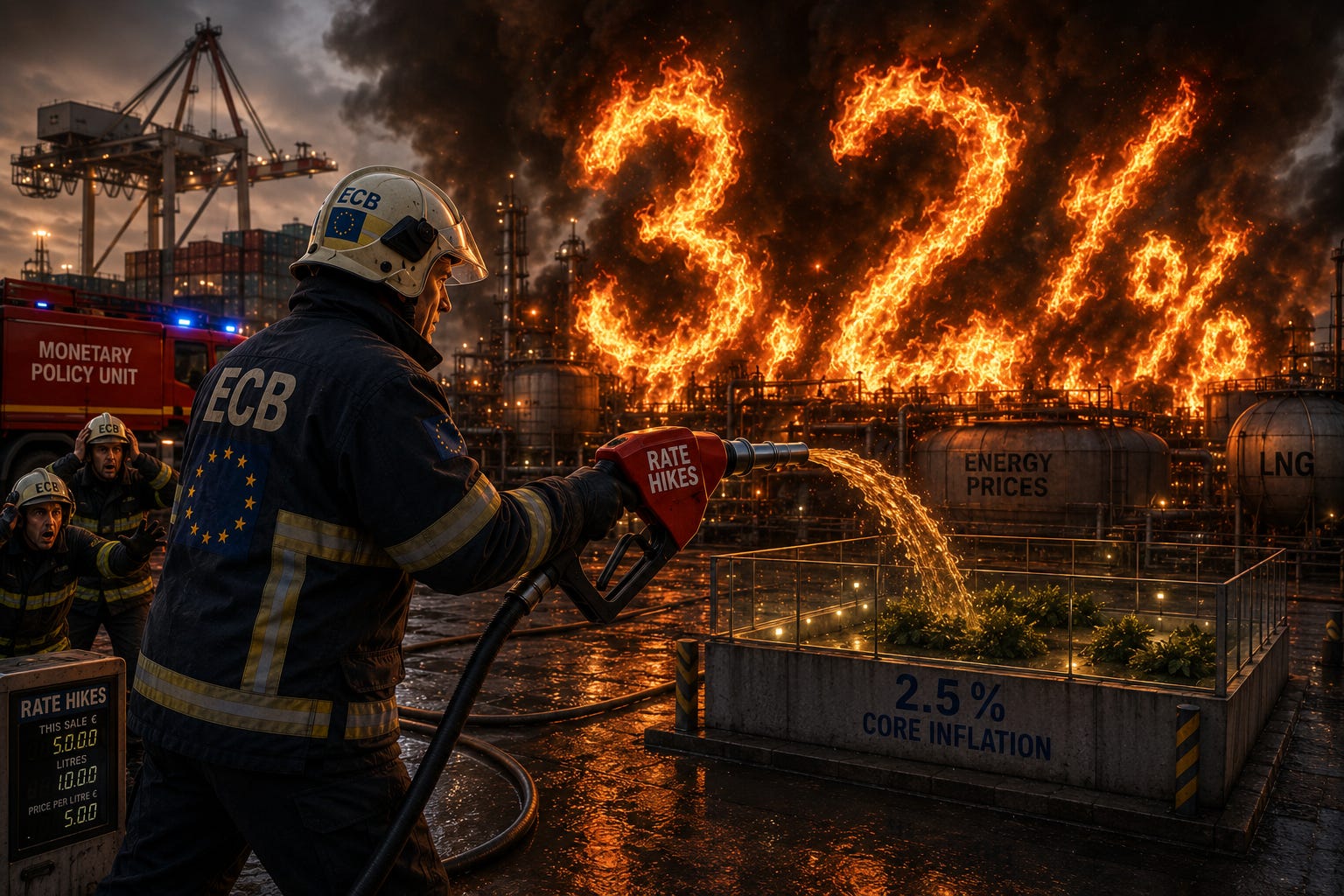
The European Central Bank’s monetary policy statement of 11 June 2026 describes the decision to raise all three key interest rates as “robust across a range of scenarios.” Six days before that sentence was published, Eurostat released its revised estimate for first-quarter eurozone GDP: minus 0.2 percent, the first contraction in over three years.
A central bank that calls its own decision “robust” in the same week the economy it governs prints negative is either confident or cornered. The distinction matters for every European household with a mortgage, every corporate treasurer managing euro-denominated debt, and every fixed-income portfolio manager running duration in Frankfurt, Amsterdam, or Milan.
The deposit facility rate rose to 2.25 percent. The main refinancing rate went to 2.40 percent. The marginal lending facility reached 2.65 percent, all effective from 17 June. These are the first rate increases since the tightening cycle ended in September 2023, reversing the easing cycle that ran from June 2024 through June 2025. At the press conference, Christine Lagarde rejected the term “insurance hike” with visible conviction. She rejected the word “stagflation” with almost equal force.
The inflation she is fighting is real. Eurozone headline HICP hit 3.2 percent in May 2026, the highest reading since September 2023. Energy prices surged 10.9 percent year on year, with domestic heating oil up 68.5 percent and natural gas up 10.1 percent. But strip out energy and food, and core inflation was 2.5 percent, barely above the ECB’s 2 percent target. Services inflation, the one component that actually responds to monetary tightening, was 3.5 percent.
The gap between headline and core is the gap between the inflation the ECB is fighting and the inflation that interest rates can actually reach. That gap is the Strait of Hormuz, expressed as a percentage point.
Scenarica prices five paths forward, and they describe a central bank caught between a mandate it cannot ignore and an economy it cannot help.
The most probable path, at thirty-five percent, is the one that ends in humiliation. The eurozone enters technical recession in Q2 or Q3 while inflation stays above 3 percent, confirming the first genuine stagflation in the euro’s twenty-seven-year history. The ECB is forced to cut before the year is out. If you are running European duration and positioning for this scenario, you are not alone. The last time an ECB president reversed a rate hike within months of delivering it, the president’s name was Mario Draghi, the year was 2011, and the hikes he was undoing were Jean-Claude Trichet’s.
Twenty-five percent goes to the world where the Strait of Hormuz rescues her. The memorandum of understanding signed on 17 June holds. Commercial shipping normalises over the summer. Energy inflation fades from the year-on-year comparisons by early 2027. The hike looks premature but not disastrous, and by the time the textbook is written the chapter is a footnote, not a case study. If you are managing rate risk in this scenario, position for an extended pause rather than an easing cycle.
Twenty percent belongs to a path the ECB’s own institutional architecture was designed to prevent. Higher rates widen Italian and Greek sovereign spreads to levels that trigger discussion of the Transmission Protection Instrument, the bond-buying programme created in July 2022 for exactly this kind of fragmentation. If you are managing a European credit book and you see BTP-Bund spreads pushing toward 200 basis points, you are watching a central bank preparing to hike rates and buy bonds simultaneously, the monetary policy equivalent of pressing the accelerator and the brake at the same time.
Twelve percent is the scenario the market has barely considered. The MOU collapses. Hormuz re-closes. Energy prices spike further. The ECB finds itself trapped: inflation accelerating inside a recession that its own rate hike deepened. There is no playbook for this. Trichet’s 2011 error unfolded against a sovereign debt crisis. This would unfold against a shooting war and a physical energy blockade. If you have not stress-tested your European book against Brent above $100, you are underweight on tail risk.
Eight percent is vindication. The eurozone rebounds on fiscal spending, particularly the defence build-out that Germany’s constitutional amendment unlocked. Inflation fades as global energy markets rebalance. If you are betting on this path, you are betting that the European fiscal impulse is large enough to overwhelm the monetary drag of a rate hike into a contraction. The arithmetic does not obviously support it.
The reason the stagflation scenario carries the highest probability is not a forecast about European growth. It is a structural observation about what happens when a central bank uses a demand-side tool against a supply-side problem.
When inflation comes from demand, too much money chasing too few goods, higher interest rates work. They make borrowing more expensive, cool spending, and bring prices back toward equilibrium. The mechanism is well understood. It is what the ECB was built to do. When inflation comes from supply, a war closing a shipping lane, an oil shock, a physical disruption to energy infrastructure, higher interest rates cannot fix the problem. They cannot reopen the Strait of Hormuz. They cannot refill the crude tankers sitting empty at anchor off Fujairah. They cannot lower the price of heating oil for a German pensioner in Dortmund whose bill rose 68.5 percent in a year.
What higher rates can do is suppress the demand side of an economy that is already contracting, making the growth problem worse while leaving the inflation problem untouched. A central bank that raises rates into a supply shock is using a hammer to fix a leak.
The head of rates at one of Europe’s largest pension fund managers, a woman who has run the same European government bond book since the financial crisis, watched the press conference from a terminal on the fourth floor of an office building in The Hague. She had positioned for a hold. By 2:47 PM Frankfurt time, she was repositioning for what she described to her risk committee the following morning as “the Trichet trade.”
She knows the Trichet trade because she lived through it. In April 2011, Trichet raised the main refinancing rate by 25 basis points to 1.25 percent, fighting inflation driven by commodity prices, not by overheating demand. In July, he raised again to 1.50 percent. By November 2011, Mario Draghi, who had taken office three weeks earlier, cut the rate back to 1.25 percent. By December, he cut to 1.00 percent. The hikes lasted six months. Their damage to peripheral sovereigns, to business confidence, to the credibility of the ECB’s judgment, lasted considerably longer.
The ECB would argue that 2026 is not 2011. And the argument would not be entirely wrong. The GDP contraction was driven in large part by Ireland, where multinational-dominated GDP collapsed 12.1 percent in Q1, a statistical event with limited real economic meaning for the broader eurozone. Strip Ireland out, and the remaining countries grew between 0.2 and 0.3 percent. The Eurosystem staff projections published alongside the June rate decision forecast 0.8 percent growth for full-year 2026, 1.2 percent for 2027, and 1.5 percent for 2028, according to the ECB’s June 2026 projections release. Those are not recession numbers.
But those projections carry a condition that matters more than the baseline. They are, in the ECB’s own language, conditional on the assumption that the energy shock is temporary and that energy price futures normalise. If the shock is not temporary, the ECB’s own severe scenario shows growth falling to 0.5 percent and inflation rising to 4.0 percent in 2026. By 2027 in that scenario, inflation reaches 5.3 percent while GDP growth collapses to 0.4 percent. The institution published these numbers in the same document that justified the rate hike. Its own stress test describes the world in which its own decision becomes a catastrophe.
The portfolio manager in The Hague had circled the severe scenario table. She had also circled a date: 24 July, when the Governing Council meets next. If the eurozone composite PMI flash on 19 July prints below 47, the political case for a second hike evaporates before the Council sits down.
The single most important number for anyone running European duration is not the headline inflation print. It is the spread between headline HICP and core HICP excluding energy and food. In the ECB’s own June projections, headline averages 3.0 percent for 2026 while core averages 2.5 percent. That 50-basis-point gap is the Strait of Hormuz expressed as an inflation differential. It is the portion of inflation that the ECB is fighting with the only tool it has, and that the tool cannot reach. If core were at 3.5 or 4 percent, the hike would be defensible regardless of the source. Core at 2.5 percent tells you the domestic price mechanism is behaving. The problem is not in the eurozone. The problem is in the Persian Gulf.
This is where the architecture of the European Central Bank becomes the story itself. The Federal Reserve operates under a dual mandate: price stability and maximum employment. When a supply shock pushes inflation up and growth down simultaneously, the Fed can weigh both sides. It has institutional permission to look through supply-driven inflation when the labour market is at risk. The ECB has no such permission. Its primary objective under the Treaty on the Functioning of the European Union is maintaining price stability. When inflation is at 3.2 percent, the Treaty points in one direction regardless of why it is at 3.2 percent.
A central bank with a single mandate and a supply shock is a central bank with no good options, only differently bad ones. Lagarde chose the option the Treaty demands. The economy will pay the price the Treaty did not consider.
The eurozone composite PMI flash on 19 July is the first tripwire. If manufacturing prints below 45 and services dips below 48, the probability of a second hike at the 24 July Governing Council meeting drops to single digits. Watch for any softening of the language that described the June decision as “robust.”
The Eurostat Q2 GDP flash estimate, due in late July, carries the full weight of the thesis. A second consecutive contraction would confirm the eurozone’s first technical recession since the pandemic and make the June hike indefensible in any framework the ECB has ever used.
BTP-Bund spreads are the financial tripwire. If the Italian 10-year spread crosses 180 basis points, Transmission Protection Instrument activation moves from theoretical to operational. The ECB has never activated TPI. A first activation during a hiking cycle would be without precedent.
The Hormuz MOU review, expected in mid-August, determines whether the energy price assumptions underlying the ECB’s baseline projections survive contact with geopolitics. If the MOU fails, the baseline fails with it, and the 35 percent stagflation scenario becomes the central case.
The ECB’s June decision will be studied for years. Not because it was obviously wrong on the day it was made, because a case can be made for every central bank decision in the moment, but because it exposes a question the eurozone’s architects never had to answer in the currency’s first quarter-century. What should a central bank do when the mandate demands a response that the economy cannot survive? Lagarde did what the Treaty requires. The Treaty was written for demand shocks, business cycles, and peacetime price fluctuations. It was not written for a world where the Strait of Hormuz determines European inflation, where a war a continent away sets the price of heating oil in Dortmund, and where the textbook answer to inflation, raise rates, is the textbook error.
ANNEX: WHAT SHOULD EUROPEAN RATE MANAGERS DO WITH THE ECB’S REVERSAL RISK?
Five scenarios, summing to 100 percent, describe the paths from the ECB’s June 2026 rate hike. Each carries different implications for rate expectations, sovereign spreads, and portfolio positioning across the eurozone.
Stagflation confirmation and forced reversal -- 35%
If you are positioned for ECB rate cuts by Q4, this is the path that validates the trade. The eurozone enters a technical recession while inflation remains above 3 percent, driven by persistent energy costs from the Hormuz disruption. The ECB reverses the June hike before the end of 2026, cutting the deposit facility rate back to 2.00 percent or below. European government bond yields fall across the curve, with the front end leading. Corporate credit spreads widen as economic weakness deepens, but your duration book benefits from the rally. The parallel is Trichet’s 2011 U-turn, and the speed of Draghi’s reversal in November and December of that year is the template for how fast the ECB moves once the data turns.
Quantitative variable to watch: eurozone composite PMI. Currently near 48. At 1-month horizon, probability of falling below 46 is 40 percent. At 3-month horizon, probability of consecutive sub-47 readings is 55 percent. At 12-month horizon, probability of sustained contraction territory, below 48 on average, is 35 percent. Source: S&P Global/HCOB eurozone PMI flash, released third week of each month.
Energy normalisation and slow recovery -- 25%
If you are managing European rate risk, this is the scenario where the June hike proves merely premature rather than catastrophic. The Hormuz MOU holds through the summer. Commercial shipping normalises. Energy inflation fades from year-on-year comparisons by Q1 2027. The ECB pauses at the July meeting and holds through autumn. Growth recovers to 0.3 to 0.4 percent quarterly by Q4. Your positioning should reflect an extended pause rather than an easing cycle: front-end rates stay elevated, the curve flattens moderately, and peripheral spreads stabilise near current levels. The textbook records the hike as a judgment call made under fog, not a structural error.
Quantitative variable to watch: Brent crude oil price. Currently near $87 per barrel. At 1-month horizon, probability of falling below $80 is 30 percent, contingent on MOU stability. At 3-month horizon, probability of sustained trading below $75 is 25 percent. At 12-month horizon, probability of returning to pre-crisis levels below $70 is 20 percent. Source: ICE Brent futures curve and weekly EIA petroleum status reports.
Peripheral fragmentation and TPI activation -- 20%
If you are running a European sovereign book with Italian or Greek exposure, this is the scenario that tests your conviction. The rate hike widens BTP-Bund spreads beyond 180 basis points by late summer, triggering internal ECB discussions about activating the Transmission Protection Instrument for the first time. The paradox is visible to everyone in the market: the ECB buying peripheral bonds to contain fragmentation caused by its own rate hike. Your Italian and Greek duration positions face mark-to-market losses before TPI activation, then rally sharply if the ECB intervenes. The timing mismatch is the risk. If you reduce exposure before TPI is activated, you crystallise losses. If you hold and activation is delayed, the drawdown deepens.
Quantitative variable to watch: BTP-Bund 10-year spread. Currently near 150 basis points. At 1-month horizon, probability of exceeding 180 basis points is 25 percent. At 3-month horizon, probability of exceeding 200 basis points is 20 percent. At 12-month horizon, probability of TPI activation is 15 percent. Source: daily sovereign bond yield data via Bloomberg or Refinitiv.
MOU collapse and energy price spike -- 12%
If you are a corporate treasurer hedging European energy exposure, this is the scenario that turns hedging from optional to existential. The MOU collapses in mid-August. Hormuz re-closes partially or fully. Brent spikes above $100 per barrel. European natural gas benchmarks surge past the levels seen in the first weeks of the Hormuz crisis. The ECB is paralysed: inflation accelerates toward 4 percent while the economy contracts further, and the rate hike it delivered in June becomes a weight the economy cannot carry. Your energy hedges become your most valuable positions. Your interest rate positioning is secondary to your commodity exposure. This is the scenario where the 2011 parallel breaks entirely, because Trichet never had to manage a war and a rate mistake simultaneously.
Quantitative variable to watch: TTF natural gas front-month contract. At 1-month horizon, probability of exceeding 55 euros per megawatt-hour is 15 percent. At 3-month horizon, probability of exceeding 70 euros per megawatt-hour, conditional on MOU collapse, is 65 percent. At 12-month horizon, probability of sustained prices above 50 euros per megawatt-hour is 30 percent. Source: ICE Endex TTF natural gas futures.
Growth surprise and ECB vindication -- 8%
If you are positioned for European economic resilience, this is the path where fiscal stimulus overwhelms monetary drag. Germany’s defence spending ramp-up and the broader European fiscal build-out inject enough demand into the economy to offset the rate hike. Growth surprises to the upside in Q3 and Q4, reaching 0.4 to 0.5 percent quarterly. Inflation moderates as energy prices stabilise and the fiscal impulse flows through productive investment rather than consumption. The ECB holds at 2.25 percent through 2027, and Lagarde’s June press conference is cited as an example of anchoring expectations at exactly the right moment. Your European equity exposure benefits more than your fixed-income book.
Quantitative variable to watch: German federal government capital expenditure, released quarterly by Destatis. At 3-month horizon, probability of year-on-year increase exceeding 15 percent is 20 percent. At 6-month horizon, probability of new defence procurement contracts exceeding 30 billion euros is 25 percent. At 12-month horizon, probability of cumulative fiscal impulse exceeding 1.5 percent of eurozone GDP is 10 percent. Source: Destatis national accounts release and European Commission fiscal monitoring data.
Sources:
European Central Bank, “Monetary policy decisions,” 11 June 2026.
Eurostat, “GDP and employment flash estimate,” Q1 2026 (revised 5 June 2026).
Eurostat, “Euro area annual inflation up to 3.2%,” flash estimate, 2 June 2026.
European Central Bank, “Eurosystem staff macroeconomic projections for the euro area,” June 2026.
European Central Bank, “ECB press conference,” 11 June 2026.
Euronews, “ECB raises interest rates for the first time in three years as Iran war fuels inflation,” 11 June 2026.
CNBC, “ECB hikes interest rates for first time since 2023 as Iran war ramps up energy costs,” 11 June 2026.
European Central Bank, “Monetary policy decisions,” April and July 2011 (Trichet rate hikes).
European Central Bank, “The Transmission Protection Instrument,” 21 July 2022.
CNBC, “Three Saudi oil tankers carrying 6 million barrels cross Strait of Hormuz,” 18 June 2026.
Sharecast, “Eurozone Q1 GDP revised to show first contraction in three years,” 5 June 2026.
Disclaimer: This report is published by Scenarica Intelligence for informational purposes only. It does not constitute investment advice, a solicitation to buy or sell any financial instrument, or a recommendation regarding any particular investment strategy. Scenarica Intelligence is not a registered investment adviser or broker-dealer. All scenario probabilities and assessments represent the analytical judgment of Scenarica Intelligence and are subject to change without notice. Past performance of any asset or strategy discussed does not guarantee future results. Readers should conduct their own due diligence and consult with qualified financial advisers before making investment decisions.
Scenarica Premium: The full Scenarica suite includes Geopolitics, Economy, Bitcoin, AI, and Sunday Edition.
Scenarica Intelligence
We don’t predict the future. We price it.