

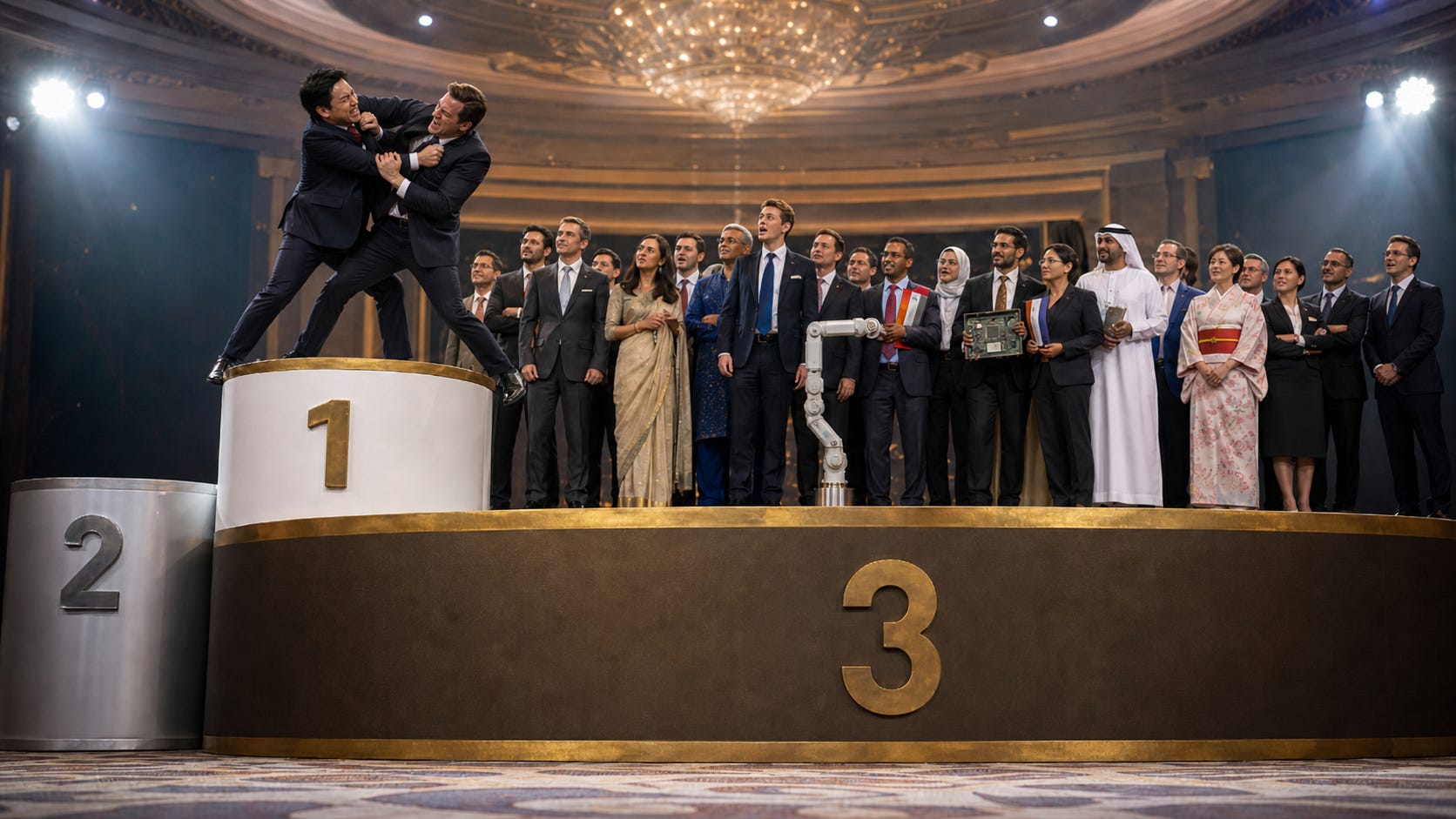
The Third Pole
Sovereign AI is not about beating GPT-5. It is about serving the four billion people GPT-5 never will.

On March 20, a concrete pad was poured on a plot of desert outside Abu Dhabi that had been scrubland six months earlier. The pad was the first of forty-seven required for a one-gigawatt compute cluster called Stargate UAE, a joint venture between G42, OpenAI, and Oracle. NVIDIA will supply Grace Blackwell GB300 systems. The first 200-megawatt section is scheduled to go live before the end of 2026.
Sam Altman called it the first major milestone in OpenAI’s “OpenAI for Countries” initiative. It was not the only AI infrastructure deal signed in Abu Dhabi that season.
Three weeks before the concrete was poured, a different team on a different floor of G42’s headquarters had finalised a different partnership with a different AI lab on a different continent. G42’s agreement with France’s Mistral AI, announced the previous May at the Choose France summit and now entering its operational phase, spans the full AI value chain from model training to agent deployment to industry-specific applications across Europe, the Middle East, and the Global South. Mistral’s models are not frontier-competitive with GPT-5 on English-language benchmarks. They are not designed to be.
Two AI construction projects. The same sovereign wealth fund ecosystem financing both. One bet that American frontier capability will serve the Gulf’s needs. One bet that it will not.
The conventional framing of the AI industry has two players: the United States, which funds and builds the frontier, and China, which matches it at lower cost. This framing is correct at the top of the capability curve. It is increasingly incomplete everywhere else.
In February 2025, President Emmanuel Macron stood at the AI Action Summit in Paris and announced that France would attract 109 billion euros in private AI investment, most of it directed toward data centre infrastructure, with a gigawatt of nuclear power pledged to AI training by the end of 2026. The financing included 20 billion euros from Canada’s Brookfield, up to 50 billion euros from the UAE over the coming years, and 10 billion euros from Bpifrance. Macron called it France’s answer to Stargate.
In May 2025, MGX, Bpifrance, Mistral, and NVIDIA announced a joint venture to build Europe’s largest AI campus in the Paris region: 1.4 gigawatts of capacity, construction beginning in the second half of 2026, operations by 2028. The partnership was formalised at the Choose France summit in Versailles, with backing from both the UAE president and Macron, and supported by an ecosystem including EDF Group, Bouygues, Ecole Polytechnique, and RTE.
Mistral sits at the centre of the European bet. The company raised 1.7 billion euros in a Series C round in September 2025 at an 11.7 billion euro valuation, followed by $830 million in debt financing in March 2026 to build data centres near Paris and in Sweden. At Davos in January, CEO Arthur Mensch told Bloomberg that the claim Chinese AI lags the United States was a “fairy tale,” and forecast Mistral’s revenue would cross one billion euros by the end of 2026. The company is not trying to build the most capable model on earth. It is trying to build the most deployable model in Europe, the Middle East, and the Global South, trained without routing data through American cloud infrastructure, sold without an American API key in the dependency chain.
This is what Mensch described to Axios as “a little more friction” in the AI adoption race. The friction is structural. It is the gap between what a frontier model can do in English and what a business in Riyadh, in Mumbai, in Seoul, or in Lyon actually needs. Five countries are spending billions to close that gap, and the thesis emerging across all five simultaneously is not the thesis the market is pricing.
Sovereign AI is not about matching GPT-5 on benchmarks. It is about ensuring that the critical national functions of governance, defence, manufacturing, and public services do not depend on a foreign company’s servers, a foreign government’s export controls, or a foreign platform’s terms of service. Mistral signed a defence contract with the French military. The logic is not that Mistral is better than OpenAI for fighter pilots. The logic is that if Washington restricts API access tomorrow morning, France’s military does not lose capability overnight.
The UAE makes the argument most aggressively. Sheikh Mohammed bin Rashid Al Maktoum announced in April 2026 that within two years, 50 percent of UAE government services will run on agentic AI capable of independently executing tasks and managing processes. The government has renamed its Ministerial Development Council to the Ministerial Council for Artificial Intelligence and Development. Government statistics confirm 97 percent utilisation of AI tools across federal entities. Abu Dhabi has declared its intent to become the world’s first fully AI-native government across all digital services by 2027.
The UAE is also the node where the thesis gets complicated, and where the structural insight the market is missing becomes visible.
Abu Dhabi is building Stargate UAE with OpenAI and Oracle. Abu Dhabi’s G42 is building sovereign AI infrastructure with France’s Mistral. Abu Dhabi’s MGX is co-financing the 1.4-gigawatt AI campus outside Paris. The same sovereign wealth fund ecosystem is underwriting both the American frontier and the European sovereignty project simultaneously.
This is not indecision. This is the hedging strategy of a country that understands something the market has been slow to price: the most valuable position in the AI era may not be at the frontier of capability. It may be at the intersection of every supply chain, every regulatory regime, and every language group that the frontier cannot optimally serve.
If you are tracking the AI infrastructure buildout and your model has two columns, one labelled US and one labelled China, you are missing the roughly 150 to 200 billion dollars in cumulative sovereign AI investment now flowing through countries that will never produce a frontier model and do not intend to. The question is whether this distributed investment coalesces into something with structural weight or remains a collection of national programmes that never coordinate.
South Korea is spending as if it has already answered that question. The Korean government’s total AI budget for 2026 reached 9.9 trillion won, approximately $7.1 billion, spread across 41 ministries and 741 programmes, according to the Presidential National AI Strategy Committee, which declared 2026 the “AI G3 Leap Year.” In May 2026, the Financial Services Commission reported that approvals through its National Growth Fund had reached $5.7 billion, including equity investment in a national AI computing centre equipped with 15,000 GPUs and a $380 million investment in AI firm Upstage.
Seoul unveiled a blueprint to become a global leader in physical AI, designating the Yangjae-Suseo corridor as the “Seoul Physical AI Belt.” The government’s target is explicit: AI G3 status, a self-declared seat in the top three AI powers globally, backed by a public-private investment plan targeting 500,000 GPUs and 50 new data centres by 2030.
The Korean bet is not on language models. It is on the AI that operates in factories, on production lines, and inside robots. Samsung Foundry sits in the semiconductor supply chain. Hyundai operates one of the world’s largest manufacturing networks. Korea is not trying to outperform Claude or GPT on reasoning benchmarks. Korea is trying to embed intelligence on factory floors at a scale that American labs, focused on the digital world, have barely begun to address.
Japan made the same calculation three weeks ago. On April 12, SoftBank, NEC, Honda, and Sony established a joint venture called Japan AI Foundation Model Development, with Preferred Networks joining the research phase. The company plans to build a trillion-parameter model. Not for conversation. For physical AI: robots, autonomous vehicles, industrial machines. The Japanese government is backing the venture with roughly one trillion yen, about $6.28 billion, through NEDO over five years. Training data will remain in Japan. No processing on foreign cloud platforms.
Japan’s Ministry of Economy, Trade and Industry published a target in March 2026 that reads like a sovereign industrial strategy from a different era: capture 30 percent of the global physical AI market by 2040. Japanese manufacturers already account for approximately 70 percent of the world’s industrial robotics production, according to METI. The foundation model is the missing layer, the intelligence that turns a robot arm from a programmed tool into an adaptive agent. SoftBank, NEC, Honda, and Sony are building that layer domestically because routing it through an American cloud platform would mean routing the operational data of Japan’s entire manufacturing base through foreign servers.
The sovereignty argument in Japan is not abstract. It is about who controls the neural network that operates the factory.
India adds a different dimension entirely. Sarvam AI, which raised $350 million in April 2026 from investors including NVIDIA, Bessemer, Amazon, and Accel, unveiled its first homegrown foundation models at the India AI Impact Summit: Sarvam-30B and Sarvam-105B, supporting more than 22 Indian languages. The company’s API platform hosts over 25,000 developers, with 150 percent year-on-year adoption growth.
India’s advantage is not compute or capital. India’s advantage is the dataset. A population of 1.4 billion people generating data in dozens of languages represents a training corpus that no Western lab will replicate, because the linguistic diversity, the code-mixing patterns, and the cultural context cannot be synthesised from English-language internet data. The Indian AI market is projected to reach $17 billion by 2027, with AI-driven services already contributing an estimated $10 to $12 billion to India’s $315 billion technology industry.
Abu Dhabi’s Technology Innovation Institute adds the final piece. TII launched Falcon H1 Arabic in early 2026, a model built on a hybrid Mamba-Transformer architecture that established itself as the highest-performing system on the Open Arabic LLM Leaderboard. Available in 3B, 7B, and 34B parameter sizes with context windows of up to 256,000 tokens, the Falcon H1 Arabic models are not designed to compete with Claude or GPT on English-language tasks. They are designed to serve the 400 million native Arabic speakers that no American or Chinese model has been optimised to understand.
The most probable path forward, at thirty-five percent, is fragmentation. Each country builds its own sovereign AI for its own needs, optimised for its own languages and regulatory environment, funded by its own capital. No meaningful coordination emerges. If you are allocating capital to the AI infrastructure trade, this scenario changes nothing in your positioning. The US-China duopoly holds at the frontier. Sovereign models serve domestic markets but never achieve the scale or interoperability to constitute a geopolitical counterweight. The metric to watch: whether any two of these five countries announce a shared infrastructure agreement, a joint training initiative, or an interoperability standard by the end of 2026.
The second scenario, at thirty percent, is the one the UAE is actively engineering. The France-UAE axis, anchored by Mistral’s European research and G42’s Gulf-scale deployment infrastructure, expands to include India’s data advantage and becomes a genuine third ecosystem. Not frontier-competitive on benchmarks, but serving two billion or more users with models that fit their languages, their regulatory environments, and their sovereignty requirements better than anything from Mountain View or Shenzhen. If you are a CTO at a multinational evaluating AI vendors for operations across Europe, the Middle East, and South Asia, this is the scenario that gives you a procurement alternative you do not currently have. The European AI Act becomes the governance framework for the axis, creating a regulatory moat that American labs cannot easily cross.
Twenty percent belongs to the physical AI breakout. Japan and South Korea’s bet on embodied intelligence proves prescient, not because language models stop mattering, but because the next wave of AI value creation moves from the screen to the factory floor, the warehouse, and the operating theatre. If you are long the AI infrastructure trade and your thesis is built on cloud inference revenue, this scenario forces a fundamental re-evaluation, because the AI that operates a robotic arm does not run on the same infrastructure, the same pricing model, or the same competitive dynamics as the AI that writes an email. Japanese and Korean companies lead this wave while American labs discover that physical AI requires manufacturing partnerships, sensor data, and real-world training environments they do not have.
The remaining fifteen percent is absorption. American hyperscalers, recognising the sovereignty demand, offer sovereign cloud and partnership deals that co-opt the third pole’s ambitions without conceding infrastructure control. Stargate UAE is the template: American models, American chips, American platform economics, delivered through an Emirati data centre with a local brand on the door. If every sovereign AI programme ends up running on American infrastructure with local branding, the sovereignty is nominal. The third pole dissolves.
The probabilities shift on three axes. If Mistral’s next major model release closes the capability gap with frontier American models to within ten percent on standard benchmarks, the France-UAE axis scenario rises to forty percent and fragmentation falls to twenty-five. If the Japan venture’s trillion-parameter physical AI model demonstrates real-world manufacturing applications before fiscal 2028, the physical AI breakout rises to thirty percent. If an American hyperscaler announces a sovereign cloud deal with India that includes data residency and model customisation guarantees, absorption rises to twenty-five percent and the axis scenario falls correspondingly.
Watch the Mistral-G42 infrastructure timeline in Abu Dhabi for the first operational milestone, expected in the second half of 2026. Mensch’s forecast of one billion euros in revenue by year-end is the cleanest test of whether European sovereign AI has a commercial engine or merely a political mandate.
Watch South Korea’s National Growth Fund quarterly approvals for the pace of GPU procurement through the national AI computing centre. The 15,000-GPU target is modest by hyperscaler standards, but it is the first sovereign compute facility in Asia outside China and Japan with explicit government equity backing.
Watch the Japan AI Foundation Model Development venture’s first technical disclosure, expected by Q4 2026 or Q1 2027. A trillion-parameter physical AI model trained exclusively on Japanese data and deployed in Japanese factories would be the strongest proof of concept the sovereignty thesis has produced.
Watch India’s government AI procurement decisions in the next two quarters for whether Sarvam or another domestic provider wins a major federal contract over an American alternative. India’s $1.25 billion government AI pledge is small relative to the scale of the market, but the signal value of a procurement decision, domestic model over American platform, would be disproportionate.
Watch the next hyperscaler sovereign cloud announcement for whether the terms are generous enough to make the sovereignty argument moot. If the absorption scenario is real, the evidence will arrive as partnership press releases, not as policy documents.
The concrete pad in Abu Dhabi will cure in the desert heat and disappear under server racks within the year. One set of racks will run American models serving American commercial interests through an Emirati data centre. Another set, two partnerships away in the same sovereign wealth fund ecosystem, will run European models serving a market that does not speak English as its first language. The duopoly is real at the frontier. But frontiers are not where most people live. The question that reprices the infrastructure trade is not who builds the most capable model on earth. It is who builds the infrastructure for the four billion people the most capable model was never designed to serve.
ANNEX: WHICH BET ON AI SOVEREIGNTY DEFINES YOUR NEXT MOVE?
The sovereign AI landscape distributes across four scenarios that sum to one hundred percent. Your exposure depends on whether you are pricing frontier capability, regional infrastructure, or the industrial applications that sit below the language model layer entirely.
Fragmented Sovereignty – 35%
If you are running an AI infrastructure book, this is the base case that requires no repositioning. Each sovereign programme builds for its domestic market. France builds for France. India builds for India. Japan builds for Japan. No coordination mechanism emerges, no shared standards, no interoperable infrastructure. The US-China duopoly holds at the frontier and controls the platforms that matter for cross-border enterprise deployment. Your NVIDIA position is unaffected. Your hyperscaler exposure is unaffected. The sovereign programmes generate localised revenue streams but none achieves the scale to challenge the existing platform economics.
The quantitative variable to track is whether any bilateral or multilateral sovereign AI infrastructure agreement is announced before the end of 2026. The probability of such an agreement within 3 months is approximately 15 percent, within 6 months approximately 30 percent, and within 12 months approximately 50 percent, with the France-UAE axis as the most likely first mover.
France-UAE-India Axis – 30%
If you are a multinational CTO evaluating AI vendors for operations across Europe, the Middle East, and South Asia, this is the scenario that changes your procurement calculus. Mistral’s infrastructure in Abu Dhabi begins serving enterprise customers outside France. India’s Sarvam models integrate with G42’s deployment stack. The European AI Act becomes the governance standard for the axis, creating compliance requirements that American labs must meet to compete in these markets. A genuine third vendor ecosystem emerges, not frontier-competitive on English-language benchmarks, but offering data residency, regulatory compliance, and multilingual optimisation that American platforms cannot match without structural changes to their architecture.
The quantitative variable is Mistral’s enterprise customer count outside France, reported indirectly through ARR disclosures. The probability of Mistral reaching one billion euros ARR by the end of 2026 as Mensch forecast is approximately 40 percent within 8 months and approximately 55 percent within 12 months.
Physical AI Breakout – 20%
If you are long the AI trade on a thesis built around cloud inference revenue, this scenario forces re-evaluation. Japan’s trillion-parameter physical AI model demonstrates factory-floor applications that language model labs cannot replicate without manufacturing partnerships and sensor data they do not possess. South Korea’s physical AI belt produces measurable productivity gains in Samsung and Hyundai factories. The AI value chain bifurcates: language and reasoning models remain a US-China duopoly, but physical AI, the intelligence that operates robots, autonomous vehicles, and industrial machines, becomes a Japanese and Korean domain.
The quantitative variable is the Japan AI Foundation Model Development venture’s first technical benchmark disclosure, expected by Q4 2026 or Q1 2027. The probability of a public demonstration showing competitive physical AI performance within 12 months is approximately 35 percent and within 18 months approximately 55 percent.
Absorption – 15%
If you are an American hyperscaler strategist, this is the scenario you are actively engineering. Sovereign cloud offerings with data residency guarantees, local model customisation, and regulatory compliance tools make the sovereignty argument functionally moot. The sovereign programmes continue to exist in name but run on American infrastructure, train on American chips, and depend on American platform economics. The third pole dissolves into the US ecosystem with local branding.
The quantitative variable is the number of sovereign cloud partnerships announced by AWS, Azure, and Google Cloud with explicit data sovereignty guarantees in the next 12 months. The probability of three or more such announcements within 6 months is approximately 40 percent and within 12 months approximately 65 percent. Watch the Stargate UAE operational launch for whether the template replicates to India or South Korea.
Sources:
CNBC, “France unveils 109-billion-euro AI investment as Europe looks to keep up with U.S.,” February 2025.
Abu Dhabi Media Office, “MGX partners with Bpifrance, Mistral AI, and NVIDIA to build Europe’s largest AI Campus in France,” May 2025.
Abu Dhabi Media Office, “G42 and Mistral AI unite to build next-generation AI platforms and infrastructure,” May 2025.
OpenAI, “Introducing Stargate UAE,” May 2025.
G42, “G42 Provides Update on Construction of Stargate UAE AI Infrastructure Cluster,” 2026.
Bloomberg, “China Not Behind US in AI, Mistral’s Mensch Says at Davos,” January 2026.
Axios, “Mistral AI CEO on AI adoption and friction at Davos 2026,” January 2026.
Mistral AI, “Mistral AI raises 1.7 billion euros to accelerate technological progress with AI,” September 2025.
Gulf News, “UAE to move 50% of government services to AI within two years,” April 2026.
Khaleeji Times, “Sheikh Mohammed announces 50% of UAE govt services to run on AI agents in 2 years,” April 2026.
UPI, “South Korea invests $5.7B to boost AI industry,” May 2026.
Korea Herald, “Seoul unveils blueprint to become global leader in physical AI,” 2026.
BABL AI, “South Korea Approves National AI Action Plan as Strategy Committee Finalizes 2026-2028 Roadmap,” 2026.
Japan Times, “SoftBank and others set up new firm to develop high-performance AI,” April 2026.
SiliconANGLE, “Japanese tech giants launch joint venture targeting physical AI for robots and machines,” April 2026.
BusinessToday, “The Sarvam Moment: How India’s Homegrown AI Startup Is Challenging ChatGPT, Gemini and Reshaping the Tech Race,” March 2026.
TII, “Abu Dhabi’s TII launches Falcon H1 Arabic,” January 2026.
Disclaimer: This report is published by Scenarica Intelligence for informational purposes only. It does not constitute investment advice, a solicitation to buy or sell any financial instrument, or a recommendation regarding any particular investment strategy. Scenarica Intelligence is not a registered investment adviser or broker-dealer. All scenario probabilities and assessments represent the analytical judgment of Scenarica Intelligence and are subject to change without notice. Past performance of any asset or strategy discussed does not guarantee future results. Readers should conduct their own due diligence and consult with qualified financial advisers before making investment decisions.
Scenarica Premium: The full Scenarica suite includes Geopolitics, Economy, Bitcoin, AI, and Sunday Edition.
Scenarica Intelligence
We don’t predict the future. We price it.