

The Warsh Inheritance
The most pro-Bitcoin Fed Chair in history may run the most Bitcoin-unfriendly monetary policy in a decade.

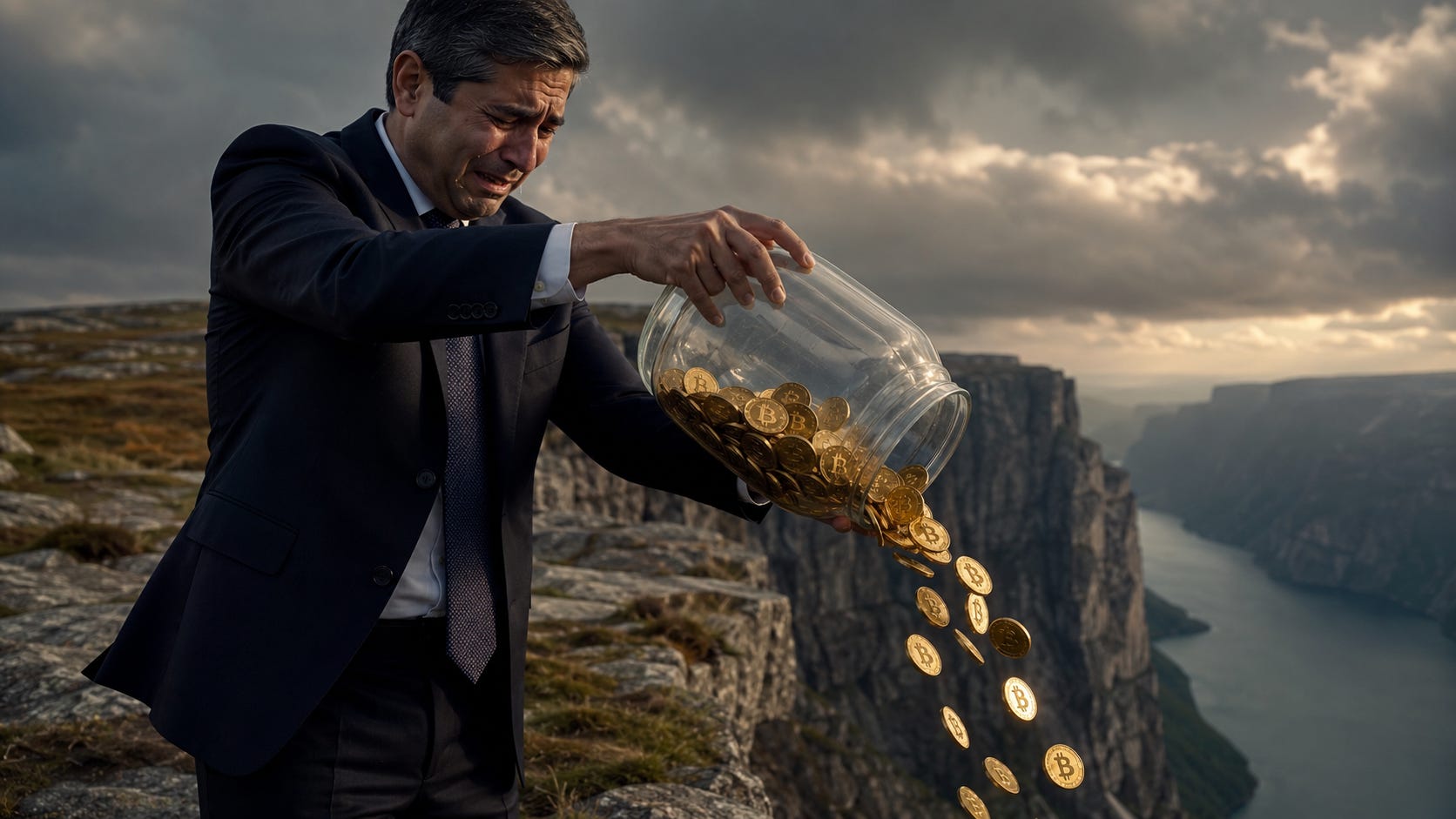
The document is sixty-nine pages long, filed with the United States Office of Government Ethics, and it reads the way financial disclosures always read: line after line of fund names, asset ranges, and holding company structures designed to be technically transparent and practically opaque. Kevin Warsh’s filing, submitted ahead of his Senate confirmation hearing in April 2026, lists combined assets of at least $192 million. The first forty pages are what you would expect from a former Morgan Stanley investment banker married to the heiress of the Estee Lauder fortune: real estate, private equity, family office structures, Hoover Institution affiliations. The pages that stopped the crypto industry cold begin around page forty-five.
Solana. Polymarket. dYdX. Compound. Blast. Flashnet. Bitwise Asset Management. Friends With Benefits. Zero Gravity. Dapper Labs. The list runs to more than twenty crypto-related entities across nearly every sector of the digital asset economy: Layer 1 protocols, Layer 2 scaling solutions, decentralised derivatives, prediction markets, Bitcoin Lightning infrastructure, NFT platforms, and at least one social token. The positions sit inside fund vehicles whose individual line items are reported without dollar values, which under OGE disclosure rules means each is worth less than a thousand dollars. They are small venture bets, not concentrated positions. But the fact that they exist at all, in the financial disclosure of the man about to become the seventeenth Chair of the Federal Reserve, is without precedent. No Fed Chair in history has entered office with a crypto portfolio. Most have entered office with no public opinion on Bitcoin whatsoever.
Warsh has a public opinion. “If you’re under 40, Bitcoin is your new gold,” he told CNBC’s Squawk Box in January 2021, when Bitcoin was trading near $30,000. Five years later, Bitcoin trades near $80,000, Warsh holds the disclosure that proves his conviction was not rhetorical, and the Senate Banking Committee has advanced his nomination on a 13-to-11 party-line vote, the first fully partisan vote on a Fed Chair nominee in the committee’s history. The full Senate vote is expected this week.
The paradox Warsh presents to the Bitcoin market is not subtle, but it is underprocessed. The world’s most powerful central banker is a personal Bitcoin believer with a documented crypto portfolio spanning the full depth of the industry. That is the adoption signal: legitimacy at the highest level of institutional finance, the kind of endorsement that no ETF approval, no exchange listing, no congressional hearing can replicate. When the Chair of the Federal Reserve has held positions in DeFi protocols and Lightning Network infrastructure companies, the reputational barrier to institutional Bitcoin allocation does not lower gradually. It disappears.
But Warsh’s monetary philosophy cuts directly against Bitcoin’s short-term price interests, and the market has already told you which signal it weights more heavily. Bitcoin fell six percent the day Trump announced the nomination on January 30. It dropped another eight percent over the following ten days. The cumulative decline took Bitcoin from roughly $90,400 to below $81,000. More than $1.7 billion in leveraged crypto positions liquidated in the aftermath. The market priced the hawk, not the Bitcoiner.
The hawkishness is not speculation. It is documented. Warsh was appointed to the Fed’s Board of Governors by George W. Bush in 2006, at thirty-five the youngest person to hold that role. He served through the 2008 financial crisis, managing the emergency lending facilities that kept Bear Stearns, AIG, and the broader banking system from collapsing. He resigned in 2011 specifically because he opposed the continuation of quantitative easing. In a Wall Street Journal op-ed in November 2025, he called the Fed’s balance sheet “bloated” and argued it “could be reduced significantly.” He criticised QE2, the $600 billion bond-buying programme launched in 2010, as producing risks that were “unknown, uncertain, and potentially large” while delivering benefits that seemed “small and fleeting.”
Warsh’s ideal Fed is clear from his public record: higher rates than current FOMC consensus assumes, a smaller balance sheet than the $6.6 trillion it currently holds, less forward guidance, and more rules-based policy. Every one of those preferences creates headwinds for risk assets, including Bitcoin. Tighter money means a stronger dollar. A stronger dollar has historically compressed Bitcoin’s price. The BTC-DXY correlation, which Scenarica covered on April 26, hit negative 0.90 in recent months. A hawkish Warsh Fed strengthens the dollar and, by that correlation, weakens Bitcoin in the near term.
The tension between the adoption signal and the monetary headwind plays out across the next two to five years along paths that the market has not properly separated.
The first path, carrying thirty-five percent probability, is the legitimacy-driven adoption boom. This is the path where Warsh’s personal signal overwhelms his monetary signal. When the Chair of the Federal Reserve has held positions in Bitwise, Flashnet, and Solana-linked ventures, the institutional permission structure changes overnight. Pension fund CIOs, endowment managers, insurance company allocators, and sovereign wealth fund committees that have avoided Bitcoin because it lacked “serious” institutional endorsement now have the ultimate endorsement. The legitimacy effect is not linear. One person’s validation does not add one unit of credibility. The Fed Chair’s documented conviction adds a step-change that enables an entire tier of institutional capital to enter. If you hold Bitcoin and you believe that adoption is the dominant long-term price driver, this is the scenario that vindicates your position within eighteen months of Warsh taking office. The mechanism: banks that were restricted from offering crypto services under the previous administration’s Operation Choke Point 2.0, the informal campaign by OCC, FDIC, and the Fed to discourage banking relationships with crypto companies, reopen those services under Warsh’s permissive stance. Every bank that opens a crypto custody desk becomes a Bitcoin on-ramp. The adoption infrastructure scales faster than the monetary headwind compresses prices.
The second path, carrying thirty percent, is the one where the hawk dominates the first twelve to eighteen months. Warsh maintains rates higher than the market expects. He accelerates the pace of quantitative tightening, shrinking the balance sheet toward the level he has publicly argued for. The dollar strengthens. Liquidity drains from risk markets. Bitcoin drops twenty to thirty percent from current levels, which would take it into the mid-fifties to low-sixties range. If you hold Bitcoin and you are trading on a twelve-month horizon, this is the scenario that tests your conviction. The pro-crypto narrative fades into background noise as the monetary reality dominates headlines. But the path has a second act. After twelve to eighteen months, the rate cycle peaks and reverses. Warsh’s hawkishness creates the conditions for eventual easing. And by the time easing arrives, the adoption infrastructure that Warsh’s legitimacy enabled, the bank custody desks, the regulatory clarity, the institutional on-ramps, is already built. Bitcoin recovers strongly on the combination of easing conditions and a structurally expanded buyer base.
The third path, at twenty percent, is the political collision. Trump has publicly demanded rate cuts. Warsh told the Senate Banking Committee that the president had not asked him for rate cuts, a statement that prompted Bitcoin to sell off further as markets interpreted it as reducing the probability of near-term easing. But the political dynamic between a president who wants loose policy and a Fed Chair who believes in tight policy is the oldest tension in central banking. If Warsh resists White House pressure as a matter of Fed independence, the public conflict dominates financial headlines and creates the uncertainty that risk assets hate most. Bitcoin trades sideways in a wide, choppy range. If you are watching for this scenario, the signal is not what Warsh says about rates. It is what Trump says about Warsh.
Here is the turn that neither bulls nor bears have properly accounted for.
Warsh must divest his entire crypto portfolio. The 2022 Fed ethics rules expressly prohibit FOMC members and senior officials from holding cryptocurrencies, individual equities, sector funds, commodities, and derivatives. New officeholders have six months to achieve compliance. OGE certifying official Heather Jones flagged the crypto positions in her review and confirmed that Warsh will be in compliance with the Ethics in Government Act once divestitures are complete.
This means the most pro-Bitcoin Fed Chair in history will, within six months of taking office, own zero Bitcoin. Zero Solana exposure. Zero DeFi positions. Zero Lightning Network infrastructure investments. The personal conviction will remain. The financial alignment will not. The market has priced neither the symbolic power of the divestiture nor the subtle shift it introduces: a Fed Chair who once had skin in the game now has only opinions. The question of whether his policy decisions will favour Bitcoin becomes not a question of conflict of interest but a question of whether conviction without exposure produces the same institutional signal as conviction with exposure.
The fourth path, carrying fifteen percent, is the one that would reshape the global monetary order. The Trump administration has already explored a Strategic Bitcoin Reserve. With a Fed Chair who has publicly called Bitcoin “the new gold” and whose documented portfolio proves he means it, the institutional resistance to sovereign Bitcoin accumulation is reduced. Warsh does not need to endorse the reserve publicly. He simply needs not to oppose it. In a political environment where the White House is pushing for sovereign Bitcoin acquisition and the Fed Chair is, at minimum, sympathetic, the path from executive order to actual purchasing becomes shorter. If the United States begins accumulating Bitcoin for a strategic reserve during Warsh’s tenure, the supply-demand dynamics shift in a way that makes every other scenario irrelevant. This path carries the lowest probability because it requires political alignment, legal authority, and institutional willingness that remain uncertain. But it carries the highest impact.
The probability distribution reveals a temporal split the market has not priced. In the short term, twelve to eighteen months, the hawk dominates. The thirty percent path and the twenty percent political-conflict path together carry fifty percent probability and both involve Bitcoin price headwinds. In the longer term, three to five years, the legitimacy signal dominates. The thirty-five percent adoption boom and the fifteen percent strategic reserve path together carry fifty percent probability and both involve structural Bitcoin appreciation driven not by liquidity but by adoption, regulatory clarity, and sovereign interest. Warsh is bearish for Bitcoin if you are trading. He is bullish for Bitcoin if you are holding. Your time horizon is the variable that determines which Warsh you get.
Watch five signals to see which path gains weight.
Warsh’s first press conference as Chair, expected within days of the full Senate vote this week, will set the tone. Listen for three things: his language on the pace of balance sheet reduction, any unprompted reference to digital assets, and whether he uses the phrase “financial innovation” or “financial stability” when discussing crypto. The choice of frame tells you which Warsh showed up.
The OCC and FDIC guidance updates on bank crypto services, expected in Q3 2026, will reveal the pace of the Choke Point 2.0 reversal. If guidance is issued permitting banks to custody crypto assets without prior supervisory non-objection, the adoption boom scenario jumps above forty percent.
Warsh’s financial disclosure updates, filed quarterly, will track the pace of his crypto divestitures. The six-month compliance window closes in November 2026. The specific timing and structure of the divestitures will signal whether Warsh is treating the requirement as a reluctant obligation or an opportunity to distance himself from the market he once invested in.
Bitcoin ETF flow data in the sixty days following Warsh’s inauguration, tracked by Bloomberg ETF analysts, will reveal whether institutional inflow accelerates on the legitimacy signal or contracts on the hawkish monetary signal. If net inflows exceed $2 billion in the first sixty days, the adoption signal is winning.
The Federal Reserve balance sheet trajectory, published weekly on the Fed’s H.4.1 report, will reveal whether Warsh accelerates quantitative tightening beyond the current pace. Any increase in the monthly runoff cap above the current level would confirm the hawk scenario is materialising.
The sixty-nine-page disclosure sits in the OGE’s database, a public document that anyone can read. Within it, buried in fund structures and holding company vehicles, are twenty entries that tell you something no previous Fed Chair’s filing has ever told you: the person about to set monetary policy for the world’s reserve currency has personally bet on the asset designed to make that reserve currency less necessary. The positions will be sold. The ethics rules demand it. The conviction that produced them will remain, undisclosed, unhedged, and more consequential than any basis point adjustment Warsh will make in his first year. The inheritance runs both ways. Warsh inherits an economy still dependent on AI capex and an inflation rate still above target. Bitcoin inherits its first believer at the centre of the institution it was built to replace. Whether that is a gift or a complication depends on which page of the disclosure you read, and how long you plan to hold.
ANNEX: WHICH WARSH DO YOU GET?
Kevin Warsh’s tenure as Fed Chair creates four distinct paths for Bitcoin over the next two to five years. The dominant force in each path, whether adoption, monetary policy, political conflict, or sovereign accumulation, determines the outcome. The four scenarios below sum to 100%.
Legitimacy-Driven Adoption Boom: 35%
If you hold Bitcoin and your horizon is three to five years, this is the scenario that rewards your patience. Warsh’s documented crypto conviction, combined with the end of Operation Choke Point 2.0, catalyses a wave of institutional adoption. Banks open crypto custody and trading desks. Pension fund allocations to Bitcoin double within twenty-four months. The legitimacy multiplier, the step-change in institutional permission created by a pro-Bitcoin Fed Chair, overwhelms the monetary headwind. Bitcoin reaches new all-time highs within eighteen months of Warsh taking office, driven by adoption flows rather than liquidity.
The variable to watch is quarterly institutional Bitcoin allocation data, reported by CoinShares and Bloomberg Intelligence. If total assets under management in Bitcoin investment products exceed $200 billion by Q4 2026, the adoption boom is materialising. Probability of crossing $200 billion AUM within 12 months: 30%. Within 24 months: 50%.
Hawk Dominates the First Year: 30%
If you trade Bitcoin on a twelve-month horizon, this is the scenario that tests you. Warsh maintains or raises rates. Quantitative tightening accelerates. The dollar strengthens. Bitcoin drops twenty to thirty percent from current levels into the mid-fifties to low-sixties range. The pro-crypto narrative takes a back seat to the monetary reality. After twelve to eighteen months, the rate cycle peaks and the adoption infrastructure Warsh enabled kicks in. Bitcoin recovers strongly in the second half of his tenure.
The variable to watch is the DXY dollar index and the Fed’s monthly balance sheet runoff pace, published in the H.4.1 weekly report. If DXY exceeds 108 and the monthly runoff pace increases above the current cap within six months of Warsh’s inauguration, the hawk scenario is confirmed. Probability of DXY exceeding 108 within 12 months: 35%. Probability of accelerated QT within 12 months: 25%.
Political Conflict Constrains Warsh: 20%
If you are watching for macro volatility, this is the scenario that produces it. Trump demands cuts. Warsh resists. The public conflict between the White House and the Fed dominates financial headlines. Risk assets, including Bitcoin, trade sideways in a wide range as the market prices uncertainty rather than direction. Warsh’s pro-Bitcoin personal stance is overshadowed by the institutional conflict. Resolution comes only when one side capitulates or the economic data forces a clear direction.
The variable to watch is the public rhetoric between the White House and the Fed, tracked through presidential statements, social media posts, and Warsh’s press conference language. If Trump publicly criticises the Fed’s rate decisions more than three times in any sixty-day period, the political conflict scenario is dominant. Probability of sustained public conflict within 12 months: 30%. Probability of the conflict materially affecting Bitcoin’s price range: 20%.
Strategic Bitcoin Reserve Acceleration: 15%
If you believe Bitcoin’s long-term value is determined by sovereign adoption, this is the tail-risk scenario with the highest impact. Warsh’s personal sympathy for Bitcoin, combined with the Trump administration’s existing interest in a Strategic Bitcoin Reserve, reduces institutional resistance to sovereign accumulation. The US begins purchasing Bitcoin for its strategic reserve during Warsh’s tenure. The supply-demand shift drives Bitcoin above $150,000 within twenty-four months.
The variable to watch is executive orders, legislative proposals, and Treasury Department statements related to the Strategic Bitcoin Reserve. Any executive action directing the Treasury or a designated agency to begin Bitcoin acquisition would confirm this scenario is in play. Probability of a formal acquisition programme beginning within 12 months: 5%. Within 36 months: 15%.
Sources:
Kevin Warsh, Financial Disclosure, United States Office of Government Ethics, April 2026.
CNBC, “Kevin Warsh: ‘If you’re under 40, Bitcoin is your new gold,’” Squawk Box, January 2021.
CNBC, “Trump Fed Pick Kevin Warsh Clears Key Senate Hurdle, Teeing Up Final Vote,” April 29, 2026.
Senate Banking Committee, “Nomination Hearing for Kevin Warsh,” April 14, 2026.
CoinDesk, “The Next Fed Chair Has a Crypto Portfolio: Here’s Everything That’s in It,” April 14, 2026.
Money.com, “Fed Nominee Kevin Warsh Discloses Over 30 Crypto Investments,” April 2026.
Crypto.news, “Kevin Warsh Crypto Holdings Must Be Fully Divested,” 2026.
Invesco, “Three Takeaways from Kevin Warsh’s Fed Chair Hearings,” 2026.
Citadel Securities, “A Framework for Chair Warsh,” 2026.
Yahoo Finance, “Warsh’s Return Revives Tensions Over the Fed’s $6.6 Trillion QE Hangover,” 2026.
Fortune, “Kevin Warsh’s Fed Criticisms Make Sense, But He’s Got a ‘Cleanest Dirty Shirt’ Problem,” February 2026.
Kevin Warsh, Wall Street Journal, op-ed on Fed balance sheet, November 2025.
Federal Reserve History, “Kevin M. Warsh,” federalreservehistory.org.
Phemex, “BTC Price Today,” May 9, 2026.
Disclaimer: This report is published by Scenarica Intelligence for informational purposes only. It does not constitute investment advice, a solicitation to buy or sell any financial instrument, or a recommendation regarding any particular investment strategy. Scenarica Intelligence is not a registered investment adviser or broker-dealer. All scenario probabilities and assessments represent the analytical judgment of Scenarica Intelligence and are subject to change without notice. Past performance of any asset or strategy discussed does not guarantee future results. Readers should conduct their own due diligence and consult with qualified financial advisers before making investment decisions.
Scenarica Premium: The full Scenarica suite includes Geopolitics, Economy, Bitcoin, AI, and Sunday Edition.
Scenarica Intelligence
We don’t predict the future. We price it.