

Three Words
The AI trade rests on one belief: America is ahead. A free Chinese model just undercut it.


The file is 744 billion parameters and it costs nothing to own. On the morning of June 16, Z.ai, the Beijing lab once known as Zhipu, posted the open weights of a model called GLM-5.2 to Hugging Face under a license that forbids almost nothing, and within hours anyone with a browser could download the thing that three years of Western AI valuations had quietly assumed only a handful of American companies could build.
For most of those three years the entire investment case for artificial intelligence rested on a single sentence. America is ahead. A free download from Beijing just turned that sentence into a question.
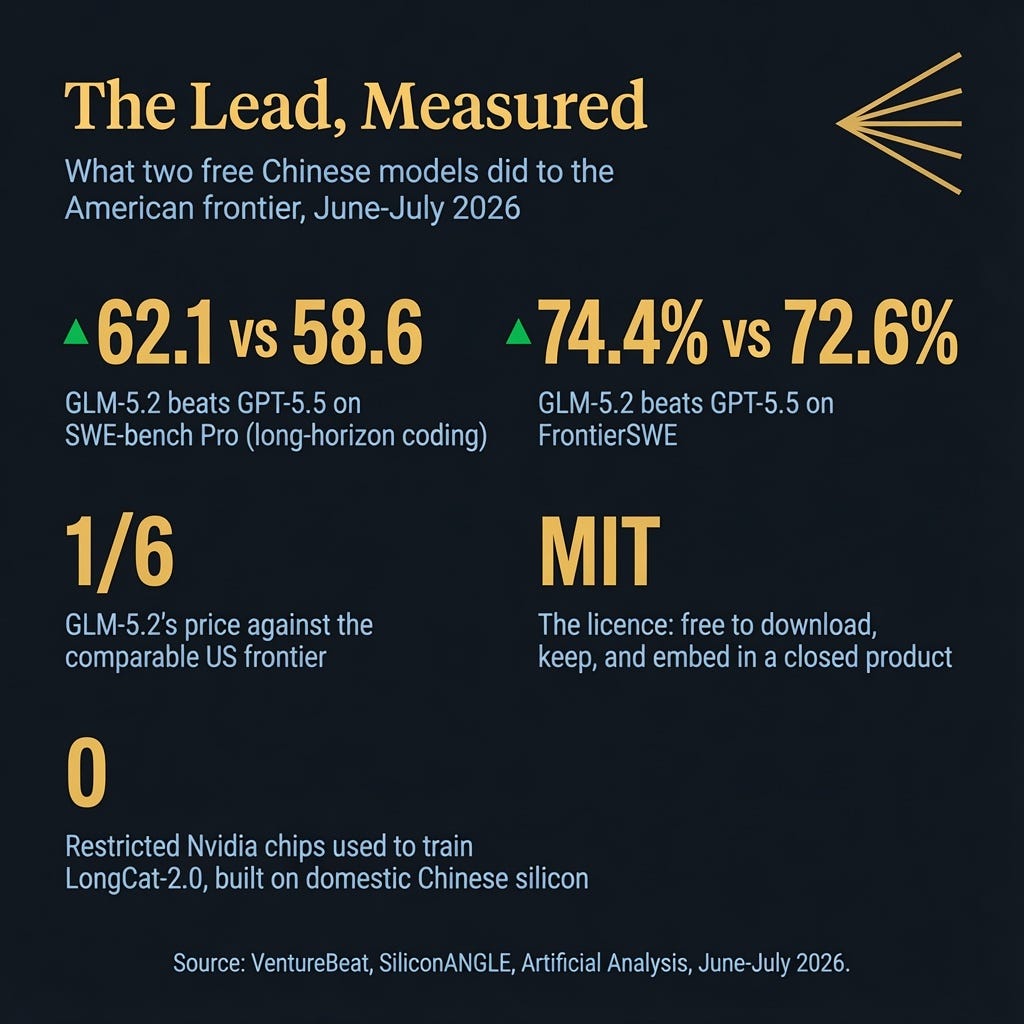
Look at what the file actually does before deciding how much that question is worth. On Artificial Analysis’s composite Intelligence Index, GLM-5.2 landed first among all open-weight models and fourth overall, a few points behind the closed American frontier. On the benchmarks that matter most to the people paying real money, the gap does not merely narrow. On SWE-bench Pro, a test of long-horizon software engineering, GLM-5.2 scored 62.1 against GPT-5.5’s 58.6. On FrontierSWE it hit 74.4 percent to GPT-5.5’s 72.6. It beat one of the two most valuable AI products in the world at the task enterprises are spending the most to automate, and it did so, by VentureBeat’s accounting, for roughly one-sixth of the price.
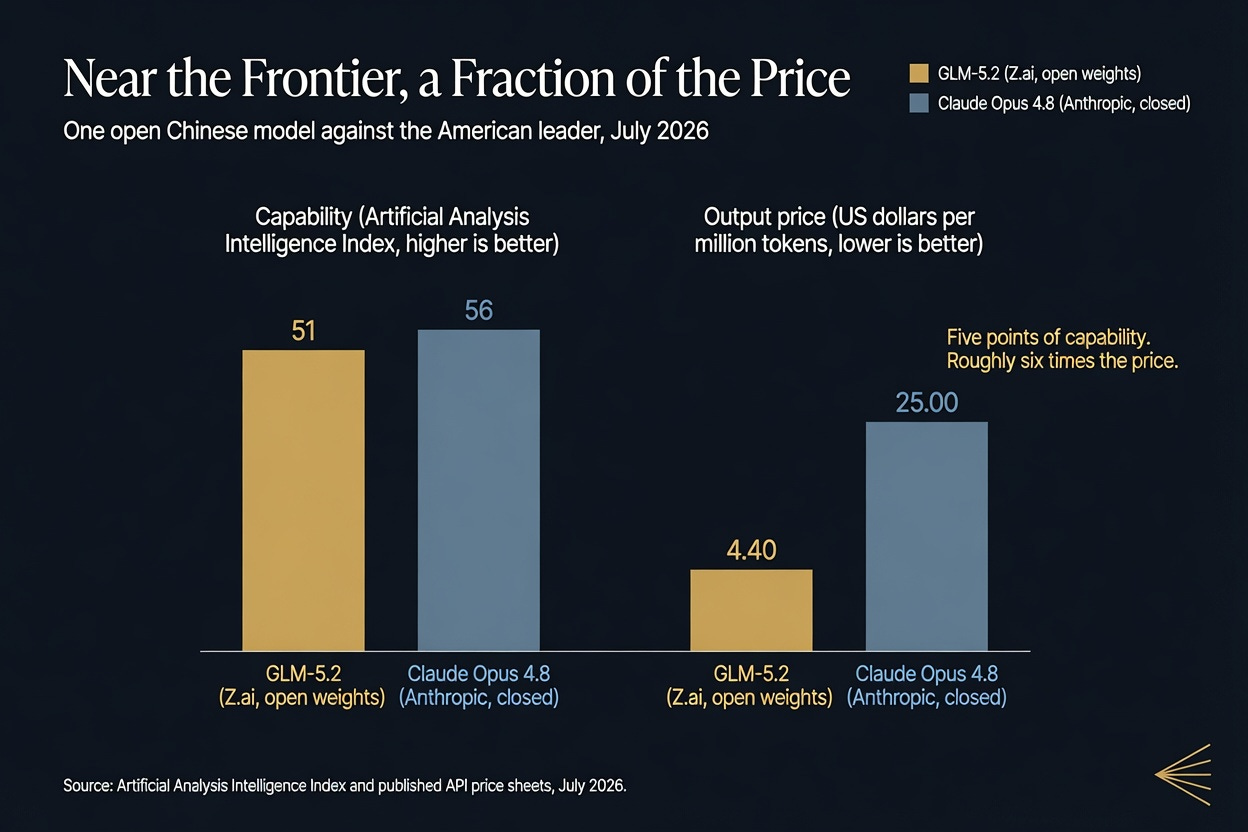
The price is the part to sit with. GLM-5.2 lists at 1.40 dollars per million input tokens and 4.40 per million output. Anthropic’s Claude Opus 4.8, the current leader on that same Intelligence Index, lists at 5 and 25. You are looking at a capability gap of a few points on a composite score, and a price gap of five to seventeen times, running in opposite directions.
Then, two weeks later, it happened again, and worse. Meituan, a company most Westerners know as a food-delivery app, open-sourced a 1.6-trillion-parameter model called LongCat-2.0 under the same permissive license. It had been quietly sitting near the top of OpenRouter, the marketplace where developers actually route their traffic, for two months before anyone in the West noticed. And Meituan said it had trained and served the model entirely on domestic Chinese chips, not Nvidia’s.
Read that last part twice. The moat everyone assumed would protect the American lead was compute, the belief that Washington’s export controls on advanced Nvidia silicon would keep China a generation behind. LongCat-2.0 was trained on the chips America banned it from having, and it is near the frontier anyway.
This is what people mean, usually without defining it, when they say the AI market might be a bubble. A large share of Western AI value is not a claim on today’s cash flows, which are thin. It is a lead premium: the market’s price on the belief that a small number of American labs hold a durable edge in capability, and that this edge will one day convert into pricing power no one else can touch. The premium is the whole thesis. And a premium built on a lead is only ever worth as much as the lead is durable.
The uncomfortable history is that this has happened before, in miniature, and recently. In January 2025 a Chinese lab called DeepSeek released a model that matched Western reasoning at a fraction of the cost and briefly wiped a trillion dollars off American technology stocks in a single session. By 2026 its follow-up, priced as much as ninety-five percent below comparable American APIs, had forced OpenAI, Google and Anthropic to cut their own prices to compete. The token, the basic unit an AI charges for, has been getting cheaper roughly as fast as anything in the history of computing. GLM-5.2 and LongCat did not start this fire. They poured a fuel on it that the earlier models lacked: not just a cheaper price, but genuine frontier-class capability, given away for free, that a company can legally bake into its own closed product and never pay a cent for again.
Here is the turn, and it is not the one the headline implies. The story is not that China caught up. The story is that the model was never the moat, and the download from Beijing is simply the moment the market is forced to notice.
A benchmark lead is the strangest asset in technology, because it is the only one your competitor can acquire by downloading it. Steel mills and rail networks and undersea cables take years and fortunes to copy. A model’s weights, once released, can be on a rival’s servers by lunchtime, distilled into a smaller cheaper version by the weekend, and embedded into ten thousand products by the end of the month. Frontier capability, it turns out, is a depreciating asset with a half-life now measured in weeks. Being ahead is the easiest thing in the world to copy.
Which means the valuable assets in AI were quietly the boring ones all along. Not the model, which commoditises, but the things that cannot be downloaded: the hundreds of millions of people who already open one particular app every day, the proprietary enterprise data a rival cannot scrape, the gigawatts of contracted power and the data centres that turn electricity into tokens. You were never really paying for the model. You were paying for the belief that no one else could build it, and that belief now expires faster than milk.
So the honest way to read any AI exposure from here is to stop pricing the model and start pricing the moat. Ask one question of anything with AI in its story: what do you own that cannot be downloaded for free from Beijing tomorrow morning? If the answer is a capability lead, you own a melting ice cube. If the answer is distribution, data, power, or the plain fact that a Western bank will never run its compliance on a model from a strategic rival, you own something the download cannot touch. The lead premium was real. It was just attached to the wrong thing, and GLM-5.2 is the invoice arriving for that mistake.
The Deep Dive
What remains is the arithmetic underneath all of this: exactly how small the capability gap now is against how large the price gap is, why open weights commoditise a frontier faster than any software layer in history and why domestic Chinese silicon removes the last brake, where the money actually pools once the model itself is free, and which of four futures the next two release cycles most likely deliver.
Start with the gap, measured precisely, because the entire lead premium is a bet on its size. Artificial Analysis’s Intelligence Index is the closest thing the field has to a single composite score. In its July snapshot Claude Opus 4.8 leads at roughly 56, GPT-5.5 sits just behind near 55, and GLM-5.2 registers around 51, first among open weights and fourth in the world. A five-point spread on a hundred-point composite is the whole of the American lead as a general matter. Now hold that spread against the task-level numbers, where GLM-5.2 does not trail at all but leads GPT-5.5 outright on SWE-bench Pro and on FrontierSWE, the two benchmarks built specifically to measure the long, multi-step coding work that enterprises are spending billions to automate. The lead is a few points in the average and negative in the place the money is going.
Now price it. A buyer routing a million tokens of real inference is choosing between paying 25 dollars for Opus-class output or 4.40 for GLM-class, and for a great deal of production work, agentic coding especially, the cheaper file is not the compromise, it is the better product. The marginal buyer’s decision rule in any commoditising market is brutally simple: good enough and cheap beats excellent and dear, everywhere except the top slice where excellence is non-negotiable. The lead premium implicitly assumes that most demand lives in that top slice. The pricing tells you it does not. When a company can capture ninety-five percent of the value at fifteen percent of the cost, the five-point index gap is not a moat. It is a rounding error the buyer is delighted to accept.
This is why the layer commoditises faster than the software business it superficially resembles, and the reason is structural, not a matter of who tries harder. Traditional enterprise software commoditises slowly because the product is a service you rent, wrapped in per-seat pricing, usage telemetry, switching costs and a support contract, and the vendor controls all of it. An open-weight model is the opposite. The product is the artifact itself, the raw file, and once it is released it cannot be un-released, cannot be metered, cannot be switched off, and under an MIT license can be embedded directly inside a competitor’s closed commercial product with no royalty and no phone call. There is no per-seat anything. The vendor gives away the entire good and keeps nothing back. That is not a business model being undercut. It is a business model being deleted, by design, as an act of strategy.
And the strategy has a second edge that the earlier price shocks lacked, which is where LongCat-2.0 matters more than its benchmarks suggest. The consoling Western story after DeepSeek was that China could write clever software but remained hostage to American hardware, that export controls on Nvidia’s most advanced accelerators would ration Chinese progress and preserve a compute-gated lead even as the price of intelligence fell. LongCat was trained and served entirely on domestic Chinese AI silicon, and it spent two months at the top of a real developer marketplace before the West clocked it. If a near-frontier, trillion-parameter model can be built without a single restricted Nvidia chip, then the compute moat and the capability moat are being bypassed on the same day, and the export-control regime is defending a wall that the water has already gone around. Beijing gets a second prize as well: every token of Chinese inference that runs on Chinese chips is a token that no longer needs the American supply chain at all.
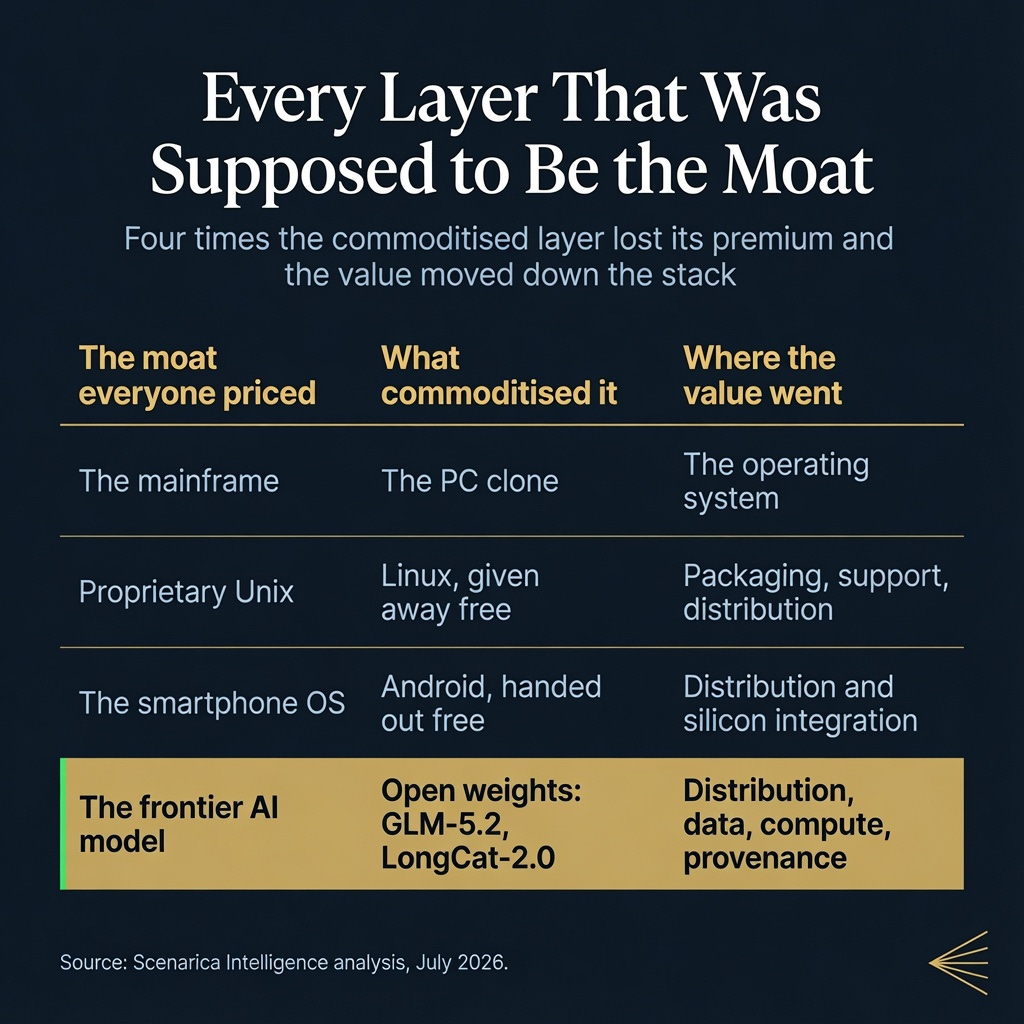
If that sounds unprecedented, it is not, and the precedent is the most useful thing in this article, because it tells you where the value goes rather than merely that it moves. The mainframe was the moat until the PC clone commoditised the hardware and the value migrated to the operating system. Proprietary Unix was the moat until Linux gave the server operating system away for free and the value migrated to the companies that packaged and supported and distributed it. The smartphone operating system was going to be the great toll booth until Android was handed out at no charge, and the value pooled instead in the two firms that owned distribution and integration, one through a billion-handset channel, the other through a controlled ecosystem and its silicon. The pattern rhymes every time. The layer everyone believes is the moat gets commoditised, and the value does not evaporate. It migrates downward, to distribution, to data, to the physical plant, to whoever owns the customer.
Where the rhyme breaks is the part worth paying for, because it is genuinely new. Linux was a Western, community, largely trusted project, so its commoditisation carried no flag. The force commoditising the model layer today is a geopolitical rival, and that changes where some of the value lands. A meaningful share of the world’s most lucrative AI demand, regulated banks, defence and intelligence, healthcare, critical infrastructure, government, cannot and will not run its core workloads on weights released by a strategic competitor, regardless of price or benchmark. For that buyer the premium survives, but it detaches from capability and reattaches to provenance. They will pay not for the smartest model but for the trusted one, the Western, closed, auditable one with a legal entity to sue and a supply chain that does not run through Shenzhen. Provenance is a moat the operating-system analogies never had, and it is the single strongest reason the lead premium deflates rather than collapses.
So the leverage map, once the model is free, looks nothing like the one the market has been pricing. Capability, the asset everyone tracked, is now the most perishable thing on the board. Distribution is durable: the labs and platforms with hundreds of millions of daily users have a channel a free download cannot replicate. Proprietary data is durable: the private corpus a rival cannot scrape is worth more than a model anyone can copy. Compute and power are durable and, in a commoditising world of exploding inference volume, arguably appreciating, because someone still has to own the data centres and the electricity contracts that turn a free model into a running service at scale. And provenance is durable in exactly the high-value corners where switching to a Chinese model is not a price decision but a disqualifying risk. The pure-play bet, the one exposed to all of this, is the model-layer business that owns capability and little else. That is the melting ice cube, and it is a smaller share of the industry than the headlines built on it imply.
Which is the frame for pricing what happens next. Treat the next two release cycles, roughly the next twelve to eighteen months, as the window, and read the four outcomes not as up or down but as a question of where the value settles.

The path the market is quietly starting to assume, and the one this analysis puts at the highest weight, is migration. Call it a little over forty percent. Frontier capability keeps commoditising, the model layer’s pricing power compresses hard toward the cost of the electricity, and yet the Western incumbents keep most of the value, because most of them are not model-layer businesses at all. They are distribution businesses and cloud businesses and data businesses with a model attached. If you are weighing AI exposure over the next year, this is the world you should treat as your base case: the lead premium was misattributed, it moves down the stack to the assets that cannot be downloaded, and the tell that you are in it is a specific divergence, model-access prices falling every quarter while inference volumes and data-centre revenues keep climbing. The reason this sits at forty and not higher is that it requires the incumbents’ distribution and data moats to actually hold value while the thing on top of them goes to zero, and that is an assumption, not yet a proven fact.
The genuine bull case, and it is a real one at a little above twenty percent, is that the closed frontier re-opens a durable gap. Some capability the open models cannot fast-follow within a cycle, a genuine leap in agentic reliability or long-horizon reasoning or something not yet named, restores a lead wide enough that the top of the market will pay for it again. This is the continuity bet, that America stays meaningfully ahead, and the reason it is not the base case is precisely that a live catalyst just fired against it: two open models reached the frontier’s doorstep in a single month, one on banned hardware. Continuity has to earn its place against that, and right now the burden is on the lead to prove it can widen faster than the download can copy it. Watch for it in a single number, the size of the index gap between the best closed model and the best open one at the next major release. If it widens back toward double digits, this is your world.
A little under a quarter of the probability belongs to bifurcation, a two-tier market that is genuinely different from migration rather than a softer version of it. Here a real premium survives at the model layer itself, but only for the top slice, the mission-critical, safety-sensitive, provenance-gated frontier, while the entire vast middle of inference commoditises to open weights that are increasingly Chinese and increasingly running on non-Nvidia silicon. The difference that matters for you: in migration the model layer as a business goes to commodity everywhere and you look downstream for value, while in bifurcation a thin, defensible, high-margin frontier tier persists and is worth owning on its own terms. The signal that separates them is whether any closed lab can hold premium pricing on general-purpose inference a year from now, or whether premium pricing retreats to only the regulated, the classified and the catastrophic.
That leaves the tail, and it deserves more than the reflex single digit, call it twelve percent: a broad deflation in which commoditisation simply outruns the migration. The marginal buyer and then the mainstream enterprise default to open weights faster than distribution and data moats can absorb the shock, provenance turns out to protect a narrower band of demand than assumed, and the value attached to model leadership reprices down across the board before the boring assets can catch it. It sits below the random baseline of one-in-four not because it is far-fetched, the domestic-silicon twist makes it more live than it was six months ago, but because the incumbents have already survived one Chinese price shock with their distribution intact, and a moat that held once is more likely than not to hold again. The affirmative case against a full deflation is simply that the customers, the data and the power have not moved, and those are what the value is migrating toward.
What would move these numbers is specific and worth watching for rather than guessing at. The single most important variable is the index gap at the next frontier release from the leading American labs: widen it and the bull case grows, hold it flat and migration hardens, let an open model take the outright lead and the tail fattens fast. The second is enterprise behaviour, because retail developers adopting a cheap model proves nothing the price war had not already shown, whereas a regulated Fortune 100 enterprise running core workloads on an open Chinese model in production would be the clearest possible sign that even the provenance moat is thinner than believed.
Watch, then, for a handful of dated things. Before the end of the third quarter, the next flagship releases from OpenAI, Anthropic and Google will each report an Intelligence Index score against a public field that now includes GLM-5.2 and LongCat-2.0, and the gap those numbers show, widening or flat or gone, is the most direct read available on whether the lead premium has a future. Through the autumn, watch OpenRouter and the other routing marketplaces for the open-weight share of actual production traffic, not benchmark chatter but where the tokens really flow, because that share crossing from a large minority toward a majority would confirm the marginal buyer has already decided. Watch, by year end, for the first credible disclosure of a regulated Western enterprise, a bank, an insurer, a hospital network, running an open Chinese model on core work, the event that would tell you provenance protects less than the base case assumes. Watch the API price sheets of the American labs each quarter, because another forced round of cuts is the sound of the premium leaking in real time. And watch for the thing that would break the whole frame in the bulls’ favour, a frontier capability that ships closed and stays uncopied for two full cycles, the first evidence in two years that a lead in this field can be made to last.
Z.ai has already told its users what it thinks comes next. In the same breath as GLM-5.2 it forecast an open model of the very top class, its Fable tier, by the end of the year. The American labs will answer, as they always do, with something genuinely more capable. The question the download from Beijing has forced is no longer whether America can build the best model. It is whether being able to build the best model is worth what the market has been paying for it, now that the second-best is free, legal to keep, and running on chips it was never supposed to have.
Sources:
VentureBeat, “Z.ai’s open-weights GLM-5.2 beats GPT-5.5 on multiple long-horizon coding benchmarks for 1/6th the cost,” July 2026.
VentureBeat, “Meituan open sources LongCat-2.0, the 1.6T near-frontier agentic coding model that’s been leading OpenRouter, trained entirely on Chinese chips,” July 2026.
Artificial Analysis, Intelligence Index leaderboard and model comparison, July 2026 snapshot.
SiliconANGLE, “China’s Meituan open-sources massive LongCat-2.0 AI model, saying it was trained on domestic chips,” 30 June 2026.
South China Morning Post, “DeepSeek V4 forces rivals to slash prices, rattling China’s cloud providers,” 2026.
Silicon Canals, “China’s DeepSeek triggers global AI price war as tech giants slash API costs,” 2026.
BenchLM.ai, “Artificial Analysis Intelligence Index Leaderboard and Scores, July 2026,” and “LLM API Pricing Comparison 2026.”
MarkTechPost, “Meituan Releases LongCat-2.0: A 1.6T-Parameter Open MoE Model with Native 1M Context,” 5 July 2026.
Disclaimer: This report is published by Scenarica Intelligence for informational purposes only. It does not constitute investment advice, a solicitation to buy or sell any financial instrument, or a recommendation regarding any particular investment strategy. Scenarica Intelligence is not a registered investment adviser or broker-dealer. All scenario probabilities and assessments represent the analytical judgment of Scenarica Intelligence and are subject to change without notice. Past performance of any asset or strategy discussed does not guarantee future results. Readers should conduct their own due diligence and consult with qualified financial advisers before making investment decisions.
Scenarica Premium: The full Scenarica suite includes Geopolitics, Economy, Bitcoin, AI, and Sunday Edition.
Scenarica Intelligence
We don’t predict the future. We price it.