


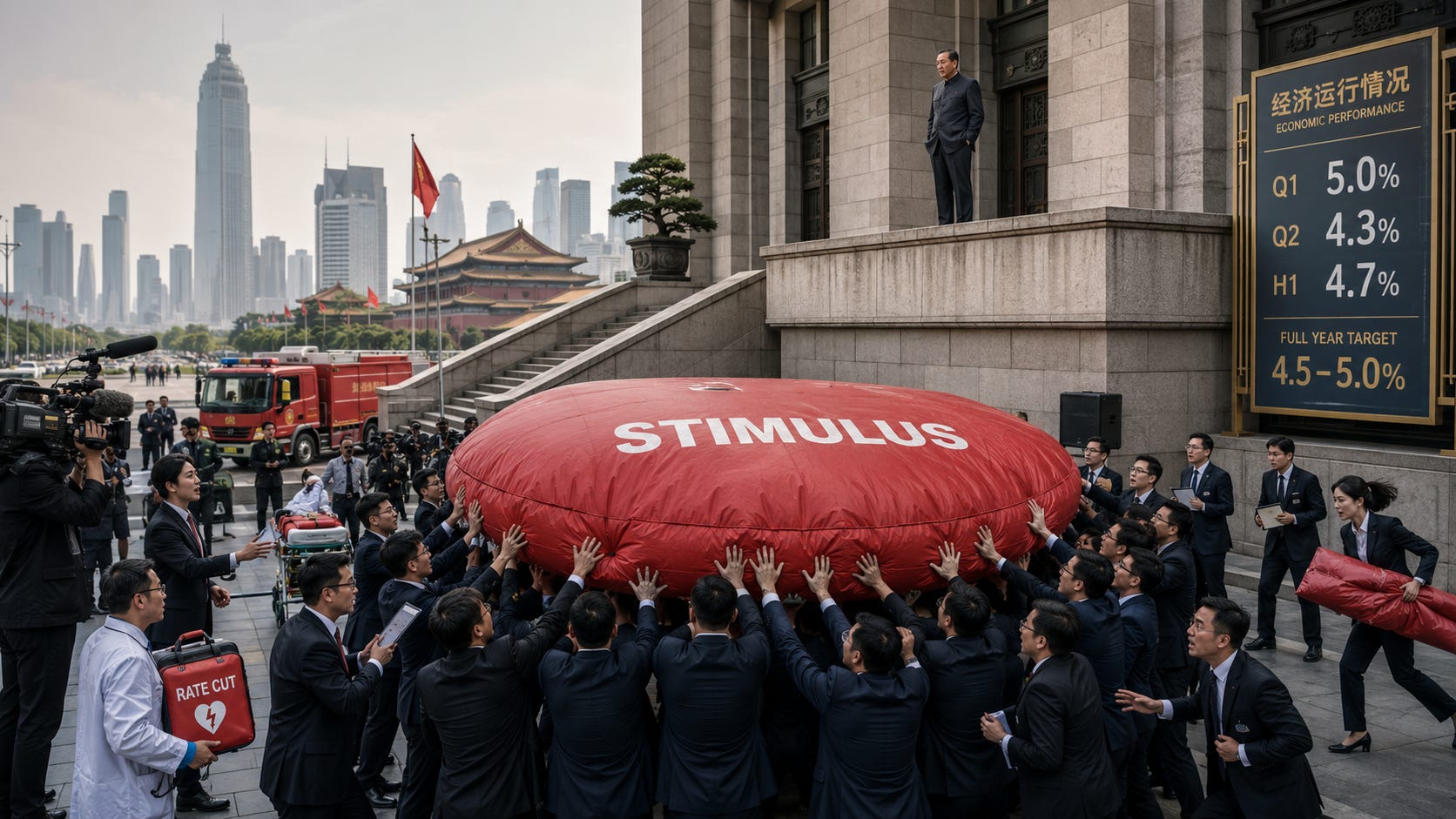
The National Bureau of Statistics published its half-year accounts on 15 July, and two numbers sat one line apart. The quarterly figure, 4.3 per cent, was the weakest since the final quarter of 2022 and fell below the floor of Beijing’s own target range. The half-year figure, printed alongside it, was 4.7 per cent.
Almost everyone traded the first number.
A second-quarter print below the band does not create a requirement for new stimulus in the second half, because the target it missed was never a quarterly target. It is an annual range, satisfied on an annual average, and the first quarter of 2026 has already paid for the second.
Beijing set that range at 4.5 to 5 per cent on 5 March, when Premier Li Qiang delivered the government work report to the National People’s Congress. It was the lowest growth target since 1991, and it was expressed as a band rather than a point. The first quarter then came in at 5.0 per cent, at the top of it. The second came in at 4.3, below the bottom, which left the half at 4.7 and comfortably inside the range Beijing had written for itself.
Now run the year forward. China’s second half is reliably the larger of the two: in 2025 the country produced 66.05 trillion yuan in the first six months out of 140.19 trillion for the year, so roughly 53 per cent of annual output arrives after June. Weight the halves accordingly, then ask what the second half has to deliver for 2026 to finish at 4.5 per cent, the floor of the band. It has to deliver about 4.3 per cent.
That is the number that printed in July.
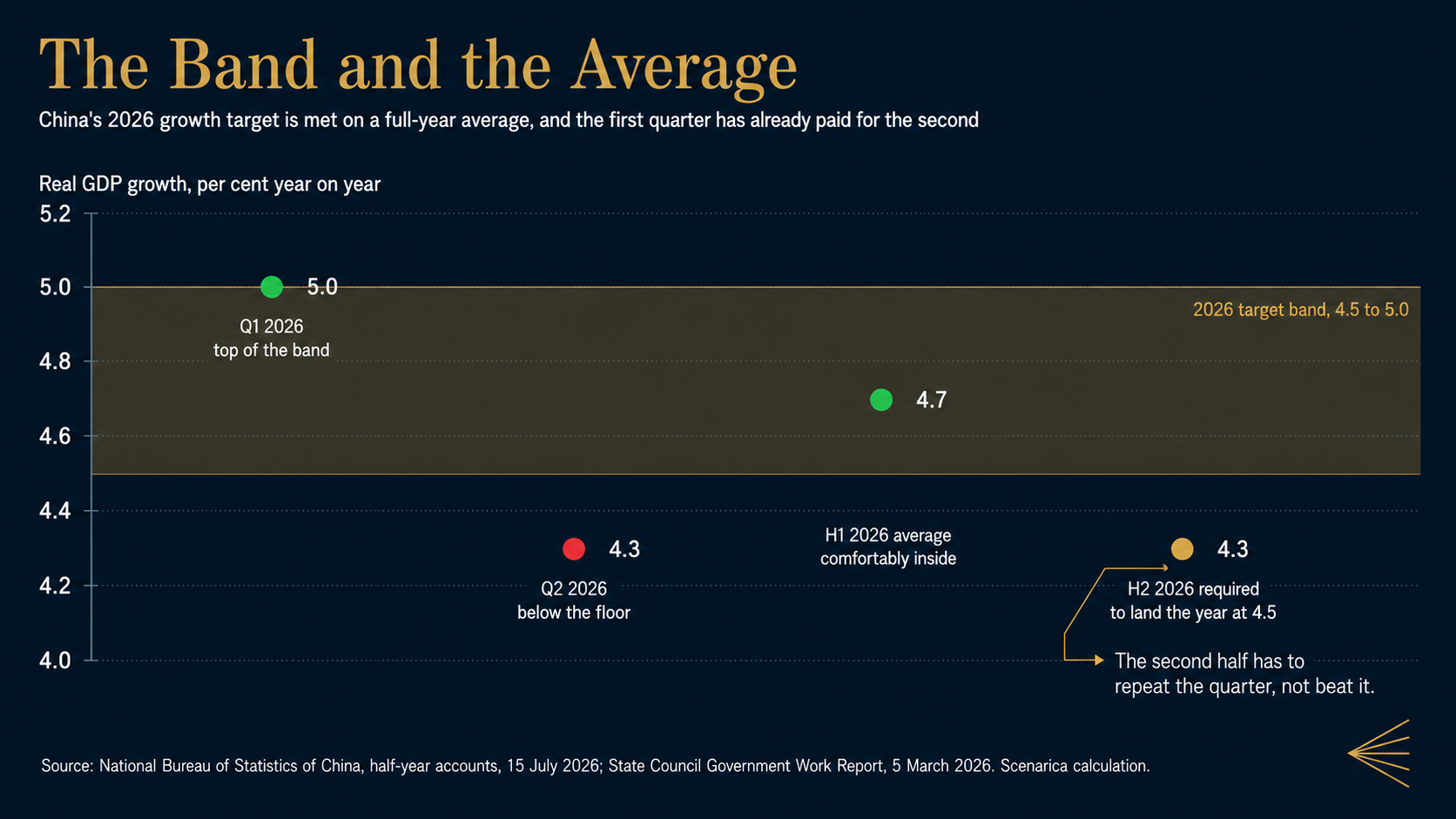
Beijing does not need the second half to improve on the quarter that three weeks of commentary have called a crisis. It needs the second half to repeat it. The method is not a trick, either: apply the same weighting to 2025, when the first half grew 5.3 per cent and the year finished at 5.0, and it reproduces the published figure to within a rounding error.
That changes what is worth measuring. Chinese policy keys on target risk rather than on growth weakness, and those two readings diverge precisely when a soft quarter arrives inside a year that opened strong.
The distinction has a long record behind it. Beijing has landed inside its stated growth target in every year of the past two decades except 2022, when a nationwide lockdown made the number unreachable, and the machinery that produces that record does not switch on because a quarter disappoints. It switches on when the annual arithmetic stops working, which makes it a threshold rather than a dial.
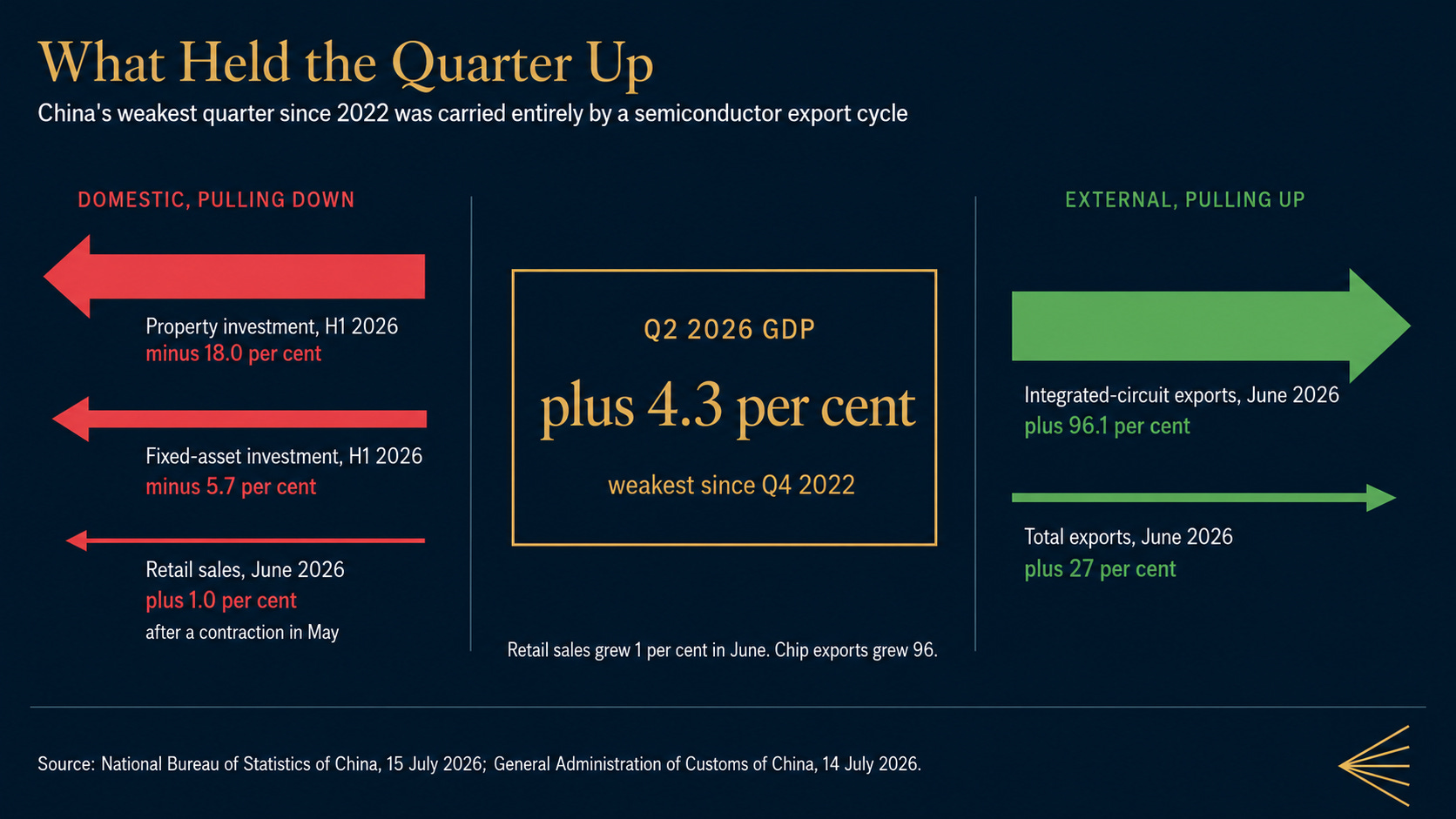
None of which makes the underlying data comfortable. Fixed-asset investment fell 5.7 per cent across the first half and property investment fell 18. Retail sales grew 1 per cent in June, a recovery only in the sense that May had contracted. What carried the quarter was trade, with June exports up 27 per cent on a semiconductor cycle that has very little to do with Chinese domestic demand.
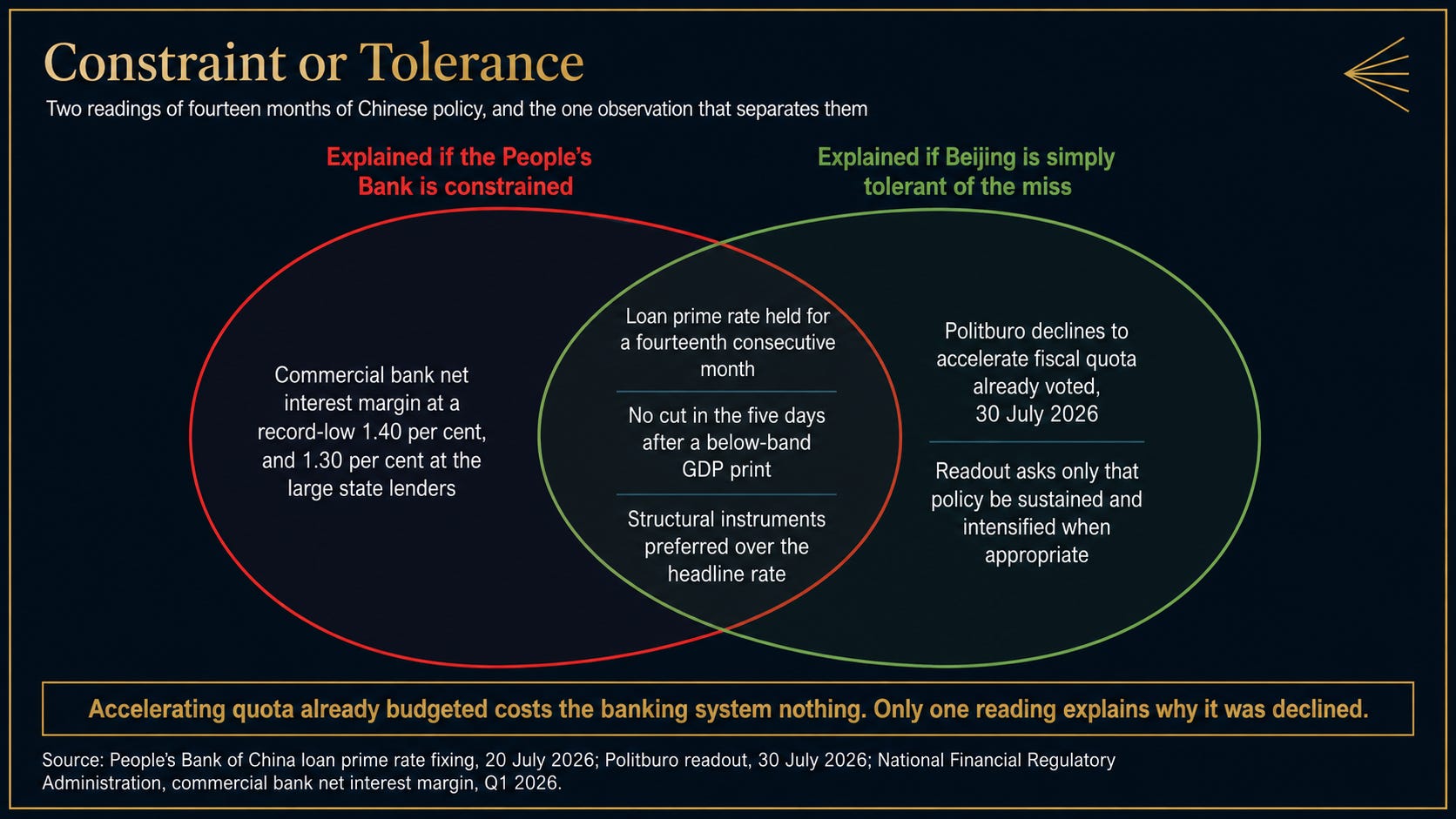
Which is why the People’s Bank did what it did. On 20 July, five days after the print, it held the one-year loan prime rate at 3.00 per cent and the five-year at 3.50, a fourteenth consecutive month without a move. The reading that circulated within the hour was constraint: the Bank would ease if it could, and cannot. There is a simpler account available. An institution looking at an annual average it is currently meeting has no reason to spend a rate cut in July.
Ten days later the Politburo met to set economic policy for the second half and arrived at the same place in different language, calling for macroeconomic policy to be sustained and intensified when appropriate. That is a body with the mandate, the meeting and the calendar to declare the year at risk, choosing not to.
For anyone carrying China exposure into the autumn, the measurement that governs Beijing’s behaviour is the distance between the running annual average and the floor of the band, and as of the half-year accounts that distance is zero.
And here the consensus position becomes hard to hold together. The same forecasters calling for second-half stimulus put 2026 growth at around 4.6 per cent, which is inside the band. The market is predicting that the target will be met and demanding a rescue for the target it predicts will be met.
Both positions cannot be information. One of them is a reflex, inherited from a decade in which every Chinese slowdown was answered with a package, and applied now to a year whose arithmetic is not asking for one.
The Deep Dive
The stimulus case has a stronger form than the one being argued, and it does not run through year-on-year growth at all.
Alongside the headline, the National Bureau of Statistics publishes a seasonally adjusted quarter-on-quarter series. In the second quarter of 2026 the economy grew 0.9 per cent against the first, down from 1.3 per cent in the March quarter. The comparable 2025 quarters ran 1.1 per cent in the second, 1.1 in the third and 1.2 in the fourth.
Year-on-year growth in any quarter is the four most recent sequential quarters compounded. Next quarter’s headline is therefore this quarter’s headline adjusted by the gap between this year’s sequential rate and last year’s, which reduces the whole question to a subtraction.
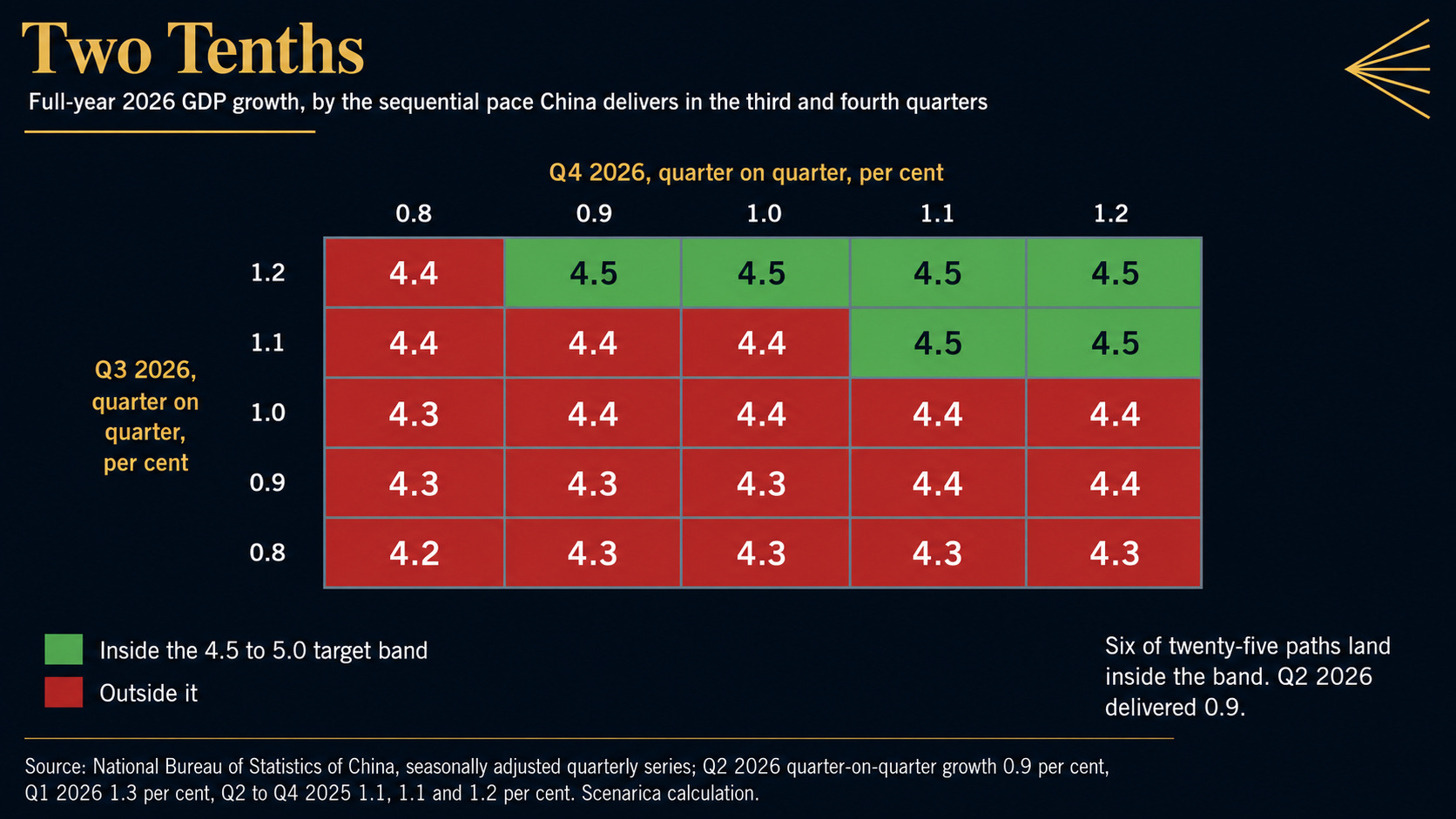
Hold sequential growth at the 0.9 per cent the second quarter delivered, and the third-quarter headline lands near 4.1 per cent and the fourth near 3.8. The second half averages under 4.0 and the year finishes around 4.3 per cent, outside the band by a margin no one could dismiss as rounding.
Now let the sequential rate recover to exactly what it was a year ago, 1.1 per cent and then 1.2. The third quarter prints 4.3, the fourth prints 4.3, the second half averages 4.3, and the year lands at 4.5, inside the band and sitting on the floor of it.
The whole year, for the second-largest economy on the planet, turns on about two tenths of a percentage point of quarterly momentum.
That quantity is smaller than the machinery measuring it can reliably resolve. Seasonally adjusting a Chinese quarter means adjusting for a Lunar New Year that moves, a property sector in structural decline, and an export cycle distorted by a semiconductor boom that pushed integrated-circuit shipments up 96 per cent in June alone. The published sequential series is revised as those inputs settle, and two tenths sits inside that revision.
So the verb doing the work in every second-half preview, stabilise, turns out to be ambiguous. Stabilisation at the second quarter’s pace does not deliver the band. Recovery to last year’s pace does. Those are different requests, and they have been used interchangeably for three weeks. The consensus forecast of 4.6 per cent for the year is a third request again, requiring roughly 1.3 per cent a quarter, about forty per cent faster than the second quarter managed.
Which brings the People’s Bank back in, because the constraint reading of 20 July is incomplete rather than wrong.
The constraint is real and it is measurable. Baseline: the National Financial Regulatory Administration reported the commercial banking system’s net interest margin at 1.4 per cent in the first quarter of 2026, a record low, with the large state lenders down at 1.30. The five-year loan prime rate is the mortgage benchmark, so cutting it reprices the largest asset book in the Chinese financial system downward at the moment that book is already the source of the weakness. Easing costs the banks something in 2026 that it did not cost them in 2019.
That account explains monetary restraint. It does not explain fiscal restraint, and fiscal restraint is the observation that separates the two hypotheses.
Beijing set a budget deficit near 4 per cent of GDP for 2026 and authorised a heavy issuance programme to fund it. Accelerating the drawdown of quota already voted costs the banking system nothing. It requires no rate decision, no margin compression, no fresh authorisation from anybody. If the leadership believed the annual target was in danger, that instrument was sitting on the table on 30 July, and the Politburo reached past it for a sentence about timing.
Leaving a free option unexercised is a verdict on the diagnosis.
Which sets the reaction function to carry into the autumn. A soft third quarter gets answered first with delivery: quota already budgeted, pushed out faster, concentrated where the Politburo said it would go, into technology, strategic industry and modern infrastructure. That impulse is real and it will register in the activity data, and it will register in almost none of the instruments the market is using to express a stimulus view.
Which matters for positioning, because of the way this particular disappointment resolves. There is no announcement that stimulus has been cancelled. No press conference, no communique, no headline of any kind. The position decays instead through a run of scheduled non-events: the loan prime rate fixing on 20 August, the fixing on 21 September, the fixing on 20 October, each a date on which something could happen and does not.
Nothing is the hardest outcome to trade, because it never supplies the moment at which a position is obviously wrong. A view that fails loudly gets closed out. A view that fails quietly gets held, financed and defended until the carry becomes the entire loss. That runs across the complex carrying China beta: industrial metals, the currencies of China’s commodity suppliers, and the China-weighted share of emerging-market equity allocation.
The first genuine information event is the third-quarter release in the second half of October, and the calendar has a cruelty in it, because by then the year is close to settled. With three quarters known, the fourth carries roughly a quarter of the annual weight, so a half-point swing in the fourth-quarter headline moves the full-year figure by about a tenth. Whatever Beijing chooses in November will land on 2027 far more than on the year it is supposed to be rescuing.
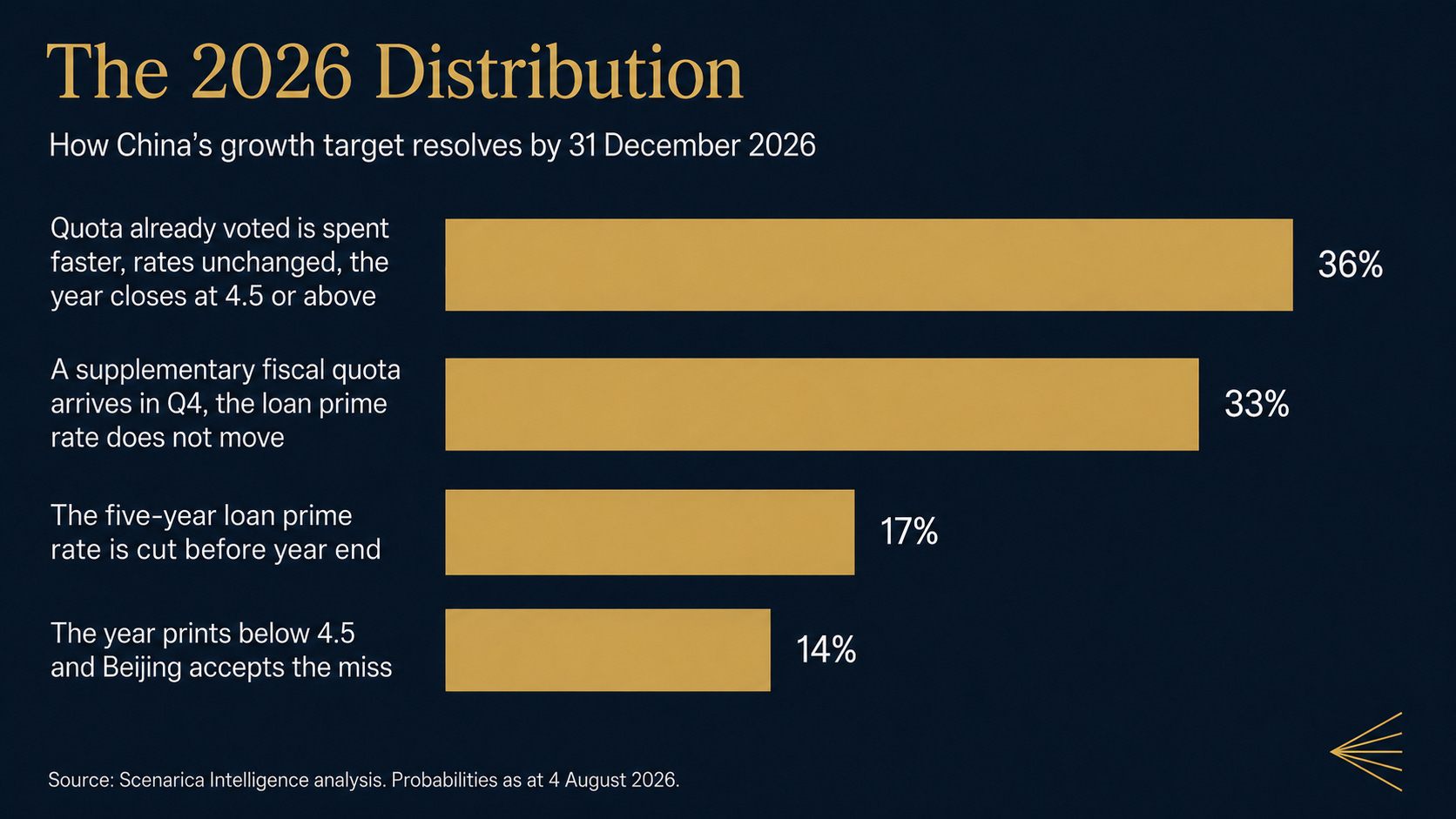
The path where nothing new is authorised at all, where the special bond quota already voted is simply spent faster through the autumn, the loan prime rate stays at 3.00 and 3.50 through December, and the year closes at 4.5 or a shade above, is the one the July evidence points at most directly. It carries thirty-six per cent. The number is not higher because it requires sequential growth to climb from 0.9 back toward 1.1, and the domestic components that would have to supply that climb are the ones still contracting.
Then there is the world where the third quarter comes in soft, Beijing concludes in October that delivery alone will not close the gap, and the Ministry of Finance brings forward 2027 quota or announces a supplementary tranche in November. The rate does not move; the balance sheet does. If you are hedged for a monetary event you will be unhedged for this one, and it carries thirty-three per cent, which makes it very nearly a coin flip against the first. The reason those two sit so close is that the observation dividing them, two tenths of a point of quarterly momentum, is not yet observable.
Now the case that would vindicate the market. A genuine deterioration below 0.9 per cent sequential, a fourth-quarter run rate heading toward 3.5, and the five-year rate finally moves, whatever it costs bank margins. Seventeen per cent belongs here, and it sits below what pure chance would assign to one of four outcomes for a specific reason: fourteen consecutive holds through a decelerating year is a long revealed preference, a record-low margin of 1.4 per cent makes each cut expensive, and the Bank has consistently chosen structural instruments over the headline rate. That is an institution husbanding an option it does not believe the year requires.
And the outcome that sits outside most forecast distributions entirely: the year prints below 4.5, and Beijing lets it. The 2026 target is the opening year of the fifteenth Five-Year Plan, and a leadership that has spent eighteen months talking about high-quality development rather than headline growth has laid the ground to reframe a 4.3 or a 4.4 as the price of restructuring rather than as a failure. That is fourteen per cent. It is low because target attainment has been near-absolute for two decades outside 2022, but it is not negligible, because the target that was cut to its lowest level since 1991 was already an admission.
What would confirm the leading path is quiet and dated. The 20 August and 21 September loan prime rate fixings coming and going at 3.00 and 3.50. The August and September activity data, on 15 September and around 15 October, showing the fixed-asset investment contraction narrowing from its first-half pace of minus 5.7 per cent and retail sales holding above June’s 1 per cent. Local government special bond issuance running ahead of its schedule rather than behind it.
What would break it is louder. A third-quarter sequential print at or below 0.9 per cent when the GDP release lands in the second half of October converts this from a positioning problem into a policy problem in a single line of a statistical bulletin. A State Council or Ministry of Finance announcement of supplementary quota before that release would mean the leadership has been reading the sequential series rather than the headline, and has decided it is a problem. And the Central Economic Work Conference in December, setting the 2027 target, will disclose how Beijing scored 2026 more honestly than any December data point will.
A point target is a promise. A range is a tolerance, and Beijing wrote this one in March, with the shape of the year already visible from where it was standing. The market has spent three weeks arguing about whether China will rescue its growth, and has not noticed that the rescue was written into the target on the day it was announced.
Sources:
National Bureau of Statistics of China, “National Economy Made Steady Improvement Despite Challenges in the First Half Year,” 15 July 2026.
National Bureau of Statistics of China, half-year GDP release: Q2 2026 GDP +4.3 per cent year on year, +0.9 per cent quarter on quarter; H1 2026 GDP 69.57 trillion yuan, +4.7 per cent; Q1 2026 +5.0 per cent, +1.3 per cent quarter on quarter, 15 July 2026.
National Bureau of Statistics of China, “Preliminary Accounting Results of GDP for the Second Quarter and First Half of 2025”: H1 2025 GDP 66,053.6 billion yuan, +5.3 per cent; Q2 2025 +5.2 per cent year on year, +1.1 per cent quarter on quarter, 28 July 2025.
National Bureau of Statistics of China, Q3 2025 preliminary accounting results: Q3 2025 +4.8 per cent year on year, +1.1 per cent quarter on quarter, 27 October 2025.
National Bureau of Statistics of China, “Statistical Communique on the 2025 National Economic and Social Development”: 2025 GDP 140.19 trillion yuan, +5.0 per cent; Q4 2025 +4.5 per cent year on year, +1.2 per cent quarter on quarter, 28 February 2026.
National Bureau of Statistics of China, June 2026 activity data: H1 fixed-asset investment minus 5.7 per cent year on year, H1 property investment minus 18 per cent, June retail sales +1.0 per cent, 15 July 2026.
State Council of the People’s Republic of China, Government Work Report delivered by Premier Li Qiang to the National People’s Congress: 2026 growth target 4.5 to 5 per cent, budget deficit around 4 per cent of GDP, 5 March 2026.
People’s Bank of China, loan prime rate fixing: one-year 3.00 per cent, five-year 3.50 per cent, unchanged for a fourteenth consecutive month, 20 July 2026.
Politburo of the Communist Party of China, readout of the meeting on the economic situation and second-half economic work, 30 July 2026.
National Financial Regulatory Administration, commercial bank net interest margin, Q1 2026: 1.4 per cent system-wide, 1.30 per cent for large state-owned banks.
General Administration of Customs of China, June 2026 trade data: exports +27 per cent year on year, integrated-circuit exports +96.1 per cent, trade surplus 125.62 billion dollars, 14 July 2026.
Reuters poll of economists, July 2026: 2026 China GDP growth forecast 4.6 per cent, 2027 forecast 4.4 per cent, policy rate expected unchanged for the remainder of 2026.
Disclaimer: This report is published by Scenarica Intelligence for informational purposes only. It does not constitute investment advice, a solicitation to buy or sell any financial instrument, or a recommendation regarding any particular investment strategy. Scenarica Intelligence is not a registered investment adviser or broker-dealer. All scenario probabilities and assessments represent the analytical judgment of Scenarica Intelligence and are subject to change without notice. Past performance of any asset or strategy discussed does not guarantee future results. Readers should conduct their own due diligence and consult with qualified financial advisers before making investment decisions.
Scenarica Premium: The full Scenarica suite includes Geopolitics, Economy, Bitcoin, AI, and Sunday Edition.
Scenarica Intelligence
We don’t predict the future. We price it.