


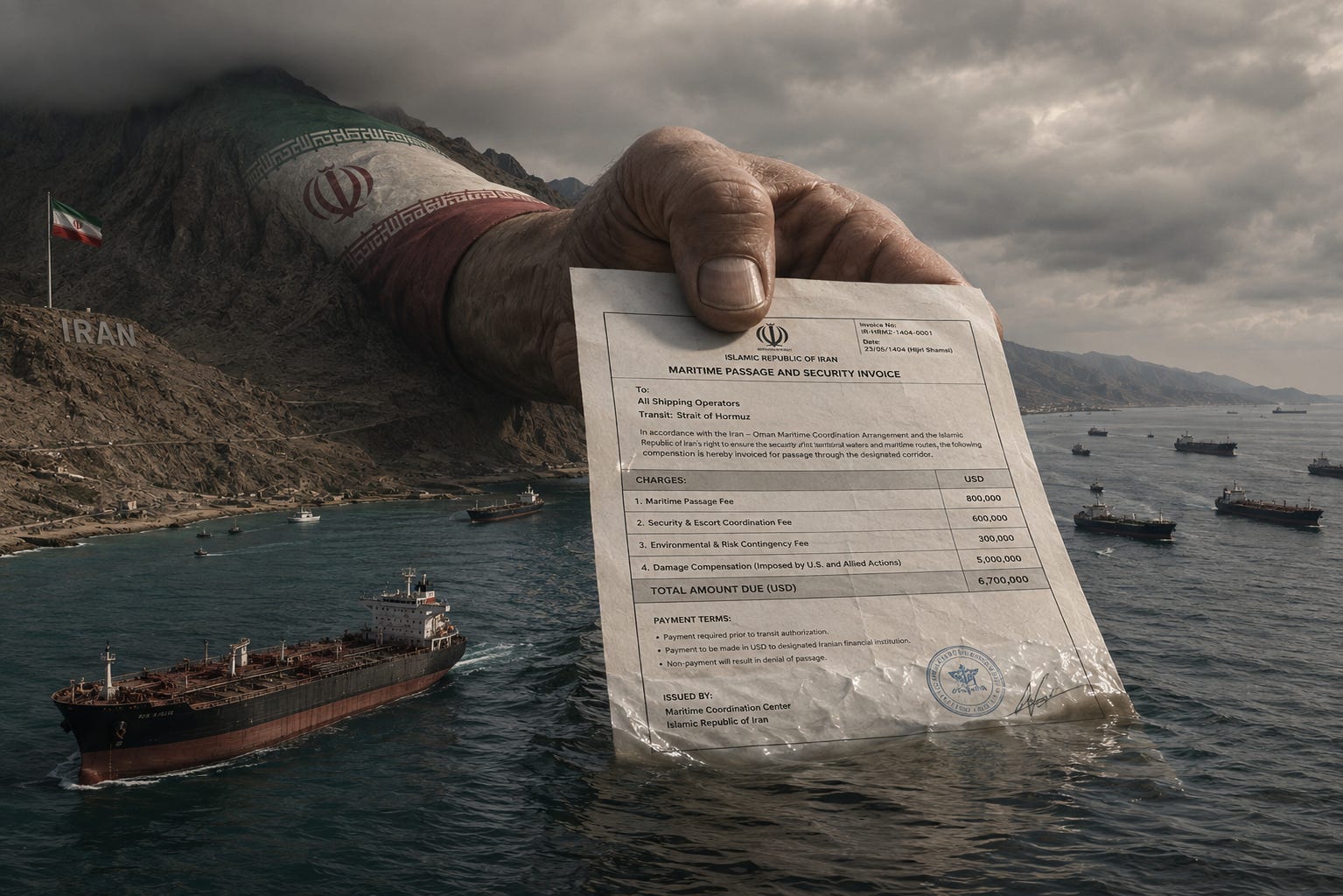
The bill moving through Iran’s parliament this week runs to eleven articles and carries a title long enough to be a policy paper: “Strategic Action for Ensuring Security and Sustainable Development of the Strait of Hormuz and the Persian Gulf.” Most of those articles describe things a coastal state might plausibly do. Navigational guidance. Inspection of maritime passages. Environmental documentation. Warehousing, in cooperation with the private sector.
Then there is the sentence Alireza Salimi, a member of parliament’s presiding board, read out to reporters on Thursday. Countries, organisations, regimes and companies judged to have caused damage to Iran must compensate Tehran, and “until such compensation is made, they would not be granted permission to transit the Strait of Hormuz or the Persian Gulf.”
Forty-eight hours earlier, this had been a shipping arrangement.
On Wednesday 5 August, Iran’s foreign ministry spokesman Esmaeil Baghaei told reporters that Tehran and Muscat were in the final stage of drafting a joint statement, and the coordinates were agreed. Inbound traffic would run largely through Iranian territorial waters, outbound through Oman’s, with a joint coordination centre to manage the flow.
Deputy Foreign Minister Kazem Gharibabadi told IRNA the new routes would run for two to four months, possibly longer. Axios reported that Washington was aiming for a Wednesday announcement.
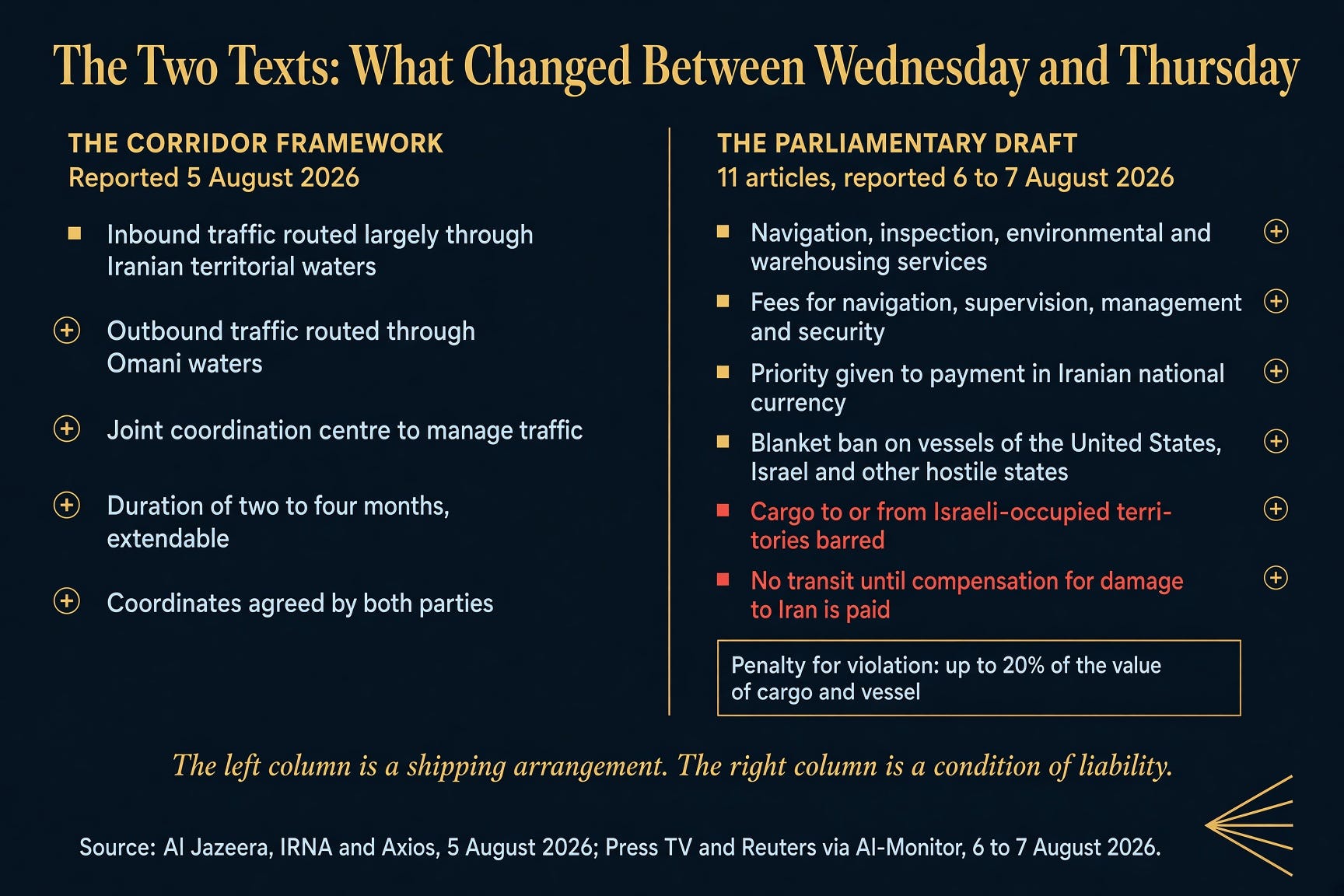
What arrived instead was a committee draft, and the draft did the one thing the corridor talks had carefully avoided doing: it attached a condition to passage, and the condition was liability for a war.
The distinction sounds like lawyer’s work and is in fact the whole architecture. Under the law of the sea, a state bordering an international strait may not levy a charge for passage itself, but it may charge for services it actually renders: pilotage, navigational assistance, environmental protection. James Kraska, professor of international maritime law at the US Naval War College, put the underlying position plainly earlier this year, saying there is “no legal basis under international law for a coastal state to charge fees in an international strait.” Iran signed the convention in 1982 and never ratified it, and argues on that basis that the transit passage regime does not bind it. The Gulf Cooperation Council’s secretary general, Jasem Mohamed Al-Budaiwi, has stated the opposite view, that such fees breach the convention.
That argument, however it resolves, is survivable. A service fee has a counterparty, a price, a currency and a bank. A war claim has a plaintiff.
Washington has spent three weeks refusing a toll. A US official told the Associated Press this month that any temporary arrangement would involve neither Iranian approval for ships to transit nor charges for the waterway, and that the aim was to restore a system in which “no party controls the lanes or the ability to transit through them.” On Monday 3 August, asked whether Iran should be allowed to charge, President Trump said: “I’m not going to let them charge. Anybody’s going to charge, we’ll charge.”
The same day, eight of the world’s largest shipping bodies, among them BIMCO, INTERTANKO, the International Chamber of Shipping and the World Shipping Council, wrote to UN Secretary General Antonio Guterres and IMO Secretary General Arsenio Dominguez warning against charges “that are a toll in all but name.”
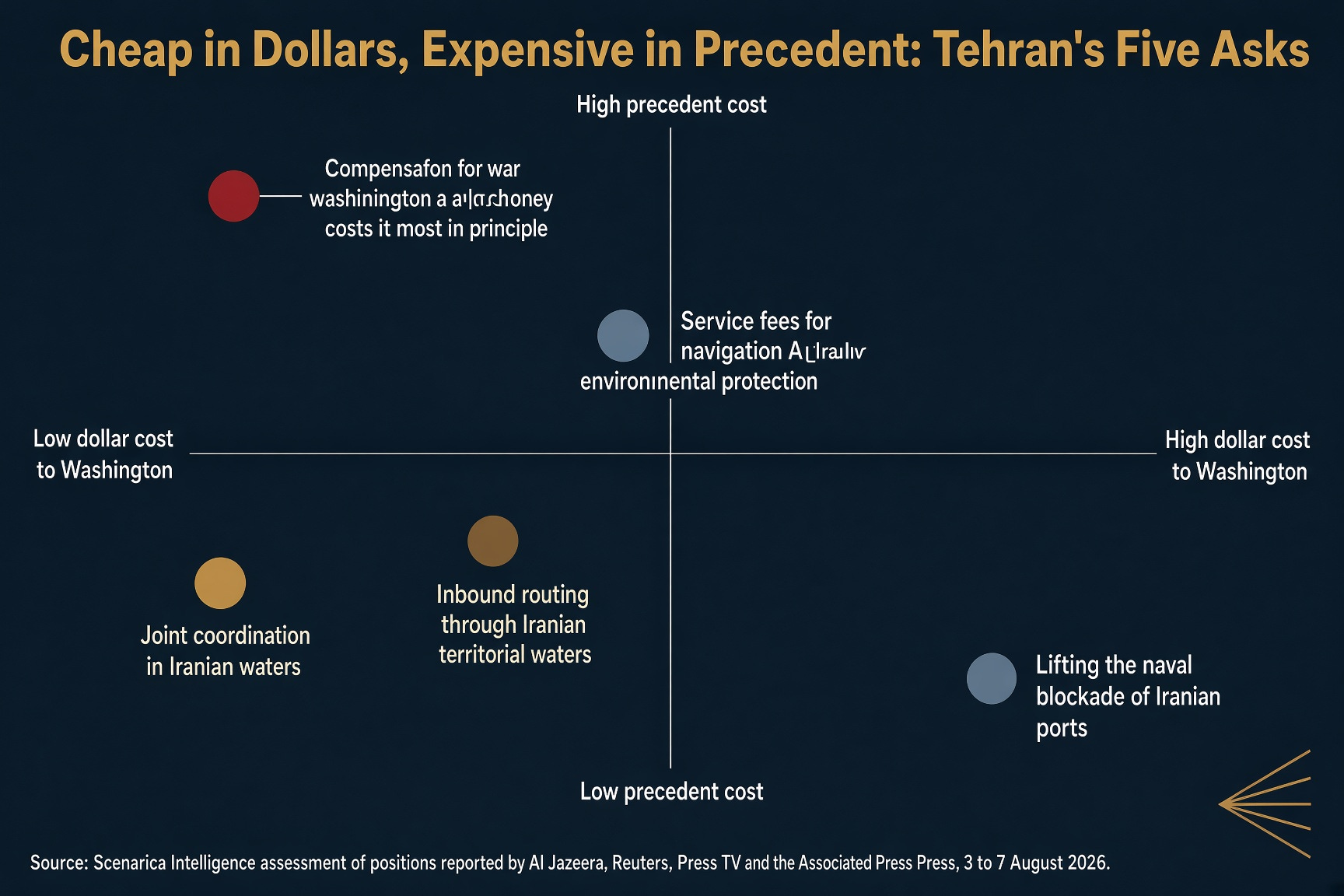
A fee is a number, and numbers are negotiable. Compensation for a war is a finding of liability, and a state that pays it once has conceded that any government sitting beside a strait may present a bill after the shooting stops. Nobody in Washington signs that, at any price, because the price is not the point.
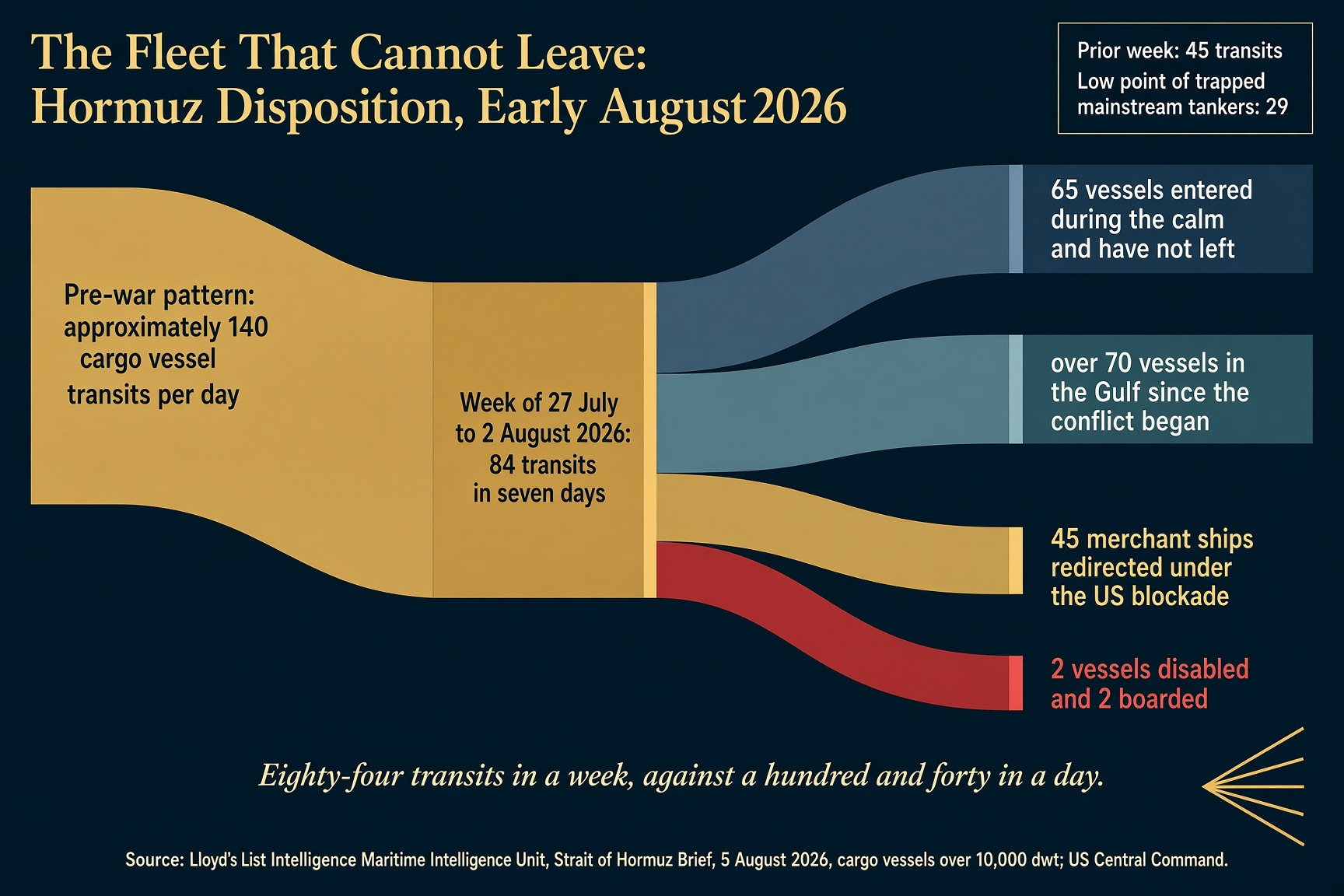
Tehran’s leverage in all this is real and it is measurable. Preliminary Lloyd’s List Intelligence figures show 84 transits of cargo vessels over 10,000 deadweight tonnes in the week to 2 August, up from 45 the week before, against a pre-war pattern in the region of 140 ships a day.
US Central Command reports 45 merchant ships redirected under its blockade of Iranian ports, two vessels disabled, two boarded. Brent settled at $82.15 a barrel on 7 August, roughly a quarter above where it traded before the strait closed at the end of February. So Iran can shut the road. What the draft bill accidentally documents is that it cannot bill for it.
Look at how the fee article is drafted. Iran would collect for navigation, supervision, management and security services, “with priority given to payments in the Iranian national currency.”
Then read what happened on 29 July, ten days before the corridor talks reached their final stage. The US Treasury designated Persian Gulf Marine Insurance Company and HormuzSafe Marine Services Authority, the two entities selling compulsory transit cover, alongside eight shadow fleet operators. HormuzSafe, developed inside Iran’s Ministry of Economy, had been accepting payment in digital assets. “The United States will not allow Iran to hold global commerce hostage,” Treasury Secretary Scott Bessent said.
A charge payable in rial, to entities under designation, conditional on a settlement of the war. Tehran has built a tollbooth on the one stretch of water where no bank will clear the ticket.
The Deep Dive
The first version of this idea passed into Iranian law five months ago, and almost nobody outside the shipping press noticed.
On 30 March, the Majlis Civil Affairs Committee moved legislation formalising transit fees that the Revolutionary Guard had already been collecting on an ad hoc basis since mid-March, through a controlled corridor near the Iranian coast between Qeshm and Larak. A vessel seeking clearance supplied its IMO number, cargo manifest, crew names, ownership details and destination to intermediaries, and received a route code and an escort. Mohammadreza Rezaei Kouchi, who chaired the committee, described the logic without ornament: “The Strait of Hormuz is also a corridor. We ensure its security, and it is natural for ships and tankers to pay us duties.”
Lawmaker Alaeddin Boroujerdi said the quiet arithmetic aloud on state television. “Now, because war has costs, naturally, we must do this and take transit fees from ships passing through the Strait of Hormuz.”
The war has costs. Someone should pay them. Between March and August that proposition has travelled from a talking point about duties, through a statute about fees, into a committee draft about liability, and every step of the journey has made the money harder to collect.
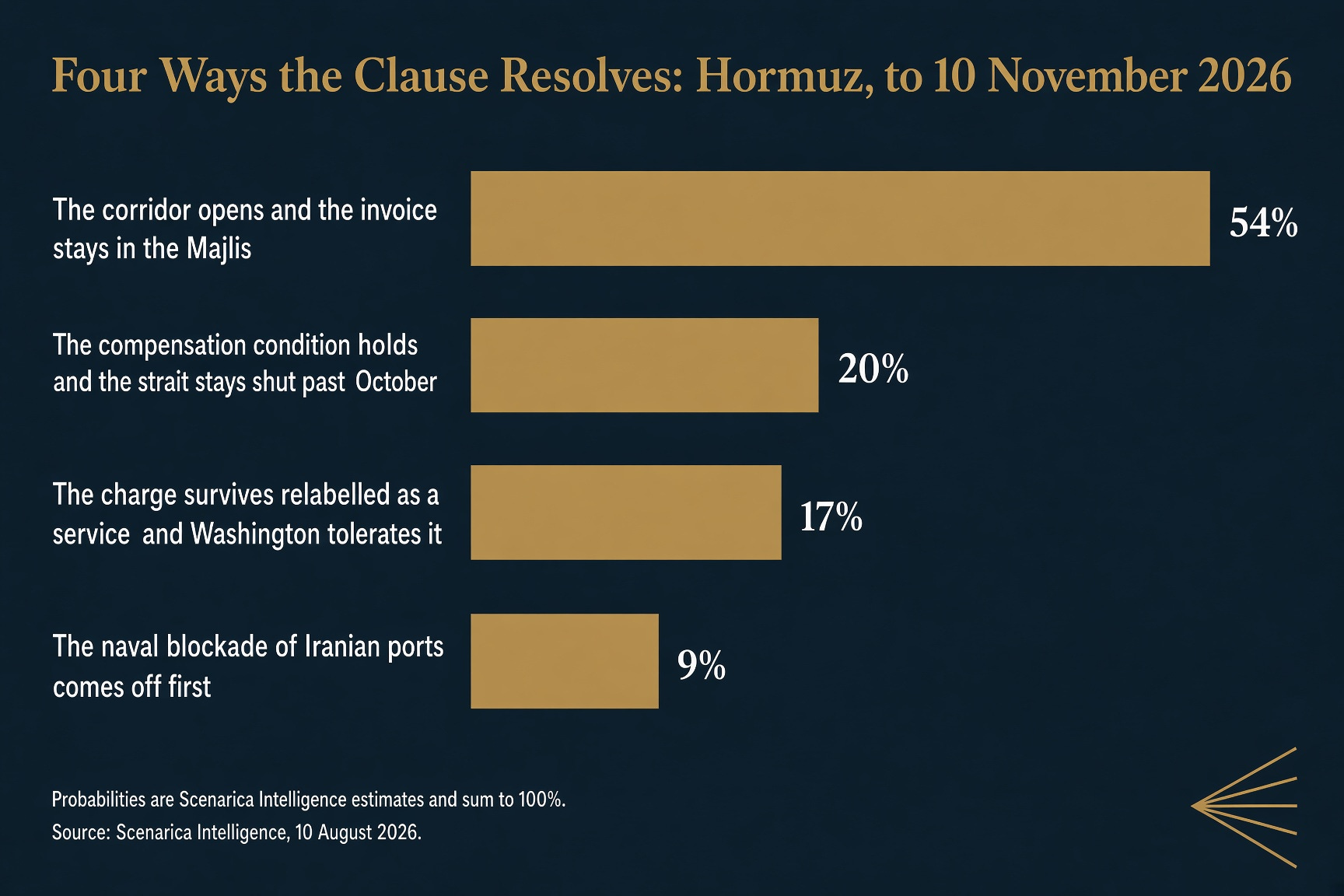
Start with the outcome that lets both governments walk away claiming they held the line, because it is the only one that does. A narrow Iran-Oman corridor statement is published in the coming weeks with no compensation language and no charge in the operative text, while the demand for war damages survives in the parliamentary bill and in Iran’s declared negotiating position. Traffic resumes at a limited rate and no shipowner admits paying anyone anything. Tehran keeps a coordination role in its own waters and a standing legal claim it can raise whenever it suits; Washington gets a document with no invoice in it.
Reuters reported this week that Iran has already dropped its original demand for control of shipping in both directions, the first documented concession of the negotiation. Weigh that against a preliminary text a member of the presiding board has publicly called “not yet the committee’s final report,” and against collecting entities already sitting on the designation list, and this path carries 54 percent, well clear of the 25 percent a coin toss would assign to any one of four outcomes. It is the only branch that requires neither principal to abandon a position stated in public.
The compensation condition could instead hold. Iran’s negotiators keep it in the operative text, Washington refuses, the joint statement is never published, and weekly transits stay in the double digits into the northern winter.
That branch earns 20 percent, below the coin toss, and the affirmative reason is that Iran is the party paying most for delay. Its ports are blockaded and its export position is wrecked, and the strait it closed is the same water its own remaining revenue has to cross. If you are long refining margins east of Suez or running freight-rate exposure into Q4, this is the branch that keeps your hedges on past October.
Seventeen percent belongs to the version Oman’s mediation is best placed to produce, in which the compensation article is dropped and a charge survives under a service label, priced for navigation and environmental protection, and Washington either accepts it or declines to enforce against it. Sina Azodi of George Washington University explained why Muscat is the venue capable of carrying that: “The Iranians trust Oman. The Americans trust Oman.” The constraint is not Omani skill, which has been considerable and patient across five earlier rounds. It is that this branch needs the US president to move off a sentence he said in public six days ago, with eight global shipping bodies and the GCC secretariat already on record that any such charge is unlawful.
Gharibabadi has been explicit about the sequence Tehran actually wants, and it is the remaining branch: the naval blockade of Iranian ports comes off first, the sanctions reimposed on Iranian oil are addressed, and the strait follows afterwards. That path is priced at 9 percent because it inverts the order Washington has insisted on since the June memorandum collapsed, and because conceding first would be read everywhere as payment for reopening. Nothing in the American posture supports it, which is precisely why it would move everything if it happened.
Iran’s own published arithmetic is where the demand starts to look different. When the March fee law was passing, Tasnim set out the revenue case: at roughly $2m a vessel, applied to the approximately 140 ships that crossed the strait daily before the war, annual receipts would exceed $100bn, somewhere between a fifth and a quarter of Iran’s nominal GDP. Bloomberg reported that some vessels had paid around $2m for passage. A more conservative model, built on Suez and Panama charging structures, put the figure nearer $400,000 a ship.
Both models rest on the same assumption, which is that the ships keep coming. They have not. Eighty-four transits in the week to 2 August is not 140 a day; annualised at $2m a vessel and assuming every single one paid, it is under $9bn, and no country, importer or operator has publicly acknowledged making such a payment. The toll’s revenue base is the traffic the toll destroys, and the destruction runs ahead of the collection.
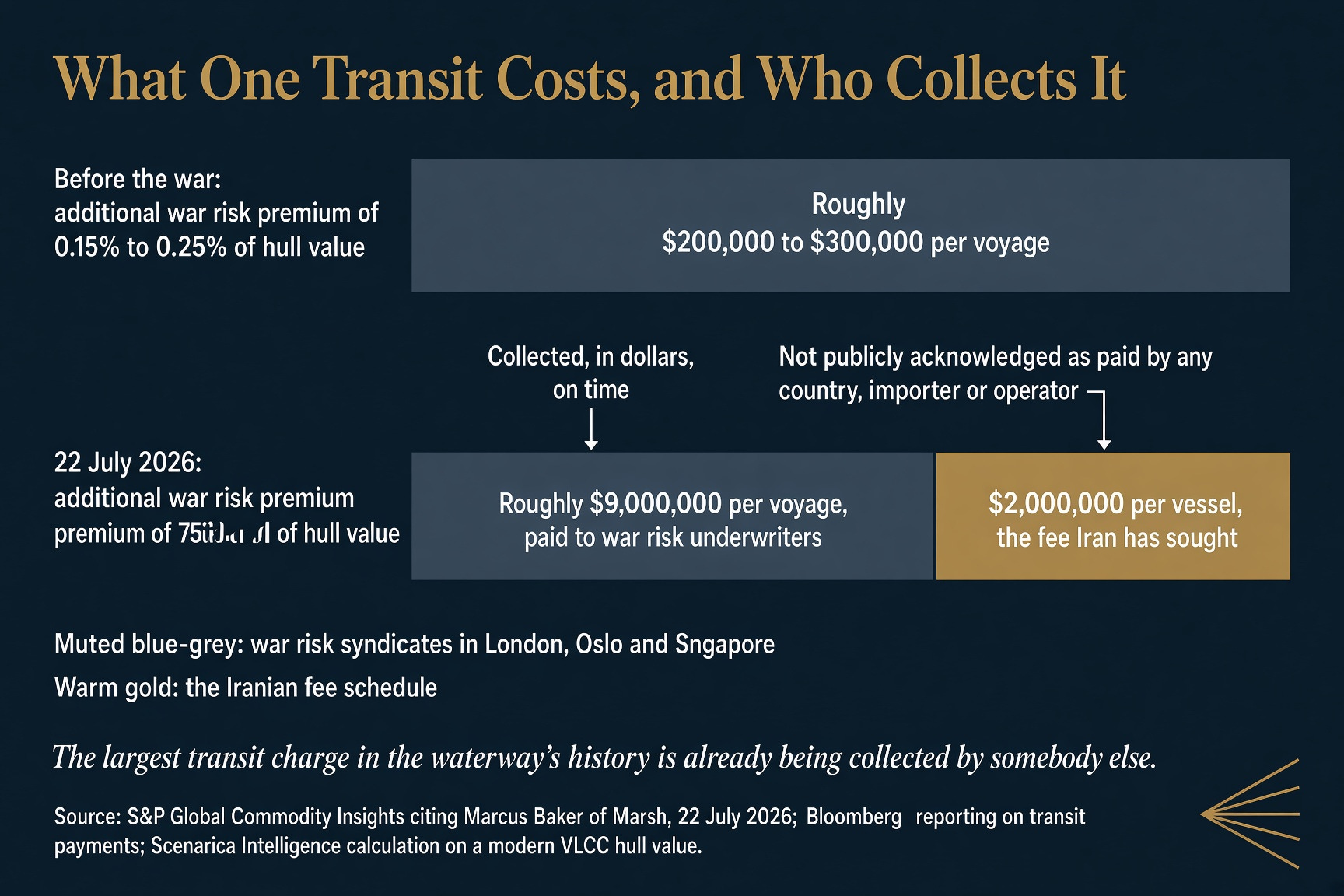
Then look at what the closure did collect, for somebody else. Additional war risk premiums for Hormuz transits ran at roughly 7.5 to 10 percent of hull value on 22 July, according to Marcus Baker, global head of marine, cargo and logistics at Marsh, up from 1 to 3 percent only weeks earlier and from a fraction of one percent before the war. On a modern very large crude carrier that is high single-digit millions for a single voyage, and in some reported cases above $10m.
So Iran asked for $2m a ship and could not get anyone to admit paying it, while its closure of the strait created a levy of roughly $9m a voyage that is paid without argument, in dollars, on time, into the war risk syndicates of London, Oslo and Singapore. The largest transit charge in the history of the waterway is already being collected, and Tehran wrote the invoice for a market it does not sit in.
Each escalation of the demand has reduced its value, for a reason that is purely mechanical. A service fee can be paid by a charterer, reimbursed through a war risk policy, cleared by a correspondent bank and expensed as a voyage cost. Every condition Tehran has added since March has knocked out one of those links.
Designation of the collecting entities on 29 July removed the bank. Requiring payment in rial narrowed the settlement to a currency nobody outside Iran wants to hold. And the compensation condition removes the counterparty itself, because a sovereign war claim carries no invoice number, no service rendered, no legal payee and no compliance officer anywhere who can approve it.
The draft’s enforcement article completes the circle in a way its authors may not have intended. It proposes fines of up to 20 percent of the value of cargo and vessel for violations. Read as an economic instrument, that functions as a seizure risk applied to every ship that declines to pay, which is exactly the hazard the sanctioned compulsory insurance scheme claimed to protect against. Treasury made the point in its July designation notice, observing that the risks the cover purported to insure were overwhelmingly created by Iran itself, and the bill would give that structure a statute.
The obvious objection to all of this is that the bill is not the deal. Iranian parliamentary drafts die routinely, get gutted in committee, or are struck down by the Guardian Council. The executive negotiates and the Majlis performs; Salimi himself said the provisions remain subject to review. On that reading the compensation article is domestic theatre, and pricing an international negotiation off it is a category error.
Most of that objection is correct, and it is why the base case sits at 54 rather than higher. The March law is the reason it cannot be the whole story. The Majlis legislated in the spring rather than merely posturing, and the fee regime it codified is now the legal furniture around which the corridor talks are being conducted. What is running here is a ratchet: each parliamentary text sets a floor that Iran’s negotiators can present as a constraint they did not choose, and that opposing negotiators must then buy out.
A bill that never passes still does work in the world. Underwriters, charterers and general counsel price declared positions, not only enacted ones. From this week onward, every legal opinion written on a Hormuz voyage has to reckon with an Iranian parliament that has publicly asserted a right to condition passage on war compensation and to fine a fifth of the cargo and hull.
That is a permanent addition to the risk file and it survives the bill’s death, which modifies the conclusion in a specific way. The compensation clause will most likely vanish from the operative text and fail completely as a revenue instrument, while succeeding at something Tehran never intended to buy: it raises the standing cost of every transit, indefinitely, and hands the increase to underwriters.
This coming week, the National Security and Foreign Policy Committee’s final report is the first hard reading available, and if the compensation article survives into it, the base case weakens and the shut-through-autumn branch takes the difference. Through mid-August, the Iran-Oman joint statement settles the question, and the thing to read is whether any charge appears at all and under what noun.
Into late August and September the Lloyd’s List Intelligence weekly transit count tells you whether words became water: sustained weeks above roughly 120 non-Iranian-linked transits confirm the corridor is functioning, and a slide back toward the mid-40s confirms it is not. At any point, a further OFAC designation of a fee-collecting entity would signal that Washington has decided to treat the statute as operative rather than aspirational. By September, the war risk market matters more than the podiums, because underwriters ratify deals that governments announce, and premiums easing back below 5 percent of hull value would be the market’s own signature on whatever gets signed.
Muscat is settling something larger than the width of a shipping lane. It is settling whether a war can be converted into a fee schedule, and every government that sits beside a narrow piece of water is reading the answer as it emerges. So far the answer is that the conversion can be attempted and cannot be completed, because completing it requires a payment rail, and the payment rails belong to the other side. Tehran spent five months building a tollbooth, the traffic it needed drove away, and the money it created went to Lloyd’s.
Sources:
Press TV, “Iran parliament weighs bill to regulate transit through Strait of Hormuz,” 7 August 2026.
Reuters via Al-Monitor, “Iranian parliamentary committee reviews draft bill to bar US, Israeli ships from Hormuz, Fars says,” 6 August 2026.
Bloomberg, “Iran-Oman Deal Proposes Ban on US, Israeli Ships in Strait of Hormuz,” 6 August 2026.
Al Jazeera, “Hormuz deal ‘close’: What’s the latest on each side’s positions?,” 6 August 2026.
Al Jazeera, “Strait of Hormuz tolls would harm livelihoods worldwide, shipowners warn,” 6 August 2026.
Axios, “U.S. nears Hormuz deal, aiming for Wednesday announcement,” 5 August 2026.
CNN, “An agreement on the Strait of Hormuz is taking shape but not one Trump wants,” 5 August 2026.
Lloyd’s List Intelligence Maritime Intelligence Unit, “Strait of Hormuz Brief: 5 August 2026,” 5 August 2026.
Bloomberg, “Shipowners Warn Hormuz Tolls Could Set Precedent for Global Transit Fees,” 5 August 2026.
Joint letter of eight shipping associations to UN Secretary General Antonio Guterres and IMO Secretary General Arsenio Dominguez, 3 August 2026, signed by the Asian Shipowners’ Association, BIMCO, Cruise Lines International Association, European Shipowners, the International Chamber of Shipping, INTERCARGO, INTERTANKO and the World Shipping Council.
US Department of the Treasury, Office of Foreign Assets Control, “Treasury Disrupts Iranian Regime’s Strait of Hormuz Extortion Network,” press release, 29 July 2026.
Bloomberg, “US Sanctions Iran’s ‘Extortion Network’ Over Hormuz Tolls,” 29 July 2026.
S&P Global Commodity Insights, “Middle East shipping insurance costs rise on Hormuz risks: Marsh,” 22 July 2026, quoting Marcus Baker of Marsh.
Turkiye Today, “Iran’s parliament passes Hormuz toll law in defiance of international maritime rules,” 30 March 2026, citing Tasnim and Fars, and quoting Mohammadreza Rezaei Kouchi, Alaeddin Boroujerdi, James Kraska and GCC Secretary General Jasem Mohamed Al-Budaiwi.
Trading Economics, Brent crude settlement, 7 August 2026.
IRNA, remarks of Deputy Foreign Minister Kazem Gharibabadi, 5 August 2026.
Disclaimer: This report is published by Scenarica Intelligence for informational purposes only. It does not constitute investment advice, a solicitation to buy or sell any financial instrument, or a recommendation regarding any particular investment strategy. Scenarica Intelligence is not a registered investment adviser or broker-dealer. All scenario probabilities and assessments represent the analytical judgment of Scenarica Intelligence and are subject to change without notice. Past performance of any asset or strategy discussed does not guarantee future results. Readers should conduct their own due diligence and consult with qualified financial advisers before making investment decisions.
Scenarica Premium: The full Scenarica suite includes Geopolitics, Economy, Bitcoin, AI, and Sunday Edition.
Scenarica Intelligence
We don’t predict the future. We price it.