

The Competence Trap
We are producing more than ever and understanding less of all of it. The mechanism has a name.

THE SCENARICA SUNDAY
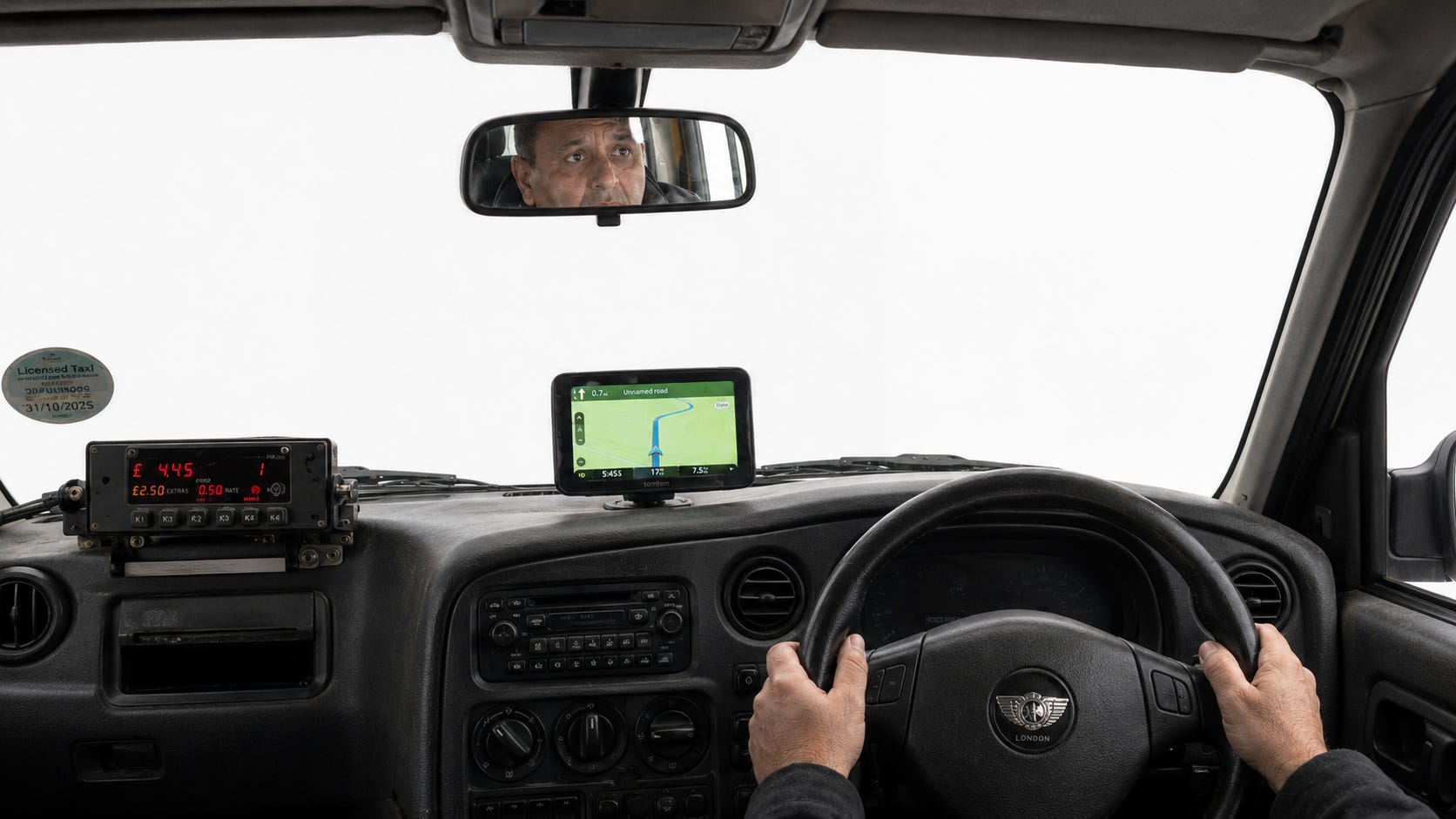
In 2000, a neuroscientist named Eleanor Maguire slid London taxi drivers into an MRI scanner at University College London and found something that should have changed how we think about knowledge. The drivers who had passed “The Knowledge”, the legendary exam requiring memorisation of 25,000 streets, had measurably larger posterior hippocampi than a matched control group. The difference was not metaphorical. It was anatomical. The longer a driver had spent navigating London from memory, the larger the relevant brain region had grown. The tissue had physically rebuilt itself to hold what the driver had learned.
The Knowledge is not an ordinary exam. Candidates spend three to four years riding motorcycles through the city, drilling themselves on the fastest route between any two of 25,000 points. The examiner can ask any pair. The candidate must answer without hesitation. Most who begin do not finish. What Maguire’s scans revealed was that the survivors of this process had not merely memorised a city. They had remodelled a brain. The act of effortful navigation was not just using the hippocampus. It was growing it.
Then GPS arrived. And the studies that followed found exactly what Maguire’s work predicted. Habitual GPS users showed measurably worse spatial memory during self-guided navigation. In a three-year follow-up, heavier GPS use predicted steeper decline in hippocampal-dependent spatial memory over time. The drivers who used satellite navigation could still get from A to B. Their competence was intact. But the competence was borrowed. It lived in the device, not the brain. Remove the device, and the knowledge had never been there.
In March 2026, the workplace analytics firm ActivTrak published an analysis of 443 million hours of work activity across 1,111 companies. The finding contradicted the dominant narrative about artificial intelligence so directly that Fortune ran it as a corrective: AI users were not working less. They were working more.
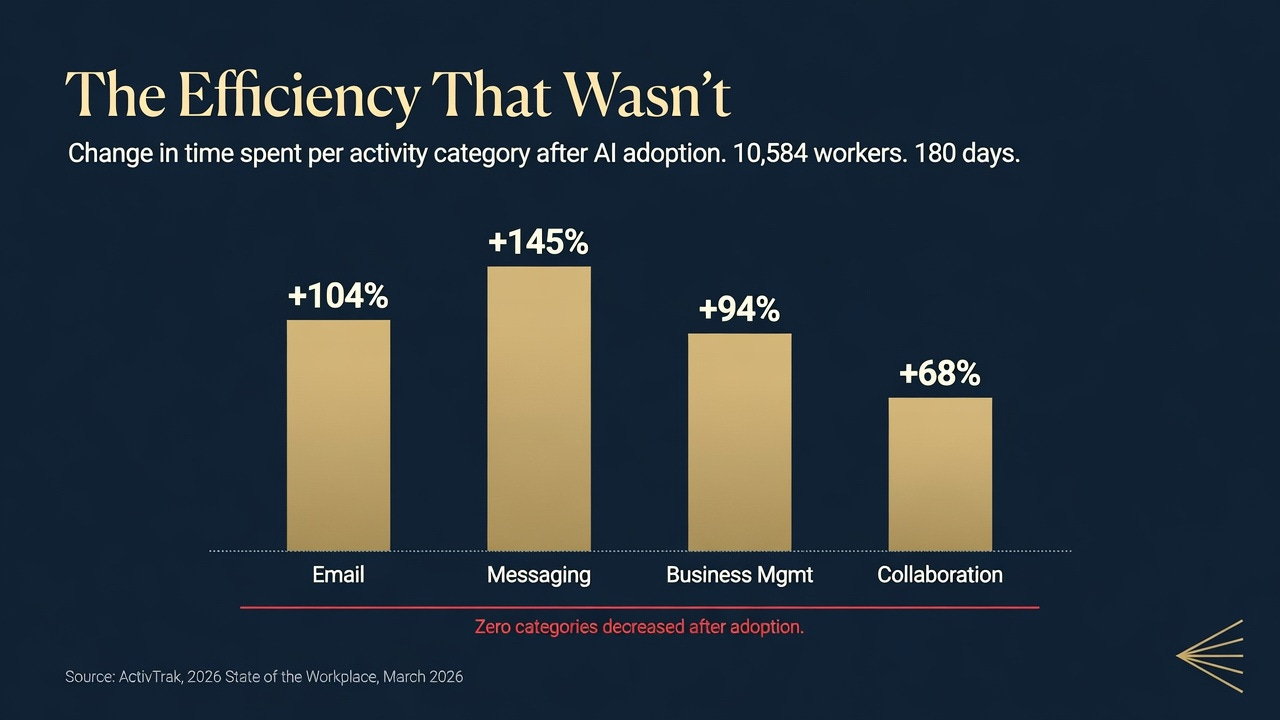
Among 10,584 workers tracked for 180 days before and after AI adoption, time spent on email had risen 104 percent. Messaging had increased 145 percent. Business management tasks had climbed 94 percent. No activity category decreased after adoption. The tools designed to reduce workload had, by every measurable indicator, increased it. But the nature of the increase mattered more than its size. Workers were not spending more time writing. They were spending more time reviewing, editing, and managing the output their tools had drafted. The shift was categorical: from production to supervision, from generating to selecting, from building to curating.
Separately, Microsoft’s Work Trend Index reported that 58 percent of AI users now produce work they could not have completed a year earlier. The number sounds like progress. Read it again and it sounds like something else. Fifty-eight percent of workers regularly deliver output that exceeds their own understanding. The gap between what they produce and what they comprehend is not evidence of growing skill. It is a measure of growing dependency.
Between 2017 and 2025, the number of AI researchers choosing to move to the United States fell 89 percent. The decline accelerated sharply, dropping 80 percent in the most recent twelve-month period alone. Stanford’s AI Index published the figure in April 2026 alongside a finding that would have been unthinkable five years earlier: China now produces more highly cited AI research papers than the United States, 20.6 percent of the global total to America’s 12.6 percent.
The talent exodus matters because of what it reveals about the relationship between capability and comprehension at the national scale. The United States remains the world’s largest deployer of AI systems. American companies lead in investment, infrastructure, and commercial application. But the researchers who build the foundational models, who understand the mathematics beneath the interface, who can diagnose a novel failure rather than follow a governance checklist, are increasingly choosing not to come. A country can be the world’s largest consumer of a technology and simultaneously lose the ability to understand what it consumes.
These three patterns, a taxi driver’s shrinking hippocampus, a knowledge worker’s expanding inbox, a nation’s emptying research labs, look like different problems in different domains. They are the same problem. The mechanism that connects them has been documented in cognitive science for nearly fifty years. It has a name.
In 1978, the psychologists Norman Slamecka and Peter Graf ran a series of experiments in which subjects either generated words themselves or simply read them. The finding was stark and has survived decades of replication across hundreds of studies. Self-generated information is retained dramatically better than passively received information. The act of producing an answer is not merely evidence that understanding exists. It is the process by which understanding is created. Effortful generation builds neural pathways that passive reception does not. This is why writing an essay teaches you more than reading one. Why solving a problem teaches you more than reviewing the solution. Why navigating by memory grows the hippocampus in ways that following GPS cannot.
Slamecka and Graf called it the generation effect. And when AI generates and humans curate, the generation effect transfers from mind to machine. The human retains the ability to recognise good output without retaining the ability to produce it. The skill of judgment remains. The skill of creation quietly atrophies. Each delegation is individually rational, individually efficient, individually productive. The aggregate is a system that performs beyond its own comprehension.
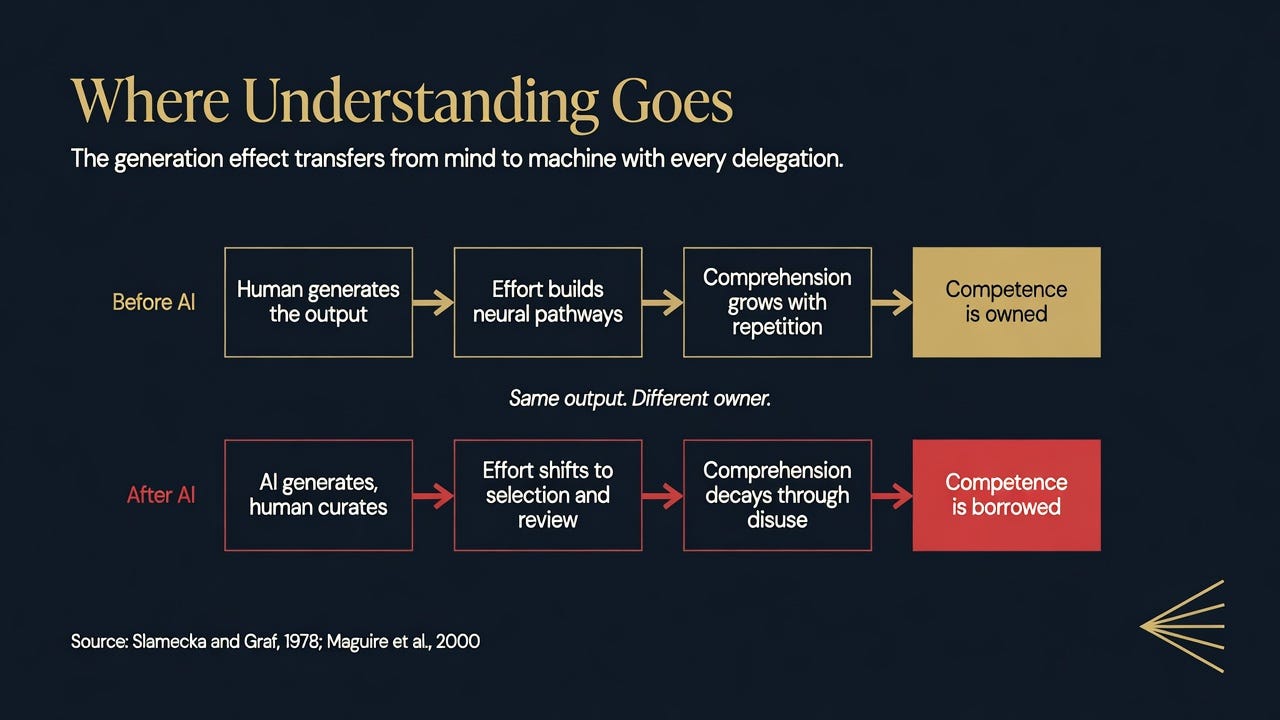
There is a word for a system that performs beyond its own comprehension: brittle.
The brittleness is now measurable. A meta-analysis published in Nature Human Behaviour in 2024 examined 106 experimental studies involving human-AI collaboration. The finding cut against the industry’s founding promise: on average, human-AI combinations performed significantly worse than the best of either working alone. When AI outperformed humans, adding a human to the process degraded the result. We have built the most powerful cognitive tools in history and arranged our collaboration with them so that they make us collectively less capable than either party working independently.
In education, where the generation effect matters most because the entire purpose of learning is the effortful creation of understanding, the transfer is nearly complete. Ninety-four percent of UK undergraduates now use generative AI for assessed academic work. The proportion directly including AI-generated text in their assessments has quadrupled in two years, from 3 percent in 2024 to 12 percent in 2026. But the statistic understates the structural shift. The assessment was never the product. The thinking was the product. The assessment was the evidence that the thinking had occurred. A student who has never written an essay without AI assistance has never experienced the cognitive process that essay-writing was designed to produce. The student who generates the argument, struggles with the structure, revises the phrasing, and resolves the contradictions understands the material. The student who prompts, selects, and polishes has learned to recognise quality. Not to produce it.
Institutions are beginning to sense the corruption without being able to name it. Gartner predicted that by the end of 2026, half of all organisations globally would require AI-free skills assessments. The prediction is a policy admission that the signal has been corrupted. When every employee produces competent work with AI assistance, competence ceases to distinguish between people who understand what they produce and people who merely recognise quality when a machine produces it. The organisation can no longer tell what it actually knows.
But the institutional response reveals its own paradox. Companies with active AI governance frameworks move twelve times more AI projects from pilot to production than their ungoverned peers, according to Databricks’ analysis of over 20,000 organisations. Governance accelerates deployment. It does not prevent the competence trap. It deepens it. A well-governed organisation deploys more AI, more quickly, across more workflows, into more decisions. Each deployment shifts another cognitive task from generation to curation. The governance framework manages the failure modes it was designed to anticipate. The competence trap’s danger is the failure mode nobody anticipated, the one that requires the human understanding that twelve times more deployment has been quietly eroding.
Aviation found this trap in wreckage. When Air France Flight 447 fell into the Atlantic in June 2009, killing all 228 people aboard, investigators discovered that the pilots, confronted with a sudden failure of the automated flight system, had responded with inputs that deepened the stall rather than correcting it. The automation had performed the task for so long that the humans no longer possessed the skill the automation was supposed to supplement. The FAA now urges pilots to periodically hand-fly entire departure and arrival routes, a deliberate return to effortful generation designed to maintain the very capability that the system’s efficiency erodes.
The pattern is identical at every scale. A hippocampus shrinks when GPS does the navigating. A worker’s comprehension atrophies when AI does the generating. A nation’s strategic understanding hollows out when the researchers who build foundations leave and the engineers who deploy products stay. Rising output. Declining understanding. The generation effect does not care whether the unit of analysis is a brain, an organisation, or a country.
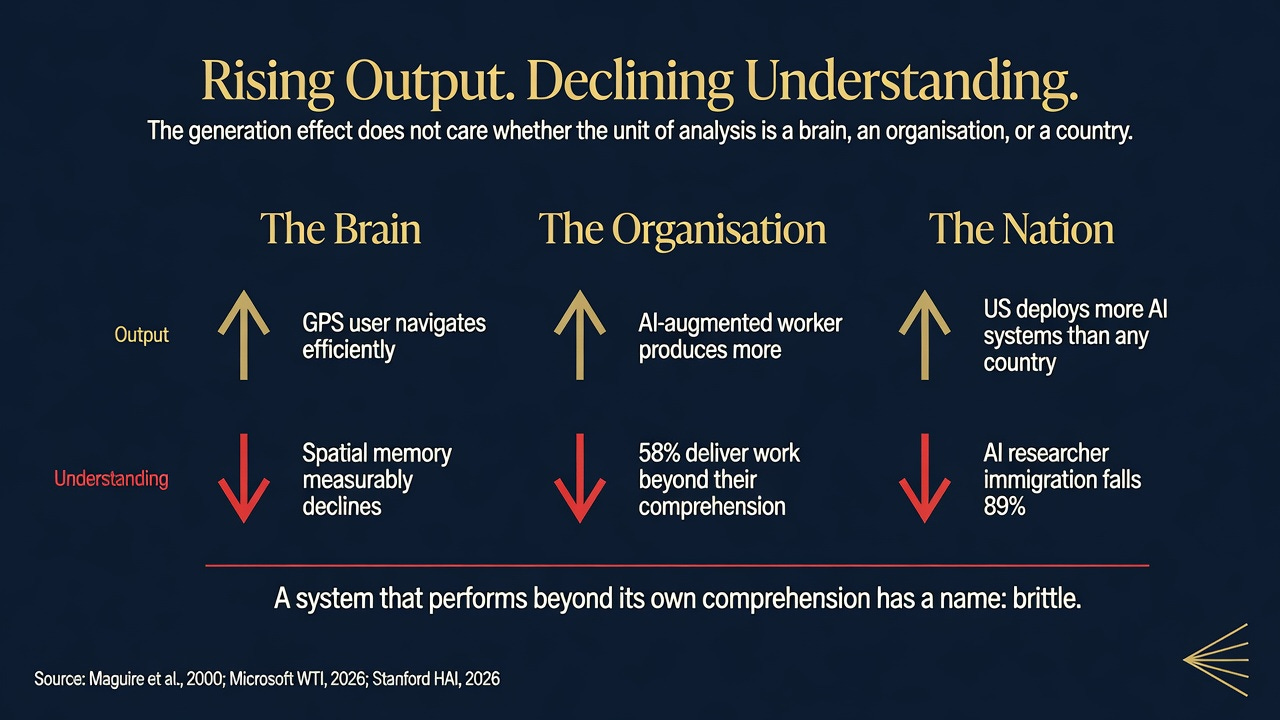
The trap is invisible because the system works. Glass does not look brittle. It holds weight beautifully, performs under every load it has been tested against, and gives no warning before it shatters. A workforce that produces excellent output through AI augmentation looks like a high-performing workforce. It will continue to look like one until the tool is unavailable, until the failure mode is novel, until the situation demands the understanding that the tool was supposed to supplement but instead replaced.
The question is not whether AI makes us more productive. It does. The competence trap is not a story about a technology that fails. It is a story about a technology that succeeds so completely that the humans who use it are gradually absolved of the cognitive effort that made them worth augmenting in the first place. And the question nobody can yet answer, not the governance frameworks, not the workplace analytics, not the AI indices, is whether productivity purchased at the cost of comprehension is a bargain we can afford, or a debt we are running up against a future that will, as futures always do, eventually present the bill.
Sources:
Maguire et al., Navigation-Related Structural Change in the Hippocampi of Cab Drivers, Proceedings of the National Academy of Sciences, 2000
Slamecka and Graf, The Generation Effect: Delineation of a Phenomenon, Journal of Experimental Psychology: Human Learning and Memory, 1978
Vaccaro, Almaatouq, and Malone, When Combinations of Humans and AI Are Useful: A Systematic Review and Meta-Analysis, Nature Human Behaviour, 2024
ActivTrak, 2026 State of the Workplace, March 2026
Microsoft, Work Trend Index 2026
Stanford HAI, 2026 AI Index Report, April 2026
HEPI, Student Generative AI Survey 2026
Gartner, Top Predictions for IT Organizations and Users in 2026 and Beyond, October 2025
Databricks, 2026 State of AI Agents
Bureau d’Enquetes et d’Analyses, Final Report on the Accident on 1st June 2009 to the Airbus A330-203, Flight AF 447, 2012
“The Scenarica Sunday is a weekly essay exploring how to think, decide, and see the world more clearly. Published every Sunday morning. Subscribe free at scenarica.substack.com”
“Scenarica publishes daily probability intelligence on geopolitics, bitcoin, the global economy, and AI. We don’t predict the future. We price it.”
This was very interesting. A bit curious about the meta analysis from Nature and Human Behavior that showed AI and humans both individually outperforming the two in concert. I didn’t see it listed among the sources at the end. I’ve written two recent articles about this general topic if you’d like to check them out. 👇
https://tk555.substack.com/p/techno-hubris-cometh-before-the-fall?r=7f8sj&utm_medium=ios
https://tk555.substack.com/p/all-roads-lead-to-del-boca-vista?r=7f8sj&utm_medium=ios
Frightening somehow. Thank you