

The Roundabout
The AI industry's biggest deals may be a few firms funding each other to buy each other's chips.


In 1999 a telephone-equipment company called Lucent found a way to make a sale without a buyer. If a young carrier wanted to build a network but could not afford the switches and the fibre, Lucent would lend it the money to buy Lucent’s switches and Lucent’s fibre. The loan went out one door and came back through another as revenue. On paper, demand was roaring. By the time the accountants finished, Lucent had committed roughly eight billion dollars to financing its own customers, and its chief executive, Richard McGinn, was running the fastest-growing blue chip in America.
Then the customers stopped paying. Traffic never caught up to the fibre in the ground. Lucent wrote down billions in bad debt, lost more than sixteen billion dollars in a single year, and pushed McGinn out. Across the sector, close to two trillion dollars of market value evaporated between 2000 and 2002, and so much unused cable sat buried under American soil that the industry gave it a name that stuck for a decade: dark fibre.
Hold that shape in your head, because it is happening again, at many times the size, and hardly anyone is calling it by its name.
Here is the shape. In September, Nvidia signed a letter of intent to invest up to one hundred billion dollars in OpenAI. OpenAI, in turn, has committed to pay Oracle roughly three hundred billion dollars for cloud computing over five years, and to buy another two hundred and fifty billion dollars of Microsoft’s Azure. Oracle and Microsoft spend a large share of that money on the most expensive component in a data centre, which is a Nvidia chip. Nvidia, separately, holds an equity stake in the specialist cloud company CoreWeave and signed a deal worth up to 6.3 billion dollars to buy CoreWeave’s unused capacity through 2032. CoreWeave, in turn, is one of the largest single buyers of Nvidia chips on Earth.
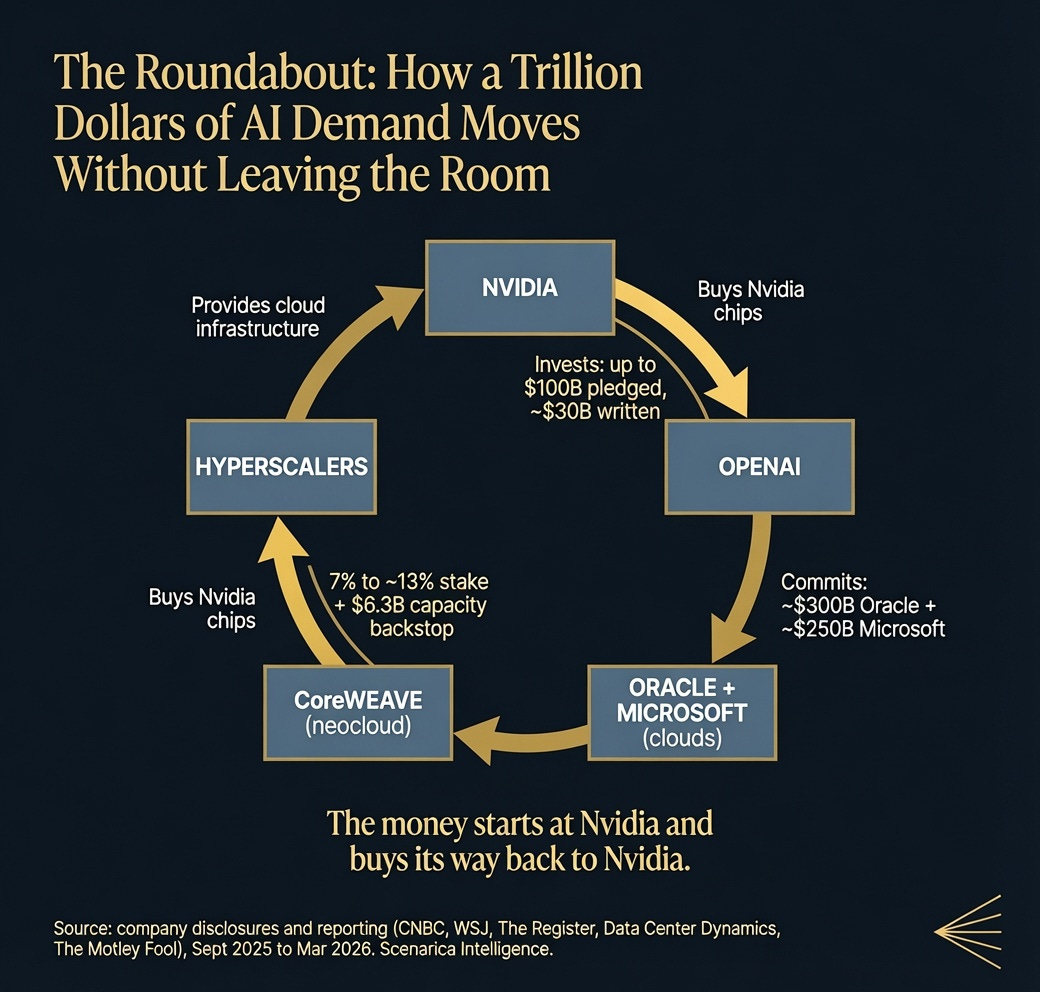
Draw those arrows on a napkin and something uncomfortable appears. The money starts at Nvidia, travels through OpenAI, arrives at Oracle and Microsoft and CoreWeave, and buys its way back to Nvidia. Follow it through the whole AI boom and it never quite leaves the room. It just keeps changing name tags.
This has a plain-English name, and it is not fraud. It is called vendor financing, and in its honest form it is ordinary: a supplier helps a promising customer afford the product, betting that the customer will grow into a real business and pay it back. The danger is subtler than dishonesty. When a supplier funds the customer who buys its product, a sale gets recorded that no genuinely new buyer paid for. Demand looks larger than the outside world actually asked for. And when the same handful of companies are each other’s suppliers, customers and investors all at once, the loop can generate the appearance of a market long before there is a market.
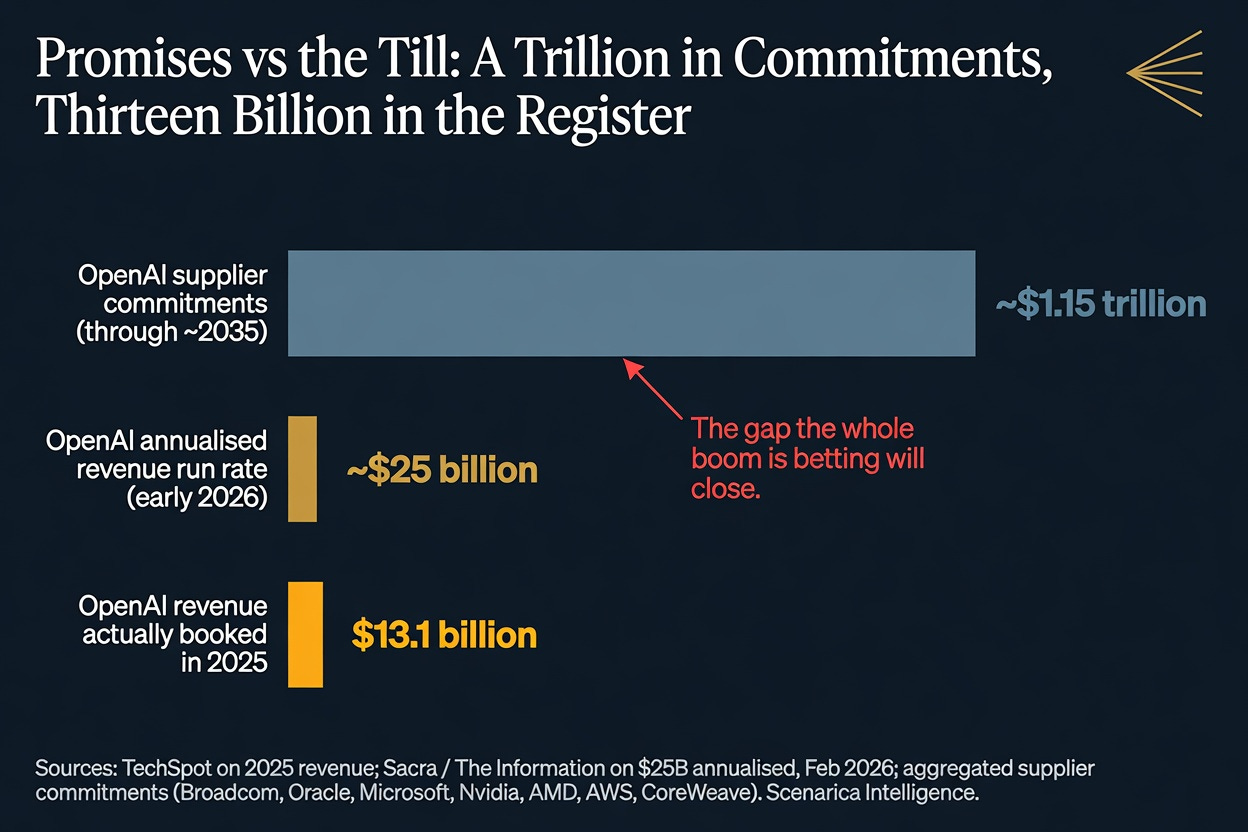
So the number that should keep you up at night is not the trillion. It is the gap between the trillion and the till. OpenAI, the company sitting at the centre of nearly every arrow, booked about 13.1 billion dollars of actual revenue in 2025. Its commitments across all its suppliers run past a trillion dollars over the coming decade. That is the whole question in one line: a company with thirteen billion dollars of real sales has promised to spend more than a thousand billion, and much of that promise is being counted, today, as somebody else’s demand.
Now, before you conclude the whole thing is a mirage, sit with the harder truth, because it is the one that actually matters. The circle is not proof that the demand is fake. Lucent’s fibre was real glass in real trenches, and every strand of it eventually carried traffic. The tragedy of 1999 was never that the technology was fictional. It was that the money arrived years before the customers did, and the companies that borrowed to build could not survive the wait.
That is the right lens for AI, and it is more unsettling than the simple accusation. The chips are real. The models are real. Hundreds of millions of people genuinely use them. The only question that decides how this ends is whether enough revenue from real outside customers, the small business paying for ChatGPT, the enterprise paying for Copilot, the developer paying for an API call, arrives fast enough to convert those promises into cash before someone in the circle has to write a cheque they cannot cover. Not whether the demand is real. Whether it is real in time.
And here is the part the headlines missed while they repeated the trillion. The first crack has already shown, and it came from the one player everyone assumed was unshakeable. Nvidia’s headline commitment to OpenAI was always a letter of intent, an “up to” number tied to hardware being deployed, not a cheque. Over the winter, reporting revealed that the grand hundred-billion-dollar plan had gone quiet, and what Nvidia actually wrote was a thirty-billion-dollar equity stake taken in an OpenAI funding round early this year. Jensen Huang, Nvidia’s chief executive and the closest thing this boom has to a central banker, said in March that this investment “might be the last time” his company puts money into OpenAI before it goes public.
When the lender at the centre of the roundabout starts rationing the fuel, that is not noise. That is the financier telling you, in the politest possible language, that he has looked at the same napkin you just drew.
The Deep Dive
What remains is the machinery underneath the metaphor: exactly how a promise becomes reported demand, the arithmetic of how far the promises outrun the cash, where the 1999 rhyme holds and the precise point where it breaks, which of these four companies is actually load-bearing and which can walk away, and which of three futures the next eighteen months most likely delivers.
Start with the accounting, because circular financing does its work in the space between two words that sound identical to a layperson and mean very different things to an auditor: booked and paid. When Oracle signs OpenAI to a three-hundred-billion-dollar cloud contract, almost none of that is revenue yet. It enters a line called remaining performance obligations, or RPO, which is the dollar value of contracts signed but not yet delivered. It is a backlog, a promise of future business. Oracle’s total RPO has swelled past six hundred billion dollars, and by most external estimates roughly half of that single backlog traces to OpenAI alone. RPO is a wonderful thing to show investors. It is also, crucially, not money. It is the expectation of money, contingent on the customer still existing and still paying when the bills come due, which in Oracle’s case begins in earnest in 2027.
Nvidia’s side of the loop books faster and looks cleaner, which is exactly why it is more seductive. When CoreWeave buys Nvidia chips, Nvidia records real revenue immediately, hardware shipped, cash or receivable in hand. The awkwardness is only visible if you notice where CoreWeave’s money came from. Nvidia holds equity in CoreWeave, so it profited when CoreWeave raised capital. Nvidia has agreed to buy CoreWeave’s unsold capacity, which underwrites the very demand that lets CoreWeave borrow to buy more Nvidia chips. None of these steps is illegal, and none is even unusual on its own. Stacked together, they mean a portion of Nvidia’s growth is being purchased with financing Nvidia itself helped arrange. The revenue is real. The independence of the buyer is what is in question.
Put the arithmetic in one frame and the scale of the timing bet becomes hard to unsee. OpenAI’s revenue run rate reached roughly twenty-five billion dollars on an annualised basis by early 2026, up from thirteen billion booked across 2025, a genuinely explosive growth rate of nearly three times year over year. Set that against commitments that exceed one trillion dollars over the decade, and even tripling annually, OpenAI does not generate the cash to cover its own promises for years. The bet embedded in every arrow of the roundabout is not that AI demand exists. It is that AI demand compounds at close to triple digits, without interruption, through a decade of the largest capital commitments in the history of private enterprise. That is a specific, aggressive, and entirely unproven wager, and it is currently being reported to the world as “backlog.”
This is where the 1999 rhyme is worth taking seriously rather than waving around, because the parallel is exact in three places and it breaks in two, and the breaks are where the real analysis lives. It is exact in mechanism: a dominant supplier funds its customers so they can buy its product, and the funded purchase is counted as demand. It is exact in concentration: a small number of firms are wound around each other so tightly that no single one can be assessed in isolation. And it is exact in the psychology, the genuine conviction among smart people that this time the build precedes a real and enormous market, which in the telecom case happened to be true and still bankrupted almost everyone who acted on it early.
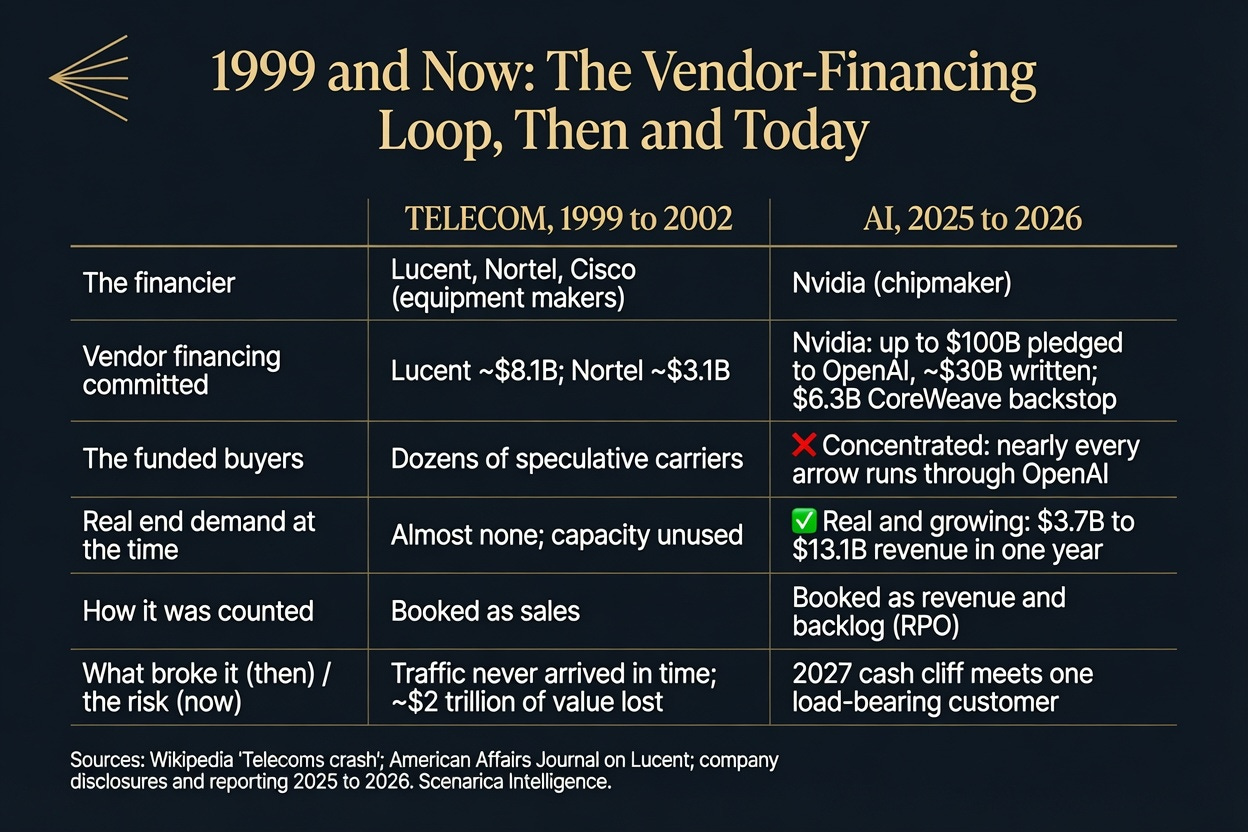
Now the two breaks, because they are the reason this is not simply a rerun. The first break is the demand base. In 1999 the customers Lucent financed were speculative carriers with almost no revenue, selling capacity nobody was using yet. OpenAI, whatever you think of its obligations, has real end users paying real money in numbers that grew from under four billion dollars to over thirteen in a single year. The demand is not hypothetical. It is simply, so far, an order of magnitude smaller than the promises written against it. That is a materially better starting position than the telecom carriers ever had, and anyone drawing the doom parallel too neatly is ignoring it.
The second break cuts the other way, and it is worse. Lucent and Nortel were financing dozens of separate customers, so the failure of any one buyer was survivable. The AI loop is the opposite: it is grotesquely concentrated on a single node. Trace the arrows again and nearly all of them pass through OpenAI. It is the anchor tenant of Oracle’s backlog, a primary justification for Microsoft’s Azure buildout, a major reason Nvidia’s demand curve bends the way it does, and thus indirectly the reason the neoclouds can borrow. In 1999 the system had many small points of failure. In 2026 it has essentially one large one. If OpenAI’s revenue keeps tripling, the whole structure is validated at once. If it stumbles, there is no diversification to absorb the blow, because the diversification is an illusion; it is the same customer wearing different lanyards at each company’s investor day.
Which is why the most important person in this story is not the one building the models but the one deciding whether to keep funding them, and his behaviour has already changed. Jensen Huang controls the optionality in this system. Nvidia is the supplier at the top of the loop, the one entity that can slow the whole machine simply by declining to write the next cheque, and it is the only node with a balance sheet strong enough that it never has to. His decision to shrink the OpenAI commitment from an “up to one hundred billion” letter of intent to a thirty-billion equity stake, and to say aloud that it might be the last, is the single most informative act in the entire sequence. The financier with the most information and the most to lose looked at the roundabout and quietly took his foot off the accelerator.
The counterparty on the other side of that decision is the one carrying the exposure, and the market has already begun to price it. Oracle staked an enormous share of its future on a single customer’s ability to pay, and over the first half of this year its shares fell by more than forty percent from their high as investors did the same napkin arithmetic and asked the same question about OpenAI’s capacity to honour a three-hundred-billion-dollar bill. OpenAI’s own chief financial officer, Sarah Friar, has reportedly voiced internal concern about the company’s ability to meet its future compute obligations if revenue growth does not accelerate. When the person who signs the cheques is worried about the cheques, that worry is not a bearish opinion but inside information leaking into daylight.
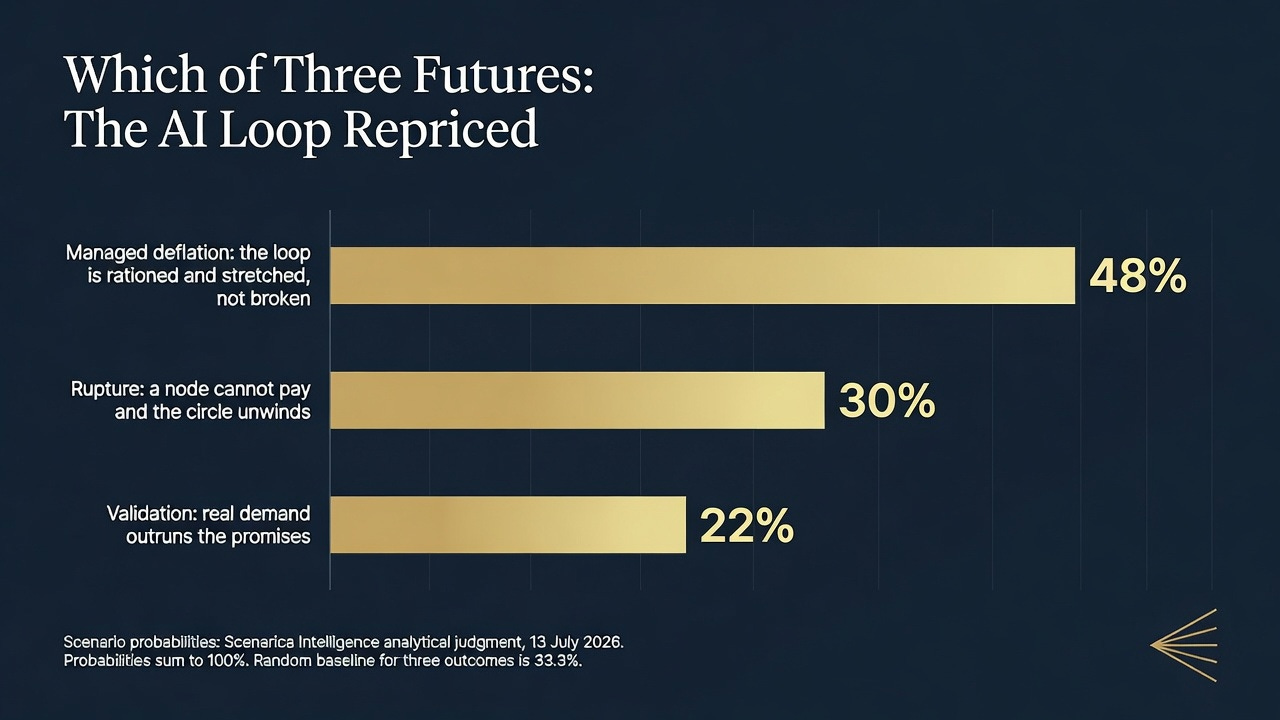
So how should you actually price this, not as a bet on any one company’s shares, but as a read on how much of the AI capex boom is genuine outside demand versus money circling among a handful of firms? Line up the ways the next eighteen months can resolve, and weigh them against the plain base rate, which is that vendor-financed buildouts historically get validated by real demand eventually and ruin most of the early builders in the meantime.
The most probable path, and it deserves close to half the weight at roughly forty-eight percent, is neither vindication nor collapse but a managed deflation. In this world real revenue keeps growing, just not as fast as the promises, and the loop is quietly rationed and stretched rather than either honoured in full or broken. Nvidia keeps its foot light, as Huang has already signalled. Oracle and OpenAI renegotiate the shape and timing of their contract without a formal default. The headline commitments get amortised, delayed, and softened, and over eighteen months the market slowly reprices “AI demand” downward to strip out the intra-industry portion, without a crash. This is the base case precisely because it is already underway: the rationing, the repricing, the internal worry are observable today, and both alternatives require a decisive break from that path rather than a continuation of it. If you run a technology or infrastructure book, this is the scenario you should be operationally ready for, because it is the one that dulls the boom without a headline event to warn you.
Then there is the harder edge, the scenario the roundabout is designed to make you underweight, and it carries about thirty percent. Here a node cannot pay in time. OpenAI’s revenue growth slows even modestly against a 2027 wall of cash obligations, and a renegotiation curdles into something the market reads as a default, most likely at the OpenAI-to-Oracle interface where the concentration is heaviest and the timing tightest. Because the diversification is fictional, the repricing does not stay contained; it forces investors to re-examine every arrow at once and to mark down the portion of AI capex that was really the same dollar in motion. Thirty percent is not a tail. It is the honest weight for a structure this concentrated with a dated cash cliff already visible, and the fact that Oracle’s shares have already fallen forty percent tells you the market is not treating it as a tail either.
The lightest of the three, at around twenty-two percent, is the one the boosters are counting on: real demand simply outruns the promises. Enterprise adoption broadens beyond software developers, consumer and API revenue keeps compounding near its current pace, and within eighteen months the outside cash flow is visibly large enough that the circularity stops mattering, because genuine buyers have arrived to validate the build. This would make the whole loop look, in hindsight, like sensible bridge financing that did its job. It sits below the random baseline deliberately, not because AI demand is weak, but because validating a trillion dollars of commitments on this timeline requires revenue to do something it has never yet done for long, which is compound at these rates without a single stumble, across a decade-length obligation, in eighteen months. It can happen. It simply should not be your central expectation.
The variable that moves these weights is singular and watchable: the gap between OpenAI’s cash revenue run rate and its scheduled cash obligations. Widen it and probability flows toward rupture. Close it and probability flows toward validation. Everything else is commentary.
Watch, then, for specific things on specific clocks. Watch Nvidia’s next two earnings calls, through the autumn, for whether that thirty-billion stake actually closes and deploys or quietly shrinks again, because a second reduction would confirm the financier is not rationing but retreating. Watch OpenAI’s revenue against its own stated thirty-billion-dollar target for full-year 2026, reported around the turn of the year, because a miss is the crack from which everything else propagates. Watch Oracle’s quarterly RPO disclosures and any language about restructuring the OpenAI contract; the first mention of “revised terms” is the tell that 2027 arrived early. Watch whether Nvidia’s 6.3-billion-dollar CoreWeave backstop is ever actually drawn, which would mean the neocloud’s real customers did not show up as promised. And watch, quietly, for any auditor or regulatory commentary on related-party revenue recognition across these names, because the moment an accountant asks the napkin question in public, the repricing stops being gradual.
Lucent’s fibre was never fake. It was real glass, buried early, waiting years in the dark for traffic that eventually came in volumes beyond anything the engineers had imagined. The tragedy was only ever about who was still holding it, and still solvent, when the demand finally arrived. The AI build is the same wager rewritten larger: the compute is real, the models are real, the demand is real, and the only open question is whose name is on the tag when it all finally gets used. Follow the trillion dollars around the room one more time and ask yourself the single question the whole boom rests on. Not whether the music is real. Whether it is still playing when the cash calls come due.
Sources:
Wall Street Journal / CNBC, “Nvidia, OpenAI appear stalled on their mega deal,” February 2026.
CNBC, “Nvidia CEO Huang says $30 billion OpenAI investment ‘might be the last,’” 4 March 2026.
CNBC, “Nvidia is in talks to invest up to $30 billion in OpenAI, source says,” 19 February 2026.
The Register, “Oracle insists its $300B contract with OpenAI is on schedule,” 15 December 2025.
Data Center Dynamics, “OpenAI signs $300bn cloud deal with Oracle,” September 2025.
Microsoft Corp, Form 10-Q FY2025 (Azure commitment disclosure), filed 30 September 2025; reporting on OpenAI’s incremental $250B Azure commitment, October 2025.
The Motley Fool, “CoreWeave’s $6.3 Billion Backstop Deal With Nvidia: What It Means for Each Company,” 5 October 2025.
The Next Platform, “Nvidia’s $2 Billion Investment In CoreWeave,” 27 January 2026 (Nvidia stake at CoreWeave IPO and growth).
The Motley Fool / Yahoo Finance, “Oracle Stock Plummeted by 25% in the First Half of 2026,” 7 July 2026.
Invezz, “Oracle stock falls as OpenAI reportedly misses targets; $300B deal in focus,” 28 April 2026 (Oracle RPO, OpenAI CFO Sarah Friar concern).
TechSpot, “OpenAI made $13 billion in 2025 and lost $21 billion doing it,” 2026.
Sacra / The Information, “OpenAI tops $25 billion in annualized revenue,” February 2026.
Wikipedia, “Telecoms crash”; American Affairs Journal, “Who Lost Lucent?,” August 2020 (Lucent $8.1B and Nortel $3.1B vendor financing, $16.1B 2001 loss, ~$2T sector value destruction).
Tomasz Tunguz, “Circular Financing: Does Nvidia’s Bet Echo the Telecom Bubble?,” 2026.
Disclaimer: This report is published by Scenarica Intelligence for informational purposes only. It does not constitute investment advice, a solicitation to buy or sell any financial instrument, or a recommendation regarding any particular investment strategy. Scenarica Intelligence is not a registered investment adviser or broker-dealer. All scenario probabilities and assessments represent the analytical judgment of Scenarica Intelligence and are subject to change without notice. Past performance of any asset or strategy discussed does not guarantee future results. Readers should conduct their own due diligence and consult with qualified financial advisers before making investment decisions.
Scenarica Premium: The full Scenarica suite includes Geopolitics, Economy, Bitcoin, AI, and Sunday Edition.
Scenarica Intelligence
We don’t predict the future. We price it.
Three days ago, I wrote a comment and added a link to a Springer article of mine. In hindsight, that may not have been very helpful, since it’s a paid article that needs to be purchased.
Instead, here’s a link to a related free blog post on living systems and a healthy economy.https://www.zermattsummit.org/non-classe/quo-vadis-the-biological-principles-of-a-healthy-economy/
Three days ago, I wrote a comment and added a link to a Springer article of mine. In hindsight, that may not have been very helpful, since it’s a paid article that needs to be purchased.
Instead, here’s a link to a related free blog post on living systems and a healthy economy.
https://www.zermattsummit.org/non-classe/quo-vadis-the-biological-principles-of-a-healthy-economy/