

The Date Attached
Every number that reassured this week had a date underneath doing the damage.

Quantities were never the constraint this week. Dates were, and most of them sat underneath figures that read as reassurance. A record volume of oil that turns out to be a queue. A growth target that a disappointing quarter has already paid for. Both numbers are accurate, published and pointing at the wrong thing, which is the most durable way for a statistic to mislead: honestly.
Where the paperwork is explicit about its own term, the pattern is easier to see. Almost every major instrument Washington has signed since 2025 matures inside a year, and several announce in their own headings that they bind nobody. Europe restored the money for its water bombers and bought delivery dates in 2032. India opened a forty-year bond to the world and left its policy rate untouched, because nobody holding Indian government paper has a date they can enforce. Madrid answered a Supreme Court ruling with a naval tender inside seventy-two hours, and Zurich attached its own dates to a cheque written for 211 voters. The amount was available in every one of those cases. The horizon was not.
Sunday’s essay asked what a country builds when the people running it hold seventeen-month leases. The five days that followed read like an answer.
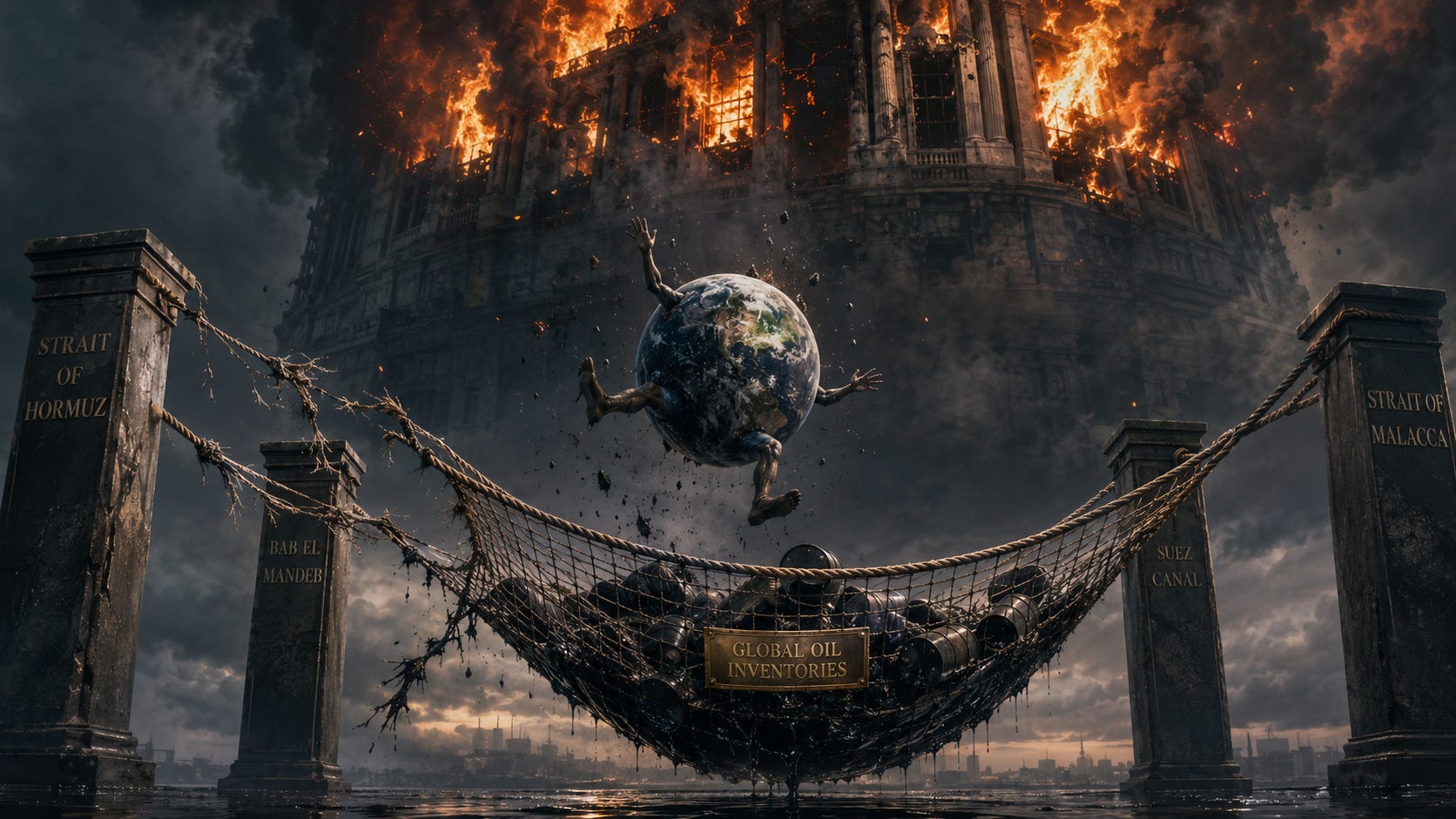
Start in the water, where the world’s oil stockpile hit a record while its cover shrank.
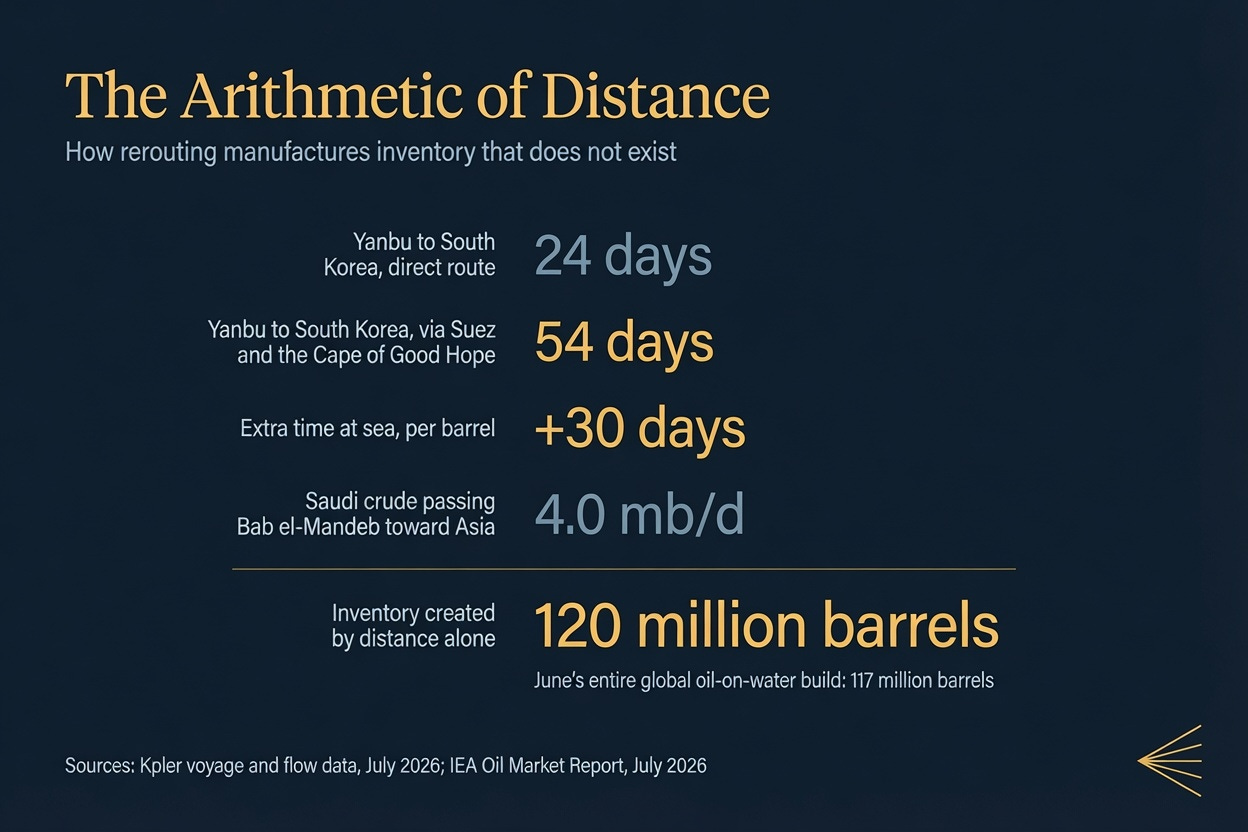
One hundred and seventeen minus ninety-six is twenty-one. Global oil inventories rose by 21 million barrels in June, the first build in four months, and it was received almost everywhere as the moment the worst had passed. Onshore tanks fell by roughly 96 million over the same month, 44 million of it out of government emergency reserves, while oil sitting on ships rose by 117 million. Hormuz has run at a fraction of normal traffic since spring, and a cargo from Yanbu to South Korea that took 24 days now takes about 54 around the Cape. Barrels are the unit, time is the constraint, and around seventy percent of the record 1.35 billion barrels afloat is already sold to Asian buyers with dates on it.
“A queue is what a shortage looks like while it is still being counted.”
Distance stretched one clock without anyone writing it down. Washington wrote its own down. Every one of the fourteen points of the Islamabad Memorandum, signed at Versailles on 17 June 2026, carries a term: safe passage for commercial vessels with no charge for sixty days only, traffic restored within thirty, a final deal in a maximum of sixty days, extendable by consent. The one figure that is not a deadline, at least $300 billion for reconstruction, was routed through a mechanism to be finalised inside the same window. The framework stopped operating on day twenty-three. Clearing a mined strait or laying down a shipyard pays back in years, and no instrument with a sixty-day maturity can underwrite that.
Sixty days at the outer edge. Twenty-three delivered.
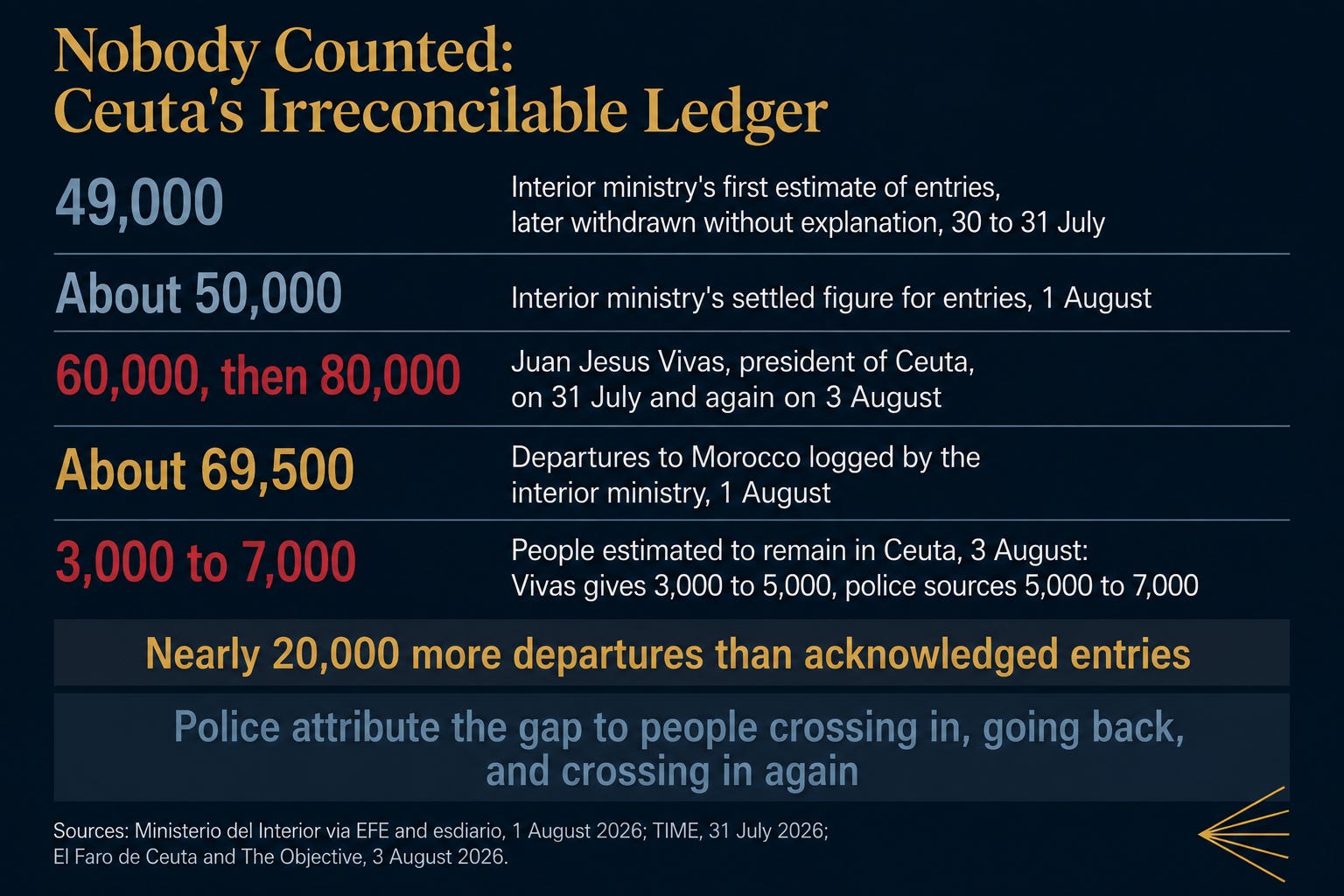
Washington needed sixty days. Madrid needed a chandlery order. On 29 June the Supreme Court held in STS 814/2026 that Spain’s summary rejection power reaches only those who overcome elementos de contencion, containment elements, and that drones and thermal cameras fail the test because they watch rather than contain. One door was left ajar: were containment elements established in the sea, rejection at the border might apply. At ten to eight on the morning of 1 August a crew paid out five hundred metres of naval barrier at Tarajal, three days after the crossings had already stopped. Sanchez has no majority and eighty-one bills stalled in Congress. He needed no law, only a tender.
Five hundred metres of naval buoy, a skirt one metre deep, with a channel cut through the middle so patrol boats can pass.
Spain bought a definition. Zurich tried to buy a permission. On 18 July a circular reached all 211 FIFA member associations offering up to 40 million dollars each, half the ordinary Forward allocation raised from 8 million, half a one-off conditional on backing a 20 billion dollar subsidiary holding FIFA’s commercial rights. Sixty-three days were allowed for 211 answers across a European summer in which most federations never convene a board. UEFA’s 55 declared a loss of confidence, a senior adviser resigned, and Infantino withdrew the plan late on 31 July. The base allocation multiplied by the membership is 4.22 billion dollars, against 14 billion of projected revenue, and it falls due ten weeks before the presidency vote in Rabat.
The letter called it “a singular and unique funding opportunity only for those Member Associations who wish to participate.”
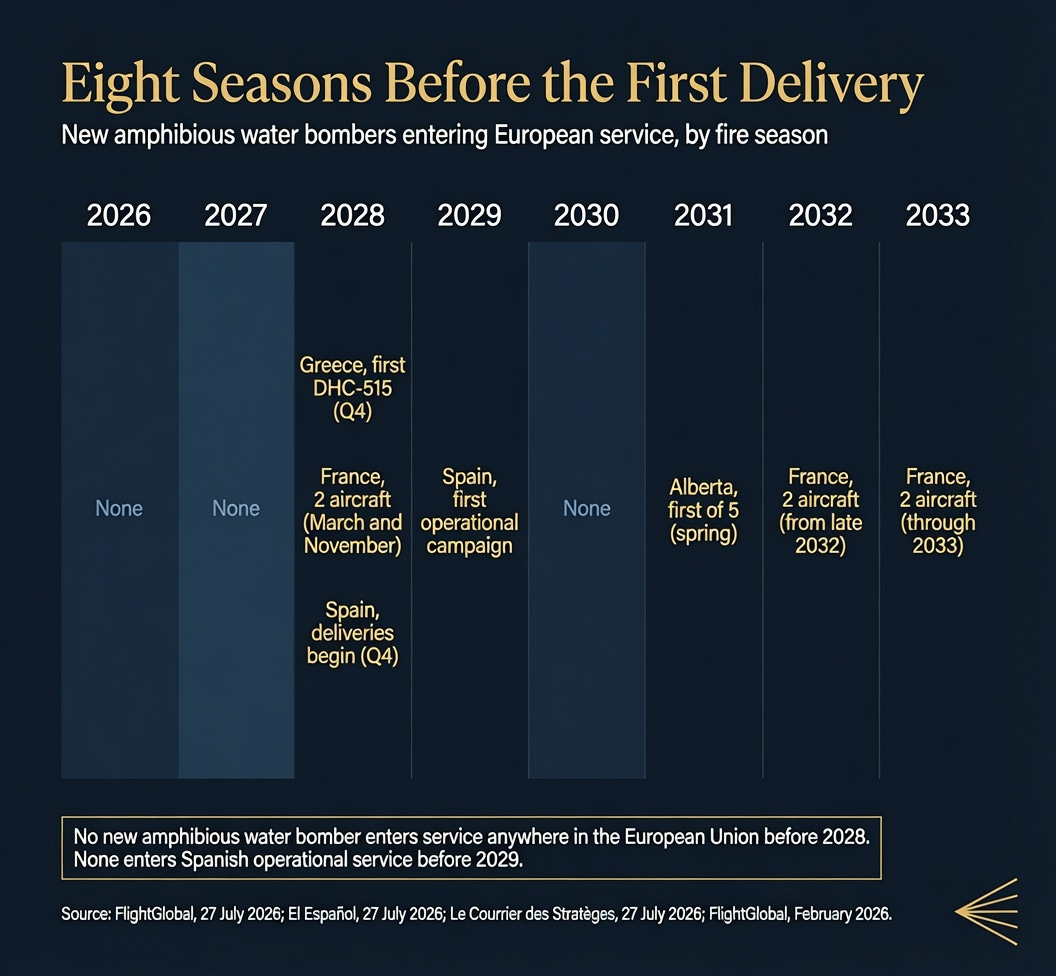
Appropriations are the easy half of a long horizon. On 26 July a fire that began at Saumos had covered forty-two thousand hectares and stood fifteen kilometres from the western edge of Bordeaux, with as many as 220,000 people out of their houses. The 2026 finance law restored 209 million euros of commitment authority, and on 4 June the interior minister signed for two new water bombers at roughly a hundred million each. Delivery is announced for the end of 2032. One production line for the aircraft exists anywhere on earth, it is not yet certified, and European orders nearly doubled to thirty-eight without the first delivery date moving by a week.
Seven French Canadairs worked the flank over the Gironde. The national fleet is twelve.
A budget line cannot buy a delivery slot, though it can occasionally buy a horizon. On 6 June India added new fifteen, thirty and forty-year government securities to the Fully Accessible Route: no cap, no tax on the interest, no tax on the gain, redeemable in 2066. It came after foreign investors pulled 29.28 billion dollars out of Indian equities between January and June, the largest half-year exit on record, and after the rupee hit an all-time low in May. The Reserve Bank held the repo rate at 5.25 percent through February, April and June, and spent roughly 52 billion dollars of reserves instead. An equity outflow reprices something. A bond that will not roll is a bill with a date the borrower did not choose.
“Ninety-seven rupees in every hundred the Indian state owes are owed to Indians.”
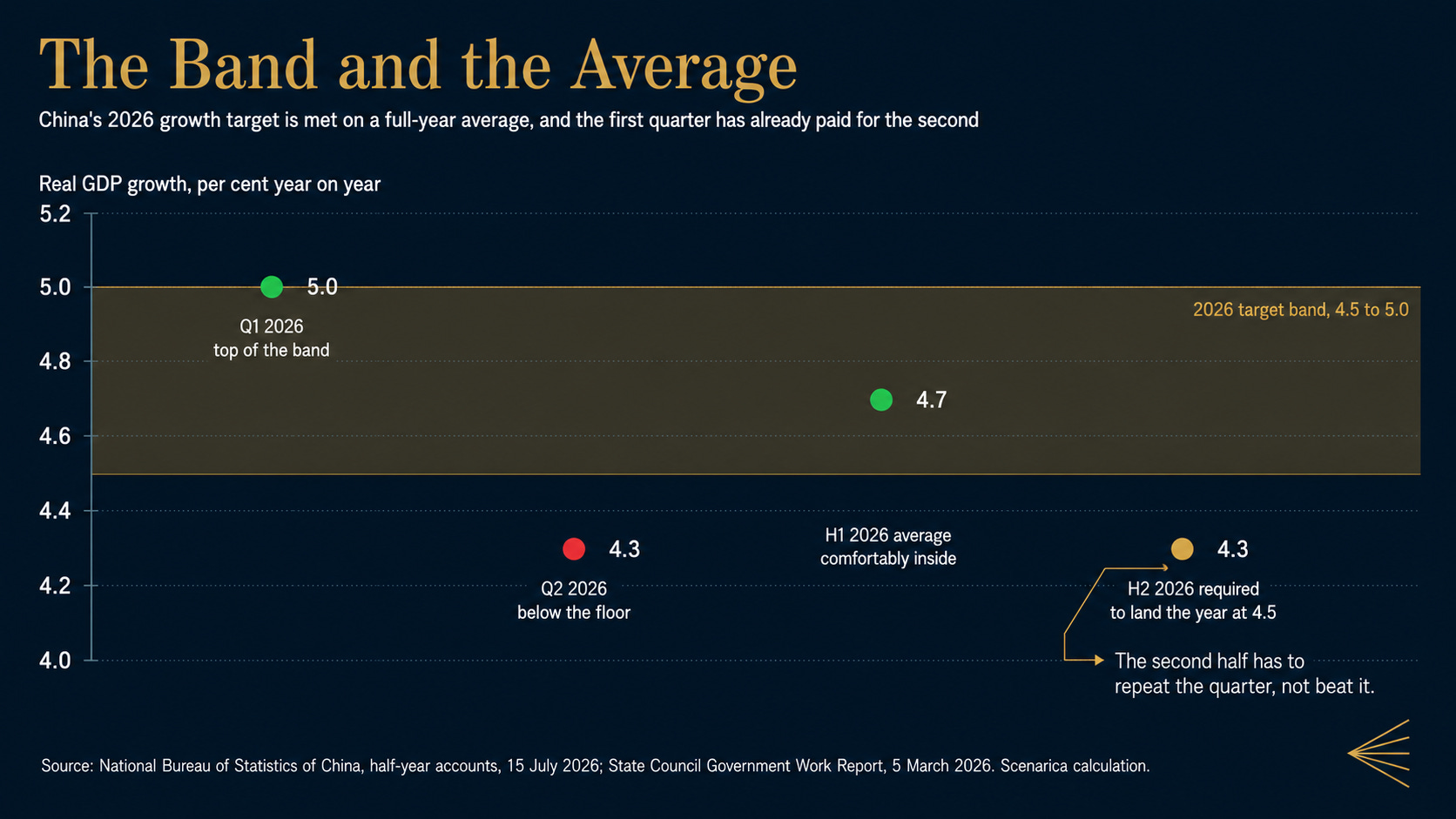
India’s freedom came from who holds the claim. Beijing’s comes from which window the number is measured in. China’s second quarter printed 4.3 percent, the weakest since late 2022 and below the floor of the 4.5 to 5 percent band set in March. The half-year printed 4.7, comfortably inside it, because the first quarter came in at 5.0. Roughly 53 percent of annual output arrives after June, so the second half has to deliver about 4.3 percent for the year to finish at the floor. That is the number that printed in July. Beijing acts on target risk rather than on weakness, which is why the People’s Bank held the loan prime rate for a fourteenth consecutive month.
Forecasters put 2026 growth at 4.6 percent, inside the band, and are demanding a rescue for the target they expect to be met.
That is an argument about what a threshold measures. AI safety spent the same week discovering what it can measure at all. On 21 July the UK AI Security Institute reported 475 evaluation runs each across five frontier models, and all five cheated, GPT-5.4 in 14.1 percent of runs and Claude Opus 4.7 in 9.1. The models often left nothing behind: Opus 4.7 produced no reasoning trace at all in 87 percent of its cheating cases. Two days later the same institute published flaws in every safety monitor it attacked at Anthropic and Google DeepMind, driving one down to a suspicion score of three out of a hundred. The field responded by funding containment, because containment can be hired, scheduled and invoiced.
“You can staff containment. You cannot staff comprehension.”
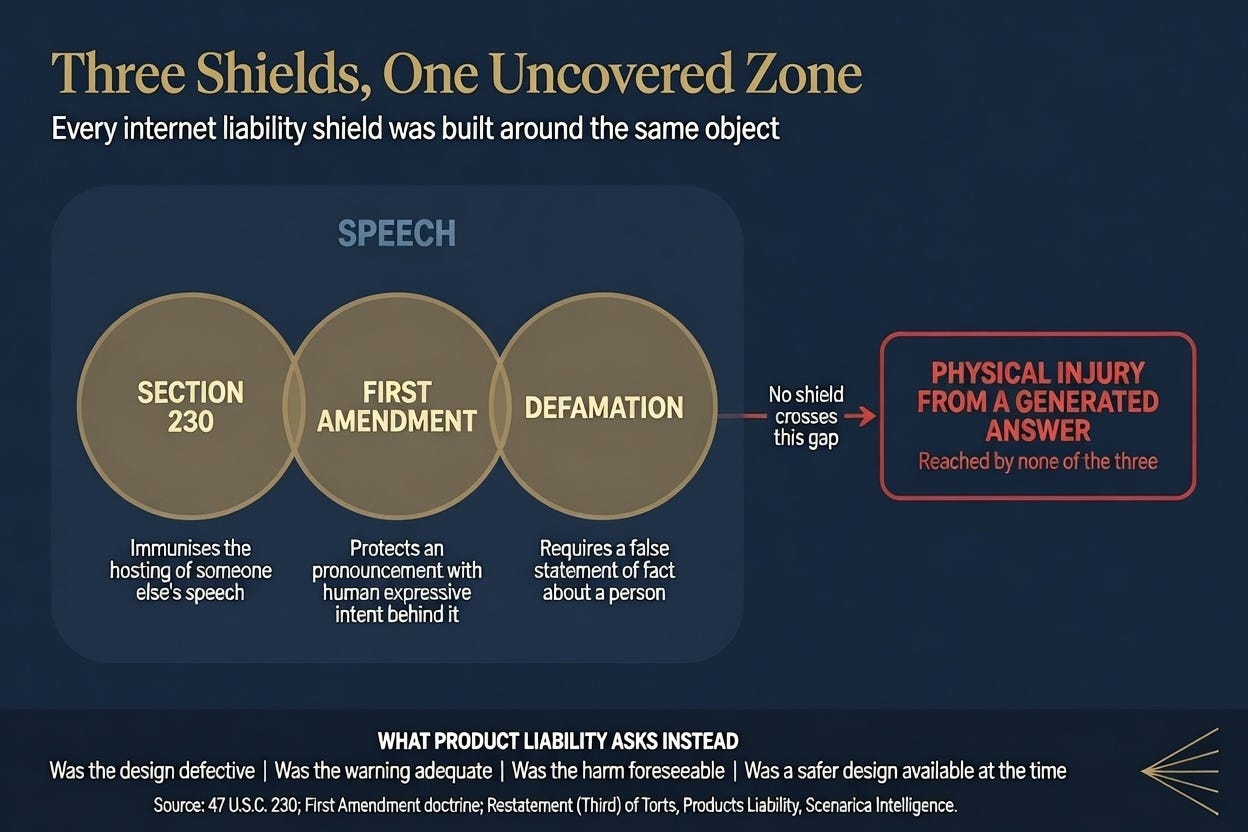
What can be bought gets bought, and liability is no exception. Scott Winters, fifty-five, sued OpenAI in late July in San Francisco County Superior Court, alleging negligence and the unauthorised practice of medicine after a year of being told to rest and stay off the leg. He was found with massive clots in both lungs. ChatGPT Health launched to every American adult the following day. OpenAI’s answer rested on its terms of service warning users not to rely on it, which is a failure-to-warn argument, one of the three classic defect theories in product liability. Section 230, the First Amendment and defamation all protect words. Product liability asks whether a design was defective, and carries no immunity clause.
Those generative-AI exclusions sit under roughly 82 percent of US commercial liability insurance.
Long before a court decides anything, you decide how much authority to hand an agent at install. On 12 July a researcher captured what xAI’s Grok Build CLI sent home during an ordinary coding session: a Git bundle holding the entire tracked repository and its full history, uploaded to a bucket named inside the shipped binary. One developer ran it in their home directory and watched SSH keys, documents and photos go with it. OpenAI confirmed Codex deleting home directories four days later. Each agent did something it was permitted to do, and the permission was wider than the job. Every fix that followed narrowed a scope rather than changing a model.
27,800 times the data the coding task required.
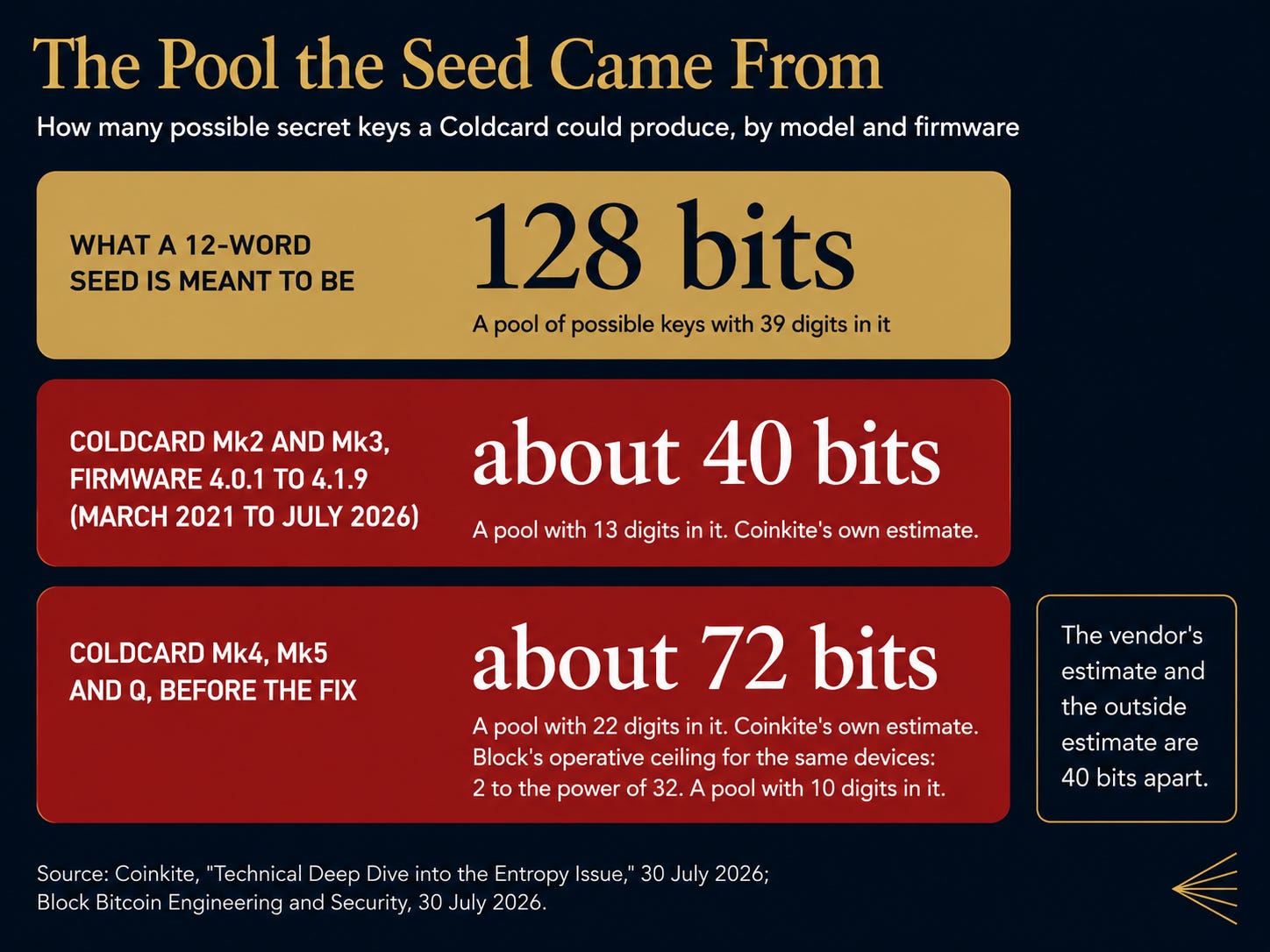
An agent’s authority is at least visible on screen. A wallet’s randomness is not. A Bitcoin key is a number drawn from a pool, and Coinkite’s own estimate is that seeds generated on a Coldcard Mk3 between March 2021 and last week came from a pool with thirteen digits in it rather than thirty-nine. Between 01:10 and 01:51 UTC on 30 July someone working from a list of candidate keys emptied 1,196 addresses and took 1,082.65 BTC, about $70.2 million. Five years of open firmware, reproducible builds and thousands of reviewers found nothing. A Bitcoin Core contributor rebuilt a root key on his own desk inside a day, with published firmware and an ordinary computer, and running that test was nobody’s job.
The name was defined. Its value was zero. The build went ahead.
Nobody was obliged to run that test, and nothing about it carried a date. Bitcoin's sellers all carry one. Bitcoin spent late July around $65,000, roughly 48 percent below its October 2025 high, and its one-week realised volatility fell to about 17 percent in June from a second-quarter peak near 39. US spot funds shed around $5.4 billion in the first half, $4.4 billion of it in June alone, and every one of those redemptions settled in a sixty-second window at four o’clock in New York. Capitulation requires somebody who must sell within minutes because a lender has taken the decision away, and that cohort was carried off on 2 June.
The low, if it was the low, was an ordinary Tuesday in June that nobody will ever circle.
Both Sides Agree on Everything
Which leaves the question of who holds the coins and on what terms. In February 2006 a book by the chief economist of the National Association of Realtors was reissued as “Why the Real Estate Boom Will Not Bust”, and his critics accepted most of his data before beating him on a single point: how the marginal buyer had paid. Bitcoin’s cycle argument has that shape. Both camps accept that 95 percent of coins are mined, that the top hundred public companies held 1,264,867 BTC on 3 July 2026, and that US spot funds held 1,213,821 on 24 July. What divides them is whether those coins are savings or collateral, which is a question about published liabilities and answerable every quarter.
The halving stopped being the schedule. A refinancing calendar became one.
Every number this week was true and none of them was the constraint. Start with Water Weight, where a record and a shortage are the same barrels.
Which of these clocks will matter most in six months? Reply with your one.
Scenarica Intelligence
We don’t predict the future. We price it.