

The One Engine
The whole market now runs on the AI boom, and its foundations are borrowed.


The whole American economy now runs on a single engine, and this week the bill for that dependence came due in five different currencies. Data-centre and AI construction accounted for roughly three-quarters of US growth in the first half of the year, which means the Federal Reserve can no longer fight inflation without risking the one thing holding the expansion up. Kevin Warsh has quietly become a hostage in his own boardroom. That would be uncomfortable enough if the engine were sound. It is the state of the engine that should worry you. One piece this week traces a trillion dollars of AI demand that travels in a circle among four companies and may never leave the room. Another watches a free Chinese model undercut the belief that America’s lead is worth paying for. A third finds Bitcoin, sold for a decade as the hedge for when markets fall, now falling in lockstep with the very AI trade it was meant to escape. Last week’s brief was about American pressure producing the opposite of its aim; this week that same pressure keeps a second Gulf war burning while the oil market has simply stopped looking up. Start with the Fed, because a chair who cannot move is the clearest picture of how much is balanced on how little.
Strip artificial-intelligence spending out of the American economy and what is left barely grows. Data-centre and AI construction made up roughly three-quarters of US growth in the first half of 2026, which turns the Fed’s July decision into something stranger than an inflation call. Kevin Warsh, sworn in as chair in May on a thesis that AI would make everything cheaper, now faces the reverse: the buildout is bidding up power and prices while carrying the entire expansion. Raise rates to cool inflation and he cracks the one engine holding growth up. Hold, and he feeds an asset boom already stretched. He tore the forward guidance out of the Fed’s statement because he genuinely cannot say which fire he is willing to let burn.
A central bank that cannot raise rates without breaking the economy it is meant to stabilise is running a hostage situation in which it is also the hostage.

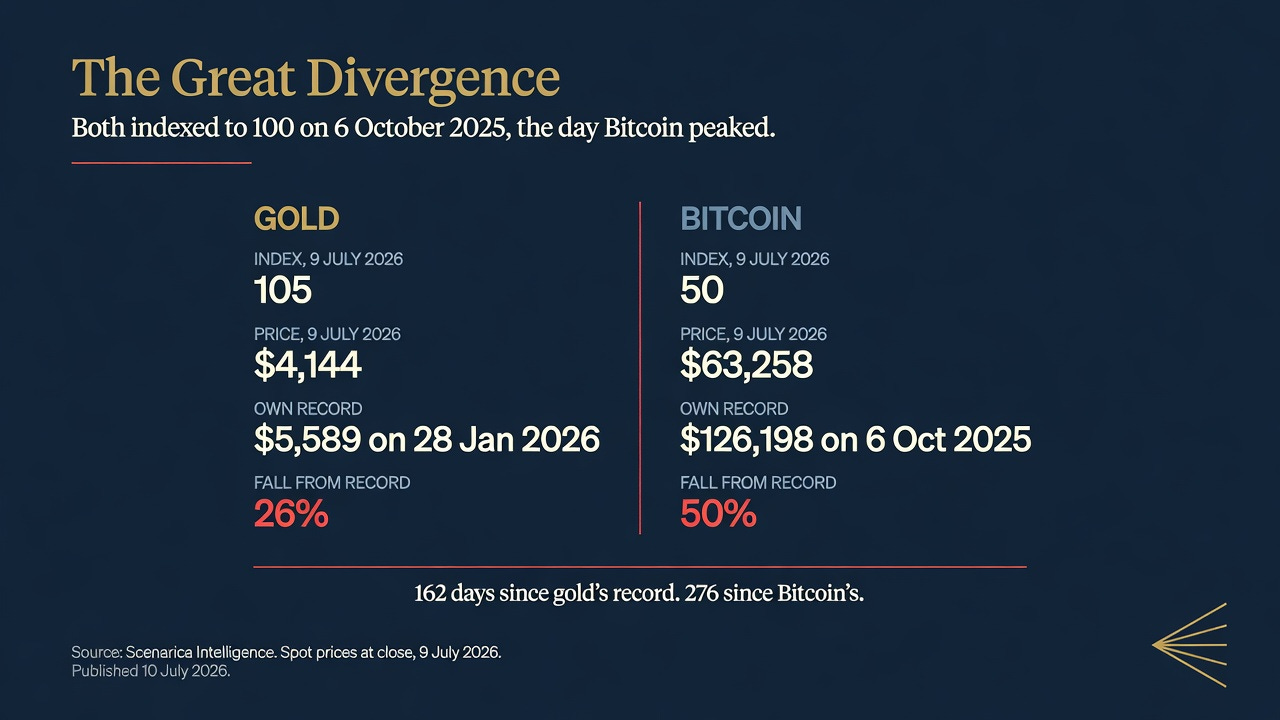
For a decade Bitcoin was sold to institutions on one promise: that it marched to its own drum and would hold when everything else fell. In April the promise inverted. Its correlation to the American stock market reached 0.96, which means nine tenths of its daily move is now just whatever equities are doing. Gold set records above 5,500 dollars an ounce across the same eighteen months while Bitcoin shed close to half its value. The spot ETFs changed the marginal holder from a true believer into a model portfolio that trims the most volatile thing in the drawer first, and that thing is Bitcoin.
The hedge built to rise when stocks fall now moves with them at 0.96, very nearly the same trade wearing two names.
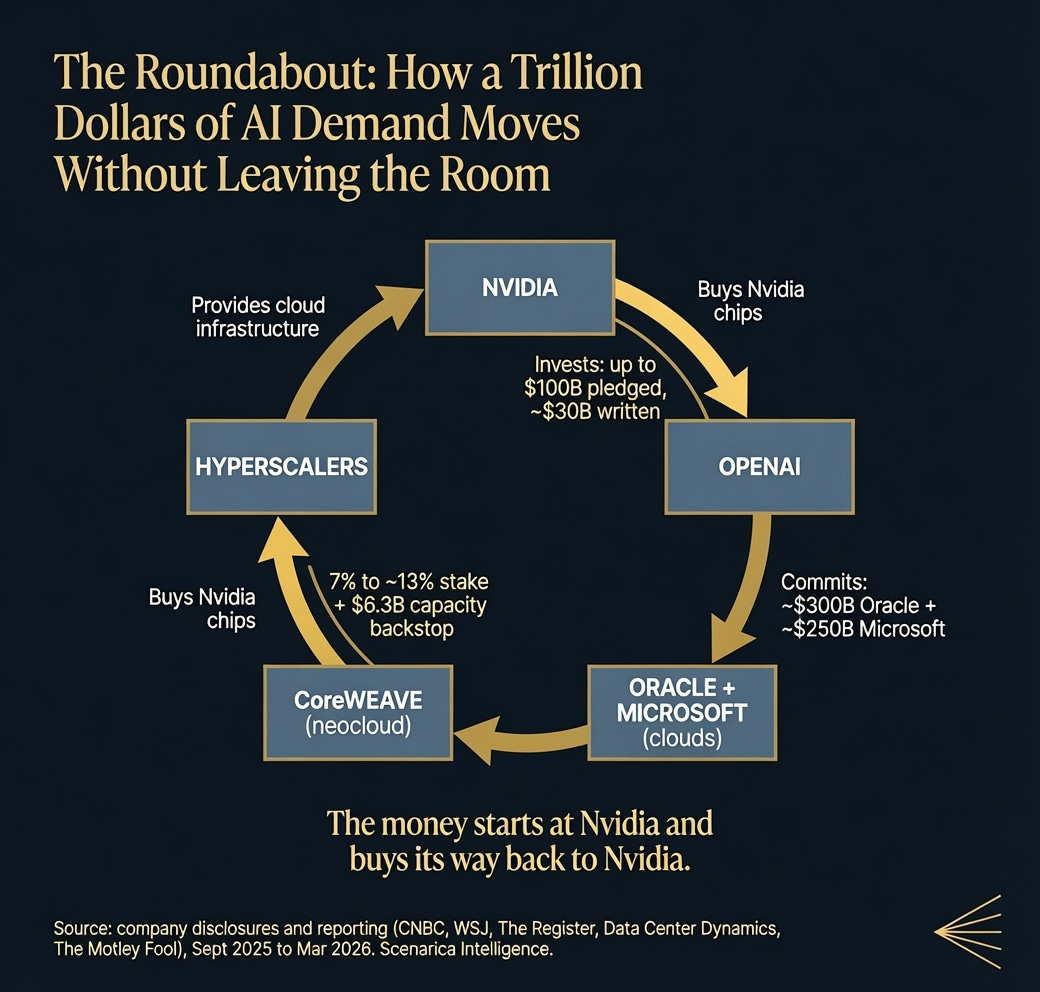
In 1999 a company called Lucent booked roaring demand by lending its own customers the money to buy its switches, until the customers stopped paying and two trillion dollars of telecom value evaporated. The shape is back, and larger. Nvidia invests in OpenAI, which commits hundreds of billions to Oracle and Microsoft, which spend it on Nvidia chips, which is also what CoreWeave, backstopped by Nvidia, buys. The money changes name tags without ever leaving the room. OpenAI booked about 13 billion dollars of real revenue last year against commitments that run past a trillion.
The chips and the models are real, exactly as Lucent’s fibre was real. The only question is whether outside customers pay fast enough to cover the promises before someone in the circle writes a cheque they cannot honour.
Thirteen billion dollars in the register. More than a thousand billion promised.

On 16 June a Beijing lab posted the open weights of a model called GLM-5.2 to the internet under a licence that forbids almost nothing. It ranked first among open models and beat GPT-5.5 outright on the coding benchmarks enterprises pay most to automate, at roughly one-sixth of the price. Two weeks later Meituan open-sourced a larger model trained entirely on Chinese chips, the ones export controls were meant to keep out of its hands. For three years the entire AI investment case rested on three words: America is ahead.
A benchmark lead is the one asset a competitor can acquire by downloading it. The moat was never the model. It is distribution, data, power, and the plain fact that a Western bank will not run its compliance on a strategic rival’s weights.
A capability gap of a few points, and a price gap of five to seventeen times, running in opposite directions.

For three years AI models kept forgetting what you told them, held back by a small context window, and a whole industry grew up to feed them the right few pages at the right instant. That workaround, retrieval-augmented generation, became a multi-billion-dollar category. Now the window has grown from a few dozen pages to a small library, and for a great deal of ordinary work you can simply hand the model the whole book. The catch the launch posts skip is that the models cannot reliably use all of it, so the category is being repriced rather than buried.
Last Sunday’s essay described a culture optimising for the appearance of knowledge over the substance; a million-token window that only works across a fraction of itself is that same gap rendered in silicon.
It was the machinery for handing a forgetful genius one index card at a time, and the genius just learned to hold the whole book.

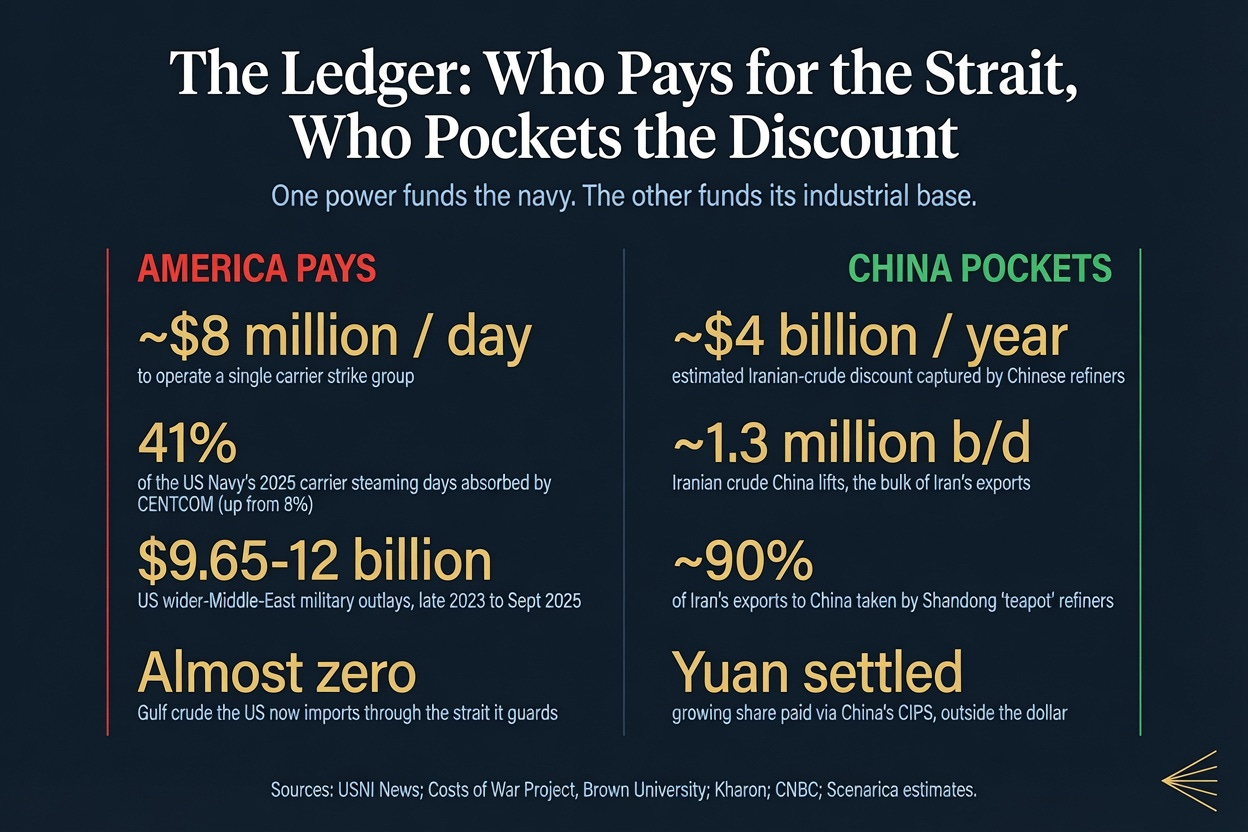
A refinery in Shandong spent the first week of July buying Iranian crude for a good deal less than the 74 dollars Brent was fetching, because in the whole world there was essentially one buyer left willing to touch it. That discount is the real scoreboard of the Gulf war. Washington spends billions a year, and runs a carrier at eight million dollars a day, to keep Hormuz open, guarding a doorway it barely uses, while China, which buys close to half the Gulf’s crude, pockets a saving measured in billions on the isolated barrel.
Every buyer the Treasury frightens off Iranian oil removes a rival bidder and cheapens the cargo for Beijing. The pressure campaign is not bankrupting Iran. It is subsidising China.
You cannot sanction your way out of a monopsony you are building yourself.

A tanker was burning east of Hormuz on 8 July, American jets were hitting ninety targets across Iran, and the price of oil ticked up four percent and handed a third of it back by Thursday. Five months ago the same headlines drove Brent toward 120 dollars. The market has watched this film twice and stopped buying tickets. What did not change is the channel: a fifth of the world’s oil still passes through twenty-one nautical miles of water, and every bypass pipeline ever built covers barely a quarter of it.
The physical odds of a real closure are higher than in February, because this time the tankers are actually being hit, while the priced odds have fallen to a rounding error and almost no one is paid to sit in the gap between them.
A quieter oil market did not become a safer one this week. It became a market that has trained itself not to look up.

The alliance held its summit in Ankara, and the address was the most honest thing said all week. Turkey is the only NATO member bordering the Iran war, the sole government both Russia and Ukraine will sit with, the patron of the new Syria, and the keeper of the straits. No other member holds that portfolio, and it is geography, not Brussels, that sets the price. Sitting beside Erdogan, Trump offered to lift the sanctions imposed over Turkey’s Russian air defences and to consider selling back the F-35 it was once expelled from buying.
Indispensability is not loyalty. An ally you cannot discipline, who keeps a working channel open to every adversary the alliance is organised against, is not an anchor but a single point of failure wearing an anchor’s uniform.
We’re going to be taking the sanctions off. It’s time.
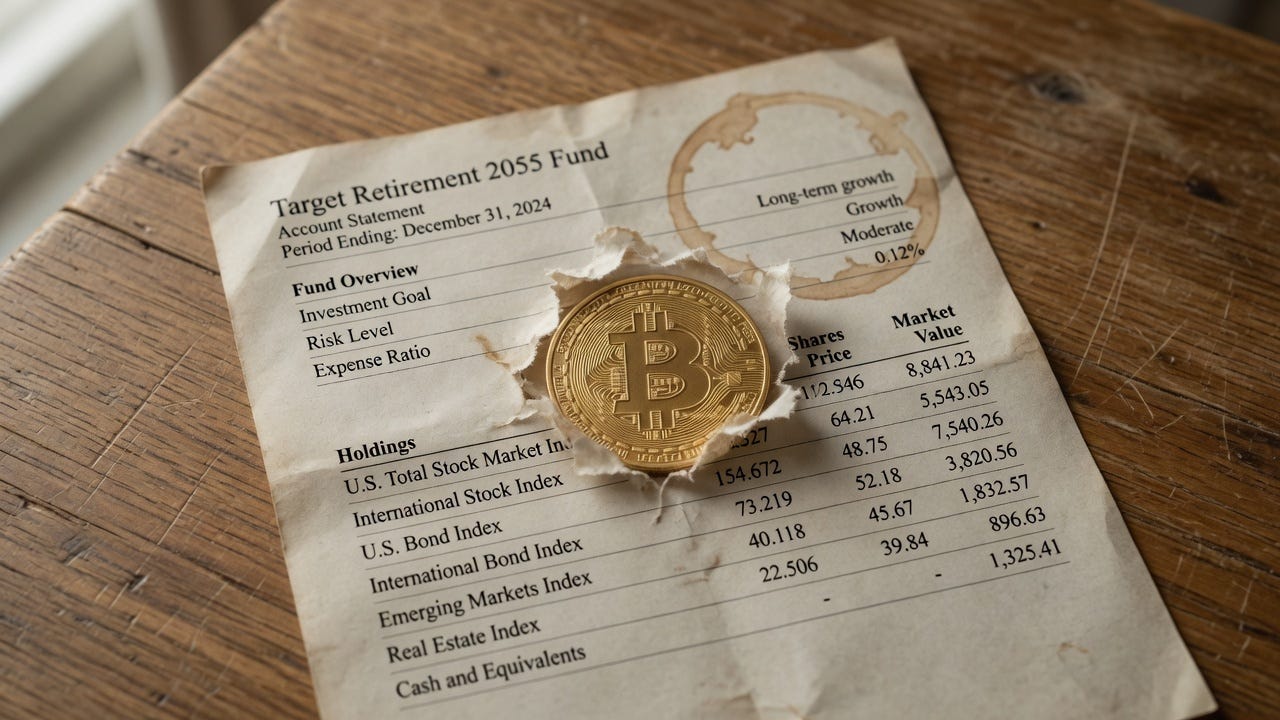
18,712. That is the number of Bitcoin on a rocket company’s balance sheet, and since SpaceX joined the Nasdaq-100 on 7 July, a sliver of them is yours. You never clicked buy. A spot Bitcoin ETF is a decision; index inclusion is a rule, and rules do not ask. Every fund built to mirror the index was obliged to buy SpaceX at whatever price the market quoted, and the coins rode along in the hold, into target-date funds and workplace pensions held by the people least likely to be watching.
The dollar exposure is trivial today, but the channel is now open, normal, and rules-based, and passive money is engineered never to sell on bad news.
SpaceX is now the third Bitcoin holder in the Nasdaq-100, and the buy order was written by a committee you have never heard of.

Weigh the silver in the phone in your pocket and you will not find a full gram, and you will never get it back, because it is dispersed into the device too finely to ever recover. That is the fact the macro world keeps missing. Gold is hoarded, and almost every ounce ever mined still exists in a vault or a ring. Silver is spent, into solar cells and circuit boards and the wiring of AI data centres, and it does not come back. The market has now run six straight annual deficits, pulling 762 million ounces out of above-ground stock.
Even with solar makers cutting their silver use by nearly a fifth this year, the shortfall widened rather than closed. A market that hoards its safe-haven asset can always disgorge it under stress; a market that eats it can only run out.
Gold is the metal you inherit. Silver is the metal you use up, and the world has quietly begun to run the two accounts in opposite directions.
Read The Hostage Chair first: it is the clearest picture of an entire economy balanced on one borrowed engine.
If the AI engine stalled tomorrow, which of this week’s stories breaks first? Reply with your pick. Every reply gets read.
Scenarica Intelligence
We don’t predict the future. We price it.
What does a reader do when he or she discovers a new (to them) resource of excellent commentary/analysis paired with fine and clear expository writing? He subscribes, of course. And then, approximately once a month, a dead-tree magazine arrives of varying length with 10 or 20 or 30 articles, and the reader has 30 days to read the articles that interest him, parse all that knowledge and assimilate it into his understanding, perhaps even actionable intelligence. All before the next issue arrives. Seems possible, even probable.
So what does a reader do when a new and interesting resource writes 5-10 new articles *per week* - and each article is important, insightful, packs a punch, is always helpful and often useful, and all are engagingly well-written?
Reading Scenarica has become, for me, akin to eating chocolate cake for breakfast, lunch, dinner, supper, and dessert. And in-between snacks. No matter how quickly I read, however, I fail to catch up; the author writes faster than I can read. Sigh. I suppose there are worse things in life than an abundance of chocolate cake. (Fortunately, I love chocolate cake!)